

A face serum is a lightweight water- or gel-based treatment that carries one active ingredient — vitamin C, niacinamide, hyaluronic acid, retinol or peptides — at a higher concentration than a moisturizer, applied to damp skin after cleansing and before moisturizer. Pick the serum by its active, not its price.
What Is a Face Serum and What Does It Actually Do?
A face serum is a thin, fast-absorbing treatment step that concentrates one active far higher than a moisturizer can, sitting between cleansing and moisturizer to work on a single named concern. Search for serum facial serum, face serum or facial serum and the results land on the same shelf: the naming is marketing history, not chemistry.
The difference from a cream is delivery. A moisturizer carries occlusives and emollients that sit on the surface to slow water loss, so an active has to fight through that film. A skin care serum drops most of those thickeners, which lets it hold 5% niacinamide or 15% vitamin C in a fluid that sinks in within a minute.
Essences, ampoules and facial oils are the same step under different labels. An essence is usually a more dilute watery version, an ampoule a short-course concentrate, and an oil an occlusive that belongs after — not instead of — a water-based treatment. If a bottle is mostly silicone and fragrance with the active near the end of the list, it is a moisturizer wearing a serum's name.
Order matters because absorption does. Serum skincare sits third: cleanse, tone if you use one, then serum on damp skin, then moisturizer, then sunscreen in the morning. That is the whole mechanism — thinnest to thickest, active closest to the skin. For the full sequence, see how to build a skin care routine, and for the evidence behind the category, dermatologists at Harvard have written on what a skin serum can and cannot do.
How Do You Choose the Best Serum for Your Face?
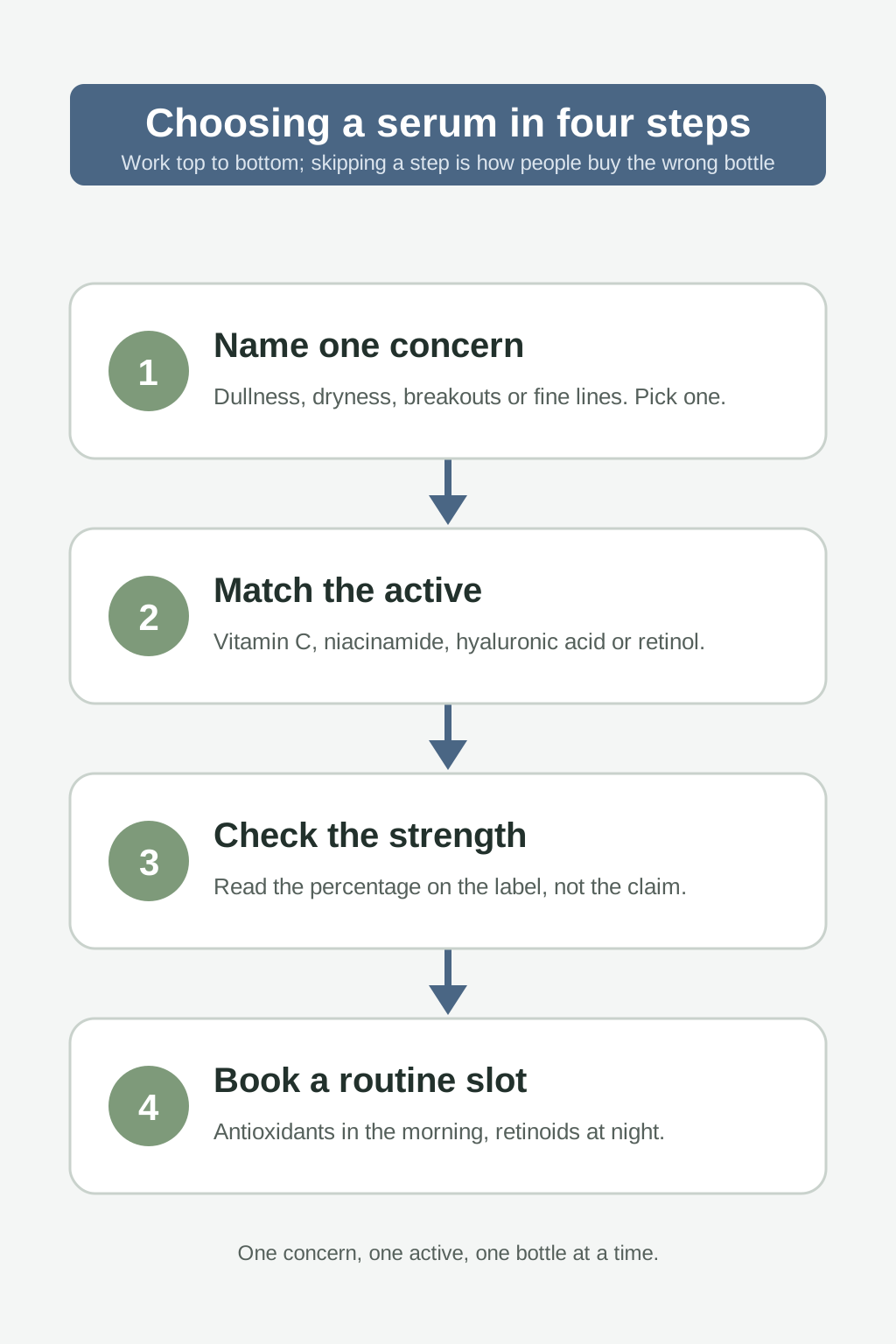
Choose by the concern you can name, then by the active's strength, then by a texture you will wear daily; brand and price decide far less than any of the three. Run those three filters in order and most shelves collapse to two or three bottles.
Filter one is the concern. "Better skin" is not a target; dullness, dehydration, congestion, redness or fine lines are. Filter two is the active that has evidence for that concern, at a strength printed on the pack. Filter three is texture: a gel that vanishes in forty seconds will get used, a tacky one will not.
That is also why the best facial serum for a colleague can be the wrong bottle for you. A 10% vitamin C that brightens oily skin can sting a compromised barrier for a week. The best serum for face care is the one matched to your skin's current state, not its aspiration.
Reading the label separates a good face serum from a diluted one. Actives printed ahead of the preservative block are usually present at a meaningful percentage; actives printed after it are often at a fraction of a percent. Check for an opaque or airless pack if the active is vitamin C or a retinoid, both of which degrade in light and air. Then divide price by milliliters — great face serums claims survive that arithmetic surprisingly rarely.
Lists of recommended face serums disagree because each publisher weights a different concern, budget band and tester panel. The overlap between them is the useful part: bottles that appear on five unrelated lists are usually well-formulated rather than well-marketed. The same logic applies when choosing skincare products that actually work across the rest of a routine.
Not sure which skin type you are buying for? Six questions, two minutes, and a shortlist built around your answer.
Which Serum Actives Match Which Skin Concern?
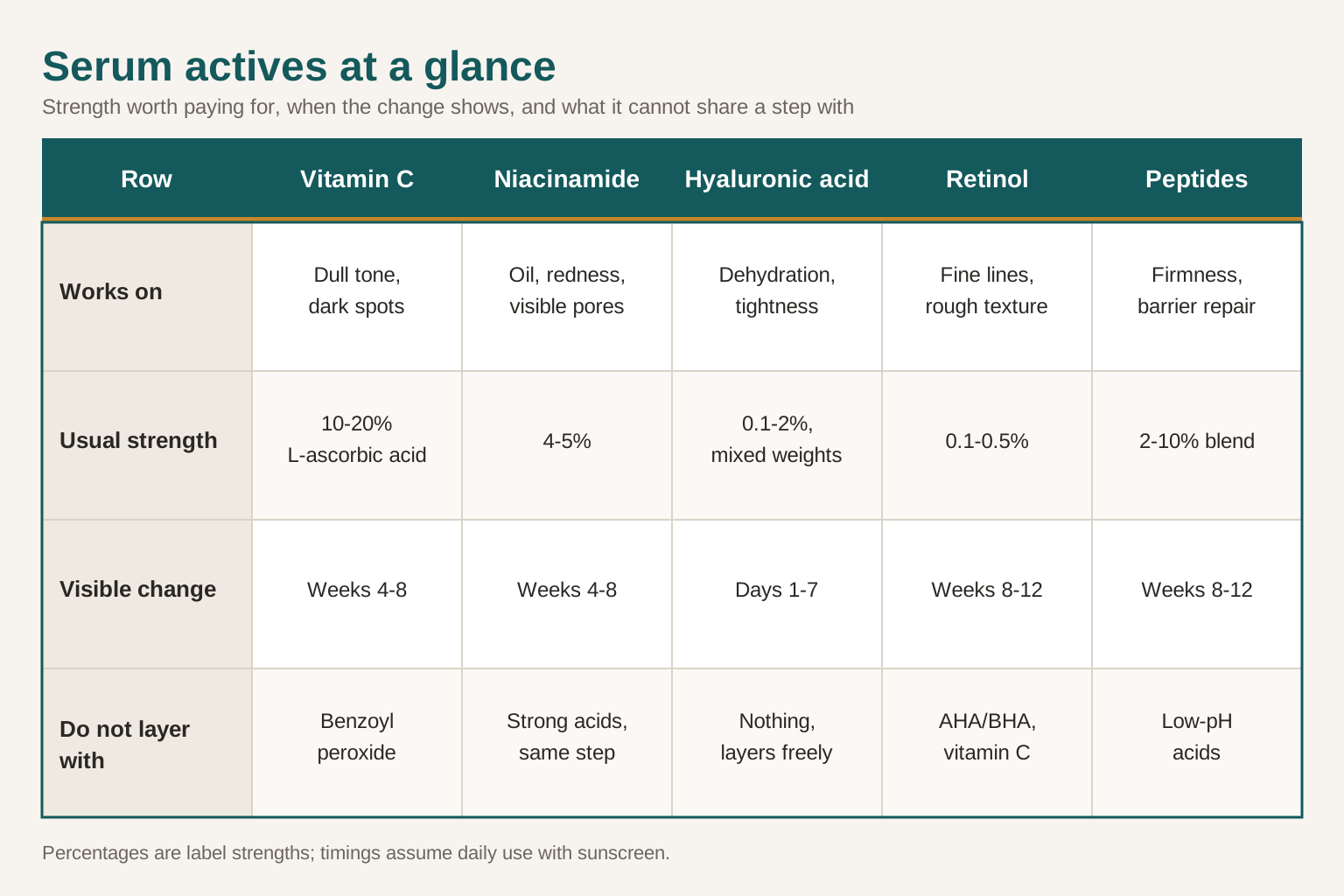
Vitamin C evens tone, niacinamide calms oil and redness, hyaluronic acid holds water, retinol rebuilds texture and peptides support firmness: one concern, one active, one bottle. One grid pairs each active with the strength worth paying for, the week its effect becomes visible, and what it must not share a step with.
If vitamin C is the active your concern points to, the full set of vitamin C serum benefits covers dark spots, collagen and dullness, which strength to buy, and how fast results show.
| Active | Works on | Usual strength | Visible change | Do not layer with |
|---|---|---|---|---|
| Vitamin C | Dull tone, dark spots | 10–20% L-ascorbic acid | Weeks 4–8 | Benzoyl peroxide |
| Niacinamide | Oil, redness, visible pores | 4–5% | Weeks 4–8 | Strong acids in the same step |
| Hyaluronic acid | Dehydration, tightness | 0.1–2%, mixed weights | Days 1–7 | Nothing; it layers freely |
| Retinol | Fine lines, rough texture | 0.1–0.5% | Weeks 8–12 | AHA/BHA, vitamin C |
| Peptides | Firmness, barrier repair | 2–10% blend | Weeks 8–12 | Low-pH acids |
An aisle of skin care serum products is narrower than it looks: almost every bottle is built on one of those five molecules plus a supporting humectant. Once you can name the active, the rest of the packaging is positioning. Strength claims on serum beauty products are worth checking against the ingredient list, because "with vitamin C" and "15% vitamin C" are not the same promise.
Good serums tend to carry fewer actives, not more. A formula stacking retinol, glycolic acid and vitamin C has to compromise the pH each one needs, so all three underperform and the irritation risk climbs. The two useful exceptions are vitamin C with vitamin E and ferulic acid, which stabilize each other, and niacinamide with hyaluronic acid, which do different jobs at the same pH. Depth on the individual actives is in niacinamide serum strength and layering and seven checks before buying hyaluronic acid, and a plain-language summary of the documented benefits of face serums is a reasonable starting point.
Some product links here are affiliate links, and a purchase may earn us a commission at no extra cost to you.
Keep the strengths, slots and conflicts on one printable page, one page per active.
Which Face Serums Are Worth Buying by Skin Type?
Dry skin wants a humectant serum under a richer cream, oily skin wants niacinamide, dull skin wants vitamin C, and reactive skin wants a short fragrance-free formula. Roundups of top face serums are assembled from press samples and retailer bestsellers, which is why the same five bottles recur and why cost per milliliter is rarely printed.
Read a ranking for its angle rather than its order: what separates top rated face serums from heavily advertised ones is whether the write-up names a skin type it does not suit. A humectant-heavy pick that saves dry skin in winter can feel sticky and pill under makeup on oily skin, and a mattifying niacinamide fluid that steadies oily skin leaves dry skin tight by noon. Picks for vitamin C specifically are covered in dermatologist-approved vitamin C picks.
Some product links here are affiliate links, and a purchase may earn us a commission at no extra cost to you.
Before buying from any list of top facial serums, convert the price to cost per milliliter. A 30 ml bottle at three times the price of a 50 ml one is five times the cost per use, and good facial serums in the same strength band vary by that much. Comparing top rated skin serums on that number alone removes most of the guesswork.
What Makes a Serum Deliver Real Glow?
Glow comes from three measurable things: water held in the upper skin layers, an even tone, and a smooth surface that reflects light evenly rather than shine sitting on top. A face serum for glowing skin works on those three, and each moves on its own schedule.
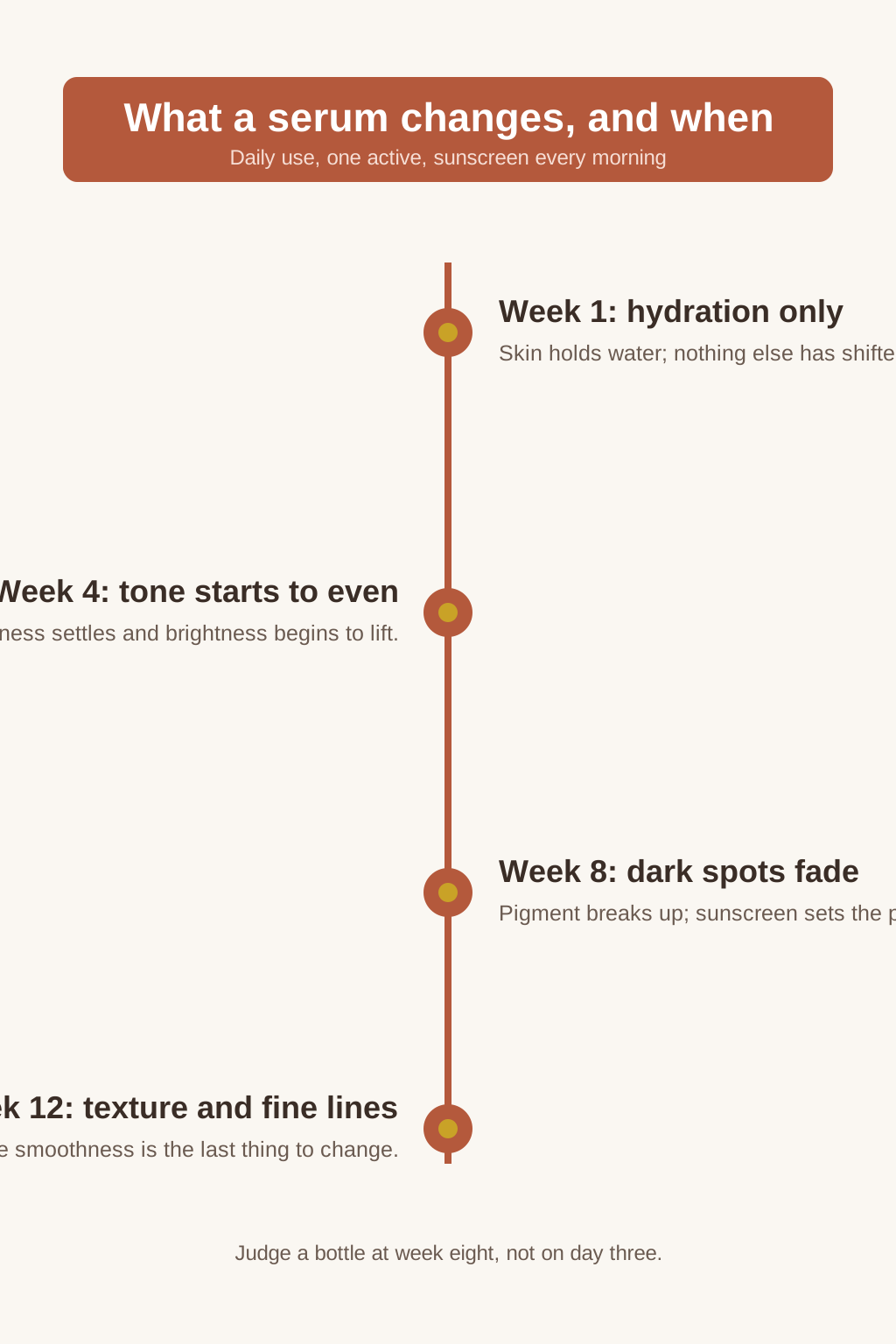
Hydration is the fast one — a humectant plumps the surface within days, which is why a new bottle seems miraculous in week one. Tone takes four to eight weeks of an antioxidant or niacinamide. Surface smoothness takes a retinoid and three months. The best serum for radiant skin is almost always a tone-evening active rather than a highlighter, because light bounces evenly off skin of uniform color.
To test whether a best glow serum is actually hydrating or merely reflective, apply it and wait three hours. Real hydration leaves skin soft and comfortable with no visible film; mica or silicone shine sits on top, transfers onto a tissue and disappears after cleansing. Strip the brand names out of any top 10 serum for glowing skin list and the same three actives remain: vitamin C, niacinamide and hyaluronic acid.
Some product links here are affiliate links, and a purchase may earn us a commission at no extra cost to you.
A weekly treatment can support the same three mechanisms; face masks for a radiant complexion covers that side.
How Does a Serum Fit a Morning Routine?
In the morning, apply serum to damp skin after cleansing, wait about a minute, then seal with moisturizer and sunscreen; antioxidants belong in this slot and exfoliating acids do not. Three to four drops cover a face and neck, pressed in rather than rubbed.
The best daytime serum is an antioxidant because it does something sunscreen cannot: vitamin C and ferulic acid neutralize free radicals that get past SPF, so the two work as a pair. Exfoliating acids in the morning raise sun sensitivity for the hours you are most exposed, which makes them a poor best day serum regardless of how good the formula is.
Pilling under foundation is a timing problem, not a formula problem. A hydrating serum for makeup needs sixty seconds to absorb before moisturizer, and another sixty before sunscreen; skipping those two minutes is what makes products roll. A water-based fluid such as a light hydrating serum layers more predictably than an oil under a silicone primer.
A moisturizing serum for face use replaces a cream only on oily skin in humid weather. On dry or mature skin it supplements one, because a serum has no occlusive to hold that water in. For where every other step lands, see correct skincare order, what goes first.

Check whether the actives already on your shelf can share a morning serum step, and which ones need to move to the evening.
Which Serums Actually Soften Wrinkles?
Retinoids carry the strongest trial evidence for fine lines, with peptides and vitamin C as slower support; expect softened texture over months, never the effect of an injectable. A good wrinkle serum changes the skin's collagen turnover, so the timeline is biological rather than cosmetic: nothing at four weeks, surface smoothness at eight to twelve, fine lines at three to six months, and deep folds essentially unchanged.
If peptides are the part you want to lean on, compare choosing a peptide serum that firms so you know which sequences and strengths hold up and which are mostly label decoration.
Strength is a trade against tolerance. Retinol at 0.1% suits a beginner and takes longer; 0.3% is the common working strength; 0.5–1% works faster and peels more. Retinaldehyde converts to retinoic acid in one step instead of two, so it acts closer to a prescription at lower irritation, and costs more for it. Whichever you pick, start twice a week at night and build up. Cleveland Clinic's clinical guidance on using retinol and its side effects is a sober account of what to expect, and which anti aging actives reduce wrinkles compares the alternatives.
Some product links here are affiliate links, and a purchase may earn us a commission at no extra cost to you.
What Habits Waste a Good Face Serum?
Serums are wasted by bone-dry application, switching bottles every two weeks, stacking three actives at once, skipping sunscreen, and leaving vitamin C exposed to light and air. Each has a fix that costs nothing.
- Apply within a minute of cleansing, while skin is still damp — humectants pull water from the air in dry rooms otherwise.
- Stay on one bottle for eight to twelve weeks. Most complaints that good skin serums "did nothing" come from two-week trials.
- Run one active at a time, or split them between morning and evening, rather than layering three at once.
- Wear sunscreen daily. Vitamin C, niacinamide and retinol all work on pigment that ultraviolet light replaces faster than any serum clears it.
- Buy vitamin C in an opaque or airless pack and finish it within three months of opening.
The eight-to-twelve-week rule is the one people break most often. Hydration answers in days, tone in four to eight weeks, pigment nearer twelve, and texture at three months, so a bottle abandoned at week two was judged before its active had a chance to act. If a serum stings, flakes or flushes for more than a week, the answer is usually frequency rather than a new product; rules for calmer sensitive skin sets out how to build back up.
How Much Should You Spend on a Serum?
Price tracks packaging and marketing more closely than performance, so compare cost per milliliter and active strength; a well-formulated drugstore bottle often matches a luxury one. Judge the best skin serum for you on two numbers: the percentage of the active, and what one application costs.
The same logic applies to clinical labels: before paying extra, check which medical grade skincare is worth buying and where affordable options work just as well.
That gap is easiest to see side by side in Timeless vitamin C versus C E Ferulic, where strength, pH and price per bottle decide which bottle earns your money.
Paying more is worth it in three narrow cases. Airless or opaque packaging genuinely protects vitamin C and retinoids, and a cheap dropper bottle wastes both. A stabilized vitamin C system with vitamin E and ferulic acid is harder to formulate than a plain one. And an encapsulated retinoid delivers a higher effective strength at lower irritation, which buys tolerance rather than speed. Outside those, extra spend buys fragrance, a heavier bottle and a box. A useful sanity check: work out the cost of one pump, not the cost of the jar. At three to four drops a day a 30 ml bottle lasts roughly three months, so divide the price by ninety and decide whether that daily figure is one you will keep paying.
One serum lesson a week, and nothing else in your inbox.
One serum lesson a week. No product dumps, no hype.
Thanks — you're on the list.

