

The best anti aging serum for most people is a 0.3%-0.5% retinol or retinaldehyde serum: topical retinoids are the only wrinkle actives with repeated randomized-trial support, improving wrinkling within one month and holding for 24. Choose 10-15% L-ascorbic acid instead when pigment and dullness, not lines, dominate.
What does an anti aging serum actually change?
An anti aging serum delivers a concentrated active onto bare skin, so it can soften surface lines, tone and hydration in weeks and wrinkle depth only over months. The format is the point: a serum is low-viscosity and water-based, which lets it carry 10% vitamin C or 0.5% retinol at a strength a rich cream cannot hold stably.
Before narrowing to anti aging actives, it helps to understand how to choose a face serum for your concern, how to layer it in the morning, and how to judge strength and cost per ml.
Split the results by clock. Hydration and light reflection shift in two to four weeks because humectants and barrier lipids work on the top 20 micrometres of skin. Collagen density, and with it wrinkle depth, changes on a fibroblast timetable measured in months.
What a serum will not do: tighten slack tissue, reverse midface fat loss, or hold ground without daily sunscreen. Ultraviolet exposure drives the matrix-metalloproteinase activity that degrades the collagen your serum is trying to build, so skipping SPF cancels most of the gain. For deeper folds, a thicker occlusive formula is the better spend, and our guide to anti aging cream picks for deep wrinkles covers that ground.
One label test filters most of the market: the best serum names its active and its percentage on the carton. An active listed without a number is a marketing decision, not a formulation one.
Which serum actives have real evidence behind them?
Topical retinoids carry the strongest randomized-trial evidence for wrinkles, 10-15% L-ascorbic acid comes second for tone and pigment, and peptides, niacinamide and hyaluronic acid mainly buy hydration and barrier comfort. That hierarchy is the whole shortlist, and it is why two bottles usually beat six.
Peptides sit at the softer end of that evidence list, so it helps to know which peptide serum formulas firm skin and which ones only deliver hydration.
Retinoids sit at the top on volume of trial data, not marketing spend. A systematic review of randomized trials on topical tretinoin for photoaging pooled seven controlled studies and found wrinkling, mottled pigment and sallowness improving from month one and still improving at 24 months, with erythema, peeling and dryness as the standing price. Retinol and retinaldehyde are the over-the-counter routes into the same receptor pathway, converting more slowly and at lower potency, which is exactly what makes them usable on thin skin.
| Active | Evidence for wrinkle depth | Strength worth paying for | Irritation risk |
|---|---|---|---|
| Retinoid (retinol, retinaldehyde) | Strong: repeated randomized trials | 0.3-0.5% retinol, 0.05-0.1% retinaldehyde | High |
| Vitamin C (L-ascorbic acid) | Moderate: tone and pigment first | 10-15% at pH below 3.5 | Moderate |
| Peptides | Weak: small, often non-significant | Any well-formulated blend | Low |
| Niacinamide | Weak for depth, good for tone | 4-5% | Low |
| Hyaluronic acid | Surface only: no collagen effect | Mixed molecular weights, 1-2% | Very low |
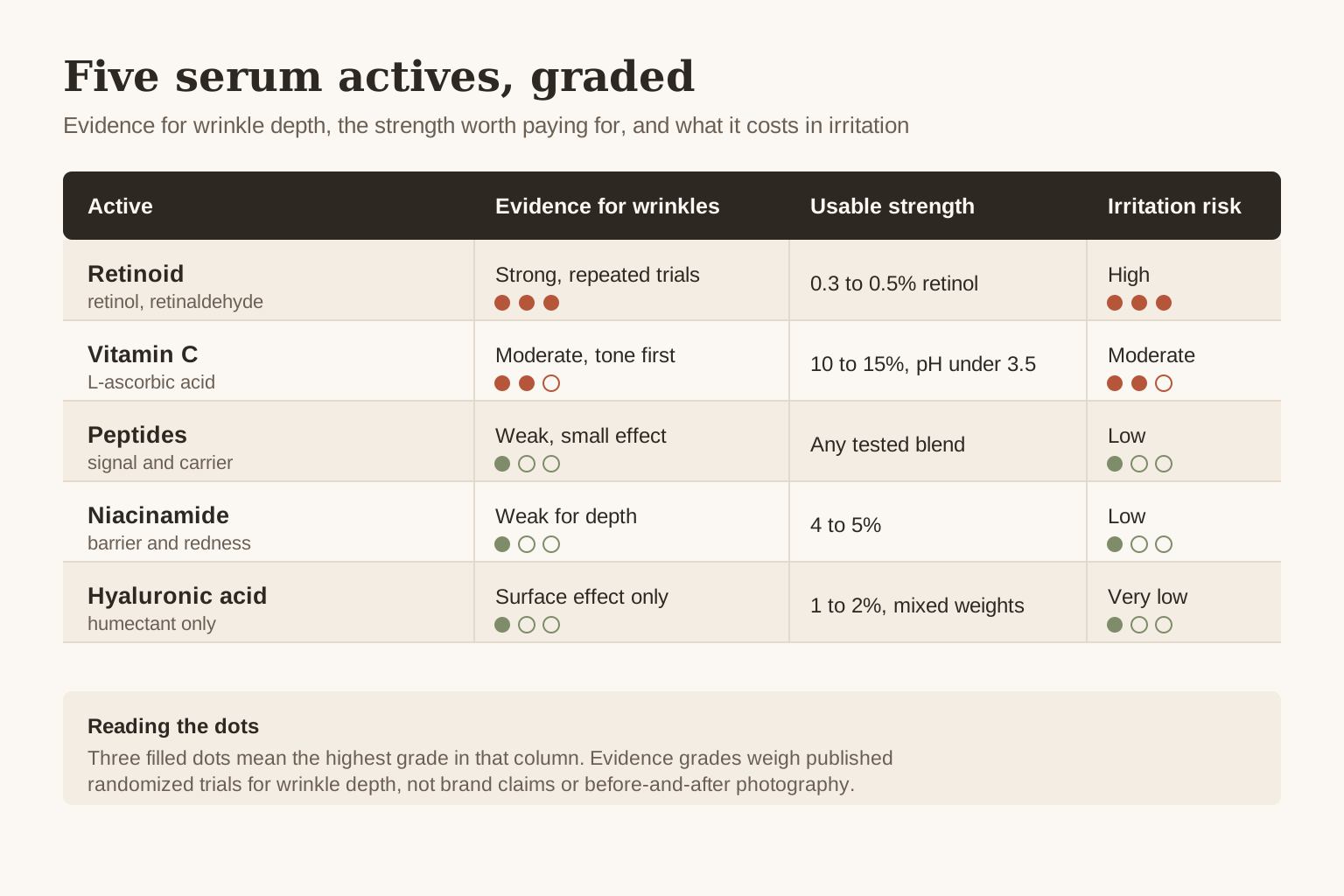
Vitamin C is the second tier and a different job. L-ascorbic acid needs 10-15% concentration and a pH under 3.5 to penetrate, and it oxidises in weeks once air reaches it, which is why the credible formulas pair it with vitamin E and ferulic acid in an opaque, air-restricted bottle. Read more on picking one in our roundup of the dermatologist-approved vitamin C serum for face.
Peptides, niacinamide and hyaluronic acid deserve honesty rather than dismissal: they improve hydration, redness and barrier comfort reliably, and they move wrinkle depth modestly at best. Their real value is tolerance, because they let you keep a retinoid in the routine instead of abandoning it in week three.
That grading is how a best serum for wrinkles shortlist should be read. Top wrinkle serums separate from a scented cream in a dropper on one signal — a named active at a trial-tested strength — and a genuine best face serum for wrinkles will print both. A wrinkle serum advertising eight actives has divided one formulation budget eight ways, and each ingredient arrives at a token dose. If you want the strengths and layering rules in one place, our retinol serum strengths and how to use them goes deeper on the ramp.
Some links below are affiliate links, which may earn us a commission at no extra cost to you.
How do you read a serum label before you pay for it?
Check four things on the label: the named active, its percentage, the pH or encapsulation system, and air-restricting opaque packaging, then divide the price by millilitres. Those four checks take twenty seconds and remove most of the shelf.
For a worked example of those four checks, see C E Ferulic versus Timeless compared on strength, pH and price per bottle.
Position in the ingredient list decides whether the number on the front means anything. Ingredients above 1% are listed in descending order, so an active sitting below the fragrance and the preservative system is present at a fraction of a percent — enough to print on the carton, not enough to change skin.
Price per millilitre is the only cost metric that survives six months of daily use. A 30 ml bottle at 40 dollars costs 1.33 per millilitre; a 15 ml bottle at 70 dollars costs 4.67. On that measure the best rated face serum is often the plain one in a larger pump, and the luxury 15 ml runs out in seven weeks.
Three ingredients explain most abandoned bottles: added fragrance, high-concentration essential oils, and alcohol denat high in the list. Each raises the odds that a best serum for anti wrinkle purchase stings on week two and lives in a drawer by week four — and a serum you stop using has an efficacy of zero.
Treat rankings sceptically. A top rated anti wrinkle serum list built on affiliate revenue rarely names a percentage, a pH or a trial; a good anti ageing serum label gives you all three to check yourself. The same discipline applies to hydrators, and our breakdown of the seven label checks for a hyaluronic acid serum shows the checks in action.
Which serum suits your skin stage, from perimenopause onward?
Pick by tolerance, not age: low-strength retinoid plus morning vitamin C suits skin in the 50s, while skin in the 60s does better on buffered retinaldehyde or peptides over a ceramide base. Age bands are a proxy for barrier strength, and barrier strength is what actually sets the ceiling.
Through the 40s and early 50s, sebum output falls and post-inflammatory pigment lingers longer, so the pairing behind most best anti aging serum for 50s advice is a 0.3% retinol three nights a week plus a 10-15% vitamin C morning. That combination attacks lines and tone on separate clocks without stacking two irritants in one application.
From the 60s, barrier repair comes first. The best anti aging serum for 60s is usually 0.05-0.1% retinaldehyde or a peptide serum applied two or three nights a week over a ceramide cream, because the stratum corneum is thinner and desquamation is slower, leaving less margin for a nightly acid.
Tolerance, not percentage, defines the best serum for older skin and the best serums for mature skin. The practical rule: the best face serum for mature skin is the strongest formula your skin accepts without redness that persists past the next morning, which for many people means starting twice weekly and adding one night every two weeks.
Then match a best facial serum for aging skin to the concern that bothers you most, because no single bottle leads on lines, pigment and firmness at once. If redness or oiliness complicates the choice, our guide to a niacinamide serum for oily and sensitive skin covers the gentler route.
Best serums for aging skin, picked by the concern they lead on
Five serums, each leading on one concern: fine lines, dry mature skin, uneven tone, sensitivity, and crepey neck texture, with the trade-off stated for every one. Read them as five angles, not a ranking — the best aging serum for one reader is the wrong buy for another.
That framing matters because a list of top 10 face serums that reads as ten winners has tested nothing. A shortlist of best facial serums anti aging is useful only when each entry says who it is not for. A top serum for anti aging earns the title across a six-month run with adherence, not in a two-week before-and-after shot under different lighting.
On firmness, one honest note: the best skin tightening serum question has a ceiling. Firming actives improve surface quality, hydration and light reflection, which reads as tighter skin in a mirror; they do not shorten ligaments or lift underlying laxity. For what does move that needle, see skin tightening treatments that firm loose skin. And if a prescription retinoid is already in your routine, a best facial serum for aging skin belongs on the alternate nights as support, not as a second retinoid.
Some links in this list are affiliate links, which may earn us a commission at no extra cost to you.
Do you still need a moisturizer if the serum is good?
Yes: a serum delivers the active while a moisturizer supplies the lipids and occlusives that hold water in, so mature skin almost always needs both layers. They are sequential jobs, not competing purchases, which is why the best serum and moisturizer for mature skin are chosen as a pair.
Buffering is the technique that makes a strong active survivable. Applying a ceramide cream first, or mixing a pea of retinoid into it, slows delivery and cuts peeling; the cost is a slightly slower result, which is a fair trade against quitting in week three.
One bottle is occasionally enough. Oily skin in a humid climate can run a hydrating serum alone and stay comfortable. Skin above 55, where barrier lipids and sebum have both dropped, almost never can — and skipping the cream usually shows up as tightness within a day.
When you choose a best face serum and moisturizer combination, avoid doubling up: two products both carrying niacinamide or two both carrying fragrance add irritation without adding benefit. Pick the active in the serum and the lipids in the cream, and check the formats by skin type in our face moisturizer buying guide by skin type.
The link below is an affiliate link, which may earn us a commission at no extra cost to you.
How do you apply an anti aging serum so it works?
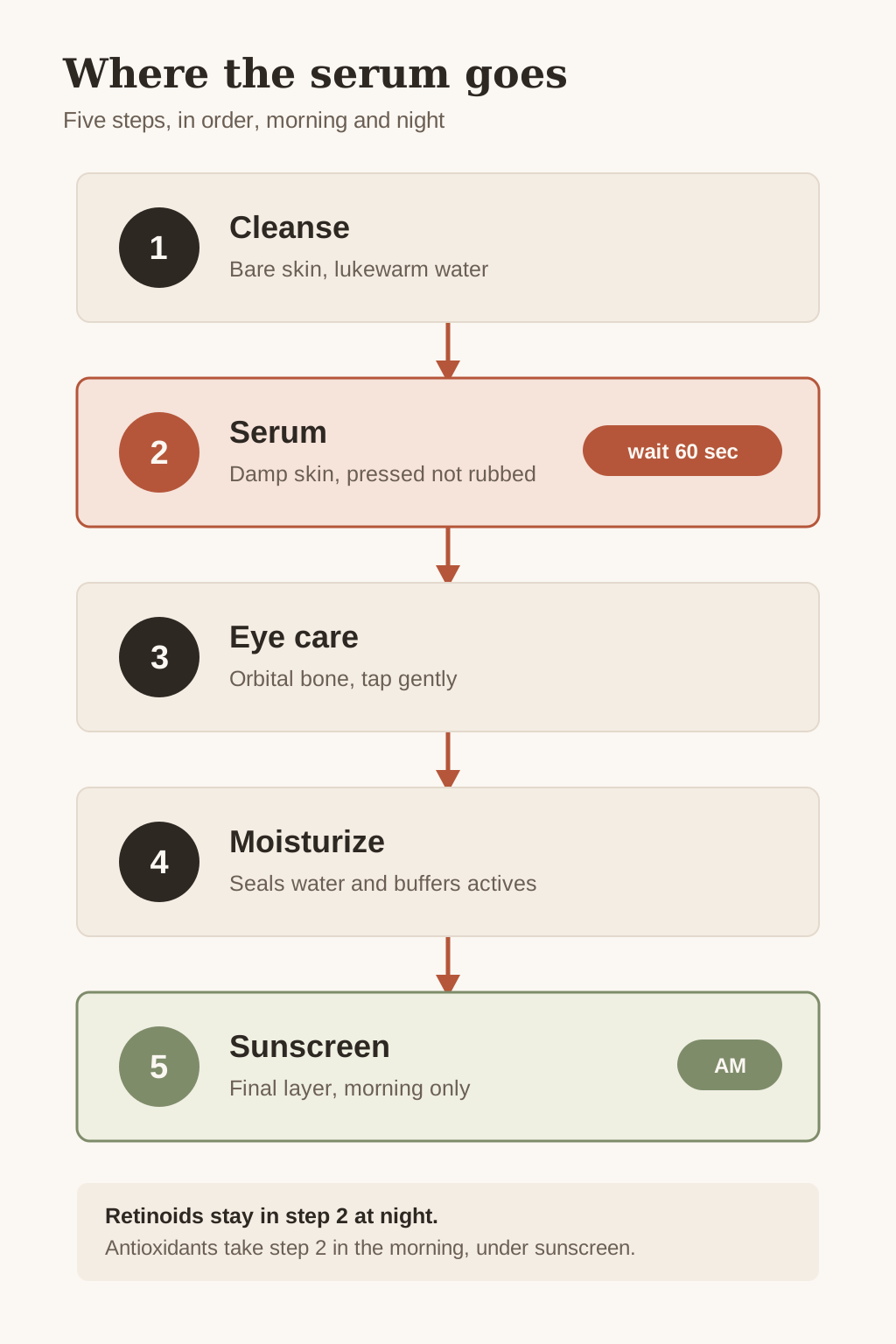
Press three or four drops onto clean, slightly damp skin before any cream, keep retinoids to the evening and antioxidants to the morning, and build frequency over four weeks. Pressing rather than rubbing matters on thin skin: friction is its own irritant.
Splitting actives across the day is why a best face serum for women in her forties often means two bottles rather than one. Acids and retinoids belong at night, when there is no ultraviolet load and no sunscreen to displace; antioxidants belong in the morning, where they work alongside SPF. In the morning, apply your broad-spectrum sunscreen as the final step, over everything else.
The frequency ramp prevents retinoid dermatitis: two nights a week for two weeks, then alternate nights for two more, then nightly only if the skin stays calm. Guidance from dermatologists on the difference between a retinoid and retinol is the same in substance — start with the least intense formula and build slowly.
What not to combine in one session: a retinoid with an AHA or BHA, a retinoid with benzoyl peroxide, or vitamin C with a high-pH treatment that neutralises it. Wait roughly 60 seconds after a watery serum so the cream on top does not dilute and drag it. The full sequence sits in our guide to the correct skincare order, step by step.
Storage is the quiet variable. Heat, light and an open jar destroy more active than any application mistake: keep serums closed, out of a sunny window and out of a steamy shower, and finish an ascorbic acid bottle within three months of opening.
How long until a serum shows results, and what will it never do?
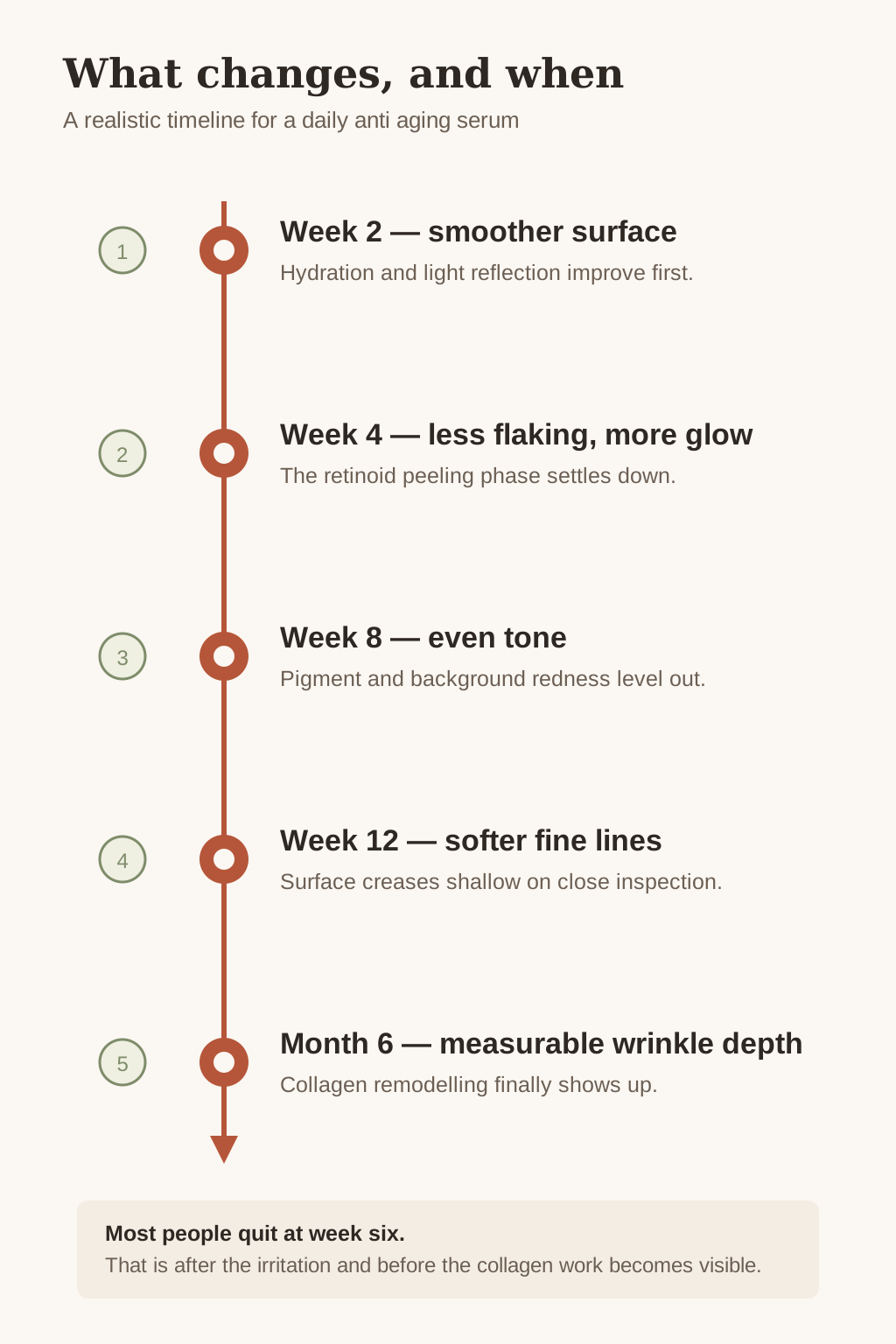
Expect smoother texture by week two, better tone by week eight and measurable wrinkle change nearer month six, and no topical will lift sagging tissue or deep folds. Hydration arrives first because it is a surface effect; collagen remodelling runs on a far slower cycle.
Hence the three-month rule for judging any bottle. Stopping at week six — the point where the irritation has faded but the collagen work is still invisible — is the commonest reason a serum gets written off as useless.
The hard limits are worth naming. No topical resolves deep nasolabial folds, jowls, midface fat loss, or sun damage already seated in the dermis; those need energy devices, injectables or surgery. Around the eyes, where skin is thinnest, a dedicated eye cream for creases around the eyes is the more realistic tool than a face serum.
Read claims against what a cosmetic is allowed to say. The line drawn by how regulators separate a cosmetic wrinkle claim from a drug claim is useful: a product that only makes lines look less noticeable is a cosmetic, while anything claiming to change skin structure or build collagen is making a drug claim. See a dermatologist if stinging persists past a fortnight, new pigment appears, or two years of disciplined use has changed nothing — a prescription retinoid or an in-office treatment is the next step, not another anti wrinkle serum sold as the best anti aging serum.
One evidence-checked skincare answer lands in your inbox each week, with no product dumps.
One evidence-checked skincare answer a week. No product dumps.
Thanks — you're on the list.

