

Why skincare order changes what each product does
A 0.5% retinoid applied over a finished layer of petrolatum-based moisturizer reaches far less of the skin than the same retinoid on bare skin. That is the whole argument for skincare order: every layer you apply becomes a filter for the one after it, so sequence decides how much of an active actually gets through instead of sitting on top and rubbing off on your pillow.
The pattern under the nine steps is short — clean, treat, seal, protect. Cleansing removes the film that blocks absorption. Treatment products go on next because they are the ones that need contact with skin. Moisturizer and oil close the surface so water stops evaporating. Sunscreen sits on top of all of it because it works as a film, not as an ingredient that sinks in.
Nine steps is the full menu, not a daily requirement. Most people run five or six on a normal day and the full set two or three nights a week. The sequence stays identical either way, which is the point: you remove steps from the middle, never reshuffle the ones you keep.
That is also the order for skin care that costs you nothing to fix. Reordering what you own is free; replacing it is not. If you are starting from an empty shelf instead, how to build a skin care routine from scratch covers which products to buy first — and a hospital dermatology team's take on which products a simple everyday routine really needs is a useful reality check before you buy a fifth serum.
The rule that decides what order to apply skincare: thinnest to thickest
Sort your products by texture and the order of skincare products mostly sorts itself out. Watery essences and toners first, then serums, then lotions, then creams, then balms and oils. A thin product cannot push its way through a thick one; a thick one spreads happily over a thin one.
The same thinnest-to-thickest logic collapses to three steps on a child's shelf, so if you are sorting one of those instead, follow kids skin care routines by age.

Two situations break the rule. Water-based products always go before oil-based ones even when the oil feels lighter, because oils are occlusive and a sealed surface blocks water-soluble ingredients behind it. And low-pH actives — glycolic, salicylic, L-ascorbic acid — work best close to bare skin, so they come before hydrating layers that would dilute them.
What order does skincare go in when two products feel identical? Apply the one with the smaller active molecule or the lower pH first, and give it the minute it needs to absorb. That is the correct order for skincare in one line, and it protects the barrier by trapping water under the occlusive layer rather than over it.
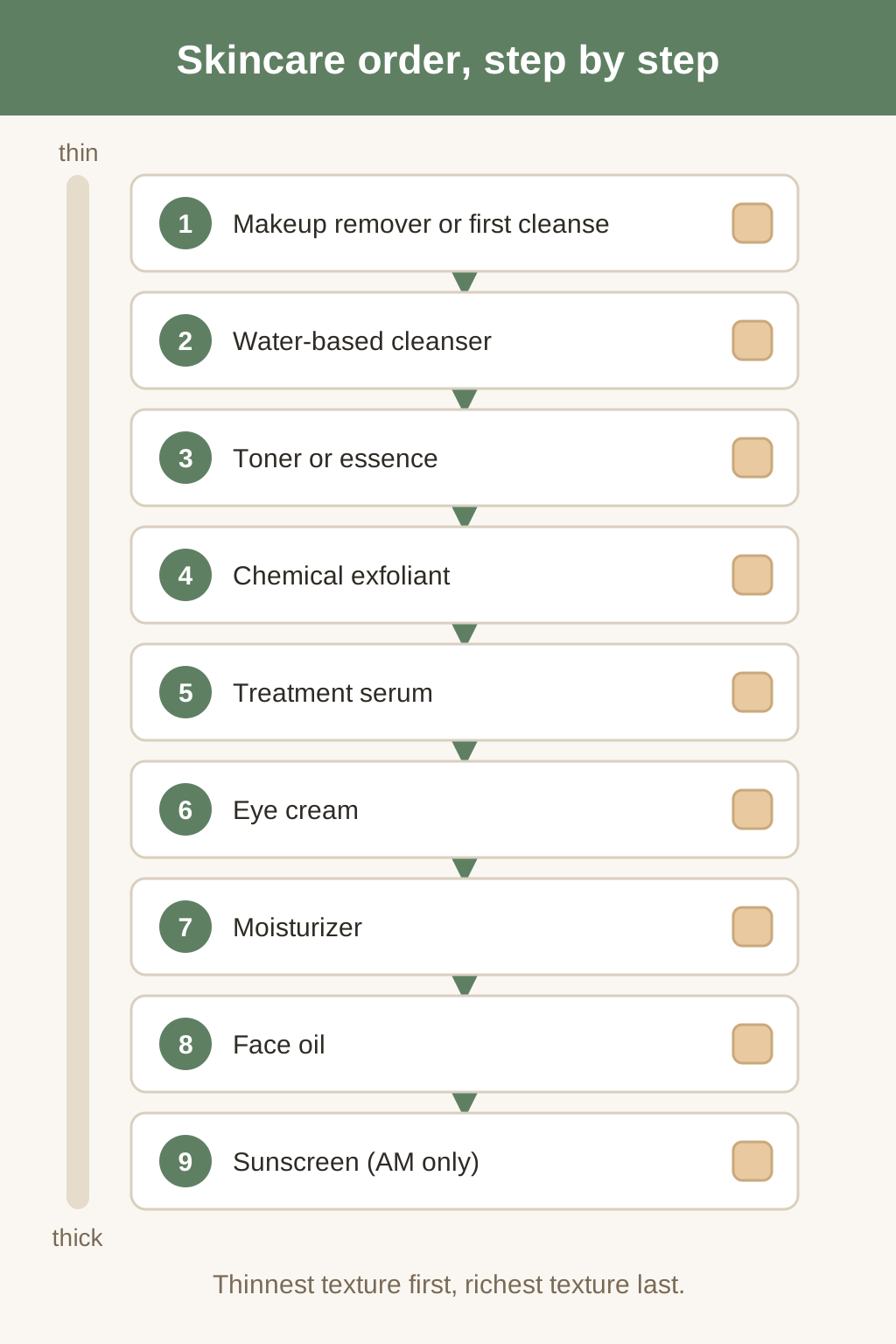
Steps 1 and 2, cleanse: the skincare steps in order start at the sink
Everything downstream is measured against how clean the surface is. Sunscreen and long-wear makeup are designed to resist water, which is exactly why a water-based wash alone leaves a film behind — and that film is what blunts your serum.

Makeup remover or first cleanse
An oil, balm or micellar water dissolves what water cannot: sunscreen filters, silicones, waterproof mascara, sebum. Massage it onto dry skin for 30 to 60 seconds, then emulsify with a little water before rinsing.
This step is not for everyone. If you wore no sunscreen and no makeup, it is an extra 60 seconds and an extra product for no measurable gain, and balms can congest very oily skin. Skip it on bare days; use it every evening you wore SPF.
Water-based cleanser
The second cleanse clears the residue the first one loosened, plus sweat and grime. Use lukewarm water — hot water strips lipids and leaves skin tight — and 20 to 30 seconds of contact, which is long enough for surfactants to work and short enough to avoid stripping.
Mornings need less. A rinse or a low-foam wash is usually enough unless you use heavy night creams. What order to put on skincare at the sink is simple: dissolve first, wash second, and never scrub either step.
Steps 3 and 4, prep: the order of face products between washing and treating
The gap between cleansing and treating is where most routines go wrong — either nothing happens at all, or three prep products stack up and dilute each other.
Toner or essence
Modern toners are hydration and pH-reset steps, not the alcohol astringents of the 1990s. Pat two or three drops onto damp skin within a minute of washing, while the surface still holds water for humectants to grab.
Honest limit: if your moisturizer already contains glycerin or hyaluronic acid, a hydrating toner adds comfort, not results. It is the easiest step to cut when you are short on time or money. For the fuller case, see what a face toner actually does.
Chemical exfoliant
AHAs and BHAs loosen the bonds between dead surface cells, which is why they belong on clean skin before anything hydrating goes on. Two or three nights a week is the working range for most people; daily use is where irritation starts.
The order of facial products matters most here: an acid and a hydrating toner compete for the same slot, so pick one per night rather than layering both. Frequency beats strength — a 2% BHA used twice weekly outperforms a 10% acid that leaves skin stinging. The dermatology guidance on how to exfoliate safely at home is worth reading before you increase either. If you prefer manual exfoliation, our gentle face scrub guide for choosing an exfoliator compares the gentler options.
On exfoliation nights, drop retinoids and any second acid. That is the whole adjustment to your skin care steps in order.
Steps 5 and 6, treat: serums and eye cream in the order of skincare routine
This is the part of the routine you are actually paying for, and the part most sensitive to sequence. Treatments go on as close to bare skin as the formula allows.
Treatment serum
Layer serums thinnest first, and keep it to two. Three actives in one sitting is how barriers break: you get flaking on day four and blame the newest bottle.
Split conflicting actives across the day rather than the minute. Vitamin C in the morning, where it adds antioxidant protection under sunscreen; retinoids at night, where no UV degrades them. That answers what order to apply skincare products more usefully than any wait-time rule. Our retinol serum guide, choosing and using retinol covers strengths and ramp-up schedules, and the vitamin C serum picks, dermatologist-approved explains which formulations stay stable.
Steps for a skincare routine that treats a concern without stacking irritation: one active per night, one new product every two weeks, and a buffering moisturizer on nights that sting.
Eye cream
Eye cream goes after serums and before moisturizer, mostly because it is thicker than a serum and thinner than a face cream. Use a rice-grain amount per eye, tapped along the orbital bone with your ring finger — not into the lash line, where it migrates and puffs.
Where eye cream belongs in the order of skin care products is less debated than whether you need one. If your face moisturizer is fragrance-free and gentle, it can do the same job. Buy a separate one when you want caffeine for morning puffiness or a formula mild enough for contact-lens wearers.
We may earn a commission from links on this page.
Steps 7 and 8, seal: moisturizer and oil in the face care routine order
Nothing you applied so far stays put without a closing layer. Sealing is a mechanical job, and the face care routine order reflects that: humectants need water underneath them, occlusives need everything else underneath them.
Moisturizer
A moisturizer does three things at once — humectants such as glycerin pull water in, emollients such as squalane smooth the surface, and occlusives such as dimethicone slow evaporation. Ceramides matter because they replace the lipids the barrier uses to hold itself together; the research on how moisturizers repair the skin barrier tracks that repair through water-loss measurements.
Apply to skin that is still slightly damp, within about a minute of your last watery layer. On oily skin, a gel-cream at night and nothing heavier is usually the right call; rich creams are the most common cause of clogged pores in an otherwise sensible routine.
Face oil
Oil goes last at night because it is the most occlusive thing on the shelf. Put it under a cream and you have sealed the cream out. Two or three drops warmed between the fingertips and pressed over the moisturizer is the whole technique.
What order to use face products when the moisturizer already contains oils? Treat the oil step as optional. It earns its place on dry, flaky or winter skin and is the first thing to cut if you are breaking out. That is the main skin routine order adjustment between dehydrated and oily skin — same nine steps, lighter textures, one fewer occlusive.
Step 9, sunscreen: what order should skincare go in before you leave the house
Broad-spectrum sunscreen
Sunscreen is the last skincare step of every morning, without exception. It forms a film on the surface, and anything applied over that film disturbs it — which is why it goes after moisturizer and before makeup.
Dose is where most people lose protection. A face and neck need roughly a quarter-teaspoon, or two fingers' length of product, to reach the SPF on the label; half that gives you far less than half the protection. Give it two to three minutes to set before makeup, and reapply every two hours outdoors — the dermatology guidance on how much sunscreen to apply and when to reapply shows reapplication is the step people skip most.

What order to use skin care products when sunscreen meets makeup: sunscreen, then base. Layering more moisturizer on top in the morning only thins the film. If you want one product doing two jobs, our best face sunscreen and SPF moisturizer guide covers where that trade-off is worth making.
Morning skin care routine order versus the order of skincare night
The two routines share a shelf and swap three products. Morning skin care routine order is built for protection: a gentle wash or rinse, a hydrating layer, an antioxidant serum, eye cream, a light moisturizer, sunscreen. Six steps, most of them fast.
The order of skincare night is built for repair, because there is no UV to degrade retinoids and no makeup to sit under. Remove, wash, tone or exfoliate, treat, eye cream, richer moisturizer, and oil or balm when skin is dry. Sunscreen disappears entirely.
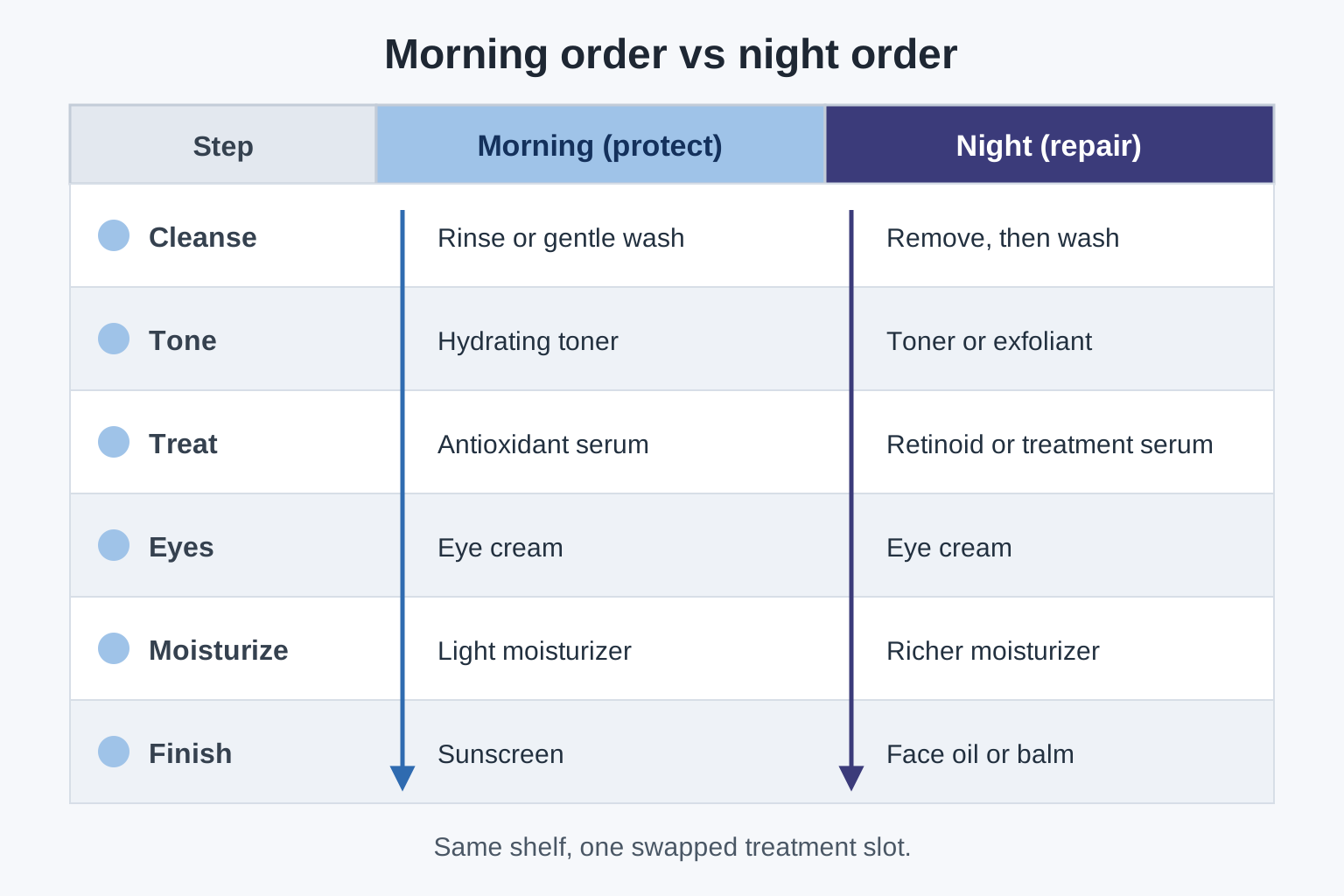
Run the same skincare routine step by step in both directions and only the treatment slot really changes: antioxidant in the morning, retinoid or acid at night. Everything else is a texture decision.
Two practical differences are worth planning for. Morning steps have to absorb fast enough to sit under sunscreen without pilling, so lighter textures win even on dry skin. Night steps have eight hours, which is why the richest cream on your shelf belongs there and nowhere else.
Layering mistakes that undo the skincare steps you already got right
The 60-second rule is real but small: applying humectants within about a minute of washing, while skin is damp, holds more water than applying them to bone-dry skin. Waiting 20 minutes between serums is not required by any formulation, and it is the main reason people abandon a routine.
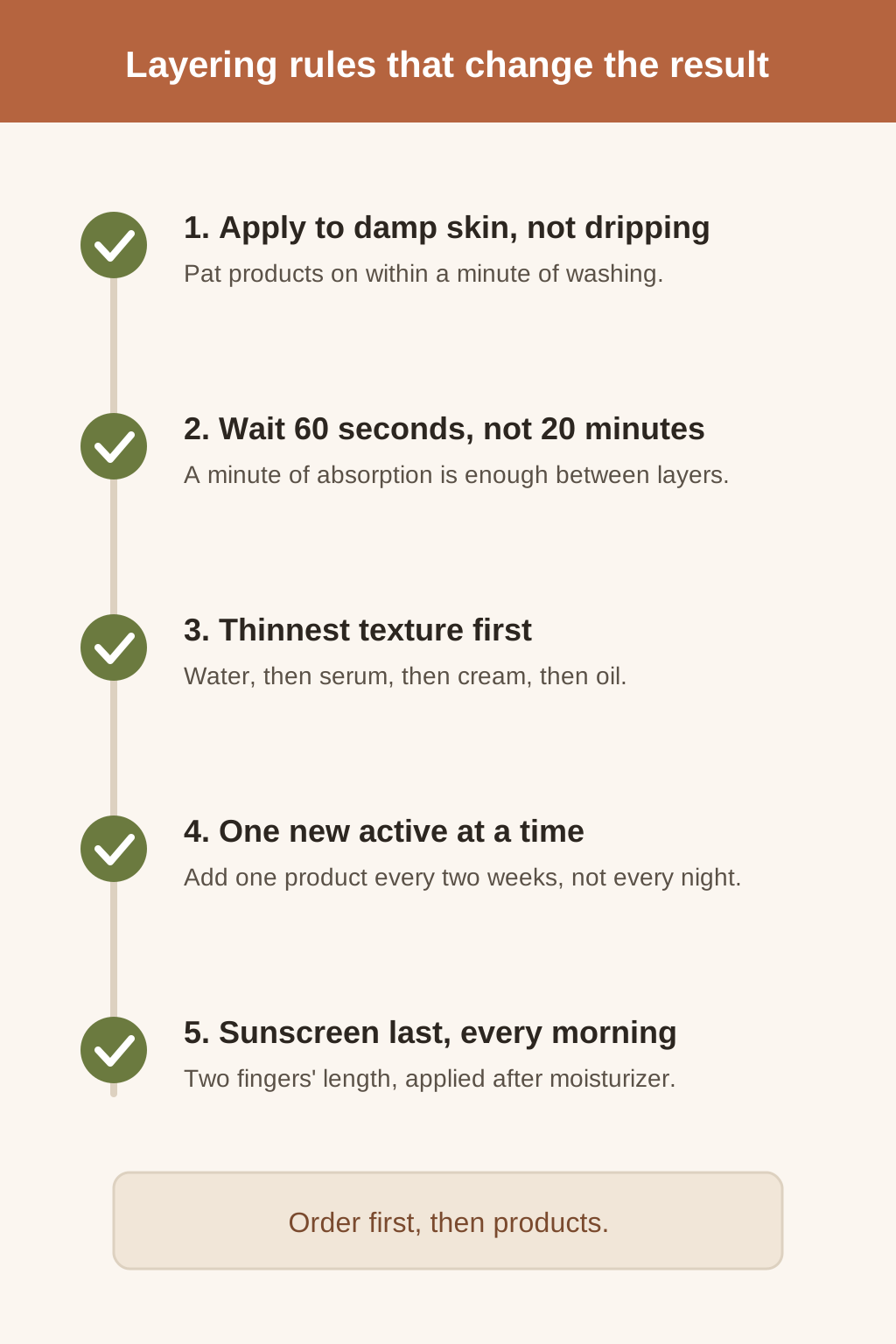
What order should you apply skin care when two actives conflict? Separate them by routine, not by minutes — retinoid one night, acid another. Waiting an hour between them on the same face is theatre.
The rest of the damage is quiet: rubbing sunscreen into unabsorbed moisturizer until it pills, doubling the exfoliant because results stalled, or dropping the moisturizer on oily days and triggering more oil. If skin stings only when one layer goes on second, the order is the problem, not the product.
Skincare order FAQ: the questions people ask after step nine
Where does a weekly mask go? After cleansing, before everything else. On mask nights, skip the exfoliant and the retinoid — what order to apply skincare matters less than not stacking three treatments in one evening.
Does the order change after hair removal or a facial? Yes. For 24 hours, use cleanser, moisturizer and sunscreen only. Acids and retinoids on freshly waxed or lasered skin cause burning, not faster results.
Do body products follow the same rule? Same logic, fewer steps: thin to thick, sunscreen last on exposed skin.
How long before I judge a new order? Eight to twelve weeks for texture and pigment changes, four for hydration. Change one variable at a time, or you will never know which change worked.
If you want the short version each week instead of another 2,000-word guide:
One routine tip a week. No product dumps.
Thanks — you're on the list.


