

Kids skin care needs three products, not ten: a fragrance-free gentle cleanser, a non-comedogenic moisturizer, and a broad-spectrum mineral sunscreen rated SPF 30 or higher. Pediatric dermatologists advise skipping retinol, vitamin C, AHAs, BHAs and peptides before about age 13, because thinner developing skin irritates and sensitizes far faster than adult skin.
What is kids skin care, and what does a child's skin actually need?
Kids skin care means keeping the barrier intact with a mild wash, a simple moisturizer and daily sun protection, because a child's thinner outer skin layer sensitizes faster than adult skin. A child's stratum corneum is measurably thinner than an adult's and loses water through it faster, so the surfactant that leaves your face merely clean can leave an eight-year-old's face tight and flaking by lunchtime.
Framed that way, skincare for kids has three jobs: lift off sweat, sebum and yesterday's sunscreen; replace the lipids that washing removed; and block the ultraviolet dose that accumulates at every school recess. Nothing on that list corrects, resurfaces or brightens, because there is nothing yet to correct.

So what skincare is good for kids comes down to a symptom test rather than a shopping list. With no acne, no eczema and no persistent dryness, dermatologists treat an almost empty routine — water, sunscreen, moisturizer on dry days — as the healthy default, not as neglect.
Kid friendly skin care therefore means fewer ingredients, no added fragrance and no exfoliating acids, because a sensitization formed at nine can follow someone for decades. That risk is not theoretical: a Pediatrics analysis of children using adult skin care regimens found the most-viewed routines aimed at this age dense with known allergens. For the adult version of the same logic, start with building a daily skin care routine in the right order and strip it back.
What skincare is good for kids? The core daily routine
The core daily routine for kids runs three steps, a fragrance-free gentle wash, a non-comedogenic moisturizer and broad-spectrum SPF 30 in the morning, repeated as a two-step wash and moisturize at night. The order never changes: thinnest first, most occlusive last, sunscreen always the final morning layer.
The three kids skin care products that earn a slot
- A fragrance-free wash — low-foaming, glycerin high in the list, no added parfum.
- A non-comedogenic lotion — a ceramide-and-glycerin base, applied within three minutes of towelling off.
- A broad-spectrum mineral SPF 30 or higher — zinc oxide or titanium dioxide, reapplied once at school on outdoor days.
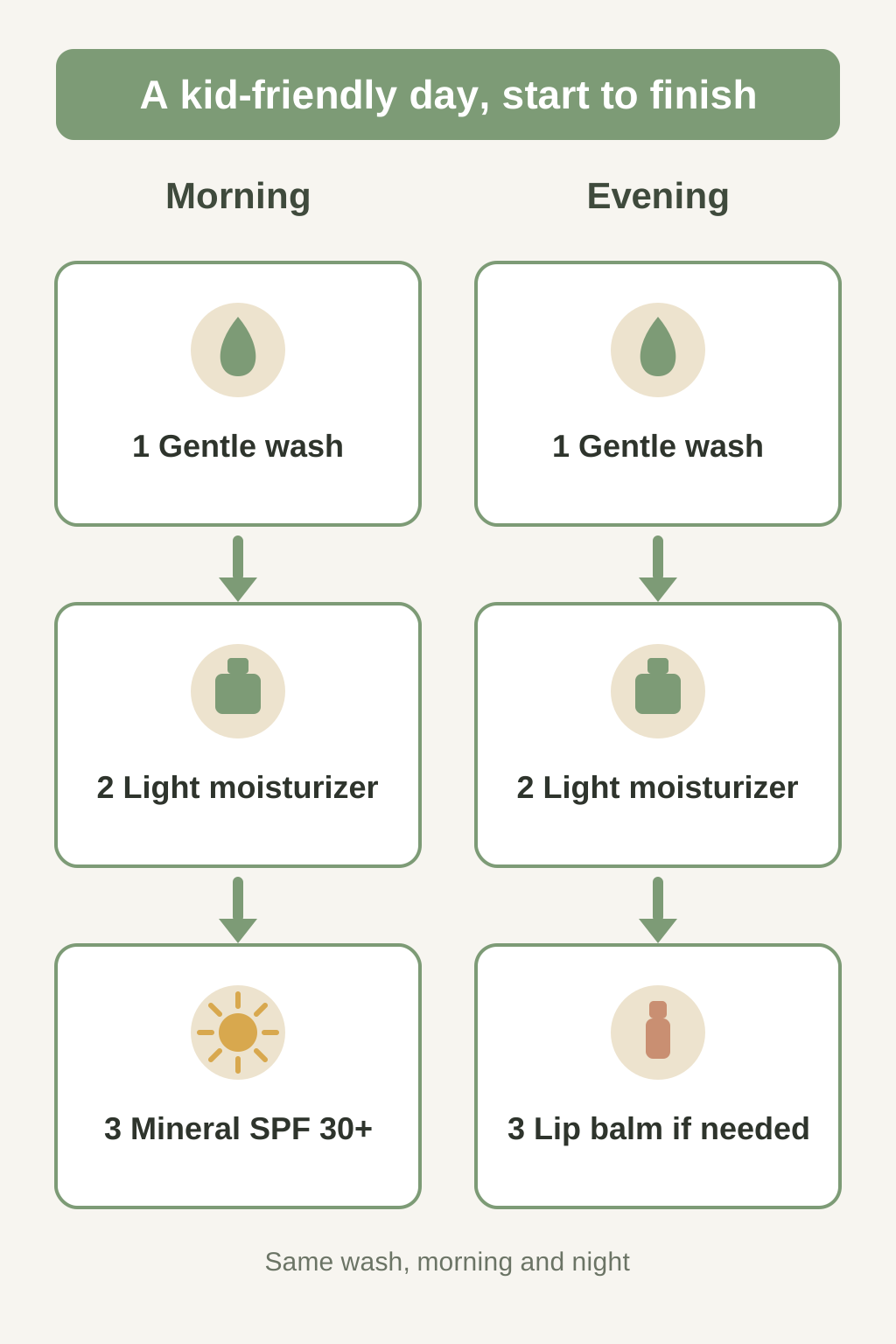
Tweens face care goes wrong on timing more often than on product choice. Washing after sport and again before bed is enough; four washes a day strip the barrier and trigger the rebound oiliness the washing was meant to fix.
What skincare should a 10 year old use on a school morning, realistically? Water, two finger lengths of sunscreen across face and neck, nothing else — ninety seconds, no negotiation. The full wash moves to the evening. Picking that wash is its own decision, and how to choose a face wash compares the formats.
Measure by finger length, not pumps: one for cleanser, one for moisturizer, two for face and neck sunscreen. Pumps vary by bottle; fingers do not.
Best skincare for kids is judged on adherence, not on an ingredient deck. A lotion that feels sticky is abandoned within a week, which makes it worse than a plainer one used every night — the honest cost of a thicker, more protective formula is that some children refuse it.
Which ingredients are safe for kids, and which should wait?
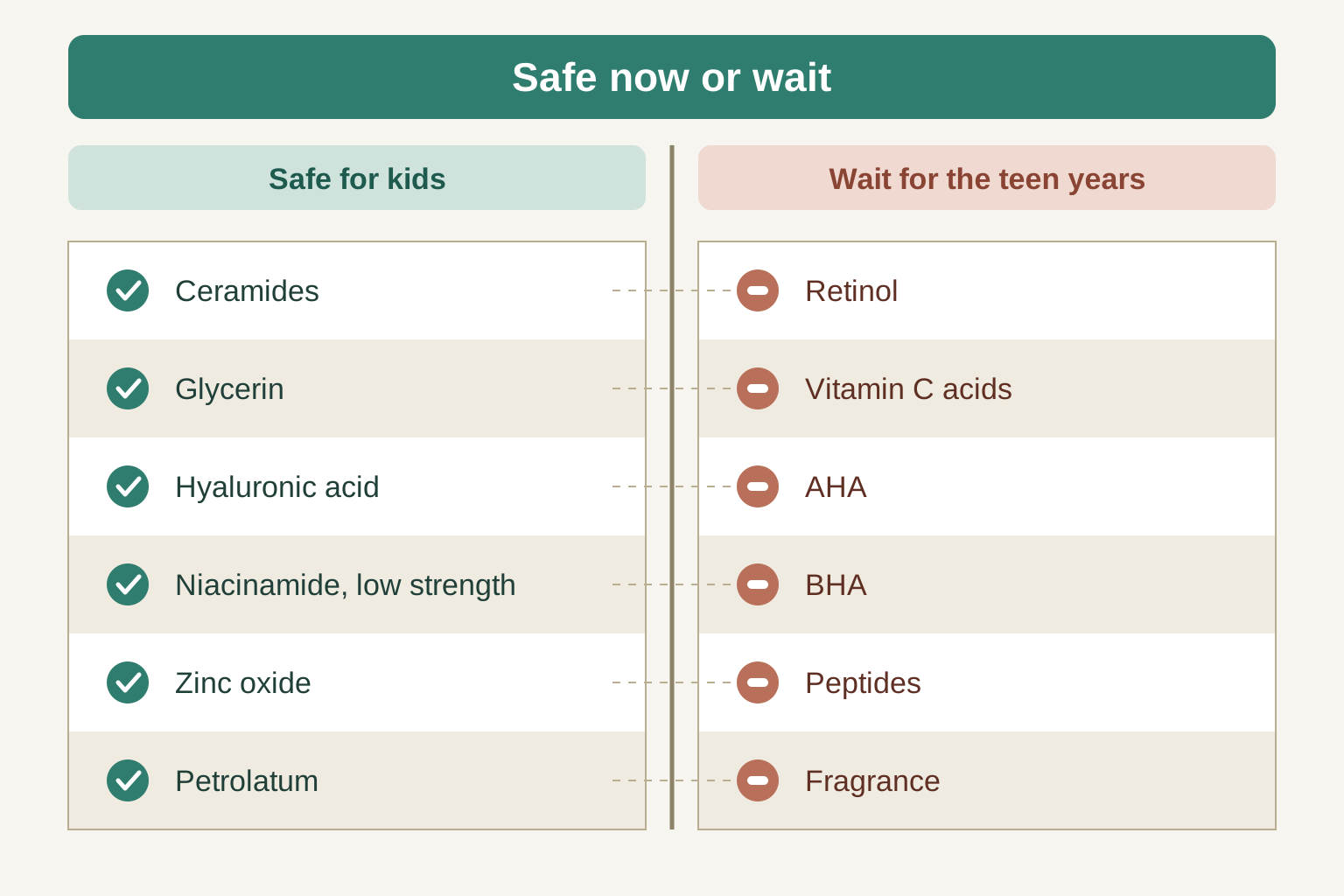
Ceramides, glycerin, hyaluronic acid, low-strength niacinamide and zinc oxide are safe before the teen years, while retinoids, vitamin C acids, AHAs, BHAs and fragrance should wait. Every entry on the safe list has a mechanism that matches what a child's skin actually does.
The safe list, and why each one is there
Ceramides and petrolatum replace or seal the lipid layer washing removes, which is barrier repair rather than treatment. Glycerin and hyaluronic acid are humectants: they bind water into the upper layers and need an occlusive on top to hold it. Zinc oxide sits on the surface and scatters ultraviolet light instead of absorbing it into skin.
The wait list, with the reason for each
Retinoids accelerate turnover in a barrier that is still maturing, so the peeling phase lands harder. AHAs and BHAs strip that barrier by design. Vitamin C acids work at a pH low enough to sting on contact. Peptides have no pediatric use case at all. On frequency and strength for an adult, safe exfoliation frequency by skin type sets the ceiling, and a child sits well under it.
Skincare for tweens goes wrong the moment an anti-aging claim enters a routine with no aging to treat. The same point runs through pediatric dermatology guidance on preteen skin care. Niacinamide is the borderline case: tolerable at 4 percent or less for oiliness, pointless at the 10 percent strengths sold to adults, and niacinamide strengths worth paying for explains where that line sits.
Skin care for tweens with genuine inflammatory acne is the single exception, and benzoyl peroxide at 2.5 percent is where it starts — not 10 percent, which irritates more without clearing faster. Best skin care for kids also skips essential oils, menthol, denatured alcohol and physical scrubs. So what skin care is good for 10 year olds comes down to four ingredient families — a mild surfactant, a humectant, a barrier lipid, a mineral filter — rather than forty.
Kids skin care by age: what changes as a child grows?
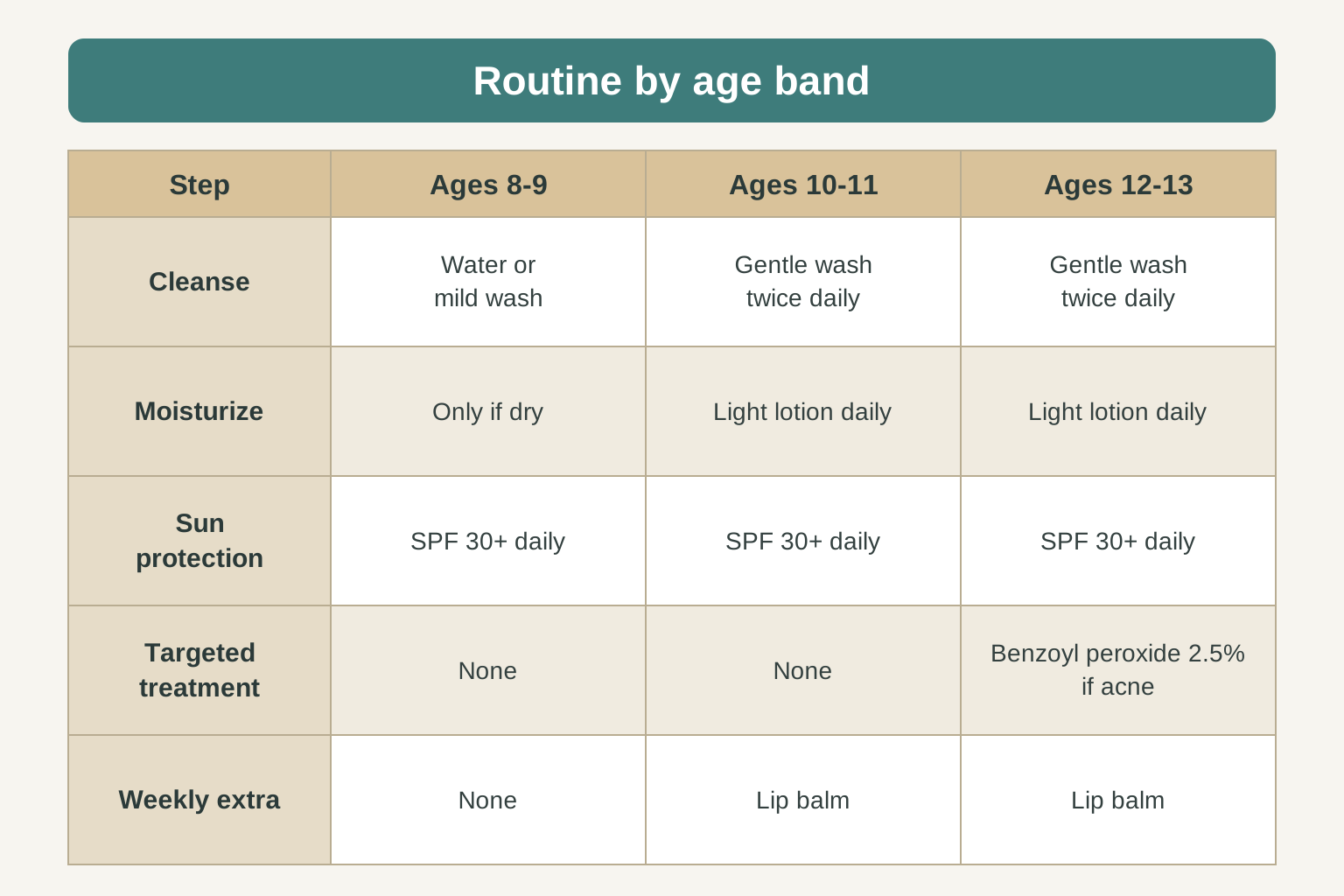
Routines shift gradually: ages eight and nine need washing and sunscreen only, ten and eleven add a moisturizer and lip care, and twelve and thirteen may add one acne-targeted treatment. One grid holds the whole progression.
| Step | Ages 8-9 | Ages 10-11 | Ages 12-13 |
|---|---|---|---|
| Cleanse | Water or mild wash | Gentle wash twice daily | Gentle wash twice daily |
| Moisturize | Only if dry | Light lotion daily | Light lotion daily |
| Sun protection | SPF 30+ daily | SPF 30+ daily | SPF 30+ daily |
| Targeted treatment | None | None | Benzoyl peroxide 2.5% if acne |
| Weekly extra | None | Lip balm | Lip balm |
Ages eight and nine
Skincare for 8 year olds is water, a mild wash after sport and sunscreen every day, nothing more. Skincare for 9 year olds and skin care for 9 year olds shift only when sebum production starts — visible shine on the nose by mid-afternoon is the trigger for a daily evening wash. Skin care products for 9 year olds should stay at two bottles, because every added slot is another chance to irritate.
Ages ten and eleven
Skincare for 10 year olds and skin care for 10 year olds add the moisturizer slot once washing becomes twice daily, since a cleanser used morning and night removes more lipid than one used at bedtime. Skincare for 11 year olds and what skincare is good for 11 year olds answer the same way: keep the base, and add a salicylic acid wash three nights a week only if clogged pores actually appear.
Age twelve onward
Skincare for 12 year olds may carry one targeted acne treatment and one weekly extra, no more — two actives at once is where irritation starts. Skin care for pre teens tracks puberty signals rather than birthdays, so two children of the same age can need different routines; if either reacts to everything, calming a sensitive-skin routine is the better framework.
How do you read a label and choose kid friendly skin care?
Choose by label rather than packaging: a short ingredient list, no fragrance, no essential oils, no exfoliating acids, and a non-comedogenic claim sitting on a plain humectant and ceramide base. The test takes twenty seconds in a shop aisle.
- Count the ingredients. Under fifteen is a good sign; over twenty-five usually means botanicals added for the label rather than the skin.
- Read the first five. A mild surfactant, water, glycerin and a ceramide is the profile you want.
- Reject parfum, fragrance, or any acid sitting higher in the list than the preservatives — list position tracks concentration.

Skin care products for 10 year olds marketed with brightening, firming or anti-aging language fail the test regardless of the age printed on the box, because those claims need wait-list actives. Best skin care products for 10 year olds are usually the plain adult sensitive-skin lines rather than the pastel kids range; the tradeoff is dull packaging, which some children mind more than parents expect.
Skin care for 10 year old girl routines and boys' routines need identical chemistry, so pink packaging is a pricing signal rather than a formulation one. Skin care products for 10 years old girl bundles often add a scrub that undoes the rest of the routine. Two categories parents ask about repeatedly: what a face toner actually does is mostly optional at this age, while makeup remover formats compared matters as soon as makeup enters the picture.
Whatever passes the label test still gets patch tested: a coin-sized amount on the inner forearm, five nights running, before it goes near a face.
What should you buy for each step of a tween routine?
Buy one product per step, cleanser, moisturizer and sunscreen, in the smallest size available, because a child's preferences and skin both change inside a single school year. Tween skincare has a buying order too: cleanser first, sunscreen second, moisturizer third, nothing else until a symptom asks for it.
Some links in this section are affiliate links, and a purchase may earn us a commission.
A kids skin care set makes sense only when every component passes the label test on its own; bundles are priced on the assumption nobody checks the third and fourth bottles. Costed monthly, the cleanser is cheapest per use, the sunscreen most expensive, the moisturizer in between.
On moisturizers, what matters in a face moisturizer is the shortlist worth paying for, and mineral sunscreen picks for faces covers the white-cast problem that makes children refuse zinc formulas. That refusal matters more than the filter type: a mineral sunscreen a child will not wear protects less than a chemical one they reapply unprompted.
How do you handle acne, eczema and sun protection safely?
Acne responds to benzoyl peroxide at 2.5 percent or salicylic acid at 0.5 to 2 percent, eczema needs a ceramide ointment after bathing, and sun needs reapplied mineral SPF. Each concern has its own dosing rule.
For acne, apply treatment on alternate nights for two weeks, then nightly if there is no peeling — starting nightly produces the raw, flaking face that ends the attempt. For eczema, a ceramide ointment within three minutes of a lukewarm bath does more than any cream applied later, and a fragrance-free, bleach-free detergent removes a trigger most families miss.

Some links in this section are affiliate links, and a purchase may earn us a commission.
For sun, two finger lengths cover face and neck, reapplied every two hours outdoors, and a wide-brim hat does work no sunscreen can. Dosing and reapplication intervals follow dermatology sunscreen guidance for children. A weekly hydrating option is a separate question, and hydrating face masks for weekly use sorts the useful from the decorative.
Best skincare products for teens cross over for older tweens on cleansers and sunscreens, and do not cross over on retinoids or acid toners. Cosmetics for teenager routines sit on top of skin care rather than replacing it, so removal at night matters more than the morning product. Book a pediatric dermatologist for cysts, scarring, eczema that cracks or bleeds, or six weeks of consistent treatment with no change.
How do you keep a routine going without the trend cycle?
A routine survives when it takes under two minutes, lives at the sink the child already uses, and changes only when a dermatologist or a real symptom asks for it. Keep the bottles visible at that sink and one tracker on the mirror.
The rule for adding anything new is one product at a time, two weeks apart, with the reason written down — a reaction then has one suspect instead of four. When a trending serum gets requested, a trade works better than a refusal: the serum waits, and the child picks the next cleanser or sunscreen themselves.
On a dry winter morning the one extra worth saying yes to is a plain unflavored lip balm, with no menthol, no flavor and no salicylic acid.
If you want the short version each week rather than the whole guide again:
One kid-safe routine tip a week. No product dumps, no trend chasing.
Thanks — you're on the list.


