

Seven rules run this guide, and each one is a heading you can act on today. They are ordered the way a reactive face responds best: subtract first, test second, add last.
What Sensitive Skin Actually Is - and What It Isn't
Sensitive skin is a reactivity pattern, not a fixed skin type. It shows up as stinging within a minute of application, burning that outlasts the rinse, tightness an hour later, or flushing that blooms and fades inside sixty minutes. Oily skin can be sensitive. So can dry skin, and the two need different products for the same problem.
It is also not a diagnosis. Eczema, rosacea, perioral dermatitis and contact allergy all produce the same symptoms and all need a clinician, because a shelf change will not fix an inflammatory condition. If your reaction includes visible rash, papules, or skin that weeps, you are past the point where product selection is the answer.
The scale is larger than most people expect. In prevalence research on sensitive skin, roughly 70% of surveyed adults report some degree of skin sensitivity, and about 46% describe theirs as moderate or very sensitive. Regional figures swing from 23% to over 90%, which tells you the label is self-reported and elastic rather than clinical.

Most people who go looking for skincare for sensitive skin are dealing with two things at once: a barrier that has been worn thin, and a specific trigger sitting in one of their products. Fix the first and the second often stops mattering. That is why sensitive skincare is decided by what you remove and how slowly you add, not by how much the jar cost.
The narrow version of this is skincare for sensitive face, where the cheeks and the skin around the eyes react while the same cream is fine on arms and legs. Facial skin is thinner, gets far more product, and takes almost all of your UV exposure. Treat the face as its own case rather than assuming a body-safe product transfers.
Why Sensitive Skin Care Starts With the Barrier
The outer layer of your skin, the stratum corneum, works like brick and mortar: flattened cells held in lipid layers made of ceramides, cholesterol and free fatty acids. Ceramides make up roughly half of that mortar. When those lipids drop, water leaves faster and irritants reach the nerve endings that would otherwise be shielded — which is why sensitivity and dryness usually arrive together.
Because washing is where that lipid mortar is most easily stripped, run through these gentle cleanser label checks before you buy and choose a formula that cleans near skin's own pH.
A review of ceramide formulations and barrier repair screened 41 reports and analysed 12, concluding that ceramide-containing creams lower transepidermal water loss and improve stratum corneum structure, performing at least as well as their comparators. The authors' own caveat is worth carrying: large double-blind trials are still missing, so treat ceramides as a reliable default rather than a proven cure. A clinical overview of sensitive skin symptoms and triggers describes the same thinned-barrier mechanism from the diagnostic side.
Four things wreck barriers, and you control all four today:
- Hot water — anything above lukewarm strips lipids faster than they rebuild.
- Twice-daily foaming cleanser — most reactive faces need surfactant once, at night.
- Overlapping actives — two acids, or an acid plus a retinoid, in the same week.
- Physical scrubs — abrasion on an already-compromised barrier compounds the damage.
Give any change two to four weeks before you judge it, because that is how long barrier lipids take to rebuild. Good skin care for sensitive skin means fewer decisions, not gentler-sounding marketing. You will know it worked when your face stops feeling tight after washing and a new product stops registering at all.
Not sure whether your skin is sensitive, dry, or simply barrier-damaged? Six questions, two minutes, and you get your skin type plus a sensitivity flag and your top concern.
Building a Short Skin Care Line for Sensitive Skin
A ten-product shelf cannot be troubleshot. When something starts stinging, you have ten suspects, no controls, and no way to isolate the culprit without stopping everything. A four-product shelf gives you a testable system.
Cut back to four products
Cleanser, moisturizer, sunscreen, and one optional treatment. That is the whole line. The cleanser removes sunscreen and sweat; the moisturizer replaces lipids; the SPF prevents the flushing and pigment that reactive skin clears slowest; the treatment is the only slot allowed to change.
The tradeoff is real: four products move slower on texture, pigment and fine lines than an eight-step routine would. You are trading speed for the ability to identify what hurt you. A short skin care line for sensitive skin is also cheaper to replace when one product turns out to be the problem — you bin one item, not a set.

Choose fragrance-free, not unscented
These are not synonyms. As the regulator explains in its guidance on how fragrance is labeled on cosmetics, a fragrance blend can be listed as the single word "fragrance" because the formula is treated as a trade secret, and manufacturers are not required to itemize allergens the way food labels must. "Unscented" often means fragrance was added specifically to mask the smell of other ingredients.
Read the first six ingredients and the last six. Fragrance, parfum, denatured alcohol, essential oils and botanical extracts almost always sit in one of those two blocks. Anything marketed as clean or natural is not exempt — limonene, linalool and lavender oil are among the most common contact allergens in cosmetics.
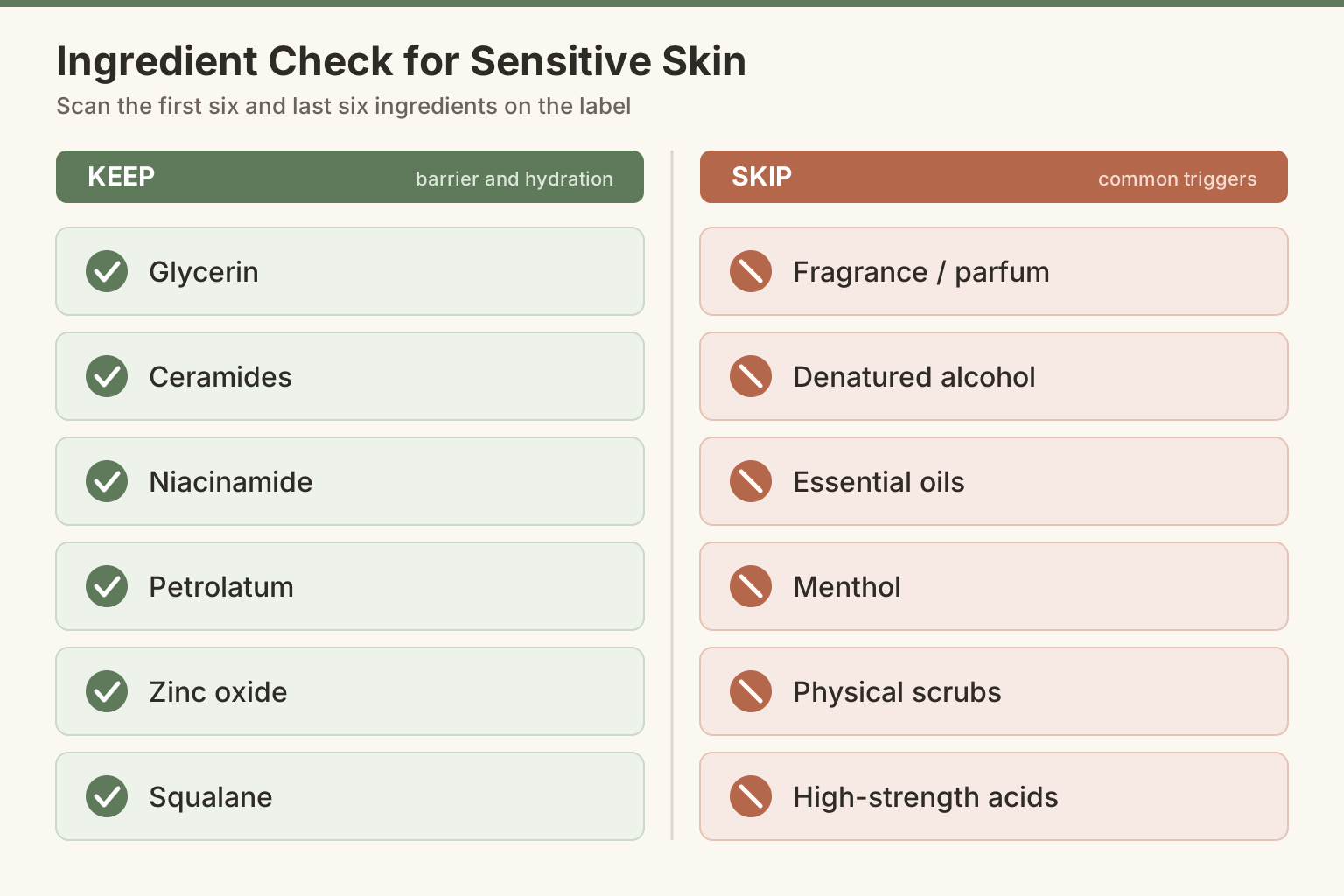
What to keep: glycerin and squalane for cheap, low-risk hydration; ceramides and petrolatum for barrier repair; niacinamide at 2–5% for redness; zinc oxide for UV. What to skip on reactive skin: fragrance, denatured alcohol, essential oils, menthol, physical scrubs, and high-strength acids. Each keeper costs you something — petrolatum is greasy, zinc oxide leaves a cast, niacinamide above 5% can flush.
Judge best skincare for sensitive skin claims by what is testable. A short ingredient list and published patch-test data beat a "hypoallergenic" badge, which has no legal definition and no required evidence behind it. When you compare humectant serums, the same logic applies to the hyaluronic acid serum buying checks that separate a useful formula from a marketing one.
A best skincare line for sensitive skin should share three things across every product: one fragrance policy, a cleanser in the skin's pH range, and no duplicate actives between steps. Buying skincare products sensitive skin shoppers rate highly is less useful than buying products that do not repeat each other.
Wash with lukewarm water only
Water temperature is free to change and immediately effective. Lukewarm — comfortable on the inside of your wrist, never steaming — keeps surfactants from stripping lipids faster than they rebuild. Sixty seconds of contact is enough; the third minute of washing does nothing your first minute did not.
The Sensitive Skin Routine, Step by Step
Four steps, in this order, with a morning variant that skips cleanser entirely. Rinse with lukewarm water when you wake up: overnight your face collects only its own sebum, and a surfactant at 7am is the most common avoidable irritation in a reactive routine.
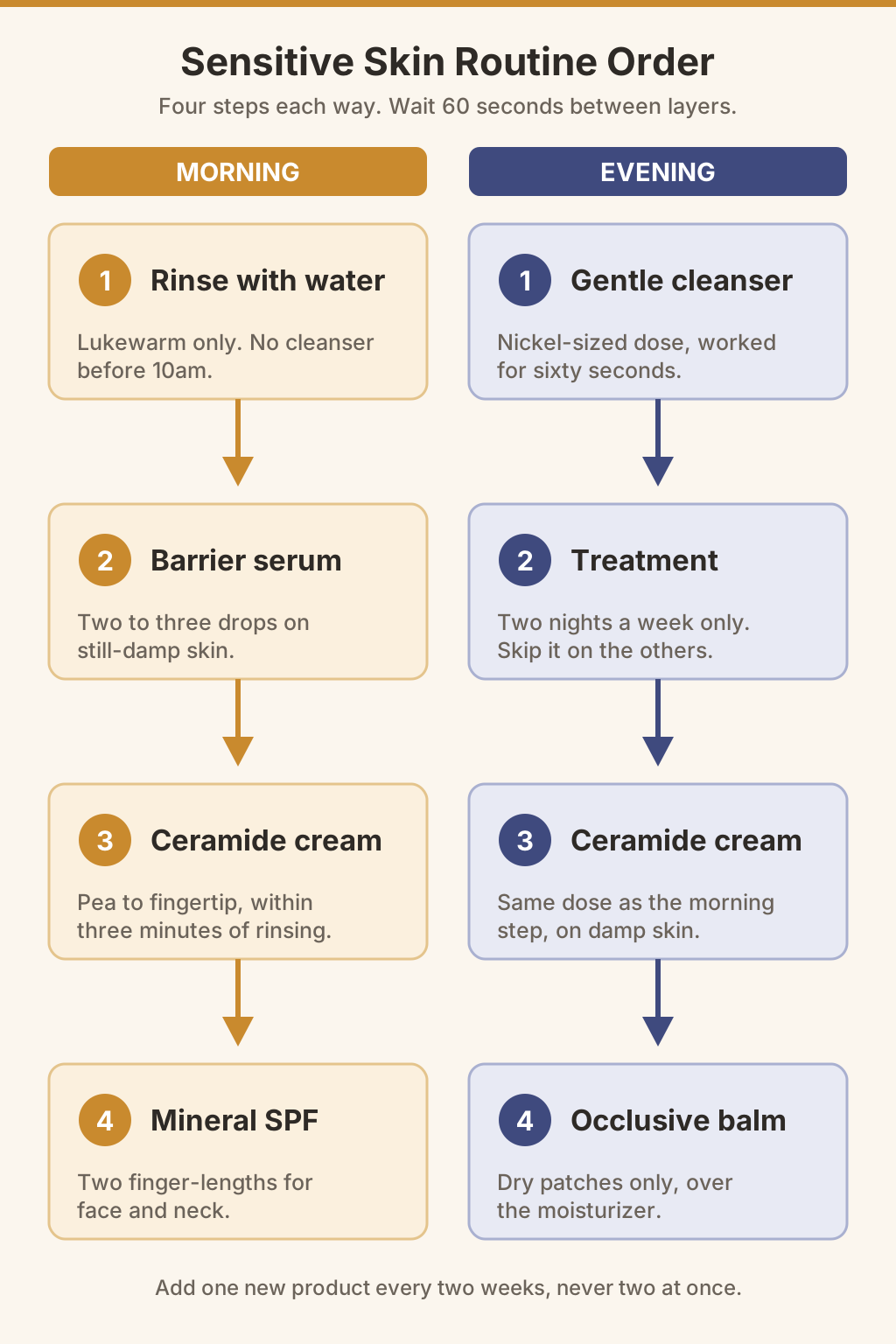
Amounts matter more than brands. A nickel-sized dose of cleanser worked for sixty seconds at night. Two to three drops of serum. A pea to a fingertip of moisturizer. Two finger-lengths of sunscreen for face and neck — the amount that actually delivers the SPF on the bottle.
Moisturize on damp skin
Apply moisturizer within three minutes of rinsing, while the surface still holds water. Humectants such as glycerin and hyaluronic acid pull moisture toward the surface; on bone-dry skin in low humidity they pull it from deeper layers instead and leave you tighter than before. Damp skin gives them something to hold, and the occlusive part of the cream then seals it in.
The limitation: damp application makes rich creams feel heavier and slower to absorb, and it will not rescue a moisturizer that is too light for your skin in winter.
Toner is optional here. It earns a slot only when it is a genuinely hydrating formula replacing a step you dropped — otherwise it is one more chance to react. If you are weighing it up, the case for and against is covered in what is a toner and its benefits, and the wider order logic in how to build a skin care routine.
On nights you use no treatment at all, the evening is cleanser, moisturizer, done. That is a complete routine, not a compromised one. Three layering mistakes undo the best skin care for sensitive skin: stacking two humectant serums, applying moisturizer to fully dry skin, and putting SPF over a cream that has not set.
Facial products for sensitive skin go into this order one slot at a time, never as a full new lineup. And face products for sensitive skin follow a different order than body products — the face takes SPF daily and roughly ten times the product contact, so it needs the tighter sequence.
Answer four questions and you get this routine ordered for your skin type and budget, with one product slot per step.
Testing New Products Without Setting Off a Flare
Every product you buy is a hypothesis. Testing turns it into an answer in ten days instead of six weeks of guessing.
Patch test for ten days
Apply a quarter-sized amount to the inner forearm, the same spot, once a day for seven to ten days. Ten days catches delayed contact allergy, which typically surfaces on days four to seven — a single overnight test misses it entirely. Before anything goes near the eye area, repeat the test on the jawline, where skin behaves more like facial skin.

At the first sign of a reaction: rinse gently with lukewarm water, apply a cool compress, use plain petrolatum, and do not reapply the product. A reaction that spreads, blisters, weeps, or is still there after a week needs a dermatologist and possibly formal patch testing, not a fifth product.
The cost of this rule is patience. Ten days per product means a four-product routine takes over a month to assemble. The best products for sensitive skin are simply the ones that survive that test, and sensitive skincare products marketed as beginner-friendly get exactly the same ten days.
Introduce one active at a time
One new product every two weeks. Two changes at once and a reaction has two plausible causes, which is the same as having none.
Start any active at its lowest available strength, two nights a week, buffered by applying moisturizer first. Hold that for four weeks before increasing frequency or concentration. If you are adding gradual exfoliation, a low-strength exfoliant is the slot to start with, not a peel. Niacinamide is the most forgiving entry point — see niacinamide serum that actually works — while retinoids demand the slowest ramp of all, covered in the retinol serum guide.
Learn the difference between transient stinging and a reaction. Brief tingling that fades within a couple of minutes, with no redness the next morning, is normal for acids and retinoids. Stinging that persists, or redness still visible at breakfast, is a reaction — stop.
The printable ten-day tracker below is for anyone assembling a routine from scratch: one row per day, AM and PM, with the reintroduction dates already filled in.
Sun Protection for Reactive and Easily Irritated Skin
UV exposure drives the flushing, broken capillaries and post-inflammatory marks that reactive skin is slowest to clear. Skip SPF and you spend the rest of the routine treating damage you are re-inflicting every morning.
Wear mineral SPF every morning
The federal guidance on SPF and reapplication gives you the numbers: choose broad spectrum, SPF 15 or higher — treat SPF 30 as the practical floor — apply about one ounce for full body coverage, and reapply at least every two hours, sooner when swimming or sweating. Apply 15 minutes before you go out.

Mineral filters — zinc oxide and titanium dioxide — sit on the surface rather than absorbing UV in the skin, which is why they suit skincare for very sensitive skin. The honest cost: a white or grey cast on deeper skin tones, noticeably longer blending, and a heavier finish under makeup. Chemical filters are more elegant, and two of them, oxybenzone and avobenzone, are the ones most likely to sting reactive skin and watery eyes. Check the active panel before you buy; a fuller comparison sits in the guide to the best sunscreen for sensitive skin.
For midday reapplication, use a mineral stick or a powder over makeup. Rewashing and relayering at lunchtime disturbs the barrier more than the missed hour of protection costs you.
Choosing for Dry, Reactive and Thin-Skinned Areas
Dry sensitive skin needs occlusion, not just hydration. A humectant-only serum in a dry room or a cold climate draws water from deeper tissue and evaporates it, and skin ends up tighter than before you applied anything.
Translated into products, the dermatologist tips for relieving dry skin is specific: creams and ointments over lotions, showers held to five to ten minutes in warm rather than hot water, moisturizer applied while skin is still damp, and formulas built on petrolatum, glycerin, hyaluronic acid, lanolin or shea butter. The same logic drives the picks in dry skin moisturizers worth using.
The eye area is the hardest case: skin there is roughly half the thickness of cheek skin, so the best skin care products for dry sensitive skin still sting when they carry fragrance or an active. Fragrance-free, low-active, occlusive-leaning formulas only.
Some links below are affiliate links. If you buy through them, we may earn a commission at no extra cost to you.
Across price points, the best skin care products for sensitive skin differ less in ingredients than in execution. Spending more usually buys finer sunscreen particles, a less greasy emulsion, and airless packaging that limits oxidation. Spending less usually costs you texture and a shorter ingredient runway — not safety.
Three signs your moisturizer is too light: tightness returning within two hours, flaking that survives gentle exfoliation, and makeup clinging to dry patches by noon. Good skin products for sensitive skin can still fail in January; swap the moisturizer for a richer one and keep the other three slots unchanged rather than rebuilding the shelf.
Calming an Active Flare-Up Without Making It Worse
For 72 hours: rinse with water only, apply one bland moisturizer twice a day, and put plain petrolatum on cracked areas. Nothing else.
Stop every active, all exfoliation — including your gentle face scrub and exfoliator guide — and every fragranced product that touches your face, which includes shampoo, conditioner and the detergent your pillowcase was washed in. Skin treatment for sensitive skin needs a clinician, not a shelf change, when the rash spreads, blisters, weeps, or has not settled within a week.
Among skin care products for irritated skin, a soothing mask is worth one use, not a daily habit — more layers usually prolong a flare. Rebuild in order: moisturizer alone for a week, then cleanser, then SPF, then actives last. If even bland moisturizers sting, that pattern usually points to a broken barrier or an undiagnosed condition, and extremely sensitive skin care starts with a diagnosis.
Sensitive Skin Questions People Actually Ask
Do "hypoallergenic" and "dermatologist-tested" mean anything?
Not much. Neither term has a legally defined standard, and neither requires published evidence. "Dermatologist-tested" confirms a dermatologist was involved somewhere; it does not say what was tested, on how many people, or what the results were. The ingredient list is the only claim you can verify yourself.
How long before I judge a new routine?
Two to four weeks, matching the time barrier lipids take to rebuild. Irritation shows up in days; improvement does not. Judging at day three is how people cycle through six products in a month and end up worse.
How do I evaluate sensitive skincare brands without buying the line?
Buy one product, not the set. Use sample sizes where they exist, and check the return policy for opened products before you order — retailers that accept opened returns make a ten-day patch test risk-free. Any brand asking you to commit to a full line before you have tested one item is asking you to run four experiments at once.
Does the best sensitive skincare have to be expensive?
No. Price buys filter quality, texture and packaging that limits oxidation — not tolerance. A petrolatum ointment costs a few dollars and outperforms most luxury creams on barrier repair; what it costs you is elegance.
How do I shop when everything claims to be gentle?
Use the checks from earlier: read the first six and last six ingredients, reject fragrance and denatured alcohol, count the actives, and patch test for ten days. Applied consistently, that filter narrows the best face care products for sensitive skin faster than any badge on the front of the box.
Can sensitive skin change over time?
Yes. Skin thins with age, cold and low humidity strip lipids faster, isotretinoin and topical retinoids raise reactivity, and hormonal shifts change oil output. Re-test a product that used to work if your climate, medication or season has changed.
One gentle-routine tip a week, sent to people who would rather subtract products than add them.
One gentle-routine tip a week. No product dumps, no hype.
Thanks — you're on the list.


