

An exfoliant removes dead cells from the stratum corneum, either mechanically with grains and brushes or chemically with acids such as glycolic, lactic and salicylic. Healthy skin sheds roughly every 28 days on its own, so exfoliating once to three times weekly supports that turnover. Frequency, not force, decides the result.
What does exfoliating actually do to your skin?
Exfoliating clears dead cells off the stratum corneum, either by abrading them away or by dissolving the desmosome bonds that hold them down, so newer cells reach the surface sooner. Those bonds are the whole story. Corneocytes are not loose dust sitting on your face; they are riveted together by protein anchors called corneodesmosomes, and shedding only happens when enzymes cut those rivets.
Exfoliating only speeds that handoff at the surface, so if discoloration is your concern, see what retinol does for dark spots, since retinol drives turnover deeper and curbs melanin as well.
That natural process is called desquamation, and in your twenties it runs on roughly a 28-day loop. By your forties it can stretch past 40 days, which is why texture, dullness and flaky patches creep in with age rather than arriving overnight. An exfoliant shortens the loop artificially.

So what is an exfoliant, precisely? Any grain, acid or enzyme that loosens those anchors or scrapes the loosened cells away. Sugar and jojoba beads do it by friction. Glycolic and lactic acid do it by interfering with the bonds chemically. Salicylic acid does it by extracting desmosomal proteins outright, which is the mechanism detailed in the review of salicylic acid as a peeling agent. Fruit enzymes such as papain digest the protein directly.
The limit worth naming early: the stratum corneum is not waste. It is a 15-to-20-layer brick wall that holds water in and irritants out. Strip past the loose top layer and you are removing living defence, not debris. That is the difference between exfoliating and sanding.
The internet mantra of exfoliate exfoliate exfoliate sells far more product than any face needs, and it is also why acid-damaged skin is now a routine clinic complaint. One well-chosen product, used on a schedule, beats three used enthusiastically. If you are still deciding where exfoliation sits against milder steps, the case for face toner benefits and purpose is a useful comparison point.
Physical or chemical: which way should you exfoliate skin?
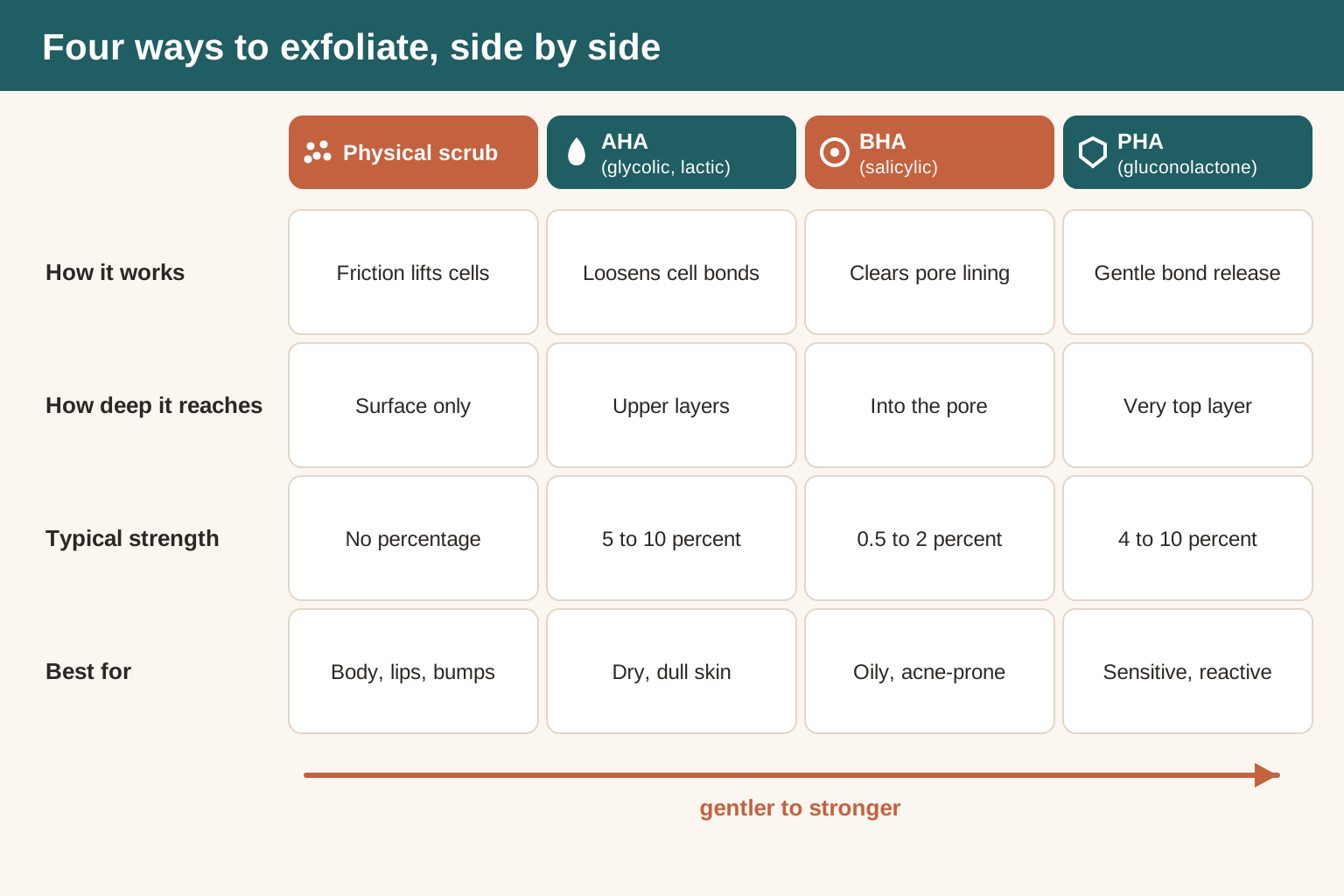
Physical exfoliants abrade dead cells off with grains or a tool, chemical exfoliants dissolve the bonds holding those cells down, and chemicals give the more even result on most faces. Pressure is the reason. A scrub only removes what your hand happens to reach, so the cheekbone gets three passes and the jawline gets one.
Sugar is the most common grain in a home-made physical scrub, and these seven DIY recipes for a sugar exfoliating scrub for lips show the 2:1:1 ratio and how often to scrub.
Physical scrubs, cloths and brushes
Particle shape matters more than particle size. Rounded jojoba spheres and rice powder roll across skin; crushed walnut shell and apricot kernel have fractured edges that cut micro-tears. A muslin cloth is the gentlest physical option and costs almost nothing. The tradeoff is control: you cannot dose friction the way you can dose a percentage. Plastic microbeads solved that once, and then the federal ban on plastic microbeads in rinse-off scrubs removed them from the shelf in 2017 on environmental grounds.
AHAs: glycolic, lactic, mandelic
Alpha hydroxy acids are water-soluble and work at the surface. Glycolic has the smallest molecule and penetrates fastest, which makes it the most effective and the most irritating. Lactic is larger, slower and humectant. Mandelic is the largest of the three and the mildest choice for reactive skin or deeper skin tones. Guidance on how to choose a face scrub covers the physical side in more depth.
BHAs and PHAs
Salicylic acid is oil-soluble, so it travels down into sebum and clears the pore lining rather than just the surface. That makes it the default for congestion; there is a separate rundown of best salicylic acid cleanser checks before you buy. Polyhydroxy acids such as gluconolactone have molecules too large to sting much, which costs speed but suits rosacea-prone skin. A scrub still wins in three places: body skin, lips, and the rough bumps of keratosis pilaris on upper arms.
Among chemical exfoliants the most common leave-on format is a toner, and knowing how to choose a glycolic acid toner means comparing its strength and pH before you commit.
How often should you exfoliate, by skin type?
Most faces do best on one to three exfoliation sessions a week: oily skin tolerates three, normal and combination skin two, dry and sensitive skin one. Sebum output and barrier thickness set the ceiling, not willpower, and pushing past it produces the opposite of the result you wanted.
Children's skin is still maturing, so before the teen years follow kids skin care routines by age rather than borrowing these adult exfoliation frequencies.
| Skin type | Sessions per week | Acid family | Starting strength |
|---|---|---|---|
| Oily | 3 | BHA (salicylic) | 2% |
| Combination | 2 | BHA or AHA | 2% salicylic or 5% lactic |
| Normal | 2 | AHA (glycolic) | 5% |
| Dry | 1 | AHA (lactic) | 5% |
| Sensitive | 1 | PHA or mandelic | 4% mandelic |
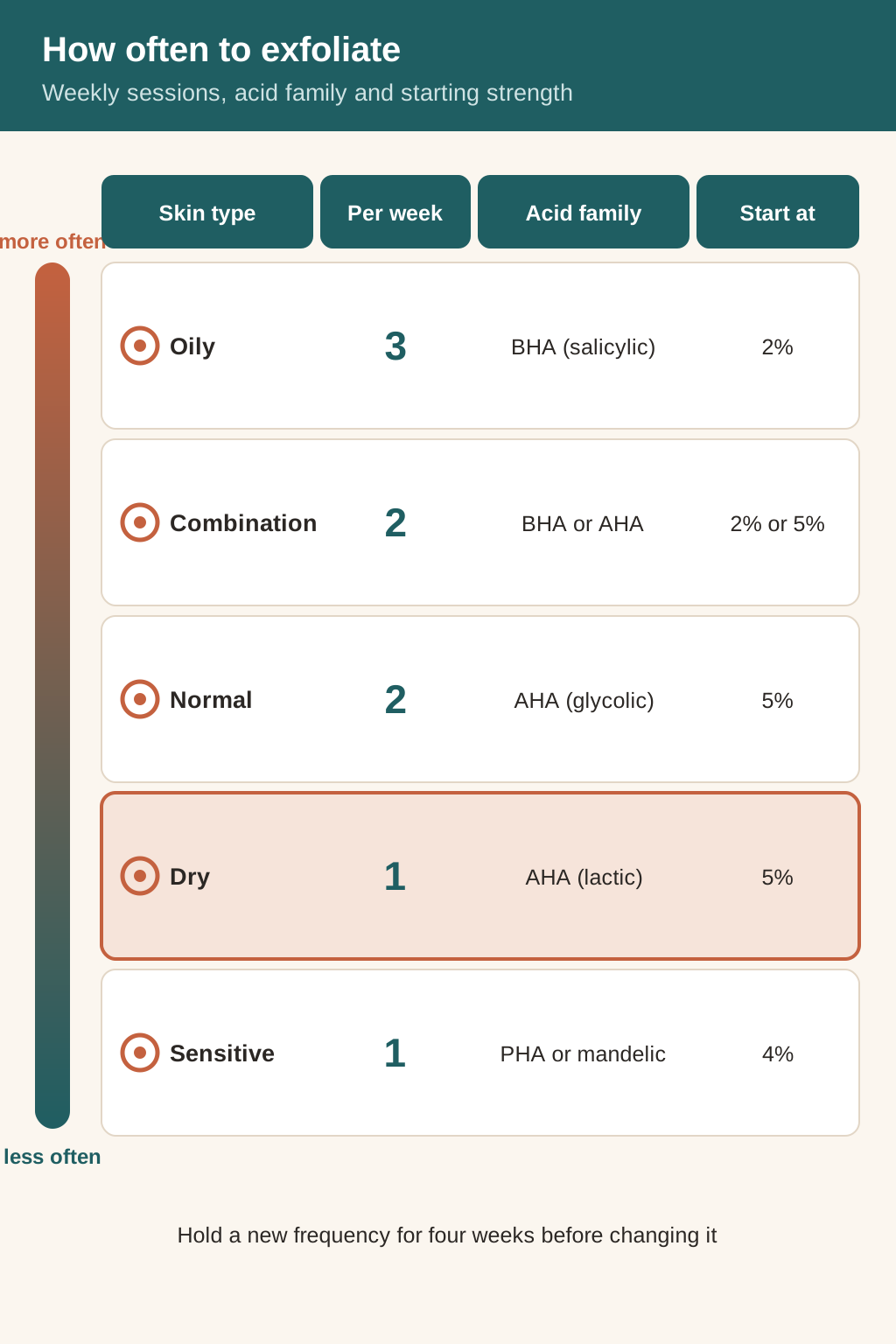
Doubling frequency does not double turnover. Desquamation is enzyme-limited, so a second weekly session removes far less than the first one did while delivering the same full dose of irritation. The honest cost of a three-times-a-week habit is a barrier you must actively maintain with richer moisturizer and strict sunscreen.
Board-certified dermatologists put it the same way in dermatologist guidance on exfoliating safely at home: the more aggressive the method, the less often it belongs in your week. Add a session only after four uneventful weeks at your current pace, and hold the new frequency for a month before judging it. Reactive skin should stay at one and treat that as the destination, not a stage; the rules for calmer sensitive skin apply in full here.
How do you exfoliate at home without overdoing it?
Cleanse first, spread one thin layer of exfoliant over dry skin, respect the label's contact time, then seal with moisturizer and, the next morning, sunscreen. Four steps, in that order, on an evening when nothing else active is going on your face.

- Cleanse and dry fully. Damp skin absorbs acids faster and unevenly. Wait 60 seconds after towelling off.
- Dose onto a cotton pad. A saturated pad spreads a thinner, more even film than fingertips, which tend to load the cheeks and starve the perimeter.
- Respect contact time. Leave-on acids stay put. Rinse-off peels come off at the stated minute, not when you remember.
- Moisturize while skin is still slightly damp, then add sunscreen the following morning.
Scrubs run on a different clock: 60 seconds of light circular motion, fingertips only, no pressure. Pressure is the real risk, not duration, and a fine-grain scrub used gently beats a coarse one used carefully. The ordering logic behind the whole evening is covered in skincare order and what goes first.
Three things stay off the face on an exfoliation night: retinoids, benzoyl peroxide and high-strength vitamin C. Each is a separate irritation pathway, and stacking them is how people end up with a stinging barrier in a week. Move retinoids to alternate evenings instead, as set out in the retinol serum guide.
Sunscreen the morning after is non-negotiable. FDA testing found UV sensitivity rose 18 percent after four weeks of AHA use and stayed elevated for about a week after stopping, which is why alpha hydroxy acid labels carry a sunburn alert matters more than the acid percentage. Use SPF 30 or higher; a daily broad-spectrum sunscreen is the cheapest insurance on the shelf.
What is the best exfoliator for dry skin?
The best exfoliator for dry skin is a low-strength lactic or mandelic acid used once a week, because both acids hold water in the stratum corneum while they loosen dead cells. Lactic acid is a natural moisturizing factor as well as an exfoliant, so it does two jobs in one pass.
Start at 5 percent lactic acid and stay there for a month. At 10 percent the exfoliation is faster and the sting is real on skin that already feels tight. Mandelic acid at 4 to 5 percent is the slower alternative: the molecule is roughly twice the size of glycolic, so it penetrates gradually and rarely flares redness.

Gritty scrubs make dry flaking look worse, not better. Dehydrated skin sheds in sheets rather than single cells, and friction lifts the edge of a sheet without removing it, leaving a rough patch that catches makeup. Acid dissolves the whole sheet evenly.
Every exfoliation night should end with an occlusive cream rather than a light lotion, and the difference between the two is explained in lotion for dry skin that works. A humectant serum layered underneath helps, though it needs an occlusive on top to hold anything; the hyaluronic acid serum things to check first explain why. Who this is not for: anyone whose dryness comes with active eczema, where acids belong nowhere near the flare.
Does exfoliating clear acne, and what is the best exfoliator for acne face?
Salicylic acid at 2 percent is the best exfoliator for acne face because it is oil-soluble and clears the pore lining, though it will not resolve deep inflammatory cystic acne. It is comedolytic, which means it prevents the plug from forming, and it is the only common exfoliant that reaches inside the follicle.
Two percent is the over-the-counter ceiling in a leave-on, and clinical peels run from 20 to 30 percent under supervision. A 60-second salicylic cleanser is the gentler entry point: contact time is short, so congestion-prone skin can use it daily without the sting of a leave-on liquid.
Can you exfoliate pimples directly?
No. If you try to exfoliate pimples by scrubbing an inflamed lesion, pressure ruptures the follicle wall below the surface, spreads bacteria sideways into neighbouring pores and leaves a red or brown mark that outlasts the spot by months. Treat the whole zone with a leave-on acid and leave the individual lesion alone.
When salicylic acid is the wrong pick
Azelaic acid at 10 percent is the swap when salicylic stings or when post-acne marks are darkening, because it inhibits tyrosinase as well as clearing the follicle. And acne that arrives as deep, painful nodules is not an exfoliation problem at all: cysts sit below the level any topical acid reaches, and they need a prescription retinoid, hormonal treatment or oral isotretinoin.
Pair any acid with a non-comedogenic moisturizer, since drying skin out triggers more oil, not less; the picks in moisturizer for acne prone skin are built for that. Keep the cleanser mild too, as set out in face wash for oily skin. The cost of this routine is patience: comedolytic results take eight to twelve weeks.
Over-exfoliation: the warning signs and the repair plan
Over-exfoliated skin turns tight, shiny, stingy and reactive to products that never bothered it, and it recovers over two to four acid-free weeks with bland moisturizer and daily sunscreen. The shine is the clue people misread: it is light bouncing off a thinned, flattened surface, not oil.
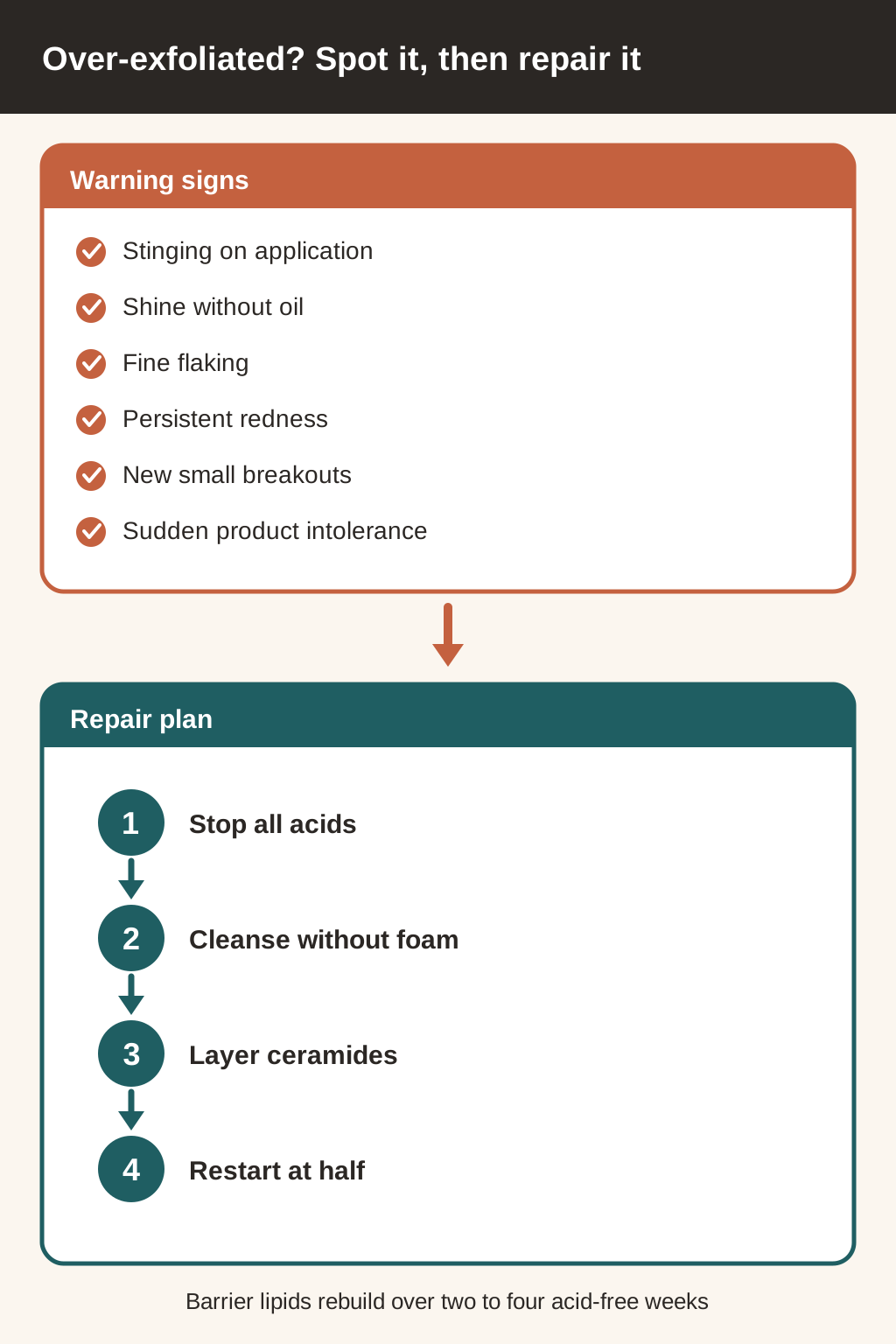
- Stinging when a product goes on, especially around the nose
- Shine without any greasiness to the touch
- Fine, papery flaking that reappears within hours
- Redness that does not settle overnight
- New small breakouts in places you do not usually get them
- Sudden intolerance of products used for months
The repair plan is four moves. Stop every acid, scrub and retinoid on day one. Switch to a non-foaming cleanser, because sulfates strip what is left. Layer a ceramide-rich moisturizer morning and night. Wear broad-spectrum SPF 30 daily, and choosing an SPF moisturizer for daily sun protection makes that one step instead of two.
Barrier lipids rebuild on a two-to-four week cycle, which is why a long weekend off changes nothing and a month changes everything. Restart at half your previous frequency and hold it for four weeks before adding anything back. Lips deserve the same restraint, and exfoliating lips without damage sets out how little they need.
One practical exfoliation tip a week, plus the products worth skipping.
One exfoliation tip a week, plus what to skip. No product dumps.
Thanks — you're on the list.


