

An exfoliating scrub is a rinse-off face scrub that lifts dead corneocytes with physical grit, chemical acids, or both. The American Academy of Dermatology advises about 30 seconds of gentle circular motion, lukewarm water, and one to three sessions weekly, fewer if a facial scrub leaves skin red.
What Is an Exfoliating Scrub and What Does It Actually Remove?
An exfoliating scrub is a rinse-off cleanser carrying abrasive particles, acids or enzymes that loosen dead cells from the outermost skin layer, the stratum corneum. The base is usually a mild surfactant or a cream, and the particles are suspended in it so they travel across skin rather than sit on it.
Healthy skin already sheds itself. A full turnover cycle runs roughly 28 days in your twenties and stretches past 40 days by your fifties, which is why dullness creeps in with age even when nothing else about your routine changes. A scrub shortens the last stage of that cycle by force.

What it removes is limited: dead corneocytes, surface sebum and the residue that dulls light reflection. It does not reach the plug inside a blackhead, the pigment under an old mark, or the collagen layer where lines form. Claims beyond the surface are marketing.
A facial scrub is also milled finer than a body scrub, because facial skin is roughly half the thickness of skin on the back and its barrier — measurable as research measuring skin barrier strength through transepidermal water loss — takes longer to recover after abrasion. For a softer starting point, see Gentle face scrub guide: choosing a face exfoliator.
Physical Face Scrub or Chemical Exfoliant: Which Belongs in Your Routine?
A physical scrub gives instant smoothness you control by pressure, while a chemical exfoliant delivers a fixed, more even dose set by concentration and pH. That single difference decides most of what follows.
If you would rather take that fixed chemical dose in a leave-on step than a rinse-off scrub, start by choosing a glycolic acid toner, comparing 5-10% strengths, pH and use frequency.
Grit is honest about its results and dishonest about its dose. You feel the polish immediately, but the depth of the exfoliation depends on how hard you pressed, how long you worked, and how wet your skin was. Two people using the same jar can land at very different places.
Acids remove that variable. Glycolic, lactic and salicylic acids break the bonds between corneocytes, so the strength is written on the carton instead of decided by your hand. The tradeoff is a delay: results build over two to four weeks rather than in one rinse.
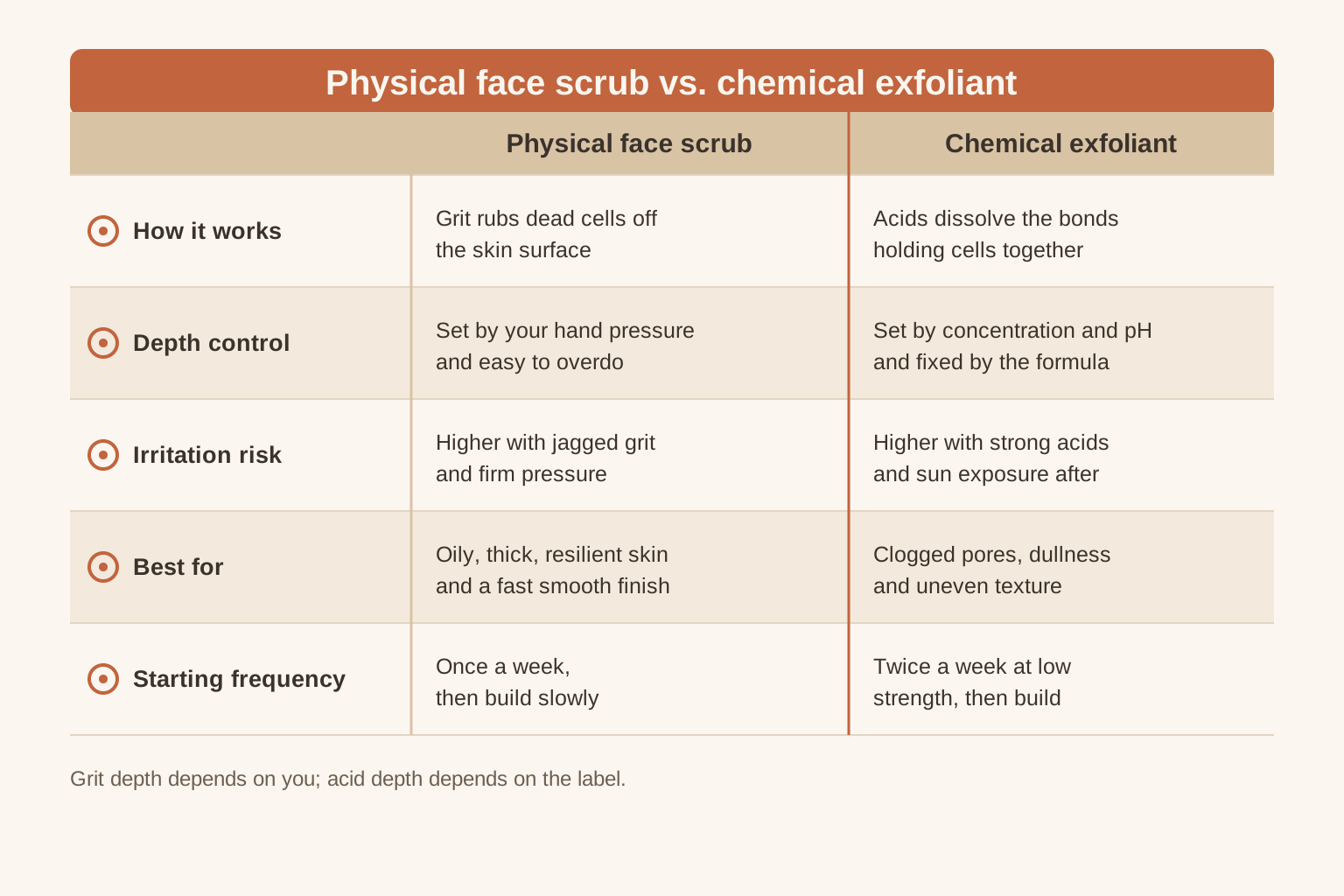
Strength has a documented ceiling. Regulatory guidance on alpha hydroxy acids treats consumer products as safe at 10 percent AHA or less with a pH of 3.5 or greater, alongside daily sun protection — after four weeks of AHA use, tested volunteers burned 18 percent faster.
Combination formulas that suspend soft grit in a low-strength acid suit oily skin that wants one step instead of two. They are a poor choice if your skin already stings from a vitamin C serum. Oily, breakout-prone skin often does better with a salicylic wash instead: Best salicylic acid cleanser: 7 checks before you buy.
How Do You Match a Face Scrub to Your Skin Type?
Match grit strength to oiliness and irritation threshold: firm grit for oily skin, cream-base scrubs for dry skin, enzymes or a washcloth for sensitive skin. Skin type sets the ceiling; technique only decides whether you stay under it.
The same skin-type logic extends past scrubs to acids and enzymes, and a full breakdown of how to exfoliate skin safely by type names strengths and frequencies for dry and acne-prone faces.
Oily and thick skin
Sebum-heavy skin holds dead cells in place, so it tolerates firmer particles and gel bases that rinse clean. A scrub blended with 0.5 to 2 percent salicylic acid clears the pore lining at the same time. The limit: oily skin still flushes if you scrub daily.
Dry and flaky skin
Dry skin needs the vehicle more than the grit. A cream or butter base deposits emollients as it rinses, so you finish softer instead of squeaky. Foaming scrubs built on sulfates strip the lipids that were holding what moisture you had.
Sensitive and rosacea-prone skin
Reactive skin usually does better with an enzyme powder or a damp washcloth than with any particle. Papain and bromelain digest surface protein without friction. Not a fit if you want instant polish — enzymes feel like nothing at all, which many people read as failure.
Deeper skin tones
American Academy of Dermatology guidance on exfoliating safely at home warns that aggressive methods can trigger post-inflammatory hyperpigmentation in richly pigmented skin — a dark mark that outlasts the roughness you were treating by months. Gentler and less often is the safer default.
What Should You Check on a Facial Scrub Label Before Buying?
Score any facial scrub on six label points: grit shape, acid concentration, pH disclosure, cleansing base, fragrance position and the frequency the brand itself states. Read the jar against this rubric in the aisle and you will reject most of the shelf in under a minute.
| Check | Green light | Walk away |
|---|---|---|
| Grit shape | Jojoba beads, sugar, rice powder, cellulose | Walnut shell, apricot kernel, crushed pits |
| Acid concentration | A stated percentage, 10% AHA or less | "With fruit acids" and no number |
| pH disclosure | pH printed, 3.5 or higher on an acid formula | Acid claimed, pH never mentioned |
| Cleansing base | Cream, oil or a mild non-sulfate surfactant | Sodium lauryl sulfate in the first five |
| Fragrance position | Absent, or last in the ingredient list | Fragrance or alcohol denat. in the top third |
| Stated frequency | A named limit, such as twice weekly | "Use daily" on a gritty formula |
Grit shape is the check most people skip and the one that does the damage. Nut shells and fruit pits fracture into jagged edges under pressure; jojoba beads and sugar are rounded, and sugar dissolves as it works, so the abrasion tapers off instead of building.
Plastic microbeads are no longer a choice to make. United States law removed them from rinse-off cosmetics, with manufacture banned in July 2017 and retail sales in July 2018, so the real decision now sits between mineral grit, botanical grit and dissolving grit.
Fragrance and denatured alcohol raise the irritation ceiling of an exfoliating scrub because you are applying them to skin you just made more permeable. On an acid formula, check the percentage against published alpha hydroxy acid limits. For the gentle end of the shelf, start with Gentle face scrub guide: choosing a face exfoliator.
How Often Should You Use an Exfoliating Scrub?
Most skin types handle an exfoliating scrub one to three times a week, and sensitive skin often tops out at once every seven to ten days. Frequency, not product choice, is what separates smooth skin from a damaged barrier.
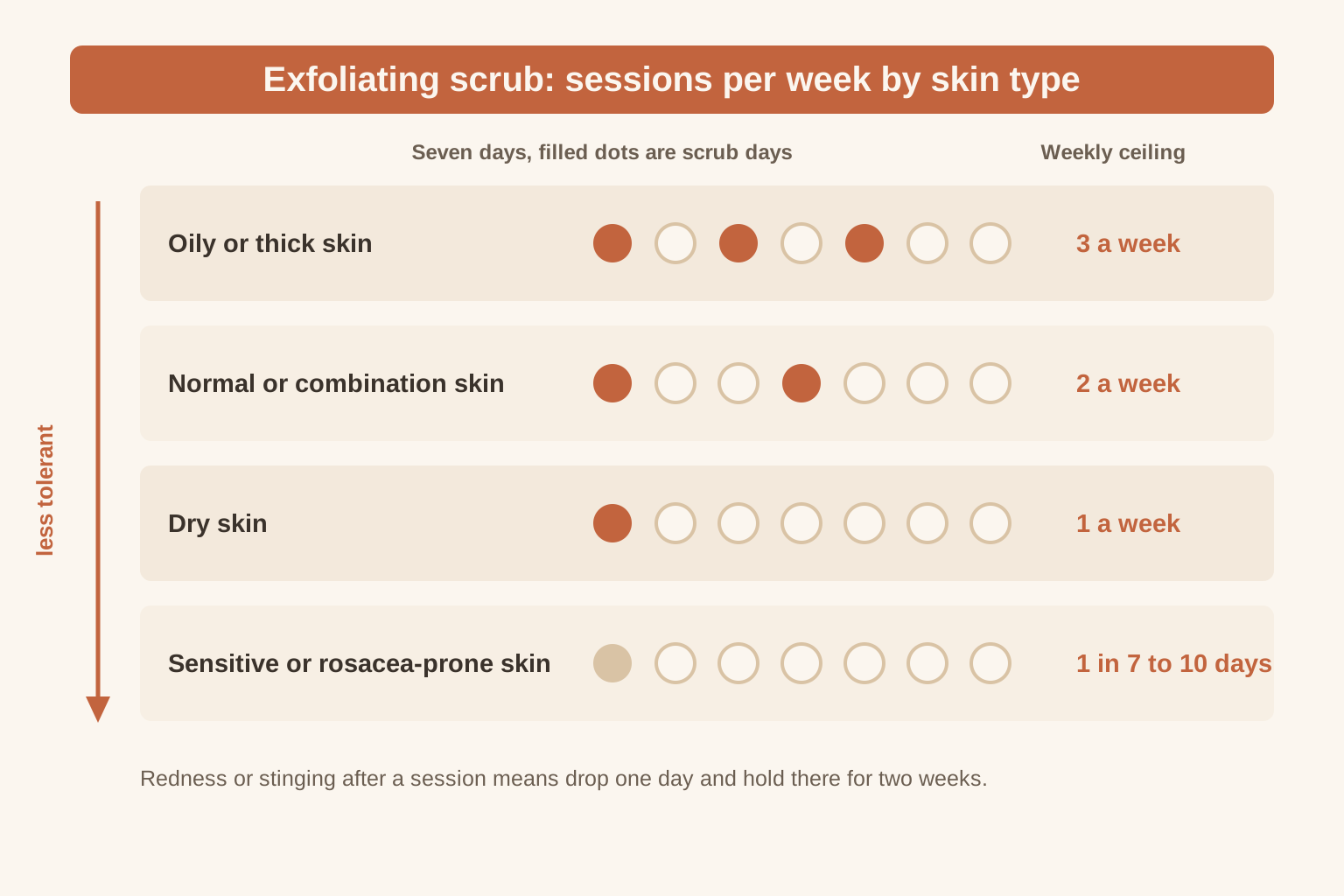
The governing rule is aggressiveness: American Academy of Dermatology guidance on exfoliating safely at home holds that the stronger the method, the less often it should be used. A coarse scrub plus a 10 percent acid is two aggressive methods, so they need separate nights, not a shared one.
Season changes the answer too. Barrier strength measured as research measuring skin barrier strength through transepidermal water loss shifts across the year, rising in summer heat and humidity. Dropping from two sessions to one through a cold, dry winter is a reasonable adjustment.
Placement matters as much as count. Exfoliate on clean, damp skin after cleansing and before any treatment serum, then moisturize. For the full sequence, see Skincare order: 9 steps and what goes first.
How Do You Use a Face Scrub Without Damaging Your Skin?
Work a pea-sized amount over damp skin for about 30 seconds in light circles, rinse with lukewarm water, then moisturize while the skin is still damp. The whole thing should take under two minutes.
- Start on damp skin. Cleanse first with your usual cleanser, then leave the face wet so the particles glide rather than drag.
- Use a pea-sized amount. More product spreads the same number of particles thinner; it does not exfoliate more.
- Thirty seconds, light circles. Fingertips only, no palm pressure, no washcloth on top.
- Rinse lukewarm. Hot water compounds the flush, so keep it tepid and pat dry instead of rubbing.
- Moisturize while damp. Applying within a minute of patting dry traps the surface water you just added.
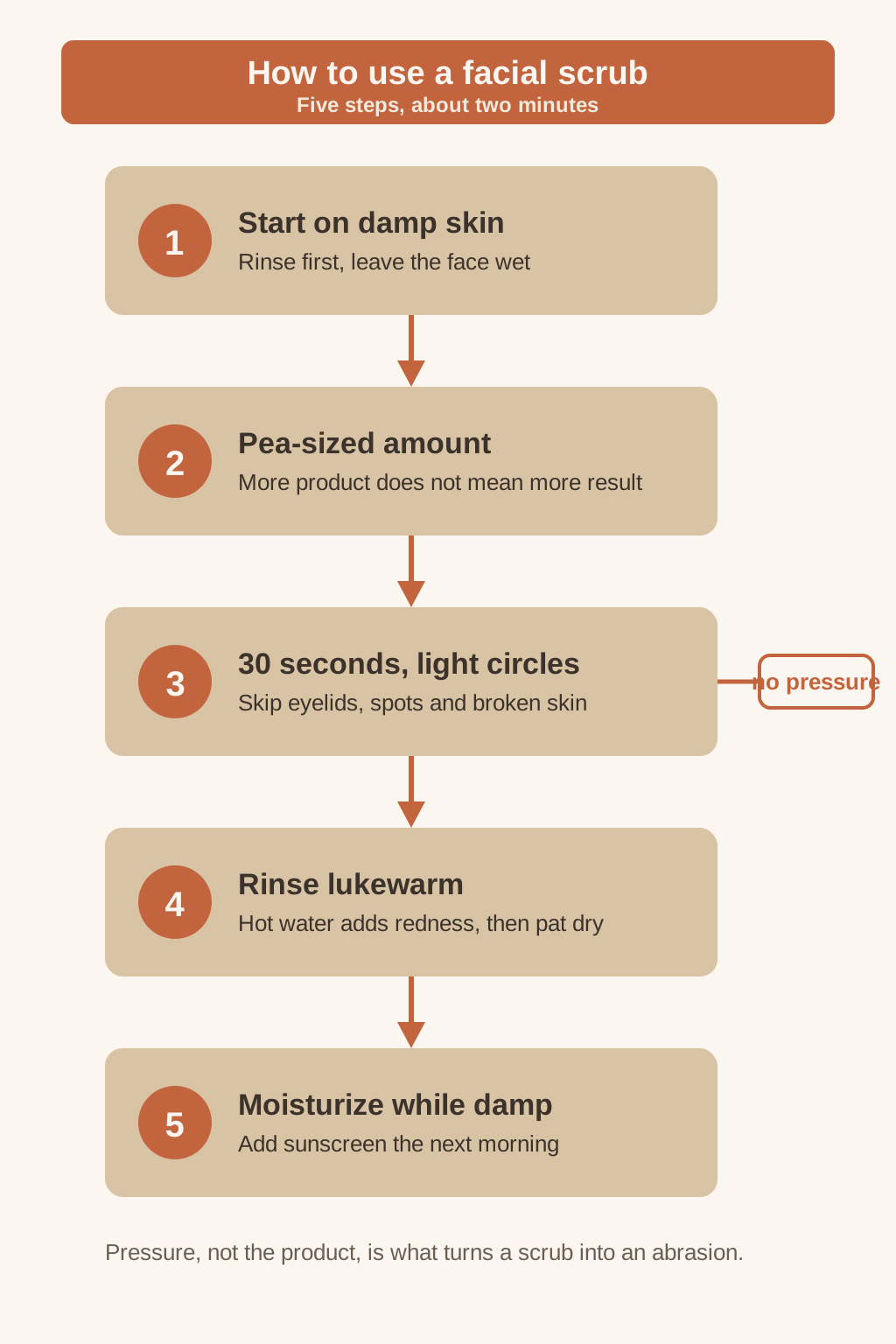
Pressure is the variable that turns a safe product into an abrasion. Dermatologist rules for washing your face without scrubbing is blunt about it: scrubbing irritates skin, and lukewarm water beats hot. The same rule applies with grit in your hand.
Skip the eyelids, active breakouts, sunburn and any broken skin entirely — eyelid skin is around 0.5 mm thick and has no margin for friction. Sunscreen the following morning matters more after an acid-containing scrub, because UV sensitivity stays elevated for about a week. Pair the routine with the right cream: Face moisturizer buying guide for every skin type.
What Are the Signs You Over-Exfoliated, and How Do You Recover?
Over-exfoliated skin stings from familiar products, looks shiny and tight rather than smooth, and needs one to two weeks with no scrub or acid to settle. The earliest signals are easy to misread as progress.
- Early: tightness within a minute of cleansing, a waxy rather than dewy shine, stinging from a serum you used comfortably last month.
- Later: redness that outlasts the shower by hours, flaking that returns within a day of removing it, small rough bumps along the jaw and hairline.
Recovery is a subtraction, not an addition. Stop every exfoliating scrub, acid and retinoid for seven to fourteen days, wash once daily with a non-foaming cleanser, and layer a bland moisturizer twice a day. Dermatologist rules for washing your face without scrubbing covers the technique for that stretch.
Reintroduce one product at a time, starting with the mildest, and test it on one cheek for three nights before taking it back to the whole face. Choosing a richer daily cream helps too: Face moisturizer buying guide for every skin type.
Are DIY Sugar and Coffee Scrubs Safe to Use on Your Face?
Fine sugar in a bland oil base is the safest homemade face scrub, while salt, coffee grounds and crushed shells stay too sharp for facial skin. The kitchen can produce a usable exfoliant; it cannot produce a controlled one.
Lips tolerate that same fine sugar far better than facial skin, so if you want to mix your own, follow a sugar exfoliating scrub for lips recipe instead.
Sugar earns its place because it dissolves. Caster sugar in jojoba or sunflower oil starts as a mild abrasive and turns into a slip agent within 20 seconds, which caps how much friction you can deliver even if you press too hard.
Coffee grounds, sea salt and crushed nut shells never soften. They hold their edges for the whole application, and salt additionally draws water out of the surface. Those belong below the neck, where skin is thicker and recovers faster.
A homemade facial scrub also has no preservative system. Oil and sugar with no water can sit for a couple of weeks, but anything containing yogurt, honey diluted with water, or fruit pulp grows bacteria within days and belongs in the refrigerator with a hard three-day limit.
A shop-bought exfoliating scrub wins on the two things a kitchen cannot control: particle size consistency and pH. If you want the convenience without the guesswork, a ready-made sugar scrub does the same job on a stable base. Lips follow different rules: Lip exfoliation without damage: picking a sugar treatment.
One practical routine tip lands in your inbox each week, with no product dumps.
One skincare routine tip a week. No product dumps, no hype.
Thanks — you're on the list.


