

Timeless 20% Vitamin C + E Ferulic delivers the same antioxidant trio as SkinCeuticals C E Ferulic for $27.95 per 1 oz bottle, and it is the better buy for most skin. C E Ferulic still owns the evidence: 15% L-ascorbic acid, 1% vitamin E and ferulic acid doubled UV photoprotection in a 2005 Journal of Investigative Dermatology study.
What is in the timeless vitamin c serum?
The timeless vitamin c serum is a 20% L-ascorbic acid solution stabilized with vitamin E and ferulic acid, sold at $27.95 for a 1 oz bottle. The same formula comes in 1.7 oz and 4 oz sizes, which is unusual in this category and the reason the cost per milliliter undercuts almost every pharmacy alternative.
Three ingredients do the work. L-ascorbic acid is the form of vitamin C with the deepest research record. Vitamin E sits in the oil phase and recycles spent ascorbic acid. Ferulic acid lowers the pH the solution needs and slows the oxidation that turns the liquid brown.
That trio is why timeless 20 vitamin c behaves like a true 20 vitamin c serum rather than a gentler derivative such as sodium ascorbyl phosphate or ascorbyl glucoside. Derivatives are more stable and less irritating, but they have to convert in the skin first, and conversion rates are modest.
Pure L-ascorbic acid demands more from the packaging than from the shopper. It degrades on contact with air, warmth and light, so amber glass, a dropper that seats tightly and a closed cupboard protect your money better than any percentage printed on the front label. Readers searching suero de vitamina c land on this same 20% L-ascorbic acid formula under its English name, so the ingredient list is the only thing worth comparing across regions.
If you want the wider field before you commit to one bottle, our guide to dermatologist-approved vitamin C serums for your face sets this formula against the rest of the shelf. The chemistry behind the low pH is documented in the dermatology literature on how topical vitamin C penetrates skin below pH 3.5, which also explains why concentrations under 8% do very little.

How does ce ferulic compare with a 20 ascorbic acid serum?
C E Ferulic runs 15% L-ascorbic acid with 1% vitamin E and ferulic acid and has published photoprotection data; a 20% serum carries more active but not more proven benefit. That is the whole comparison in one sentence, and the detail underneath it decides which bottle belongs on your shelf.
The 15% ratio is the one that was actually tested. Adding ferulic acid to 15% L-ascorbic acid with 1% alpha-tocopherol improved the chemical stability of both vitamins and lifted photoprotection from roughly fourfold to eightfold, measured by redness and sunburn cell counts. Researchers reported that ferulic acid doubled the photoprotection of vitamins C and E in human skin, and no 20% formula carries an equivalent published result.
A 20 ascorbic acid serum carries a third more active per drop, which sounds decisive and is not. Absorption through the stratum corneum peaks around 20% and then falls as concentration climbs further, so 20% is a ceiling rather than a step on a ladder. The extra five points buy you tolerance risk, not extra delivery.
Both formulas live in the same acid range. The stabilized-ascorbic-acid patent that defines the ce ferulic acid class caps pH at about 3.5 and aims for 2.5 to 3.0, because the uncharged molecule crosses the barrier and the charged one does not. Read the patented stabilized ascorbic acid composition behind the formula and the sting an ascorbic acid vitamin c serum produces on thin or compromised skin stops being a surprise.
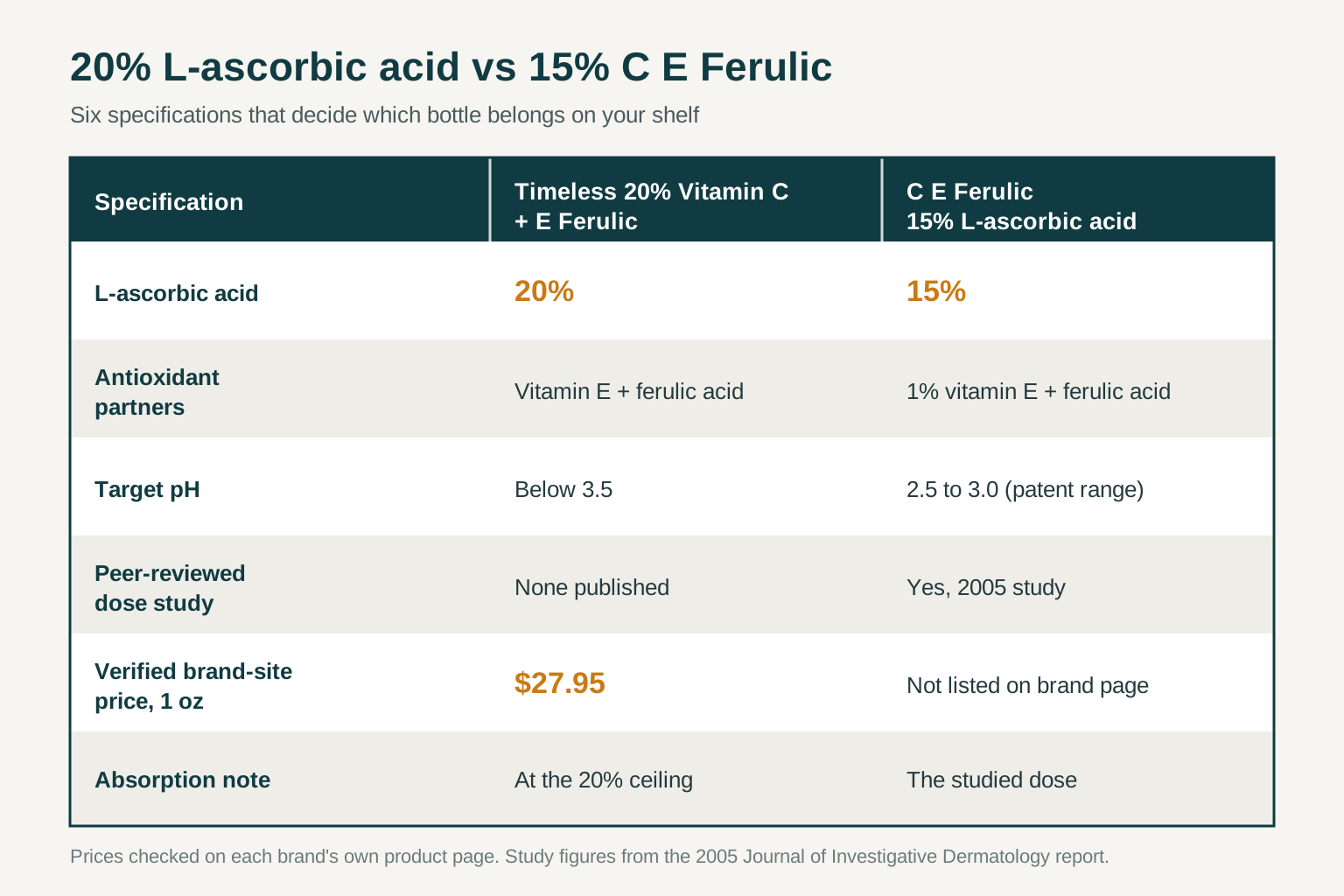
So vitamin c 15 formulas and 20% formulas diverge on tolerance and on cost per milliliter, not on mechanism. Set the vitamin c e ferulic acid serum comparison out row by row and six lines decide it: active strength, 20% against 15%; antioxidant partners, vitamin E and ferulic acid in both; target pH, under 3.5 in both; a peer-reviewed dose study, yes for the 15% ratio and no for the 20%; verified brand-site price, $27.95 for 1 oz against a figure SkinCeuticals does not publish on its own product page; and the absorption note, 20% at the ceiling against 15% as the studied dose. If you are weighing actives rather than brands, choosing a facial serum by active and strength is the wider framework.
What do skinceuticals c e ferulic reviews actually report?
Across retailer and forum reviews, owners report brighter, more even tone in four to six weeks, a distinctive sulfurous smell, and real resistance to the repeat purchase price. Those three themes repeat with unusual consistency across skinceuticals c e ferulic reviews on retailer pages, dermatology forums and long-form Reddit write-ups.
Those owner reports line up with the vitamin c serum benefits you can expect from L-ascorbic acid, from fading dark spots to less dullness, and the timeline each change usually follows.
The brightness claim holds up best. Reviewers who stayed consistent for a full bottle describe a more even skin tone and faded brown patches rather than smoother texture. The smell, often compared to hot dogs, comes from the formula's sulfur-bearing ingredients and fades on the skin within a minute or two.
Price fatigue is the other constant. A 30 ml bottle lasts most people eight to ten weeks at three to four drops a day, which turns a single purchase into a recurring cost. Plenty of long-term users say they switched to a cheaper 20% formula and could not see the difference in the mirror.
What a before-and-after photo can and cannot show
Ce ferulic reviews that include a skinceuticals c e ferulic before and after photo usually show pigment fading, not wrinkle reversal. Pigment changes photograph well because they are differences in color. Fine lines photograph badly, because lighting angle and facial expression move a crease more than any serum does in twelve weeks.
A single skinceuticals ce ferulic serum review also cannot tell you how a formula behaves on your barrier, your climate or your routine. That is why skinceuticals vitamin c reviews cluster around two measurable things: how much the acid stings on day one, and how fast the liquid darkens in the bottle.
The honest limitation is a gap in the evidence, not in the reviews: no published head-to-head trial compares the 15% ferulic formula against a 20% competitor on the same faces. Anyone claiming a winner from clinical data is overreading it. For the ingredients with the strongest wrinkle evidence, see anti aging serum ingredients that reduce wrinkles.
Which vitamin c with ferulic acid serum is the better buy for your skin?
Buy the 15% ferulic formula if your skin tolerates acids and you want the studied ratio; buy the 20% bottle if price per milliliter is what keeps you consistent. Consistency is the variable that actually decides results, because vitamin C only works on the days you apply it.
Pay for the 15% formula when two things are true: your skin already handles low-pH products without flushing, and the published photoprotection data matters to you enough to justify roughly six times the cost per milliliter. It is not the right buy if rationing an expensive bottle makes you skip mornings.
Choose a 20% bottle when cost per milliliter decides your habit. A bottle you finish in three months beats a bottle you ration for nine, and the larger sizes make the arithmetic plainer. The tradeoff is real: 20% at a low pH stings more on dry, rosacea-prone or freshly exfoliated skin.
A third group should skip both. If acids reliably leave you red, start with a ferulic serum at 8 to 10% or a derivative formula and build tolerance over a month. The best budget vitamin c serum argument is plain arithmetic: a $28 bottle used daily for twelve weeks delivers more total active to your face than a $180 bottle used twice a week.
One thing neither price band escapes. Ce ferulic vitamin c formulas and their cheaper twins share the same oxidation clock once the dropper is opened, so a discounted bottle you cannot finish in three months is not a saving. If L-ascorbic acid stings no matter the strength, what niacinamide does for oily and sensitive skin is the gentler route to a more even tone.
Can the best vitamin c serum for acne scars fade dark marks?
Vitamin C fades flat post-acne dark marks by blocking tyrosinase, usually visible at eight to sixteen weeks, but it cannot raise or fill a pitted scar. The distinction matters more than any product choice, because the two problems have different mechanisms and different solutions.
Flat brown or grey marks left after a healed spot are pigment: melanin that stayed behind after the inflammation cleared. Vitamin C interacts with the copper ions at the tyrosinase active site and slows melanin synthesis, which is the mechanism described in the systematic review of vitamin C inhibiting tyrosinase and melanin formation. Pitted or rolling scars are missing dermal collagen and architecture, and no serum reaches them.
The timeline from the pigmentation literature is slow and specific: natural depigmenting agents including ascorbic acid produce moderate improvement over twelve to sixteen weeks, and only alongside daily sunscreen. Skip the SPF and new sun exposure replaces the pigment you just faded, which is why photographs taken in different seasons mislead people.
So the best vitamin c serum for acne scars is really a treatment for discoloration. For texture, the honest answers are a retinoid, a chemical exfoliant or an in-clinic procedure, and retinol strengths and how to use them at night covers the strength and night-time use that remodeling needs.
Patch test before you commit. On skin that still breaks out, apply the serum to one jawline for four nights and watch for stinging that lasts past a minute, new papules or peeling. A low-pH product on inflamed skin can set you back further than the pigment it was meant to fade.
Does a vitamin c anti wrinkle serum work on vitamin c under eye skin?
A 20% low-pH serum is too harsh for eyelid skin, so use a lower-strength or dedicated eye formula and expect tone changes over months rather than weeks. Eyelid skin is the thinnest on the face, roughly half a millimeter, with little sebum to buffer an acid.
That thinness is the whole problem with a vitamin c under eye routine built on a full-strength bottle. The sting is sharper, the flushing lasts longer, and product that migrates into the eye itself stings for several minutes. Applying less of a strong serum does not solve it, because the pH does not change with the dose.
What a vitamin c anti wrinkle serum realistically changes is tone and firmness support over months: vitamin C is a cofactor in collagen synthesis and a brake on pigment, not a filler. Crease depth responds to retinoids, sun avoidance and time, and no antioxidant reverses a line in six weeks.
Judge progress honestly or you will chase noise: one photograph a month, same window, same time of day, no smile, no flash. Shadow under the eye changes with sleep, salt and hydration, so a single bad morning is not a failed product. eye cream picks for dark circles separates pigment from vascular shadow, which decides whether any serum is the right tool.
How do you layer a ferulic acid serum in your morning routine?
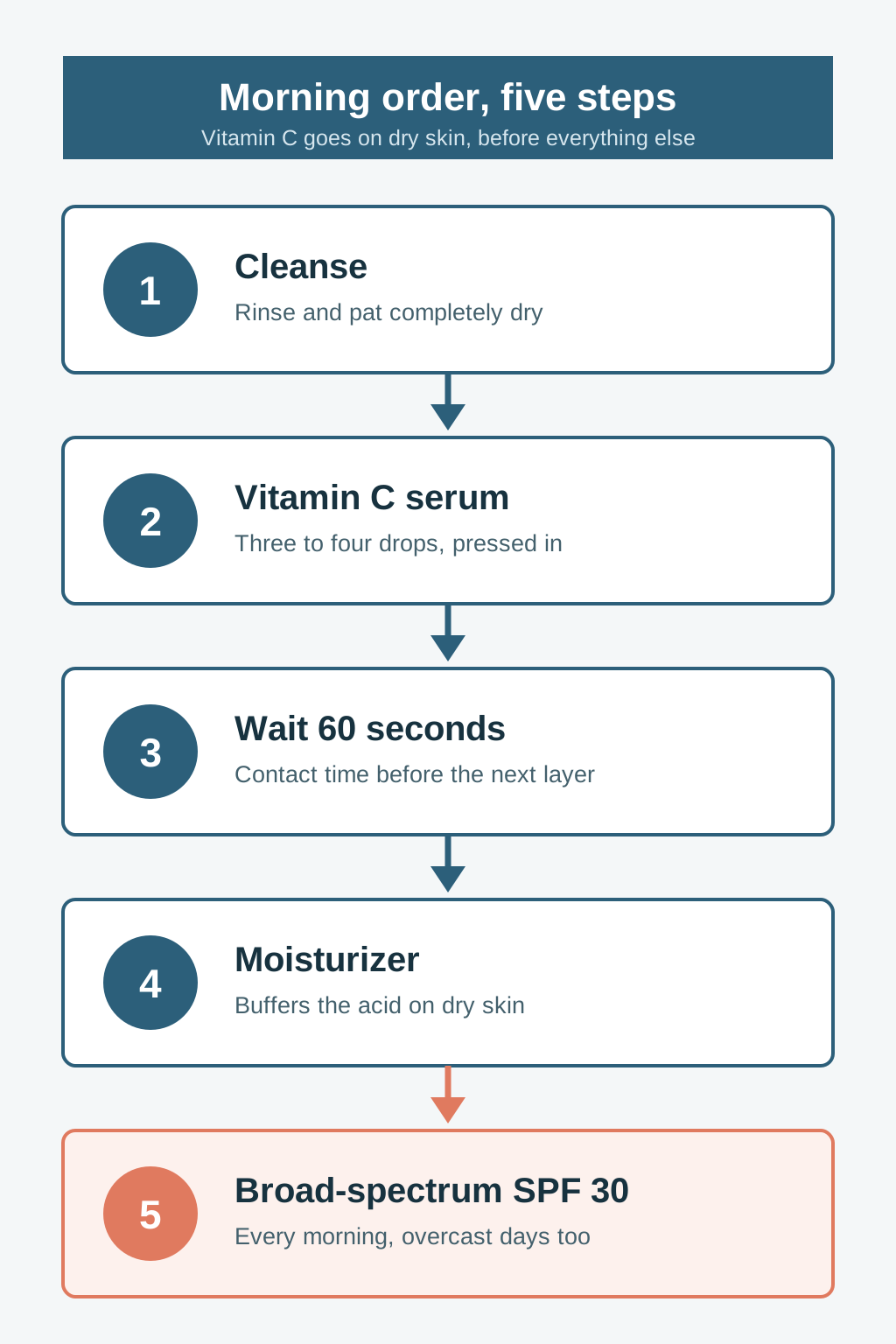
Cleanse, apply three to four drops to dry skin, wait 60 seconds, then moisturize and finish with broad-spectrum SPF 30 every morning. Five steps, in that order, and the wait is the step people skip.
- Cleanse and pat dry. Water on the skin dilutes the serum and raises its pH toward the range where L-ascorbic acid stops penetrating.
- Dispense three to four drops into a dry palm and press them over face and neck. Rubbing spreads product onto your hands instead of your skin.
- Wait 60 seconds. The acid needs contact time before anything else goes on top.
- Moisturize. On dry or reactive skin this is the step that makes a 20% serum tolerable at all.
- Finish with broad-spectrum SPF 30 or higher, every morning, including overcast ones.
A c and e serum belongs in the morning because its payoff is antioxidant defense while you are in daylight. It neutralizes some of the free radicals ultraviolet exposure generates, which is a complement to sunscreen and never a replacement for it.
Three things do not belong in the same minute: benzoyl peroxide, which oxidizes the vitamin C on contact; a fresh acid toner, which stacks acid on acid; and a retinoid, which belongs in the evening. Press your moisturizer on once the serum has had its minute, and the acid sting usually settles.
A watery vitamin c essence and a thicker serum are not interchangeable in the same slot either. An essence carries a lower concentration in a lighter base and sits closer to a hydrating step, so swapping one for the other changes the dose, not just the texture.
Sunscreen is the step that makes the antioxidant worth applying at all. Without it you spend twelve weeks fading pigment that new exposure replaces, and mineral sunscreen choices for everyday SPF is where to start if chemical filters irritate you. For the full order of a morning built around actives, see building a morning skin care routine around actives.
How do you store a vitamin c timeless bottle and spot oxidation?
Keep the bottle cool, dark and tightly closed, and replace it once the liquid turns deep amber, smells sharp or feels sticky. Storage is not a detail with this ingredient: it is most of what decides whether the last third of the bottle still works.
Air, heat and light are what degrade an L-ascorbic acid solution, and natural ascorbic acid is the least stable form in solution even when it is the most effective. The fridge door beats a sunny windowsill, and a closed cabinet beats a shower shelf where steam and warmth cycle twice a day. The evidence on why air, heat and light degrade an L-ascorbic acid solution is why packaging claims deserve as much attention as percentages.
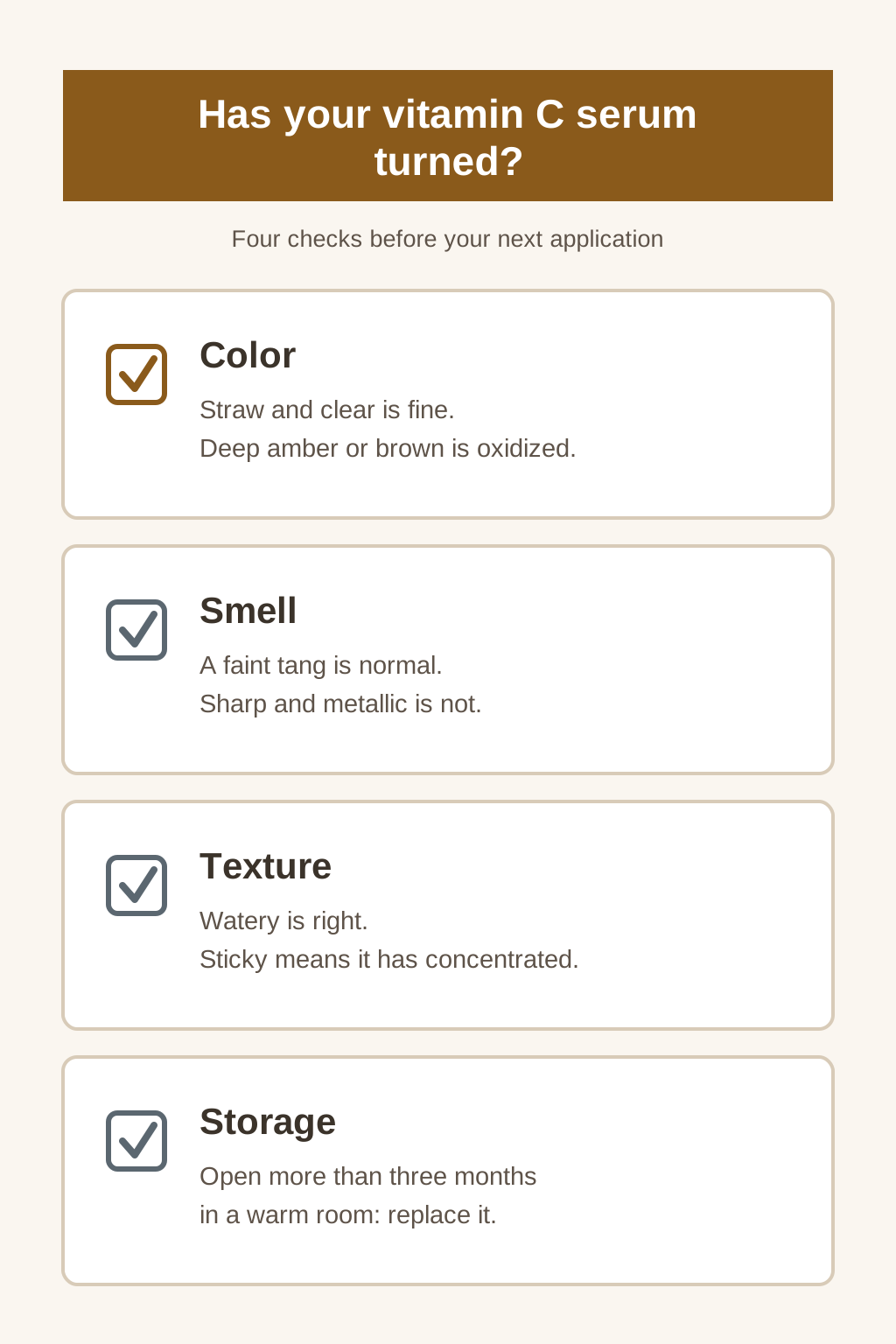
Run four checks before each application. Color: clear to pale straw is fine, deep amber or brown is oxidized. Smell: a faint tang is normal, sharp and metallic is not. Texture: watery is right, sticky means the solution has concentrated. Time: more than three months open in a warm room is reason enough to replace it.
A vitamin c timeless bottle that has gone deep amber is a sunk cost, not a salvage job. Oxidized ascorbic acid has already converted to dehydroascorbic acid and its breakdown products, and nothing in your bathroom reverses that reaction.
Which makes bottle size a real decision. Buying the smallest 20 ascorbic acid serum you will finish inside three months costs less in practice than a large bottle you waste half of, even when the per-milliliter price looks worse at checkout. the correct skincare order for layering products shows where this fits among the other products competing for the same minutes.

Where to buy timeless vitamin c and where to buy skinceuticals c e ferulic safely
Buy from the brand's own store or an authorized stockist that turns stock quickly, and check the batch date before taking any discount. With an ingredient that degrades on the shelf, freshness is a bigger variable than price.
Where to buy timeless vitamin c with a fresh batch is straightforward: the brand's own store lists all three sizes, and the large authorized retailers move enough volume that stock does not sit. A $27.95 bottle is cheap enough that chasing a few dollars through an unknown seller rarely pays.
Where to buy skinceuticals c e ferulic is a harder question, because the brand restricts distribution and counterfeits circulate. Authorized retailer lists exist for exactly this category: a professional-channel serum resold through an unverified storefront has no traceable storage history.
A skinceuticals c e ferulic sale is usually a gift-with-purchase or a retailer promotion rather than a cut price on the serum itself, so read what is actually discounted and check the batch date before you stock up on two bottles you will not finish. The marketplace trap is the same in both cases: third-party listings with unknown storage history, where a bottle may have spent a summer in a warehouse.
One evidence-checked skincare tip a week, written the way this guide is.
One evidence-checked skincare tip a week. No product dumps.
Thanks — you're on the list.
