

A vitamin C serum is a water-based leave-on treatment that delivers L-ascorbic acid, usually at 10-20%, into the skin, where it neutralizes free radicals, blocks excess melanin and signals collagen production. Used every morning under sunscreen, it visibly fades dark spots and dullness in about 8 to 12 weeks.
What is a vitamin C serum, and what is vitamin c serum good for?
A vitamin C serum is a low-pH leave-on formula built around ascorbic acid that neutralizes free radicals and switches on collagen-building enzymes in the skin. The water-thin texture and the pH below 3.5 are not styling choices: ascorbic acid only crosses the skin barrier in its unionized form, which needs that acidity. A moisturizer with a splash of citrus extract does none of this.
Two jobs explain every claim made for vitamin c for skin. First, the molecule donates electrons, so it quenches the free radicals that UV light and pollution generate before they oxidize lipids and DNA. Second, it is the cofactor that prolyl and lysyl hydroxylase enzymes cannot build stable collagen without — no vitamin C, no cross-linked collagen triple helix.
That makes a serum a daily maintenance active, not a two-week treatment. For anyone shopping vitamin c skincare, the printed percentage and the packaging matter more than the marketing copy.
Absorption drops off sharply outside a narrow strength and pH window, as research on vitamin C concentration and skin absorption sets out.
For a shortlist instead of a chemistry lesson, our dermatologist-approved vitamin C serum picks cover formulas by skin type. The cost is real: putting ascorbic acid on face skin daily means a new bottle every few months.

What does vitamin c serum do for your face day to day?
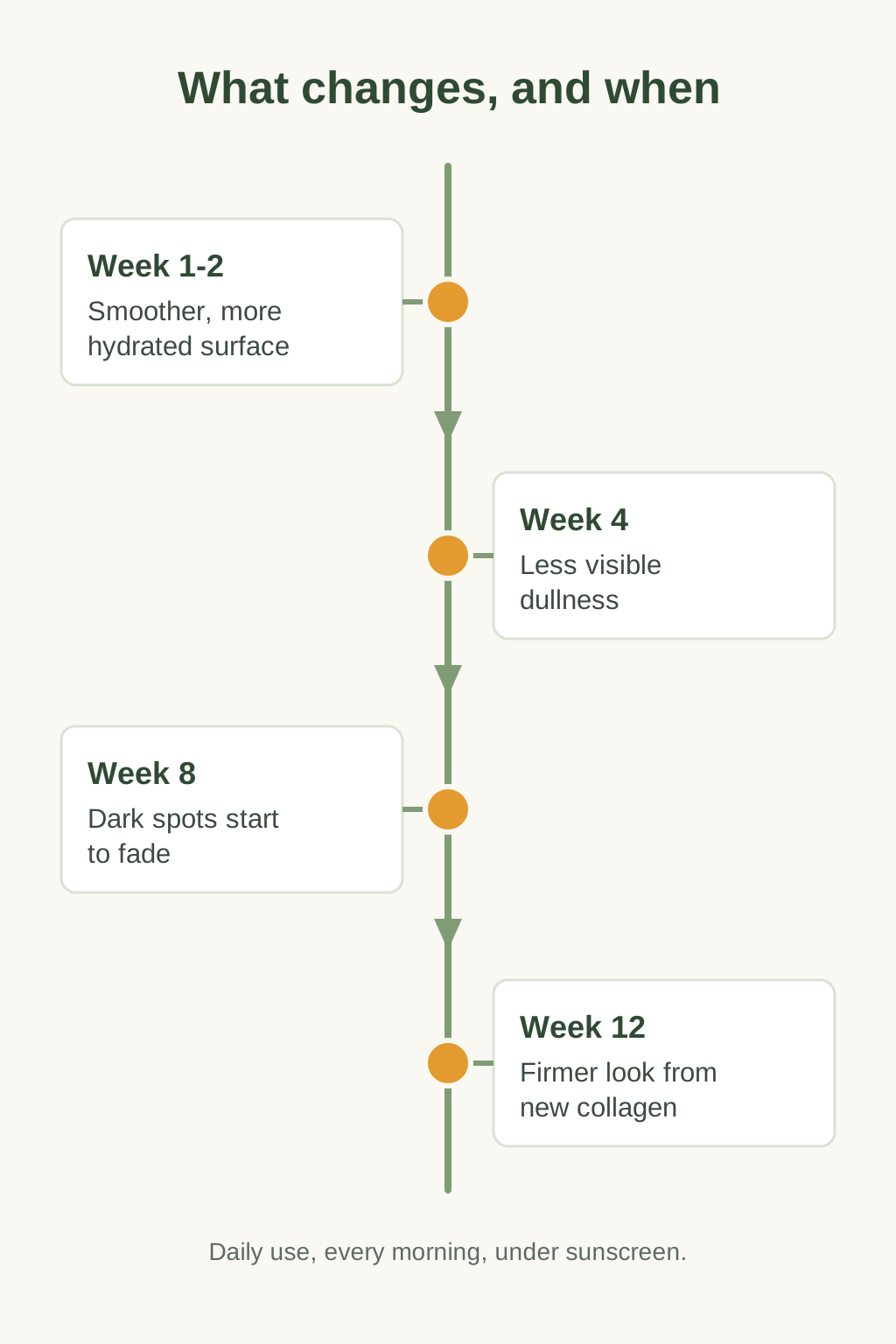
Within the first month a vitamin C serum mostly changes your surface: skin looks brighter and less sallow, post-blemish marks calm down and makeup sits more evenly. These are the vitamin c serum for face benefits you can judge in a mirror after four weeks, and they arrive long before anything structural happens.
Brighter, less sallow skin tone
Dullness is largely oxidized surface lipids and a flat, uneven stratum corneum. Vitamin C reduces that oxidative load daily, so light reflects more evenly and the yellow-grey cast lifts. Expect the change at two to four weeks. The limit: brightening is optical and ongoing, so skipping three weeks sends the cast back.
Faded post-blemish marks
The flat brown or pink marks left after a spot heals are post-inflammatory pigment, and vitamin C slows the tyrosinase enzyme that produces it while damping the inflammation feeding it. Marks shallow out over four to eight weeks. It will not do anything for a raised scar or an ice-pick depression.
A smoother, more even makeup base
A low-pH serum sinks in within a minute and leaves no film, so foundation does not cling to flaky patches or slide on an oily T-zone. The practical gain is fewer touch-ups by midday. The cost: on dry skin the serum alone feels tight, and you still need a moisturizer over it.
Daily defense against UV and pollution damage
Sunscreen blocks part of the UV that reaches you; vitamin C mops up the free radicals that get through, plus those from traffic particulates and cigarette smoke. That is the core of what does vitamin c serum do on an ordinary commute. It is not a substitute for SPF, and it cannot undo a sunburn.
The realistic vitamin c for face benefits in month one are tone, clarity and texture; deep lines and loose skin do not move in four weeks. Our guide to choosing a facial serum for your skin type sets out which concern each active is built for.
What does vitamin c serum do for your skin after three months?
Past the two-month mark the deeper work shows: dark spots lighten, new pigment forms more slowly, and skin looks firmer as fresh collagen accumulates. These slower vitamin c serum benefits for skin need a full dermal turnover cycle, which is why eight to twelve weeks is the honest minimum before you judge a bottle.
Because pigment responds slowly to any single active, it is worth comparing these results with what retinol does for dark spots, since retinol speeds cell turnover and curbs melanin on its own timeline.
Lighter, fewer dark spots
Sun spots and melasma patches fade because tyrosinase inhibition cuts melanin output at the source rather than bleaching what is already there. Patches read visibly lighter at eight to twelve weeks of daily use. The limit is strict: without daily sunscreen, one bright unprotected week replaces the pigment you spent two months fading.
Firmer-looking skin from new collagen
Because ascorbic acid is a required cofactor for collagen hydroxylation, consistent use supports new, properly cross-linked fibers. Expect a modest firmness and bounce at around twelve weeks — not a lift. For deeper wrinkles, our breakdown of what actually reduces wrinkles is the better starting point.
The mechanism is documented in the dermatology review of topical vitamin C and collagen synthesis.
Less visible redness and blotchiness
Vitamin C strengthens capillary walls and reduces the inflammatory signalling behind diffuse flushing, so blotchy patches even out over two to three months. This is the one long-term change reactive skin often notices first. The tradeoff: the same low pH that delivers the active can sting rosacea-prone skin in the first fortnight.
The clearest of the advantages of vitamin c for face care is that the gains compound with sunscreen: the serum handles radicals SPF lets through, SPF prevents damage the serum would have to repair. Stop and the pigment protection fades within weeks, so treat the vitamin c serum benefits as a subscription.
Which form should you put on your face, pure ascorbic acid or a derivative?
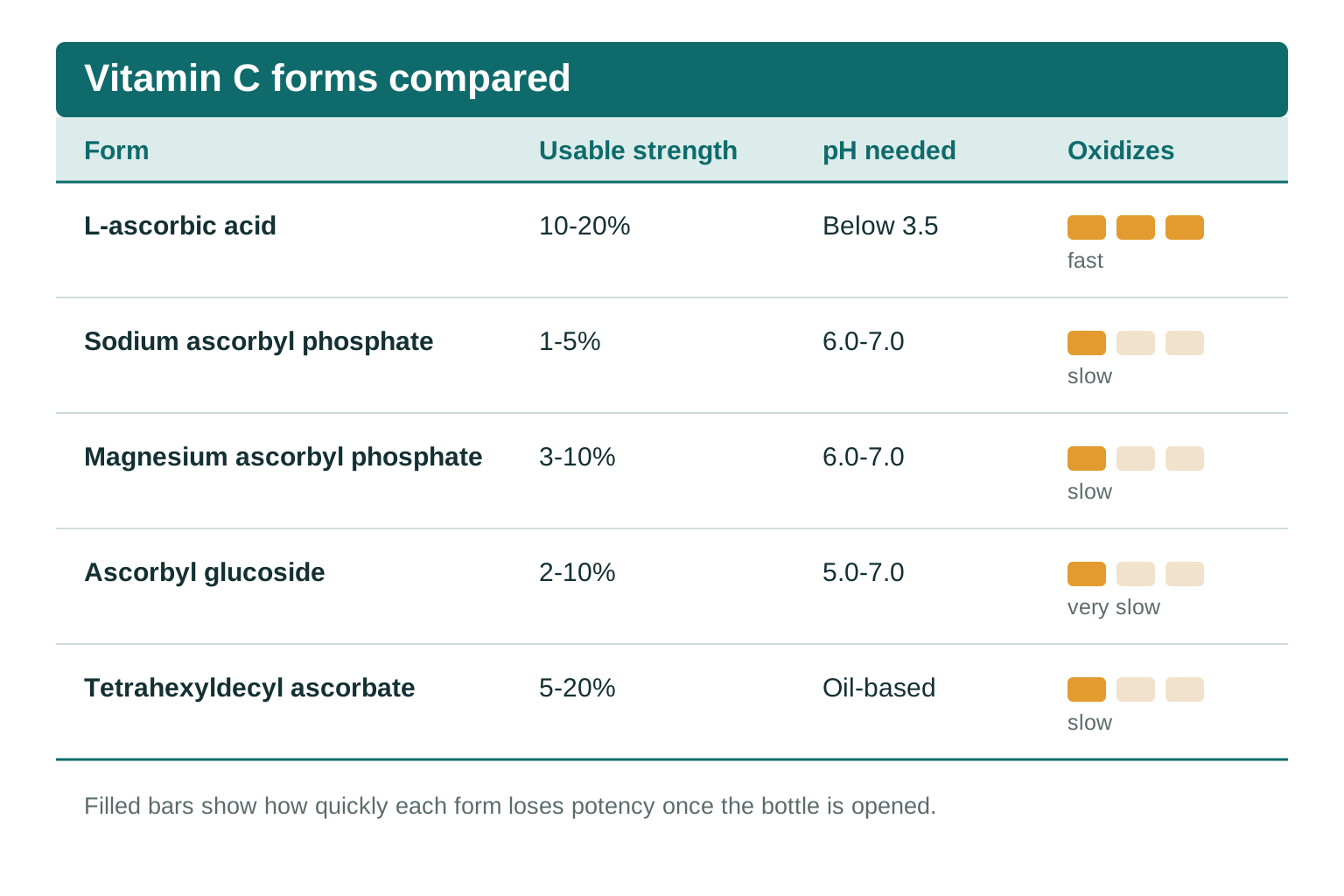
Pure L-ascorbic acid at 10 to 20 percent is the best-studied and fastest-acting form, while buffered derivatives trade some speed for a gentler, more stable formula. Five forms cover almost every bottle on the shelf, and they split on three things: usable strength, the pH the formula needs, and how fast it oxidizes.
| Form | Usable strength | pH needed | Oxidizes | Best for |
|---|---|---|---|---|
| L-ascorbic acid | 10-20% | Below 3.5 | Fast, 3 months | Normal, oily, resilient skin |
| Sodium ascorbyl phosphate | 1-5% | 6.0-7.0 | Slow | Acne-prone, sensitive skin |
| Magnesium ascorbyl phosphate | 3-10% | 6.0-7.0 | Slow | Dry, pigment-prone skin |
| Ascorbyl glucoside | 2-10% | 5.0-7.0 | Very slow | Beginners, reactive skin |
| Tetrahexyldecyl ascorbate | 5-20% | Oil-based | Slow | Dry, mature skin |
Reactive, rosacea-prone or very dry skin should usually skip pure ascorbic acid on face application and start on a phosphate or glucoside derivative, trading speed for a formula that does not sting. Three label shortcuts separate serious vitamin c skin care from decorative formulas: an opaque or amber bottle, a stated percentage rather than "vitamin C complex", and ferulic acid or vitamin E as stabilizers. A brand-level comparison sits in our review of Timeless vitamin C compared with C E Ferulic.
Does vitamin c serum work, and how long before you see it?
Yes, within limits: controlled trials show measurable gains in pigment and photodamage after eight to twelve weeks of daily use with a fresh, properly dosed formula. The honest caveat: trial formulas are made fresh, while a bottle bought in March may have been filled last year.
Readers who ask is vitamin C serum good for skin and answer no for themselves usually hit one of three problems: a serum that oxidized into orange-brown liquid before they finished it, a formula under eight percent that was never strong enough, or four weeks of patience against a change that needs twelve. All three are fixable, and none of them mean the active failed.
Is vitamin C good for face concerns of every kind? Not quite. A serum will not flatten an etched forehead line, will not replace a retinoid for wrinkle depth, and will not clear active acne. If your main concern is oil control or barrier repair alongside brightening, a niacinamide serum that pairs well with actives is the cheaper, less irritating pick.

How do you slot a skincare routine vitamin c step into your morning?
Apply vitamin C in the morning on clean dry skin, wait about a minute, then layer moisturizer and finish with broad-spectrum sunscreen every single day. Three or four drops covers a face; a full dropper is waste, not insurance.
- Cleanse and pat completely dry — water on the skin dilutes the serum and raises its pH.
- Press three to four drops over the face and neck, avoiding the immediate eye area.
- Wait 60 seconds, then apply moisturizer.
- Finish with a broad-spectrum SPF 30 or higher, such as a mineral sunscreen you will actually reapply, using about a teaspoon for the face and neck.
Layering rules keep vitamin c face care comfortable. Niacinamide and hyaluronic acid sit happily in the same routine. Retinol belongs at night, because stacking both at once multiplies irritation without multiplying results. Benzoyl peroxide is the one hard conflict: it oxidizes ascorbic acid on contact, so the two cancel out in the same application. Our walkthrough of building a skin care routine in the right order shows where every other step lands.
For the sunscreen dose that finishes the routine, see the dermatologists' guide to applying sunscreen correctly.
Three habits waste a bottle of vitamin c skincare faster than anything else: applying to damp skin, storing it in a steamy shower, and skipping the sunscreen that protects the antioxidant you just applied.
Check your own actives against each other before you commit to a routine order and get a safe, caution or avoid verdict with an AM or PM slot for each one.
The printable one-page vitamin C cheat sheet condenses strength, timing and pairing rules for your skin type into something you can keep by the sink.
Do i need a vitamin c serum, or will vitamin c oil for skin do the same job?
A water-based serum penetrates fastest and suits most skin, while oils and mixable drops are better fits for dry or reactive skin that stings at low pH. The three formats are not interchangeable. A serum carries L-ascorbic acid in water at low pH and acts quickest. A vitamin c oil for skin is usually built on tetrahexyldecyl ascorbate, which is oil-soluble, pH-neutral and far more stable, but slower. Vitamin C drops for face use — concentrated mixable drops — are stirred into whatever moisturizer you already own, which lets you dial the strength up slowly.
Whether you need one depends on your profile. Visible pigment, a dull complexion or heavy daily sun exposure argue yes. An already-even complexion with strict sun habits gains little beyond maintenance, and the money is better spent on sunscreen you will reapply — our picks for mineral sunscreen for face start there. Is vitamin C serum good for your face when it is oily or acne-prone? Yes, and a lightweight water base beats an oil every time, since oils can feel occlusive over congested pores. If wrinkle depth is the real target, read our notes on retinol serum timing for beginners before adding a second active.
Who should be cautious, and what goes wrong with vitamin C?
Reactive, rosacea-prone and barrier-damaged skin tolerates vitamin C worst, and the common failures are stinging at low pH, fabric staining and a bottle that oxidizes within three months. Add the running cost: a serum used daily is a repeat purchase every eight to twelve weeks, and an oxidized bottle is money gone.
- Stinging and transient redness on skin with a compromised barrier.
- Orange-brown marks on light pillowcases and collars.
- Potency loss within about three months of opening, faster in heat or light.
Ramp up instead of diving in: patch-test on the jaw for three nights, then twice a week for a fortnight, then every other morning, then daily if skin stays calm. Start at 8 to 10 percent, not 20. A gentle cleanser for sensitive skin and a plain moisturizer give vitamin c for skin the best chance of being tolerated.
Stop and ask a dermatologist if burning lasts beyond a few minutes, if redness persists for days, or if new breakouts appear and keep appearing after three weeks. Pushing through those signals damages the barrier that makes any vitamin c skin care work in the first place.
One practical skincare note a week, free, if you want the next one.
One evidence-checked skincare tip a week. No product dumps.
Thanks — you're on the list.
