

The best peptide serum is a multi-peptide formula built on signal peptides such as palmitoyl pentapeptide-4, paired with hyaluronic acid and worn under moisturizer. Expect modest gains in firmness and fine lines over 8 to 12 weeks of twice-daily use; a 2025 Biomolecules review names poor stratum corneum penetration as the real ceiling.
What is a peptide serum, and what does it actually do?
A peptide serum is a water-light leave-on treatment that delivers short amino-acid chains which signal skin cells to behave younger, usually at 2 to 10 percent of a named peptide complex. Peptides run 2 to 50 amino acids long, the same length your skin releases when its own collagen breaks down.
That fragment is the entire mechanism. It looks like damage, so fibroblasts respond by building matrix. A peptide is a signal, not a brick: a serum is not laying collagen onto your face, and any label implying it does is describing a molecule far too large to go anywhere.
Delivery therefore decides more than the ingredient list does. Peptides are water-loving and relatively bulky, while the stratum corneum is lipid-rich and 15 to 20 cell layers thick, and how the stratum corneum decides what gets through sets the ceiling on how much ever gets in.
In a routine a peptide serum for face skin replaces nothing. It goes on after cleansing and before moisturizer, running alongside your existing actives rather than displacing one, which is the same ranking logic as how to choose a facial serum.

Which are the best peptides for skin, family by family?
Signal peptides carry the strongest human evidence for fine lines, carrier peptides come from wound repair, neurotransmitter-inhibiting peptides soften expression lines, and enzyme-inhibiting peptides slow collagen breakdown. Four families, four jobs, and only one of them is about making new matrix.
Signal peptides are the workhorses: palmitoyl pentapeptide-4 and palmitoyl tripeptide-1 hold the largest body of human split-face data, typically single-digit percentage gains in fine-line depth over 12 weeks. Carrier peptides such as copper tripeptide-1 ferry trace copper to repair enzymes; solid wound-healing heritage, thin cosmetic trial record.
Acetyl hexapeptide-8 is the neurotransmitter inhibitor shoppers meet most. It damps the signalling behind repeated micro-contraction, softening expression lines modestly, and it will disappoint anyone expecting injectable-grade stillness. Enzyme inhibitors invert the strategy, restraining matrix metalloproteinases so existing collagen survives longer.
Ranking the best peptides for skin means grading that evidence, not collecting names:
| Family | What it does | Label name to look for | Human evidence |
|---|---|---|---|
| Signal | Prompts fibroblasts to build collagen and elastin | Palmitoyl pentapeptide-4, palmitoyl tripeptide-1 | Moderate: repeated 12-week split-face trials |
| Carrier | Delivers trace copper to repair enzymes | Copper tripeptide-1 | Limited: strong in wound care, sparse in cosmetics |
| Neurotransmitter-inhibiting | Softens repeated micro-contraction lines | Acetyl hexapeptide-8, pentapeptide-18 | Limited: small studies, modest effect sizes |
| Enzyme-inhibiting | Slows the enzymes that degrade collagen | Soybean and rice peptides, trifluoroacetyl tripeptide-2 | Weak to limited: mostly laboratory models |
This is a ladder, not a menu, so one strong family does not make every peptide a best peptide. For the wider active-by-active picture, see which anti aging serum actives have trial evidence, and for the classification itself, the four cosmetic peptide classes and why they struggle to penetrate.
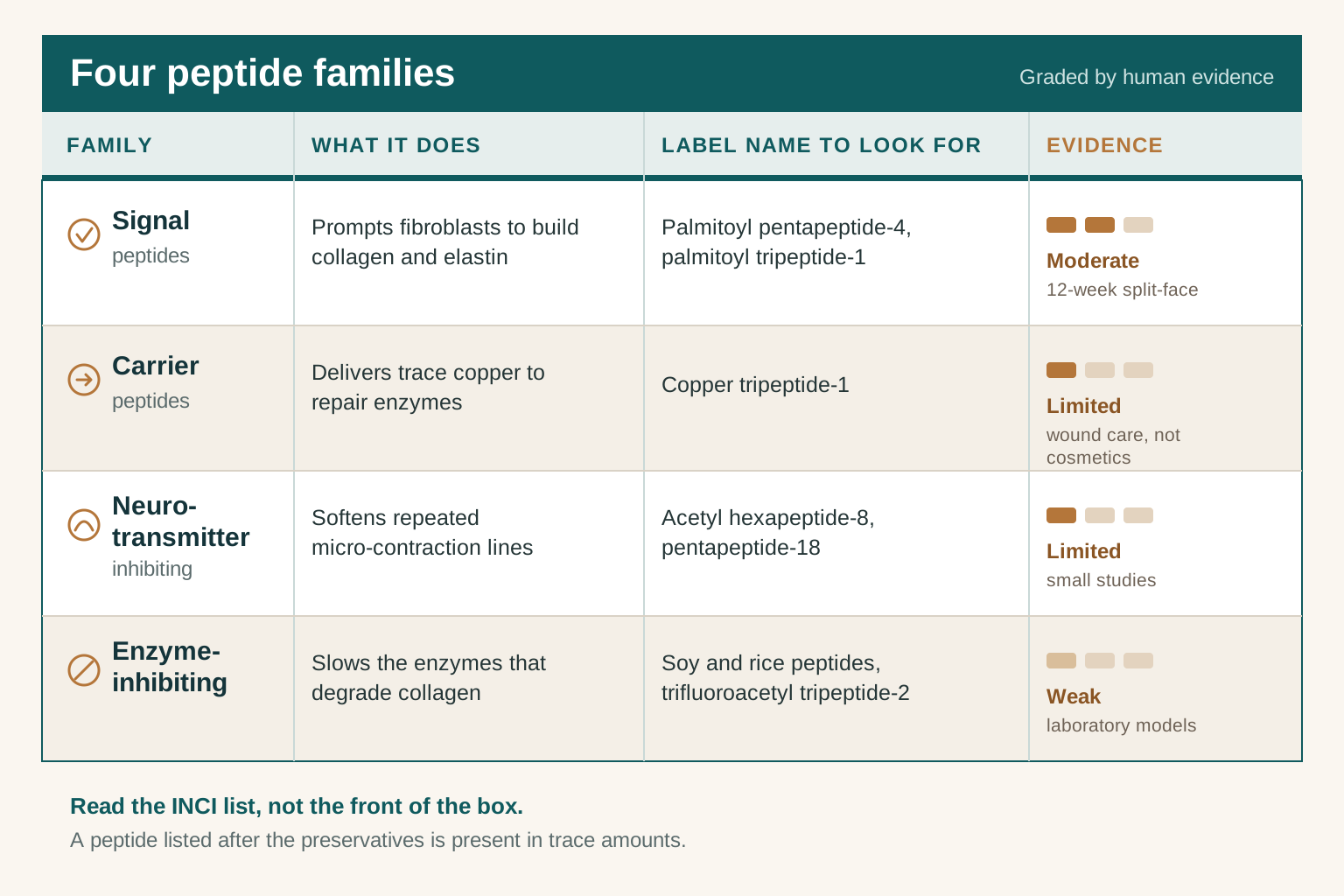
One printable page per peptide family, written for comparing two bottles in a shop aisle rather than for study.
How do you pick the best peptide serum for face skin?
Pick the best peptide serum for face skin by checking that a named peptide appears in the top third of the INCI list, with a humectant partner, a near-neutral thin base and air-restricted packaging. Five checks, in that order, settle most purchases in under a minute.
- A named peptide, not a complex. "Peptide complex" discloses nothing. You want an INCI name you can look up.
- Position in the list. A peptide below the preservatives is present in trace amounts, whatever the front label promises.
- A stated total. A published 2 to 10 percent beats a published adjective.
- A humectant partner. Glycerin or hyaluronic acid holds the film on damp skin instead of letting it flash off.
- Air-restricted packaging. Opaque airless pumps protect peptides better than a wide-mouth jar.
Texture decides the rest. A peptide serum for face use should sink in within 60 seconds near pH 5 to 7, then compare cost per millilitre, the only honest way to price a 15 ml bottle against a 50 ml one. Skip peptide waters at the end of a 40-ingredient list, fragrance-heavy formulas if you react to scent, and droppers that pull air in. The same discipline applies to hydrators, as in seven label checks on a hyaluronic acid serum.
Is a multi peptide serum better than a single-peptide formula?
A multi peptide serum is better when each peptide is present at a studied level, and worse when five names share one trace percentage that no single peptide reaches. The question is arithmetic, not philosophy.
A blend buys coverage: two or three mechanisms in one step, one bottle, one 60-second application. The cost is attribution. If your skin improves you will never know which peptide earned it, and if you react you will not know what to drop.
A single peptide at a level matching published trials beats five peptides at 0.1 percent each. Check whether any one INCI name sits in the top third of the list; if the whole blend arrives after the preservative system, the breadth is decorative.
"Super peptide serum" is a commercial tier, not a regulated one. It usually signals three or more peptides plus hydrators at a visible total, which is a reasonable thing to buy and a terrible thing to pay a premium for sight unseen.
A practical rule: run one multi-mechanism serum plus one single-active serum, rather than stacking four blends that overlap and cost four times as much. This is the same strength-versus-price trade as niacinamide serum strength worth paying for.
Which are the best peptides for skin tightening, and how much firming is realistic?
The best peptides for skin tightening are signal peptides that raise matrix density and enzyme inhibitors that slow its breakdown, and both work on crepe texture rather than heavy laxity. Firmness is a density effect, and density changes slowly.
Signal peptides add new collagen and elastin while enzyme inhibitors protect the fibres already there, which is why multi-peptide blends dominate the firming shelf and why no single molecule claims the title of best peptide for firmness alone.
"Tightening" on a carton means the dermis, roughly 1 to 4 mm down. A topical never reaches the fascia, the fat pads or the muscle, where real sagging starts.
Where a firming peptide step genuinely earns its place: crepe texture on cheeks and décolleté, slackness driven by chronic dehydration, and the papery look of thin skin. Where it does not: jowls, a heavy jawline, and anything that moves when you lie down. Those need a device or a surgeon. The realistic boundary is mapped in what topical skin tightening can and cannot do.
Pair any firming peptide with daily broad-spectrum SPF 30 or higher. Ultraviolet exposure activates the same collagen-degrading enzymes the peptides are trying to restrain, so skipping sunscreen cancels the spend.
How do you layer a peptide serum with retinol and vitamin C?
Apply a peptide serum to damp skin before moisturizer, keep low-pH vitamin C in the morning and retinol at night, and separate copper peptides from direct acids. Thin to thick, water before oil, and nothing goes on top of an occlusive.
Four to five drops cover a face and neck. Press, do not rub. Wait about 60 seconds, then seal with your moisturizer so the peptide film stays hydrated instead of evaporating.
With retinol at night, irritation is the limiting factor, not chemistry: peptides and retinoids coexist fine, your barrier may not. Buffer with moisturizer between them or alternate nights for the first month. Dermatologists' advice on dermatologists' guidance on matching a moisturizer to your skin decides which texture seals the pair comfortably, and retinol strength and night layering rules sets the starting strength.
With L-ascorbic acid at pH 3.5 or lower, split the slots: vitamin C in the morning, peptides in the evening, never mixed in the palm. Formulation ranges vary by brand, and vitamin C serum formulas for dark spots covers which strengths behave.
The one pairing worth real distance is copper tripeptide-1 with direct acids or strong vitamin C: the copper and the antioxidant work against each other, so give them different days. A multi peptide serum without copper has no such constraint.

Three questions return a safe, caution or avoid verdict for your own actives, plus the morning or evening slot that keeps every pair out of the avoid band.
How long does a peptide serum take to show results?
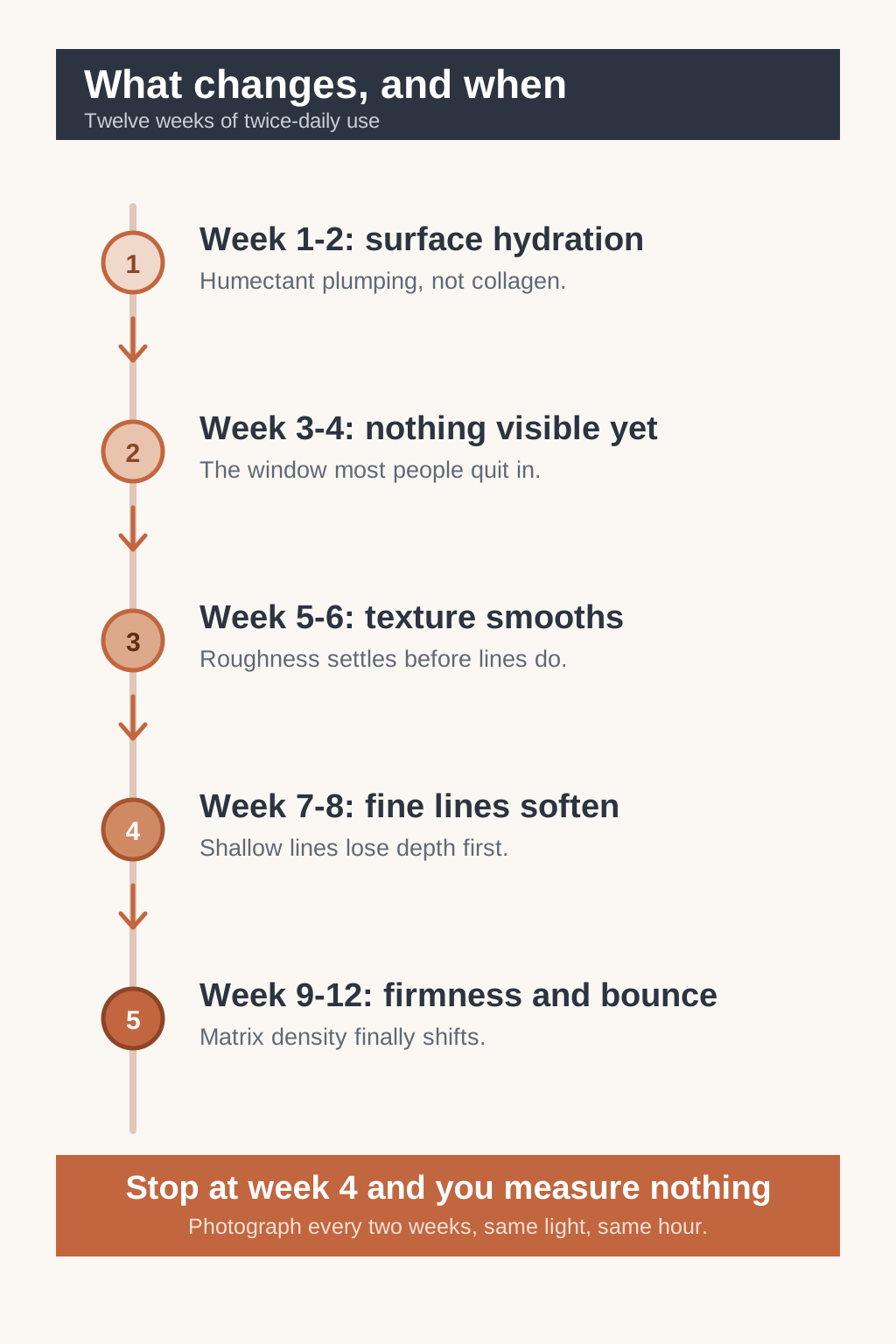
Hydration shifts within two weeks, texture around week six, and measurable firmness only between weeks eight and twelve, so judge a peptide serum at twelve weeks rather than four. Fibroblasts turn matrix over on a timescale of months, not days.
Weeks one and two bring plumping from the humectant base, which is real but not collagen. Weeks three and four usually show nothing, and that is exactly when most people quit and post a one-star review. Texture smooths around week six; fine lines soften between weeks seven and eight; bounce and firmness arrive from week nine.
Run it as a single-variable trial. One new serum at a time, photographs every two weeks in the same window light at the same hour, face relaxed and unmoisturised. Mirror impressions at midnight are not data.
Set a stop rule before you start: no change by week sixteen at a sensible concentration means the best peptide serum for you is a different product or a different active. Eye-area timelines run on the same clock, as eye cream for creases and realistic timelines sets out.
What can a peptide serum not do?
A peptide serum cannot lift heavy laxity, replace sunscreen or a prescription retinoid, and it cannot legally be sold as a collagen-building treatment without drug approval. The limits are regulatory, physical and practical at once.
Regulation draws the first line: a cosmetic may reduce the appearance of lines, while a product claiming to increase collagen production is making a drug claim. That is the FDA line between a cosmetic claim and a drug claim, and it explains why careful brands write "appearance of".
Physics draws the second. Hydrophilic peptides meet a lipophilic barrier, so laboratory results consistently outrun human ones; a 2025 review of cosmetic peptides notes a shortage of in vivo trials for precisely this reason.
Practically, peptides will not replace daily SPF, a prescription retinoid, or an energy device for true laxity. Skip them entirely during an active barrier flare, and skip them if you want filler-grade change. Neck skin has its own rules, covered in neck firming cream for crepe skin.
One ingredient breakdown a week, built from trial evidence rather than launch calendars.
One evidence-checked skincare ingredient breakdown a week. No product dumps.
Thanks — you're on the list.

