

Medical grade skincare is a marketing term, not an FDA category: it describes cosmeceutical products sold mainly through dermatologists and medical spas, usually with higher concentrations of proven actives such as retinol, L-ascorbic acid vitamin C and niacinamide. Only prescription drugs such as 0.025% to 0.1% tretinoin carry FDA approval, so the label alone guarantees nothing.
What does medical grade skincare actually mean?
Medical grade skincare means cosmeceutical products sold mainly through dermatologists, plastic surgeons and medical spas, usually with stronger actives, but the term has no legal definition and no FDA approval behind it. Medical grade skin care, medical skin care and medical skincare are used interchangeably by brands and clinics, and none of them is regulated as a standard. A serum can carry the phrase whether it holds 1% retinol or a trace amount.
What the label usually signals is a distribution model. Med skin care lines sell through licensed providers, which lets them ship higher active strengths with professional guidance on how to start, how often to apply and what to stop if irritation appears. Many brands also restrict online resellers, so the product you buy is more likely to be fresh and authentic.
Scientific skincare, by contrast, is a standard you can check yourself. It means three things on the box or the brand's site:
- A named active, such as retinol, L-ascorbic acid or niacinamide, not a proprietary "complex."
- A stated strength, such as 0.5% retinol or 15% vitamin C.
- Published evidence that the active works at that strength on human skin.
Readers who benefit most are those with a defined concern, such as photoaging, melasma or persistent breakouts, who want stronger formulas with a provider's oversight. If your skin is calm and your goal is maintenance, a well-formulated drugstore routine covers the same ground for less money. A practical primer on choosing skincare products that actually work applies the same label logic to any price tier.

How is medical grade skin care different from drugstore and prescription products?
Drugstore cosmetics, medical grade cosmeceuticals and prescription drugs can share an active, but only prescription skin pharmaceuticals must prove safety and efficacy in clinical trials before sale. In the United States, a product is regulated by what it claims to do: a cream that promises to "improve the look of fine lines" is a cosmetic, while one that claims to treat a disease or change skin structure is a drug. The FDA rules that separate cosmetics from drugs contain no middle category, which is why medical cosmetics and most health skin care products are legally plain cosmetics.
| Factor | Drugstore cosmetic | Medical grade (cosmeceutical) | Prescription drug |
|---|---|---|---|
| FDA approval before sale | No | No | Yes |
| Clinical trials required | No | No | Yes |
| Typical retinoid | Retinol 0.1–0.3% | Retinol 0.5–1% | Tretinoin 0.025–0.1% |
| Exfoliating acid | AHA up to 10% | AHA 10–15% | In-office peels 20–70% |
| Where sold | Shelves and online | Clinics and medical spas | Pharmacy, with a prescription |
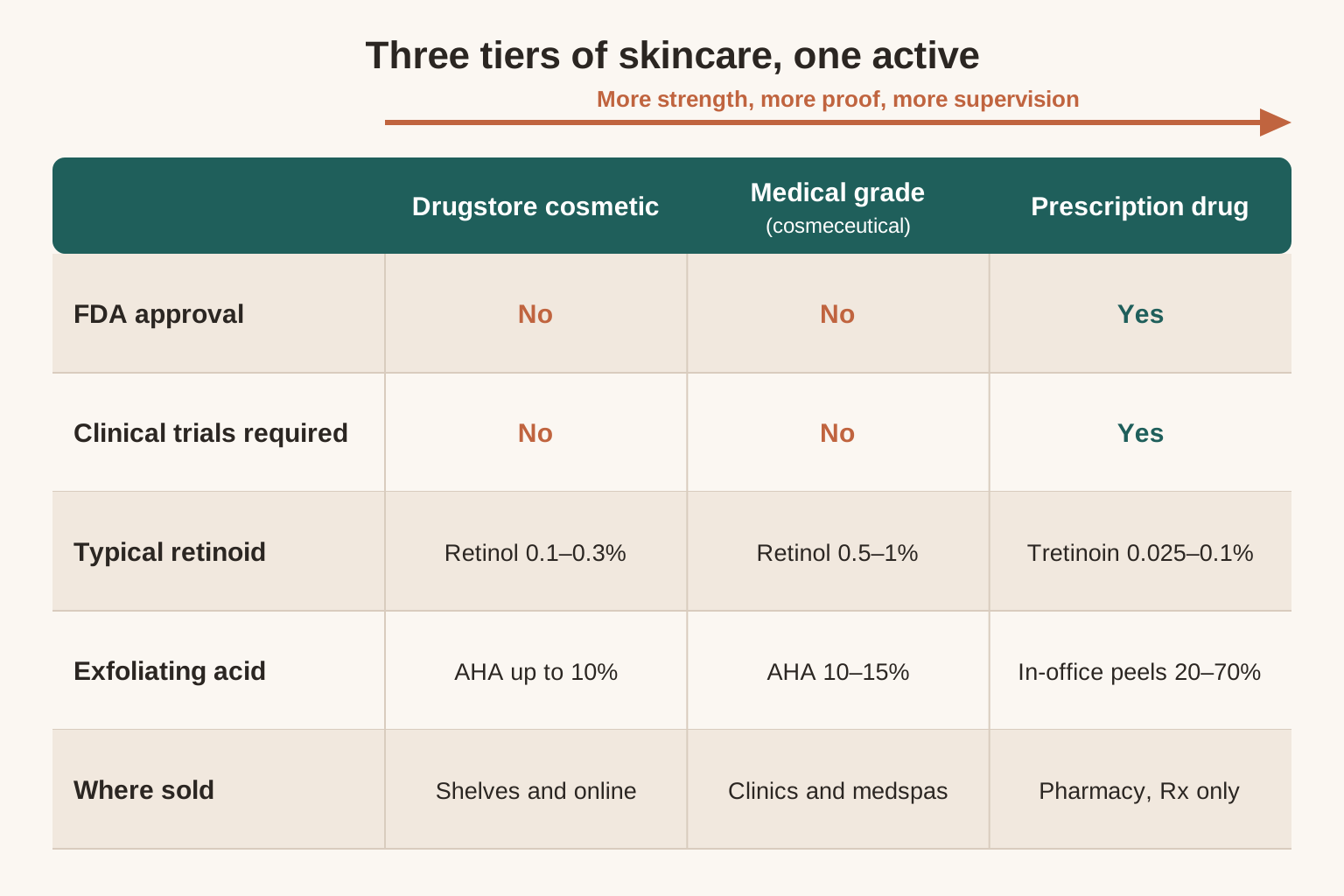
Cosmeceutical skin care products sit in the middle column. Pharmaceutical skin care lines borrow the language of medicine, yet a true prescription cream such as tretinoin or 4% hydroquinone has a dosing label, a tested formula and a pharmacist behind it. Since 2020, hydroquinone can no longer be sold over the counter in the United States, so any brightening serum without a prescription relies on other actives.
What the extra cost buys is usually concentration, stability work and provider advice. What it does not buy is regulatory proof. If your main goal is wrinkle care, a guide to choosing a face cream for aging skin compares the actives with real trial data behind them.
Which ingredients make medical grade skincare products worth the price?
Medical grade skincare products earn their price only when they deliver an evidence-backed active at an effective strength, chiefly retinoids, L-ascorbic acid vitamin C, niacinamide, alpha hydroxy acids and broad-spectrum sunscreen filters. Everything else on the label is supporting cast.
Retinoids
Retinol between 0.25% and 1% converts in skin to retinoic acid, the same molecule prescribed as tretinoin. Prescription tretinoin has the deepest evidence base: clinical trials of prescription tretinoin for photoaging show visible gains in fine lines and uneven pigment within months. Over-the-counter retinol is gentler and slower. Expect two to four weeks of dryness or peeling while skin adjusts. A detailed retinol serum strength and night routine guide covers how to step up strength safely.
Affiliate disclosure: we may earn a commission if you buy through the product link below, at no extra cost to you.
Vitamin C
L-ascorbic acid works best at 10% to 20% and a pH below 3.5, where it penetrates and neutralizes free radicals from UV exposure. It oxidizes fast, so opaque or airless packaging matters as much as the percentage; a serum that has turned dark orange has lost potency. Sensitive skin may sting at 20%. Ranked options sit in a roundup of vitamin C serum picks for brightening.
Affiliate disclosure: we may earn a commission if you buy through the product link below, at no extra cost to you.
Niacinamide and acids
Niacinamide at 4% to 5% reduces redness and oil and supports the barrier, with low irritation risk. Glycolic or lactic acid up to 10% is the safe home range for smoother texture. When reading medical grade skin care products labels, look for the percentage and the form; if neither is listed, assume the dose is low.
What is the best medical grade moisturizer for your skin type?
The best medical grade moisturizer matches your skin type first: ceramide-rich creams for dry skin, oil-free gels for acne-prone skin and fragrance-free barrier creams for sensitive skin. A medical grade face moisturizer differs from a standard cream in formulation depth: barrier lipids in a skin-like ratio, humectants such as glycerin or hyaluronic acid, and sometimes a tested active like niacinamide or peptides. A medical skin cream is worth paying for when your barrier is compromised by retinoids or acids; for healthy skin, a basic ceramide moisturizer often does the same job. A full moisturizer buying guide for every skin type lays out deeper criteria.
Affiliate disclosure: we may earn a commission if you buy through the product links in this list, at no extra cost to you.
Not sure which skin type you have? Six questions, two minutes, and you get your skin type plus your top concern.
Can affordable medical grade skincare work as well as luxury lines?
Affordable medical grade skincare can match luxury lines when the active, strength and packaging are the same, because skin responds to the molecule and its concentration, not the price tag. Niacinamide, broad-spectrum sunscreen and entry-level retinol are well-understood, stable ingredients, and budget versions at the right percentage perform comparably in practice.
Paying more can matter in three places:
- Stabilized vitamin C, where airless packaging and formulation slow oxidation.
- Encapsulated or time-released retinoids, which cut irritation for sensitive skin.
- Texture and wear, which decide whether you keep using a product for the 12 weeks most actives need.
The best medical grade skin care on a budget is judged by cost per month, not per bottle: divide the price by the weeks one container lasts at the recommended dose. A 30 ml serum used once daily lasts about two months. The tradeoff with budget formulas is usually fewer supporting ingredients and less elegant textures, not weaker actives. A breakdown of niacinamide strengths worth paying for shows where that line falls for one popular active.
Affiliate disclosure: we may earn a commission if you buy through the product link below, at no extra cost to you.
How do you judge cosmeceutical skin care brands before you buy?
Judge cosmeceutical skin care brands with five checks: a named active with its strength, published evidence for that active, protective packaging, an authorized seller and a monthly cost you can sustain.
- Active named with strength. "0.5% retinol" passes; "retinol complex" does not.
- Evidence for that active. Look for human trials on the ingredient, not before-and-after testimonials.
- Packaging that protects it. Airless pumps or opaque tubes for vitamin C and retinoids.
- Sold by a licensed or authorized provider. Whether you shop at a clinic on the medical grade skincare main line or at a practice near obagi beverly hills ca, an authorized seller can confirm lot freshness.
- Price per month fits. A routine you cannot afford to repeat for 12 weeks will not show results.
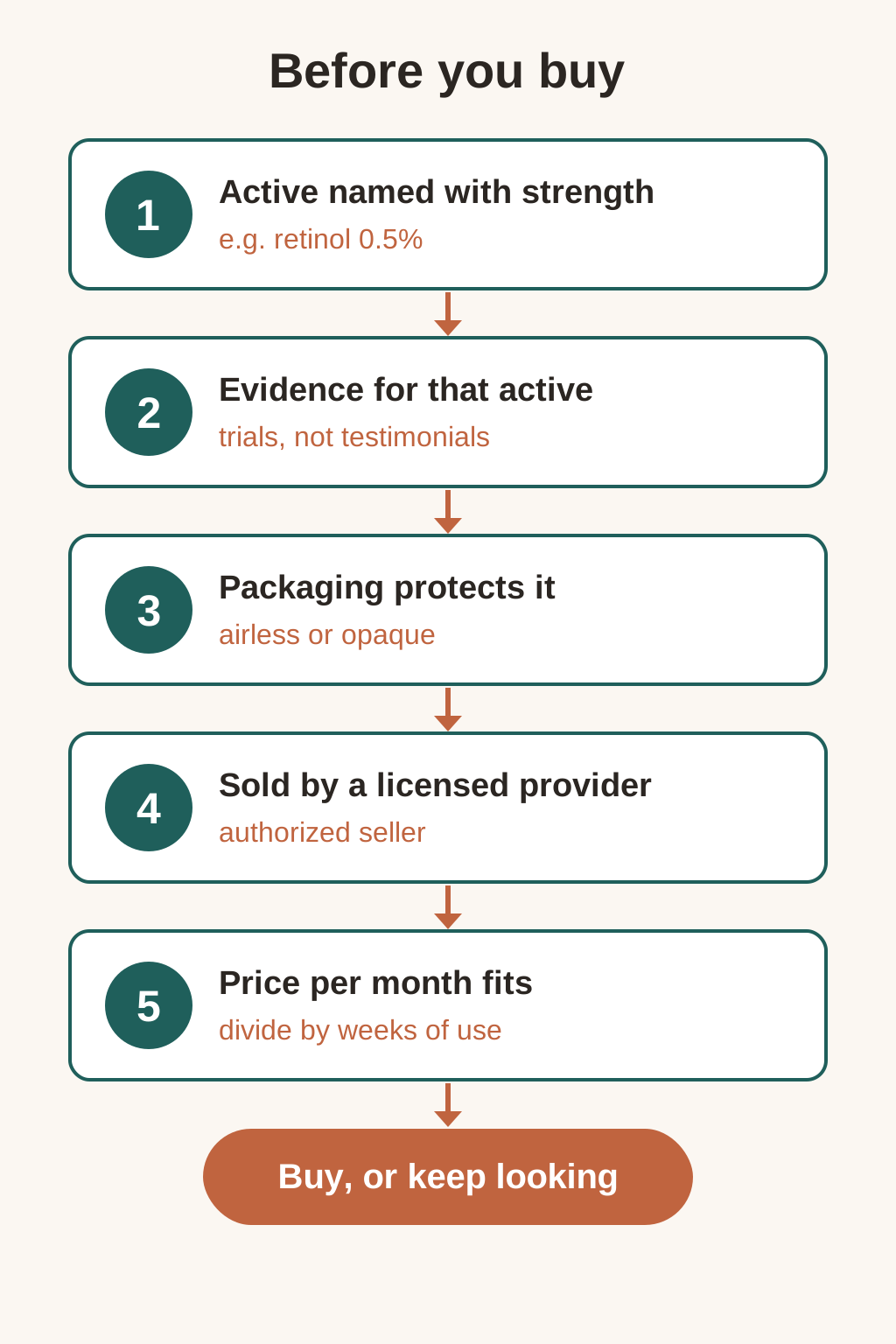
Unverified marketplaces are the main risk for pharmaceutical skin care lines: diverted stock can be expired or stored hot, and counterfeits can contain more acid than the label states. The FDA warning on at-home chemical peels names products with acid levels high enough to cause burns and scarring. Treat any peel without a stated percentage as a red flag, and keep home exfoliation within the limits laid out in a guide to how often to exfoliate safely.
How should you build a routine around medical grade skin care?
Build a medical grade routine around one active at a time: cleanse, apply the treatment serum, moisturize and finish with SPF 30 or higher in the morning, then wait four to six weeks before adding another. A lean med skin care routine looks like this:
- Morning: gentle cleanser, vitamin C serum, moisturizer, broad-spectrum SPF 30 or higher.
- Evening: cleanser, retinoid two or three nights a week at first, then moisturizer.
Adding one product per month shows you which one works and which one irritates. If redness, burning or breakouts persist past six weeks, a dermatologist visit is cheaper than more products. The correct skincare order for layering covers thinner-to-thicker application in detail.
Get one short, evidence-checked skincare tip in your inbox each week.
One evidence-checked skincare tip a week. No product dumps.
Thanks — you're on the list.


