

Retinol fades dark spots: this vitamin A derivative speeds skin cell turnover and blocks tyrosinase, the enzyme that makes melanin. Over-the-counter strengths of 0.25% to 1% visibly lighten post-acne marks and sun spots in 12 to 16 weeks of nightly use, with full collagen benefits at six months.
Does retinol help with dark spots?
Retinol fades most surface pigment, including post-acne marks, sun spots and uneven tone, by accelerating cell turnover, but it works gradually and never erases deep dermal pigment.
The useful answer splits by spot type. Post-acne marks are epidermal pigment parked in keratinocytes that retinol pushes to the surface faster, so they respond first. Solar lentigines, the flat tan spots on cheekbones and the backs of hands, lighten more slowly but reliably. Melasma sits partly in the dermis and is hormonally driven, so retinol only softens its edges.
Does retinol work as well as the dedicated brighteners? Not spot for spot. Hydroquinone 4% clears a single discrete mark faster, azelaic acid 15% is better at stopping the inflammation that creates new marks, and tranexamic acid outperforms both on melasma. Retinol wins on breadth instead: one nightly step treats pigment, pore congestion, texture and fine lines at once.
That breadth is why retinol for spots behaves as a tone-evening treatment rather than a spot eraser. It lifts the whole canvas, cutting the contrast between a mark and the skin around it, instead of bleaching one circle. If you need one spot gone before a specific date, this is the wrong tool and a dermatologist procedure is the right one.
Over-the-counter strengths of 0.25% to 1% produce real epidermal change at roughly a fifth to a tenth of prescription tretinoin's per-application potency, which buys you a far gentler adjustment period. If you are choosing between percentages, our retinol serum guide to strengths and formulas sets out what each rung costs in irritation.
What does retinol do to your skin once it absorbs?
Retinol converts to retinoic acid inside skin cells, binds nuclear retinoic acid receptors, speeds keratinocyte turnover, dampens tyrosinase activity and switches on collagen synthesis in the dermis.
What does retinol do before any of that happens? Two enzymatic conversions. Retinol oxidizes to retinaldehyde, retinaldehyde oxidizes to retinoic acid, and only retinoic acid fits the receptor. Each step loses molecules, which is the structural reason a 1% retinol behaves like a small fraction of a 0.025% tretinoin rather than its equal. Vitamin A chemistry and the family tree of its derivatives are set out in a review of how vitamin A derivatives act in skin.
What does retinol do to your skin across 12 weeks of use? Three measurable things. Epidermal turnover shortens from roughly 40 to 50 days toward about 30, so pigmented cells exit sooner. Melanin granules already in the epidermis get dispersed rather than clustered, which reads as evener tone. Fibroblasts in the dermis start laying down new collagen I and III, thickening skin that photodamage has thinned.
What does retinol do for your face beyond pigment is the part most people notice first: the cells lining each pore shed more regularly, so blackheads loosen, and surface texture smooths within eight weeks, well before any spot looks lighter.
Is retinol good for skin barriers? Only on a delay. Faster turnover sends immature corneocytes to the surface, so transepidermal water loss rises for two to six weeks and skin stings, flakes and reddens before it settles. The same turnover also strips the thickened stratum corneum that scatters UV, so daily protection stops being optional, and a mineral sunscreen for the face is the least irritating way to cover a retinol-adjusting face.
Which dark spots retinol fades and which it will not
Retinol reliably lightens post-inflammatory marks and superficial sun spots, partially helps melasma when paired with daily sunscreen, and does nothing for birthmarks or pigment sitting deep in the dermis.
Depth decides everything. Pigment held in the epidermis rides the turnover conveyor belt that retinol speeds up, so it can leave. Pigment that has dropped through a damaged basement membrane into the dermis sits below the cells retinol acts on, and no topical shifts it — that is the pigment that needs laser, microneedling or a chemical peel.
| Spot type | Retinol effect | Weeks to visible change | Better partner active |
|---|---|---|---|
| Post-acne marks | Strong | 8 to 12 | Azelaic acid 15% |
| Sun spots | Strong | 12 to 16 | Vitamin C 10% to 15% |
| Melasma | Partial | 16 to 24 | Tranexamic acid |
| Post-inflammatory redness | Partial | 12 to 20 | Niacinamide 4% |
| Birthmarks | None | No change | Dermatologist assessment |
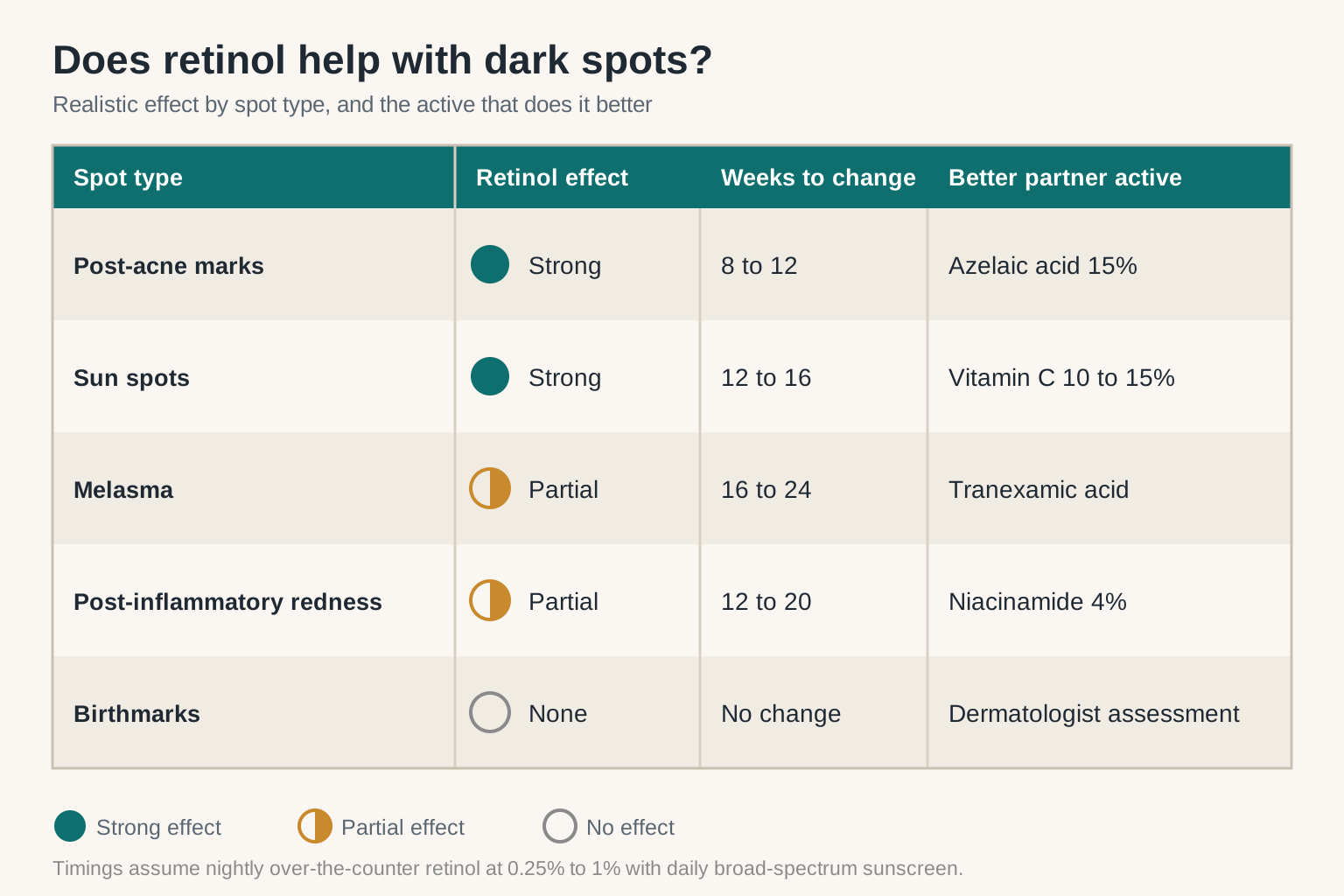
Read that pattern the right way round: the benefits of retinol for skin show up as overall tone evenness, not as one circle disappearing. Two spots of equal darkness can sit at different depths and respond on different timetables, which is why progress photos under identical lighting beat memory.
Darkness under the eyes is a separate problem — much of it is vascular shadow and thin skin rather than melanin, and the approaches for fading dark circles under the eyes differ from pigment treatment entirely.
One spot type deserves a clinic before any active: a mark that is growing, changing color, bleeding or newly irregular needs a dermatologist to rule out melanoma, and dermatologist guidance on fading dark spots sets out what warrants an appointment.
How long retinol takes to fade a dark spot
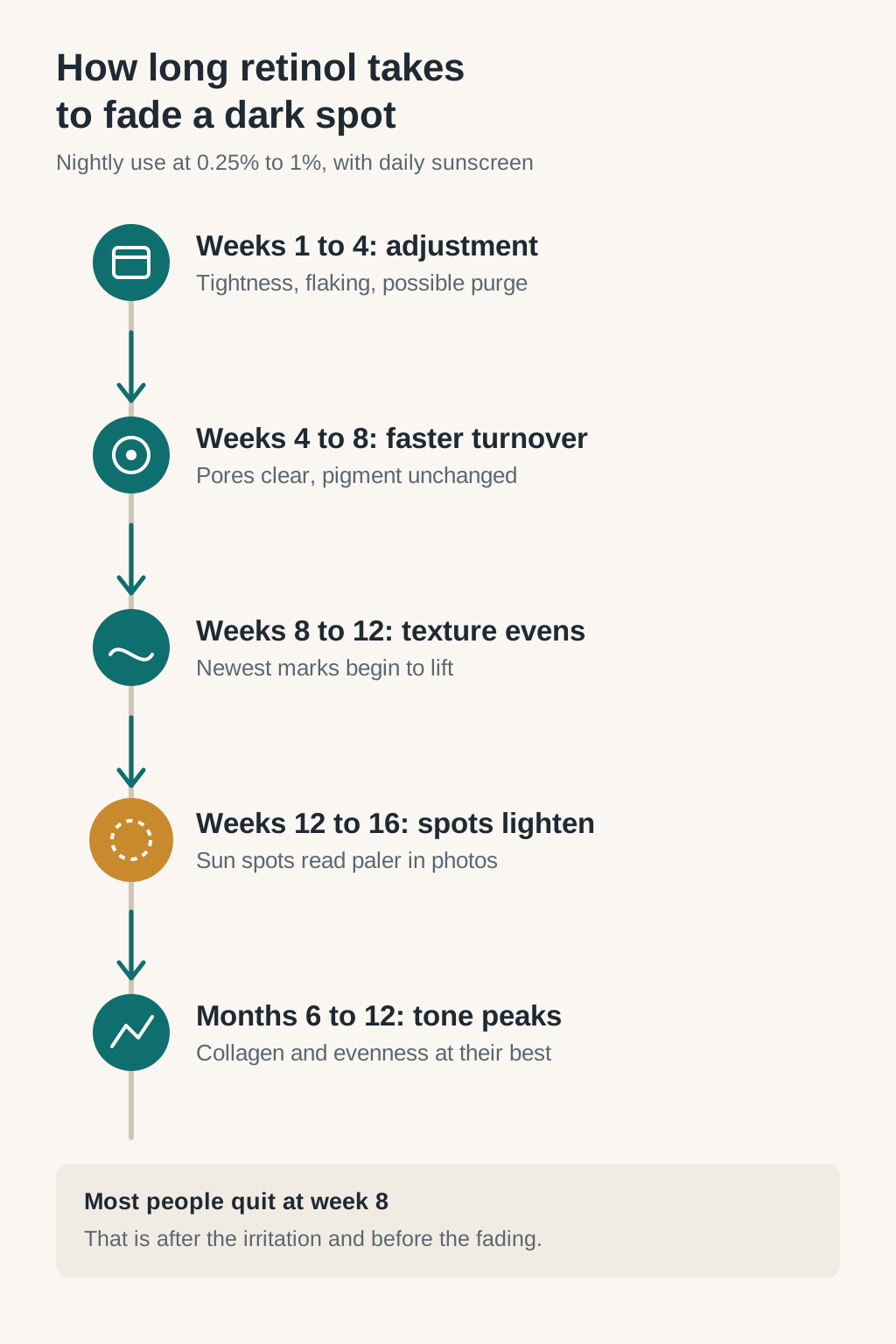
Expect first visible lightening at eight to twelve weeks of nightly use, meaningful fading by week sixteen, and peak tone and collagen change between six and twelve months.
The timeline runs in four stages. Weeks one to four are pure adjustment: tightness, flaking around the nose and chin, sometimes a purge of existing congestion. Weeks four to eight bring faster turnover without much visible pigment change. Weeks eight to twelve smooth texture and begin lightening the newest marks. Weeks twelve to sixteen are when older sun spots finally look paler in photographs.
Does retinol work faster at higher strengths? Marginally, and the cost is real. Jumping from 0.25% to 1% compresses the pigment timeline by perhaps two to four weeks while roughly doubling the chance of a flare that forces a two-week break — which cancels the gain. Clinical measurements of retinol's effect on photoaged skin are documented in clinical research on topical retinol for photoaged skin.
The retinol serum benefits that arrive early are worth naming, because they are what keep people going: smaller-looking pores by week six, fewer new breakouts by week eight, and makeup sitting flatter on the cheeks long before any spot shifts.
Most people who conclude retinol failed them stopped somewhere around week eight — after the irritation and before the payoff. If you want faster visible brightening alongside it, the morning-side case for vitamin C serum benefits you can expect is the realistic add-on.
When to use retinol in your evening routine
Use retinol at night on dry, freshly cleansed skin, starting at two nights a week, because ultraviolet light degrades it and fresh turnover raises sun sensitivity.
The sequence is short: cleanse, wait until skin is genuinely dry, apply retinol, then moisturizer. Damp skin raises penetration and irritation together, so the two or three minutes of drying time measurably reduce stinging. Knowing when to apply retinol within a full routine is easier when the whole order is mapped, and building a skin care routine step by step places each step by texture.

Across a week, keep retinol away from glycolic or salicylic acid, benzoyl peroxide and high-dose vitamin C on the same night — not because the molecules cancel out, but because stacked irritation triggers the inflammation that darkens pigment. Alternate nights solve it.
When to start using retinol depends on your reason. For acne and post-acne marks, the teens and early twenties are standard practice under clinical guidance. For collagen, the mid-twenties is when synthesis measurably slows, which is the usual argument for starting then rather than at forty.
The frequency ramp that fails least often: two nights a week for four weeks, alternate nights for four more, then nightly if nothing stings. Any flaking means you drop back one rung rather than push through.
One hard exclusion: retinoids are avoided in pregnancy and breastfeeding, and retinoid safety advice for pregnancy and breastfeeding explains the precautionary reasoning; azelaic acid and niacinamide cover pigment in the meantime.
Where to apply retinol on your face and where to stop
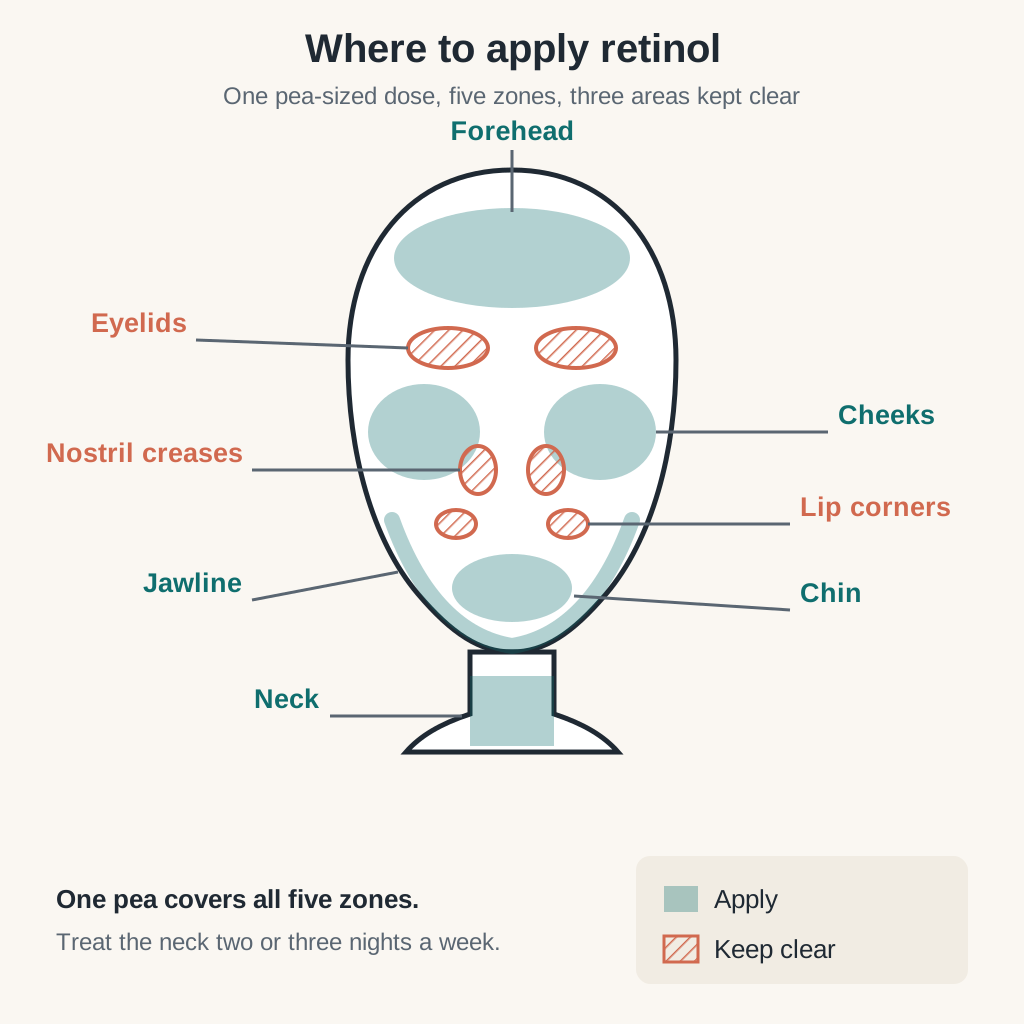
Spread a pea-sized amount across forehead, cheeks, chin and jawline, carry it down the neck, and keep it off eyelids, nostril creases and lip corners.
Where to apply retinol is a dosing question, not a targeting one. One pea covers the whole face; dabbing a heavier blob onto a single mark does not speed that mark up, it just concentrates irritation and risks the inflammatory darkening you are trying to fix. Five dots — forehead, each cheek, nose, chin — then spread outward.
Zones that take the full dose
Forehead, cheeks, chin, jawline and neck all tolerate the same nightly pea. Retinol forehead wrinkles respond to exactly that dose, because the horizontal lines there come from the same collagen loss retinol reverses — no extra layer, no separate product, just the months of consistency the collagen needs. If fine lines rather than pigment are your main concern, the ingredient comparison in serums that actually reduce wrinkles is the place to weigh retinol against peptides.
Zones to keep clear
Stop at the orbital bone — the ridge you can feel under the eyebrow and above the cheekbone. Eyelid skin is roughly 0.5 mm thick against 2 mm on the cheek, so it flakes and reddens first, and product migrates inward overnight anyway. Nostril creases and lip corners pool product and crack. Skin on the neck and chest is thinner than facial skin too, so treat it two or three nights a week rather than nightly.
Retinol serum or retinol cream for pigment
Serums carry higher, faster-penetrating retinol suited to oily or resilient skin, while creams buffer the same active in occlusive lipids and suit dry or sensitive skin.
Retinol serum uses come down to vehicle: a thin, mostly water-or-silicone base puts the active against the stratum corneum with little between, which is why serums tend to carry the higher percentages and reach pigment that sits deeper in the epidermis. The trade-off is less cushioning and more peeling in the first month. Delivery through the skin and the follicle is reviewed in research on how topical retinoids penetrate the epidermis.
Retinol cream benefits run the other way. Fatty alcohols, ceramides and squalane slow release and hold water in, so the same 0.3% feels like half of itself. Dry, sensitive or mature skin usually finishes a tube of cream and abandons a bottle of serum.
What is retinol cream used for beyond dark spots is largely maintenance: nightly tolerance-level dosing, the neck, and the backs of hands, where thin skin and constant washing make a serum sting. Many people run a serum on the face and a cream everywhere else.
Two retinol serum benefits are formulation rather than strength. Encapsulated retinol releases over hours instead of all at once, cutting irritation at the same percentage. Opaque, air-tight packaging matters because retinol oxidizes in light and air — a clear dropper bottle on a windowsill loses potency within weeks.
The strength ladder, in order: 0.25% for sensitive or first-time use, 0.5% as the working dose most pigment routines settle on, 1% for oily resilient skin that has already tolerated 0.5% for three months, and 0.1% adapalene as the over-the-counter retinoid that skips the conversion steps entirely and acts faster on acne-driven marks. Placing whichever you choose correctly in the queue matters, and skincare order and what goes first settles the order question.
How to layer retinol without wrecking your barrier
Pair retinol with niacinamide, ceramides and daily broad-spectrum SPF 30 or higher, and keep exfoliating acids and benzoyl peroxide on separate nights.
Is retinol good for skin that is already irritated? No — on compromised skin it compounds the damage. The sandwich method is the fix: a thin layer of plain moisturizer, then retinol, then moisturizer again. It cuts stinging noticeably and costs only a few weeks of slower progress. Two scheduled recovery nights a week, with nothing but cleanser and moisturizer, prevent most abandoned routines.
Three pairings are safe on the same night: niacinamide for redness, hyaluronic acid for the water loss, ceramides for the barrier lipids. A niacinamide serum applied before the retinol step is the simplest of the three to add.
- Same night, safe: niacinamide, hyaluronic acid, ceramides, azelaic acid.
- Alternate nights: AHA and BHA exfoliants, benzoyl peroxide, high-dose vitamin C.
- Every morning without exception: broad-spectrum SPF 30 or higher.
Acid exfoliation still has a place on the off nights, and exfoliating skin safely without over-stripping it covers how often is too often. For the buffering step itself, choosing a niacinamide serum that actually works explains which concentrations actually calm redness.
The benefits of retinol for skin compound only alongside sunscreen. Skip it and new melanin replaces every spot you faded, because retinol has thinned the stratum corneum that was scattering some of that UV. That is not a nice-to-have; it is the difference between twelve weeks of progress and twelve weeks of nothing.
The honest limitation: retinol is maintenance, not a cure. Turnover returns to baseline within weeks of stopping, collagen gains fade over months, and pigment creeps back if sun exposure continues. Budget for a tube every three to four months, indefinitely.
One practical routine tip a week, written for people using actives on pigment.
One retinol-safe routine tip a week. No product dumps.
Thanks — you're on the list.

