

A skincare set is a pre-packaged routine of three to five products - typically a cleanser, a treatment serum, a moisturizer and SPF - sold together at a discount. It earns its place only when every item fits your skin type and gets used; one product you skip erases the bundle saving.
What Is in a Skincare Set, and What Are You Actually Buying?
A skincare set is a boxed routine - usually a cleanser, a treatment, a moisturizer and SPF in some combination - picked to work together rather than to cover every possible need. The product count is the first thing to read: most skincare sets hold three to five items, and that ceiling is deliberate. Four steps is about as much as people keep doing past week three, so a sixth bottle becomes the one at the back of the cabinet.
Retailers shelve the same boxes under skin care sets and brands use both spellings on one page, so the two phrases return identical inventory. The clumsier strings shoppers type, skin care sets skincare among them, land on those same collection pages. Two listings that look like rivals are often the same four products photographed on different linen.
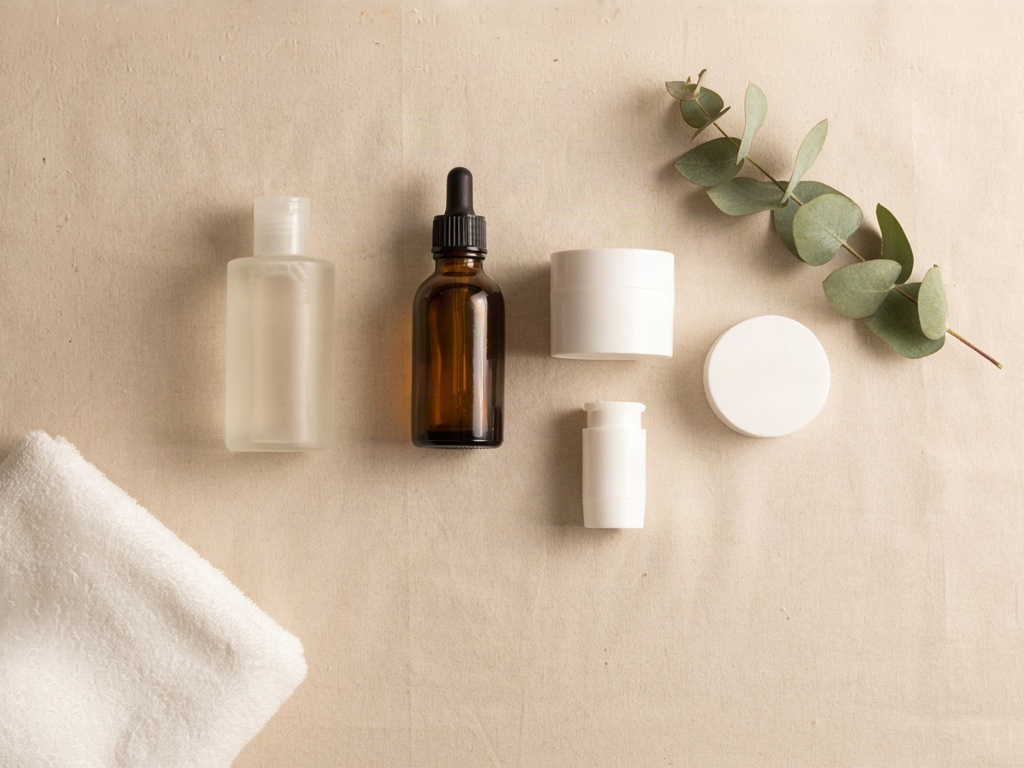
Three shapes hide under one label. A curated facial set is built around a single concern, with a treatment at its centre and the other items chosen to support it. A seasonal skin set is a merchandising exercise: holiday packaging, sizes trimmed, the concern unstated. A loose skin care products set is line overstock, which can still be good value if the sizes are honest.
A set is the wrong purchase for one specific reader: anyone already halfway through two of the four products inside. You pay for duplicates you cannot return, and they expire while they wait. Starting from nothing is the opposite case, and sequencing matters more than the box then - how to build a skin care routine from scratch sets out which step to add first.
Does a Skincare Kit Save Money, or Just Bundle What You Would Skip?
A kit saves money only when you would have bought every product in it, because each item that sits unused quietly raises the real cost per use of the rest. The honest sum is price divided by total millilitres, not the sticker price measured against the sum of full-size tickets. Retail arithmetic flatters sets because the reference price assumes you wanted all four items at full size.
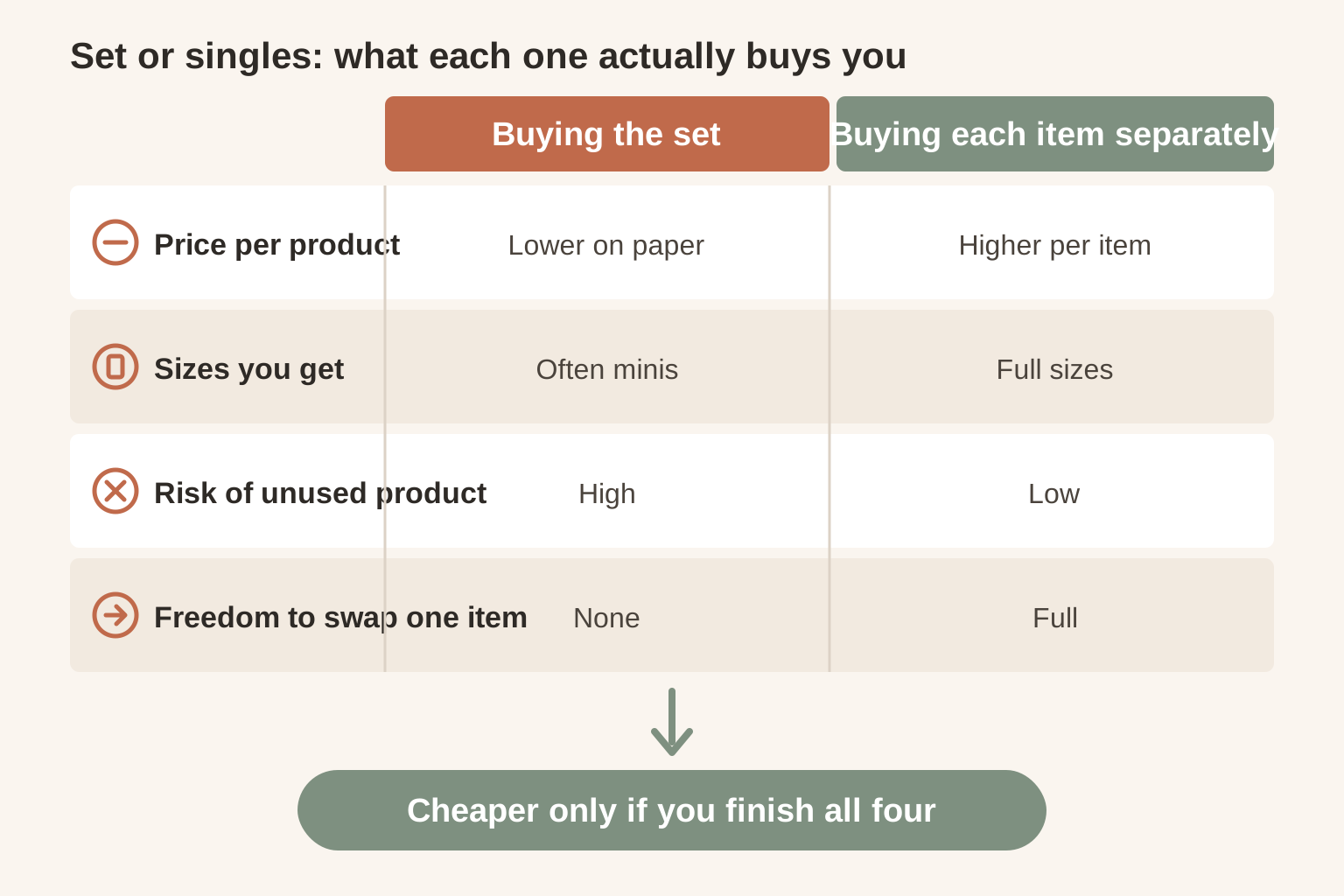
Run one example. A skincare kit priced like three full-size products looks like a quarter off. Leave the toner unopened and you have paid three prices for three products, with the discount gone and a bottle you will bin at month fourteen. A skin care kit earns its label when all four items enter rotation inside a fortnight.
Size changes the maths more than the discount does. A skin care pack of 15 ml travel bottles can run four times the cost per millilitre of a skin care bundle of full sizes, so a deep percentage off tiny volumes is still the expensive option. Check the volume on the carton before the percentage on the banner - choosing skincare products that actually earn their price applies the same test to single products.
What a skincare bundle genuinely buys is not only price. Textures are formulated to layer without pilling, you pay one shipping charge, and someone has already made the decision you were avoiding. A skin care package is the wrong shape when you need one replacement rather than four new habits: buy the single tube and keep the routine you already finish.
How Do You Grade a Skincare Set Before You Buy It?
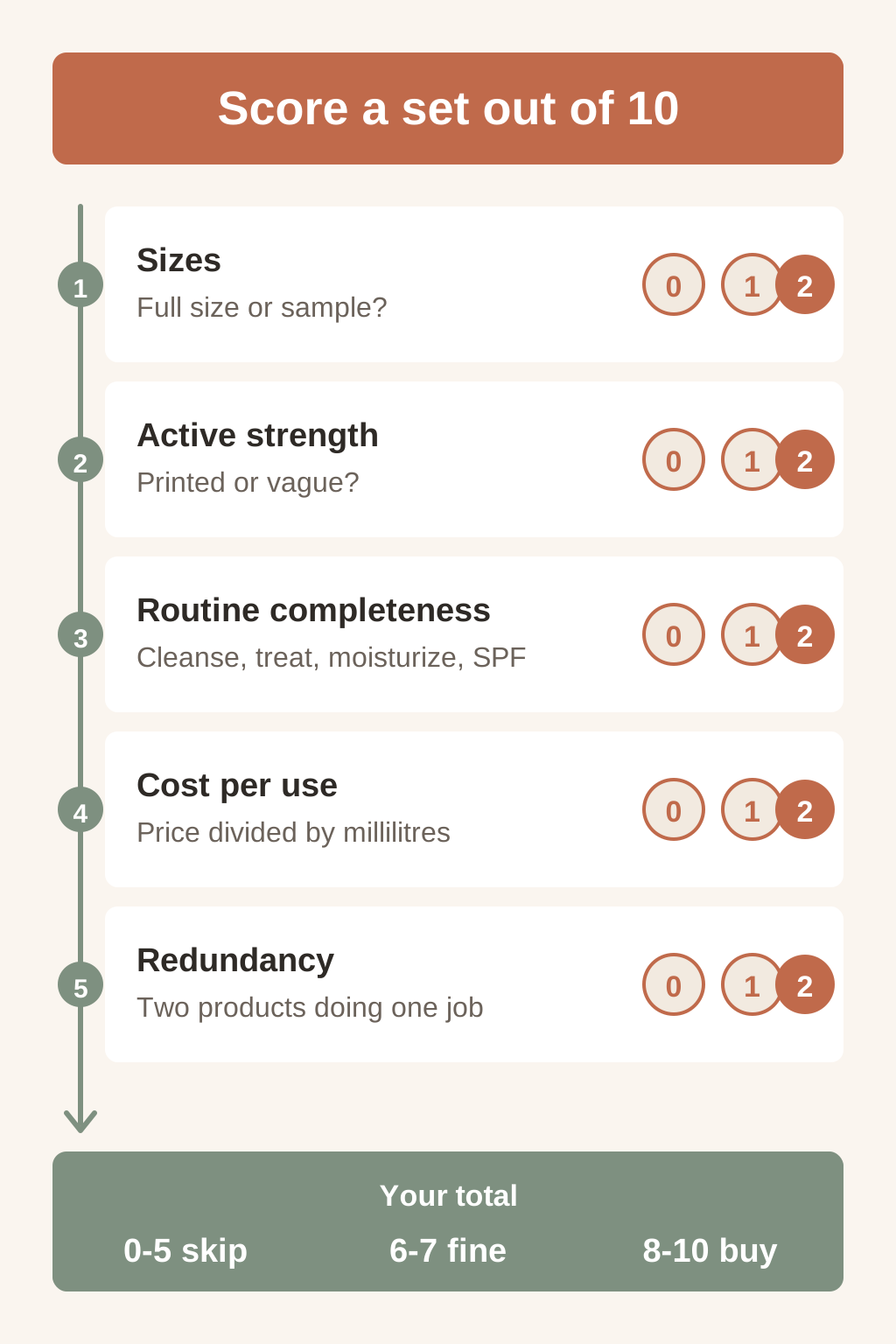
Grade any set zero to two on five checks - sizes, active strength, routine completeness, cost per use and redundancy - and the box copy stops mattering. Ten points is the ceiling, six is the pass mark, and most holiday sets land between four and seven once scored honestly.
If a set leans on clinical or professional labeling to justify a higher price, check what medical grade skincare actually means before you score its active strength.
The five-check scorecard
| Check | Score 0 | Score 1 | Score 2 |
|---|---|---|---|
| Sizes | Sachets only, under 5 uses | Deluxe minis, 10-20 uses | At least two full sizes |
| Active strength | No active named | Active named, no number | Percentage printed on the carton |
| Routine completeness | One or two steps | Three steps, no SPF | Cleanse, treat, moisturize, protect |
| Cost per use | Dearer per ml than singles | Within 10 per cent of singles | Clearly cheaper per ml |
| Redundancy | Two products doing one job | Overlap in one pair | Every item has its own job |
Sizes decide whether a box is a routine or a trailer. A 5 ml sachet gives three or four uses, a deluxe mini ten to twenty, and only a full size lets a treatment run the eight to twelve weeks a retinoid needs. Active strength is the second gate: a printed percentage beats a named ingredient with no number, because "contains vitamin C" is true at 0.5 per cent and at 15.
Routine completeness asks whether a facial skin care kit covers all four jobs. SPF is the one most often missing and the one that changes outcomes most, so read the filter and the number - what SPF and broad spectrum mean on a sunscreen label explains what the label actually promises. Cost per use and redundancy close it out: two cleansers in one box is a point lost, not a bonus.
The best skin care sets and the best skin care kits score eight or higher on this scale, and they tend to be plain boxes from single-concern lines rather than the ones with ribbon. The best skincare sets fail surprisingly often on redundancy alone. A face care kit scoring under six is a sample box wearing a routine's name: fine as a gift, wrong as a routine. If the cleanser is the item you doubt, picking a face wash for your skin type narrows that slot first.
Which Set Fits Your Skin Type and Your Main Concern?
Match the set to the job: hydration sets for tight or flaky skin, retinoid-led sets for lines, oil-control sets for shine, and fragrance-free sets for reactive skin. A hydrating facial kit should lead with glycerin or hyaluronic acid high in the ingredient list and finish with an occlusive; an oil-control set earns its place with a salicylic cleanser and a gel moisturizer, not a mattifying powder.
An anti wrinkle skin care set needs three things and no more: a retinoid with a printed strength, a buffering moisturizer bland enough to layer under it, and a daily SPF 30 or higher. Skip any of the three and the set cannot deliver, because retinoid results depend on tolerance and on not re-damaging skin by daylight. The biology is unglamorous - how connective tissue changes leave aging skin thinner and drier describes what a cream is working against.
Not sure which box is built for your face? Six questions, two minutes, your skin type and top concern.
Beauty Followup may earn a commission on purchases made through these product links.
A skin care kit for women rarely differs in chemistry from a unisex box; the differences are fragrance load, packaging and about 15 per cent on the price. A moisturizer set of a light day texture and a richer night cream is worth it in winter and redundant in July, when one jar does both jobs. For reactive skin start with the gentlest layer, which hydrating toners for dry, sensitive skin covers in detail, while retinol strengths and how to introduce them safely explains the strengths before you commit to a retinoid box.
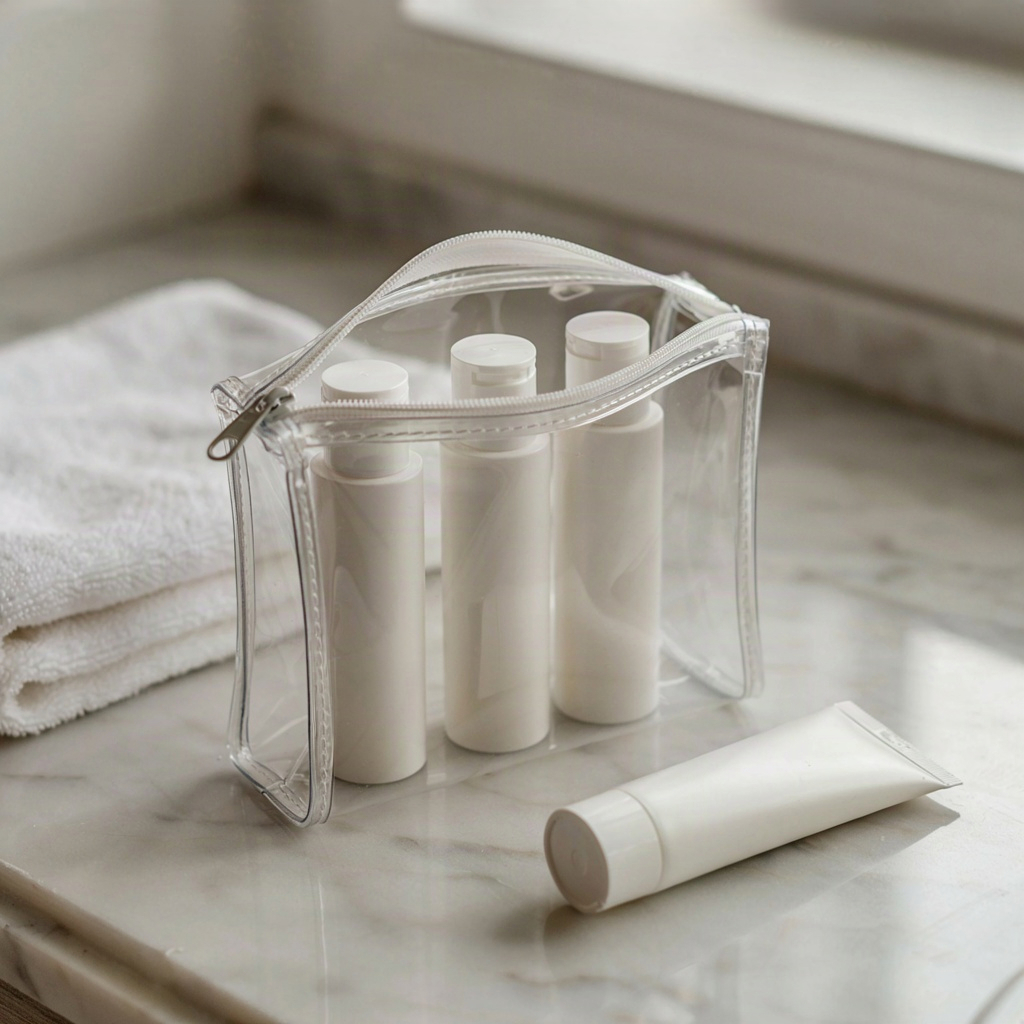
A travel skincare kit has requirements a home set does not: every bottle under 100 ml for cabin bags, screw caps or a pump lock rather than flip tops, and enough volume for two weeks. A 15 ml sunscreen covers roughly three full-face-and-neck days at the correct dose, so it is the item to supplement rather than trust.
How Cheap Can a Set Get Before It Stops Being Worth It?
Useful sets start at roughly the price of two full-size products, and trial sizes are the cheapest honest way to audition a line before committing to it. Below that floor the volumes stop supporting a routine: three usable sizes inside is the practical minimum, and the best affordable skin care sets hit it by dropping the eye cream rather than by shrinking everything.
A skin care sample kit answers a narrow question well. Fourteen uses tell you whether a cleanser strips, whether a moisturizer pills under SPF, and whether a scent is tolerable. Fourteen uses will not show a retinoid result, which needs eight to twelve weeks. Treat a skincare trial set as an audition for texture, scent and tolerance, never as evidence that a formula works.
The skincare bundle set trap is a deep discount on volumes too small to finish a single concern: 70 per cent off five sachets is still five sachets. Price floors are worth memorising instead. A competent cleanser and moisturizer both sit near the bottom of the market, a broad-spectrum SPF costs little more, and the serum is where the money genuinely goes - which is why vitamin C serum formulas worth paying for is the slot to overspend on.
Spending less does not mean doing less, as long as the three jobs stay covered. a three-step routine built on a tight budget reaches the same conclusion clinically, including letting a moisturizer with SPF 30 cover two steps at once. The cost of that shortcut is control: one product means one texture, one scent and one filter type, with nothing to swap when your skin changes in February.
How Do You Build Your Own Set Instead of Buying One?
Buy one product per step in routine order - cleanse, treat, moisturize, protect - and you end up with a kit tuned to your skin and carrying no filler. A skin care starter kit assembled this way costs more per product and less per useful product, which is the only ratio that matters after the first month.
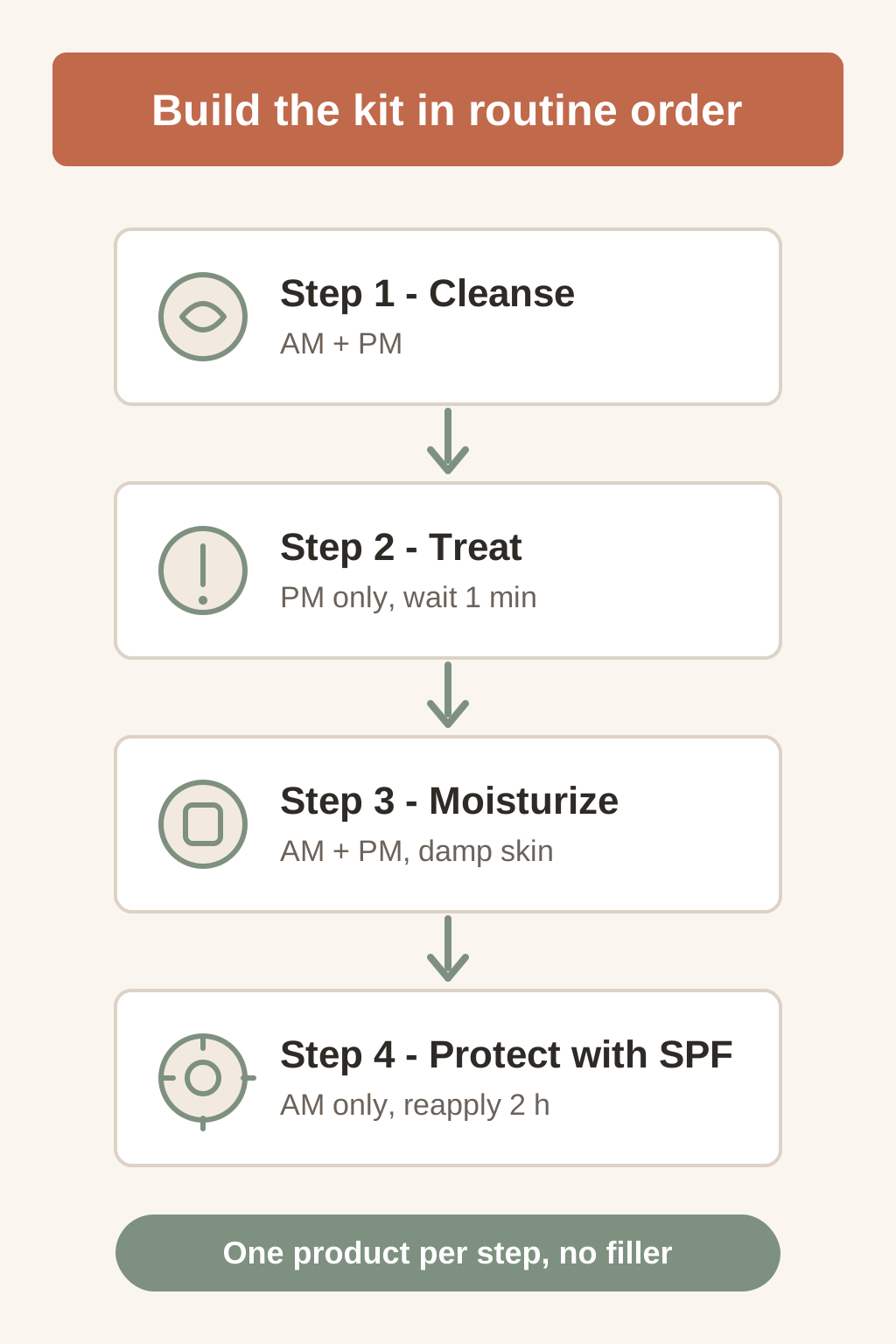
Step 1 · Cleanse
One wash that leaves skin comfortable rather than squeaky. A face cleanser kit of one gel and one cream wash pays off only if your skin swings between oily summers and tight winters; otherwise one bottle is the whole step.
Step 2 · Treat
The treatment is the step a skin care routine kit exists for, and the one to choose last - once you know whether the concern is dehydration, texture or pigment.
Step 3 · Moisturize
The layer that holds the treatment in place. Texture matters more than price: a gel for oily skin, a cream for anything that feels tight by mid-afternoon.
Step 4 · Protect with SPF
The only step with a dose: a quarter teaspoon for face and neck every morning, reapplied every two hours outdoors.
Space the purchases two weeks apart so each addition can be judged on its own, and keep the order fixed: the order dermatologists recommend for applying products is cleanse, treat, then moisturize or protect. Longer routines extend the same logic, and the correct order to layer nine products handles the fuller stack. Self-assembly costs you more decisions, several shipping charges and no bundle discount.
Answer four questions and get an ordered routine with one product slot per step, priced inside your budget band.
A printable seven-day AM and PM tracker, for anyone who has bought a set and wants to know whether they finish it.
What Makes a Set Worth Giving to Someone Else?
A giftable set is fragrance-free, gentle enough for almost any skin, full-size where it counts, and free of actives the recipient has to learn to use safely. Gifting removes the thing a good purchase depends on - knowing the skin it is for - so the safe box is deliberately boring: a mild cleanser, a ceramide moisturizer, a mineral SPF 30 or higher.
Three actives do not belong in a skin care gift set. Prescription-strength retinoids need a tolerance ramp nobody reads on Christmas morning. High-percentage acids can burn skin that was already compromised. Benzoyl peroxide bleaches towels and pillowcases, which turns a present into a laundry problem.
Packaging decides whether the set gets used. Pumps beat jars because fingers in a jar shorten its life, printed directions beat a card that goes in the bin, and nothing should need decanting before a flight. A mineral SPF is the most giftable of the three, as long as the finish suits the recipient - mineral sunscreen that avoids a white cast covers which formulas skip the chalky cast on deeper skin tones.
One honest failure mode is worth naming: skincare can read as a comment on someone's face. A set aimed at wrinkles or breakouts says something the card does not. Hydration, hands and lips are neutral ground. Given a set that does not suit you, keep the sunscreen, pass the rest to someone whose skin it fits, and do not force a routine built for a different face.
One routine tip a week, plus the sets worth their discount.
One routine tip a week, plus the sets worth their discount. No product dumps.
Thanks — you're on the list.


