

An oil free moisturizer hydrates with humectants such as glycerin and hyaluronic acid plus light silicones instead of plant or mineral oils, so it hydrates without adding shine. Choose a gel for oily skin, a lotion for combination skin, a cream for dry skin, and confirm the label reads non comedogenic.
What is an oil free moisturizer, and what is actually in it?
An oil free moisturizer hydrates with humectants such as glycerin and hyaluronic acid plus light film-formers, replacing the plant and mineral oils that give classic creams their weight. Strip the oils out of a formula and three ingredient families have to do their work: humectants that bind water, polymers that thicken without greasiness, and film-formers that slow evaporation.
In practice that means glycerin in the first five ingredients, sodium hyaluronate or a hyaluronic acid blend for surface plumping, panthenol and betaine for soothing, and dimethicone or a dimethicone crosspolymer to leave a breathable film instead of an oily one. A non oil moisturizer skips plant butters, triglycerides and the ester oils that hide behind names like isopropyl myristate.
That is why an oil free facial moisturizer can still feel cushioned rather than squeaky. Humectants hold water inside the stratum corneum, the top 15 to 20 micrometres of skin, so hydration is measured as water content in the layer itself, not as a coating sitting on the surface.
The honest limit is worth knowing before you buy. Glycerin can raise transepidermal water loss by around 29 percent when it is used without anything to seal it, which is why good oil free skin care always pairs a humectant with a film-former. Reading the label for that pairing matters more than the marketing claim, and it is the same logic behind how to pick a face moisturizer for your skin type. Dermatology reviews that explain how humectants and occlusives hydrate without added oils describe the three roles in the same order.
Oil free vs non comedogenic: what do the labels promise?
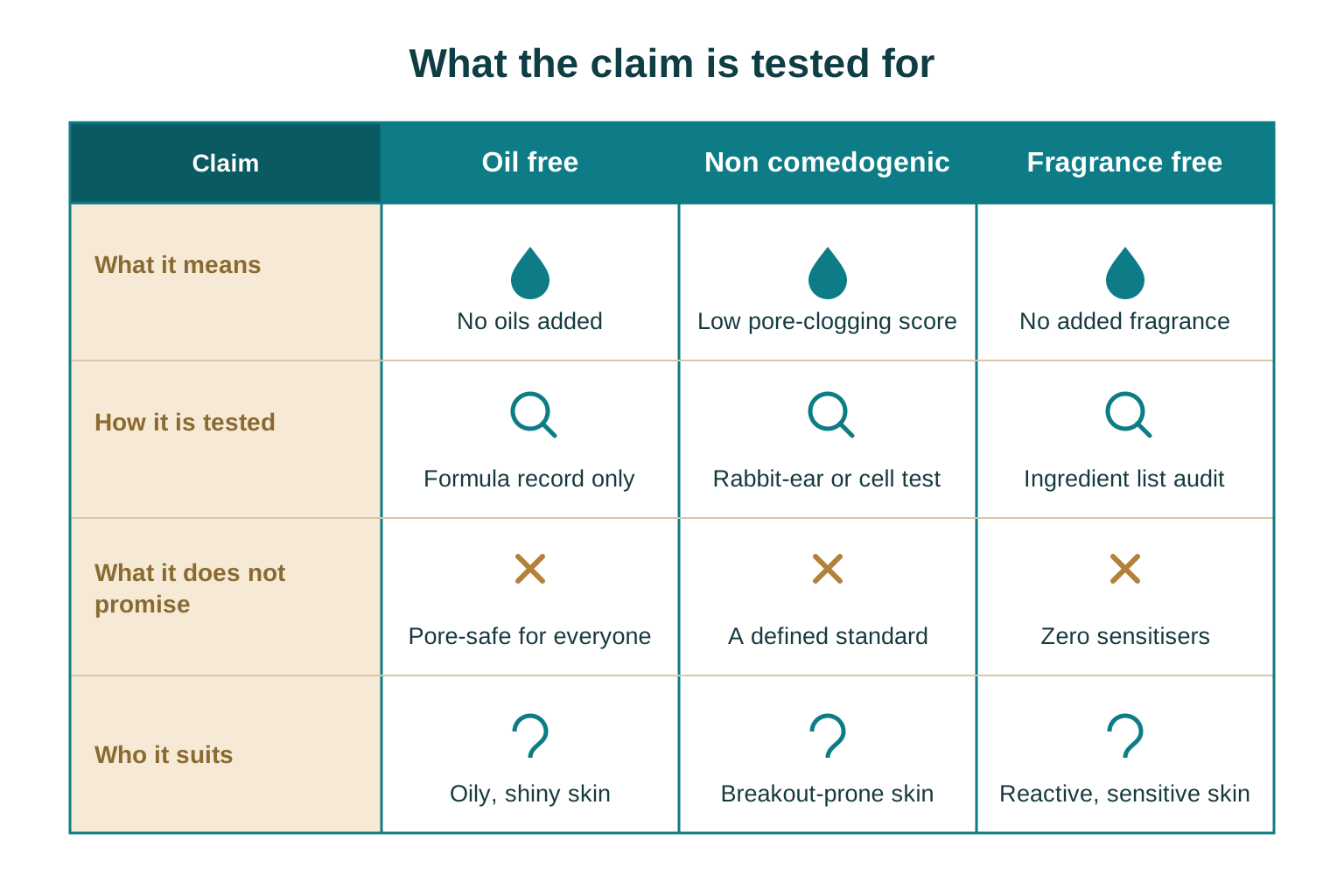
Oil free means no oils were added, non comedogenic means a formula scored low on a pore-clogging test that no regulator defines, and the two claims are not interchangeable. Three claims crowd the front of an oil free moisturiser box, and each one is tested differently.
| Claim | What it means | How it is tested | What it does not promise |
|---|---|---|---|
| Oil free | No plant, mineral or ester oils in the formula | Formulation record only, no skin test | That nothing in it can clog a pore |
| Non comedogenic | Scored low on a comedogenicity scale | Rabbit-ear scoring, or newer cell-line models | A defined standard: no regulator sets the threshold |
| Fragrance free | No added fragrance compounds | Ingredient audit against a fragrance list | Freedom from other sensitisers such as preservatives |
So a non greasy moisturizing cream can carry the non comedogenic claim on in-vitro data alone, because the traditional rabbit-ear test scores a substance under 1.5 out of 5 and nobody audits which model a brand used. One 2025 case-control study found cleansers with comedogenic ingredients were an independent risk factor for acne, with an adjusted odds ratio of 2.49.
Read the first six lines of an oil free skin cream instead. Esters and waxes sit there under names such as caprylic/capric triglyceride, cetyl alcohol and shea butter, and anything listed before the preservative is present at more than roughly one percent. That reading habit is the core of what non-comedogenic really means for acne prone skin, and the research linking comedogenic cosmetic ingredients to breakouts puts numbers on the risk.
Use oil free moisturiser reviews for finish, pilling and pump quality, which thousands of users judge reliably. Treat them as weak evidence on breakouts: a single reviewer cannot separate a formula from a new cleanser, a new SPF and a bad fortnight.
Not sure whether your skin is oily or simply dehydrated? Six questions, two minutes, and you get a named skin type plus your top concern.
Which is the best oil free moisturizer for your skin type?
The strongest pick depends on skin behaviour: a gel for oily skin, a soothing lotion for acne-prone skin, a fragrance-free formula for sensitive skin and a richer version for dry skin. Five angles cover almost every reader, so the best oil free moisturizer here is chosen by how skin behaves two hours after cleansing rather than by rank order.
For oily and acne-prone skin, a good oil free moisturizer runs on a water-light base, a short preservative system and no heavy esters in the top third of the list. An oil free lotion for acne has a second job: it has to sit under benzoyl peroxide or a retinoid without stinging, which is why niacinamide, panthenol and allantoin earn their place in those formulas.
Price bands are simpler than they look. Under roughly 15 US dollars buys competent hydration; 25 to 45 dollars usually buys texture, a better pump and a lower fragrance load; beyond that you are mostly paying for the sensorial finish. Paying more rarely buys more water in the skin, so a good oil free face moisturizer at drugstore price is a legitimate answer.
Seven concrete label checks, including niacinamide percentage and texture, sit in seven label checks for an oily skin moisturizer.
Affiliate disclosure: we earn a commission on purchases made through these links, at no extra cost to you.
Gel, lotion or cream: which oil free texture fits your skin?
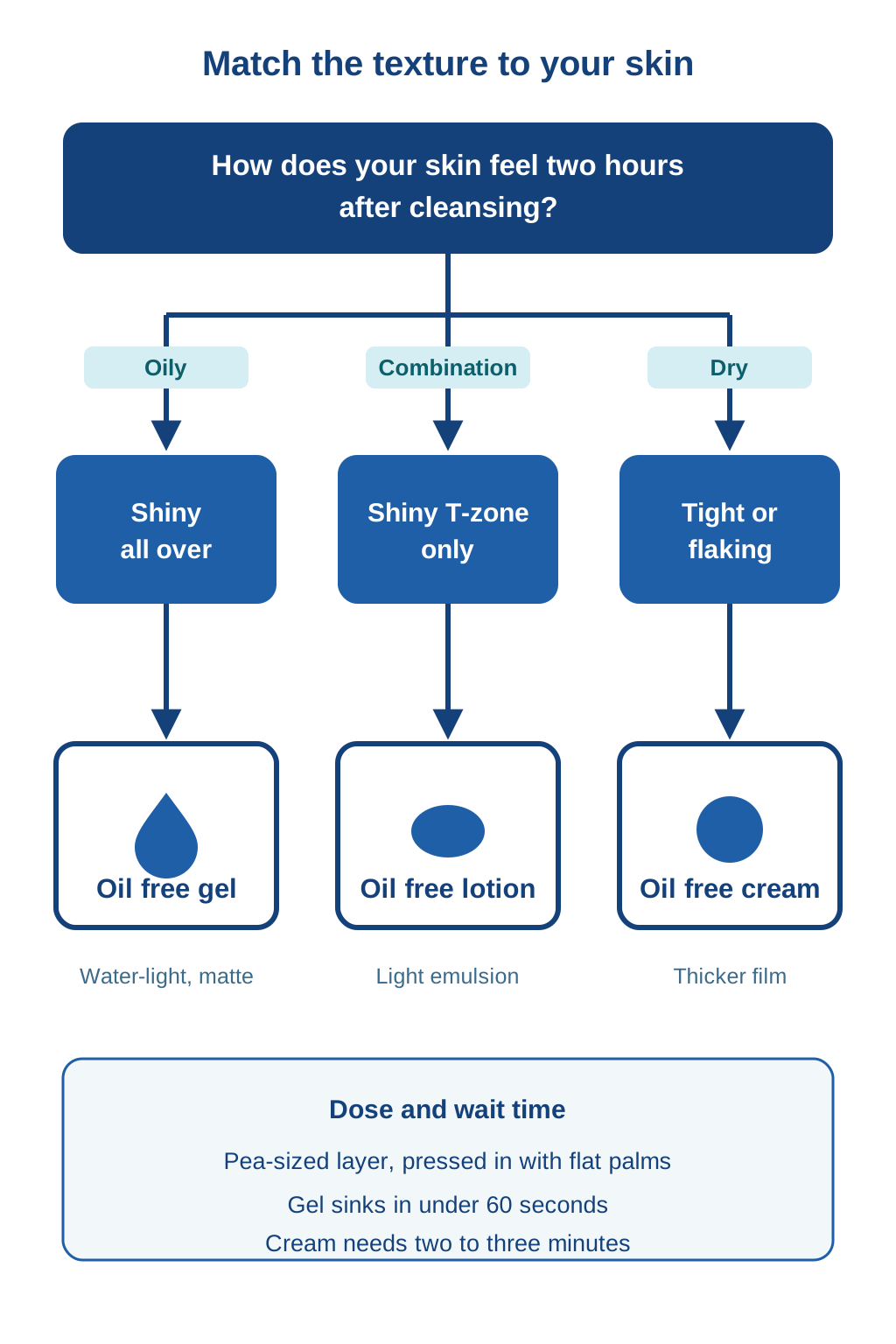
Gels suit skin that shines all over, lotions suit a shiny T-zone with normal cheeks, and oil free creams suit skin that feels tight or flakes after cleansing. An oil free gel moisturizer carries 80 to 90 percent water with a polymer thickener; an oil free lotion face formula adds more film-former; an oil free face cream pushes that load higher still for dry patches.
Absorption time follows directly. A light oil free moisturiser sinks in under 60 seconds because there is little to sit on the surface, while a cream needs two to three minutes, and makeup applied before that window is what drags product into visible rolls.
Climate matters as much as skin type. In humid air a lightweight oil free moisturizer is enough, since slow evaporation does half the work; in dry winter heating the same formula can feel spent by evening, which is the honest trade-off of a light oil free moisturizer for oily skin. A lightweight oil free face moisturizer is dosed at a pea-sized amount for the whole face, pressed in with flat palms rather than rubbed, since rubbing is what breaks a silicone film into pills.
A gel finishes genuinely matte when the polymer is the main thickener, and slightly tacky when glycerin runs high; a thin powder dusted over the T-zone fixes the latter in seconds. If you need one texture for most of the year, a plain unscented lotion is the safest default, with a gel kept for the hottest eight weeks. Switching texture alone also keeps the rest of the order intact, which is set out in the nine-step skincare order and what goes first.
Does an oil free moisturizer with sunscreen protect well enough?
A hybrid works when it is broad spectrum, SPF 30 or higher, and applied at a full quarter-teaspoon for the face; thin layers deliver far less than the labelled number. The US regulator only lets a product print "broad spectrum" once it clears a critical-wavelength test of at least 370 nanometres, and it recommends SPF 15 as the floor for any sun-protection benefit at all.
The dose is where hybrids fail. SPF is measured in the lab at 2 milligrams per square centimetre, roughly a quarter teaspoon for a face, and most people apply a third to half of that when they are using the product as a moisturizer rather than a sunscreen. Protection falls faster than the number suggests, so a thin smear of SPF 30 behaves closer to SPF 10.
A two-step routine with an oil free face moisturizer plus a separate sunscreen solves the dose problem, at the cost of 60 seconds and two products. A single hybrid wins on compliance: the SPF you actually wear beats the one you skip on a rushed morning. Keep the steps separate if you use a morning prescription retinoid, since a hybrid encourages a thin layer exactly where you need a generous one. The label rules are set out in the FDA rules behind a broad spectrum SPF label, and the format comparison continues in choosing a daily SPF moisturizer for the face.
Affiliate disclosure: we earn a commission on purchases made through these links, at no extra cost to you.
What should an oil free night moisturizer do while you sleep?
An evening formula should buffer a retinoid, slow overnight water loss and leave skin supple by morning without the heavy occlusive film that triggers congestion. Those three jobs pull in different directions, which is why an oil free night moisturizer is formulated differently from a daytime fluid: more film-former, more soothing actives, no mattifying powders you no longer need in bed.
Layering decides how much stinging you feel. Apply the retinoid to dry skin, wait 10 to 20 minutes, then press a non oily face moisturizer over the top; sandwiching a layer underneath as well cuts irritation further at the cost of some retinoid potency. Skin that is new to retinoids tolerates the buffer better three nights a week than seven.
The morning test is simple. Skin that feels supple and slightly plump on waking means a non oily moisturizer is doing enough; skin that feels tight, or that looks creased where the pillow pressed, means the film is too thin for your bedroom air.
The trade-off of a water-light evening formula is exactly that: in a heated winter room it often needs a second pressed layer on the cheeks, applied five minutes after the first. Which checks separate a working formula from a pretty jar is covered in label checks before buying a night cream.
Affiliate disclosure: we earn a commission on purchases made through these links, at no extra cost to you.
How do you pick for sensitive or dry skin without added oils?
Sensitive skin needs a fragrance-free formula with a short preservative list, while dry skin needs ceramide-identical actives and a heavier film-former to replace the missing lipids. For an oil free moisturizer for sensitive skin, three rules shorten the shortlist: fragrance-free rather than unscented, no alcohol denat in the first eight ingredients, and a preservative system of one or two agents rather than four.
If sensitive or dry skin also itches, see how to choose a fragrance free moisturizer for itchy skin, from the itch-calming ingredients to the hidden triggers worth skipping.
For skin that reacts as well as shines, the steps for choosing a moisturizer for sensitive skin, from a 10-point label score to a safe patch test, narrow the field further.
Then test before you commit. An oil free sensitive skin face moisturizer goes behind the ear or on the inner forearm twice a day for three days, because delayed contact reactions to preservatives typically appear at 48 to 72 hours rather than within minutes.
Dry skin needs a different compensation. An oil free moisturizer for dry skin cannot borrow lipids from an oil phase, so it leans on ceramide-identical actives, cholesterol-free polymer blends and a thicker dimethicone film to cut water loss. Expect a slower sink-in time and a slightly cushioned finish.
There is a point where an oil free hydrating moisturiser is the wrong call. Skin with a damaged barrier, stinging water and visible flaking usually needs real lipids, so a ceramide-rich balm at night and a water-light formula in the morning works better than forcing one texture to do both. Dermatologist advice on keeping acne treatment tolerable sits in dermatologist guidance on moisturizing acne-prone skin, and the texture options are compared in dry skin moisturizers that actually hold water.
How do you apply it without pilling or midday shine?
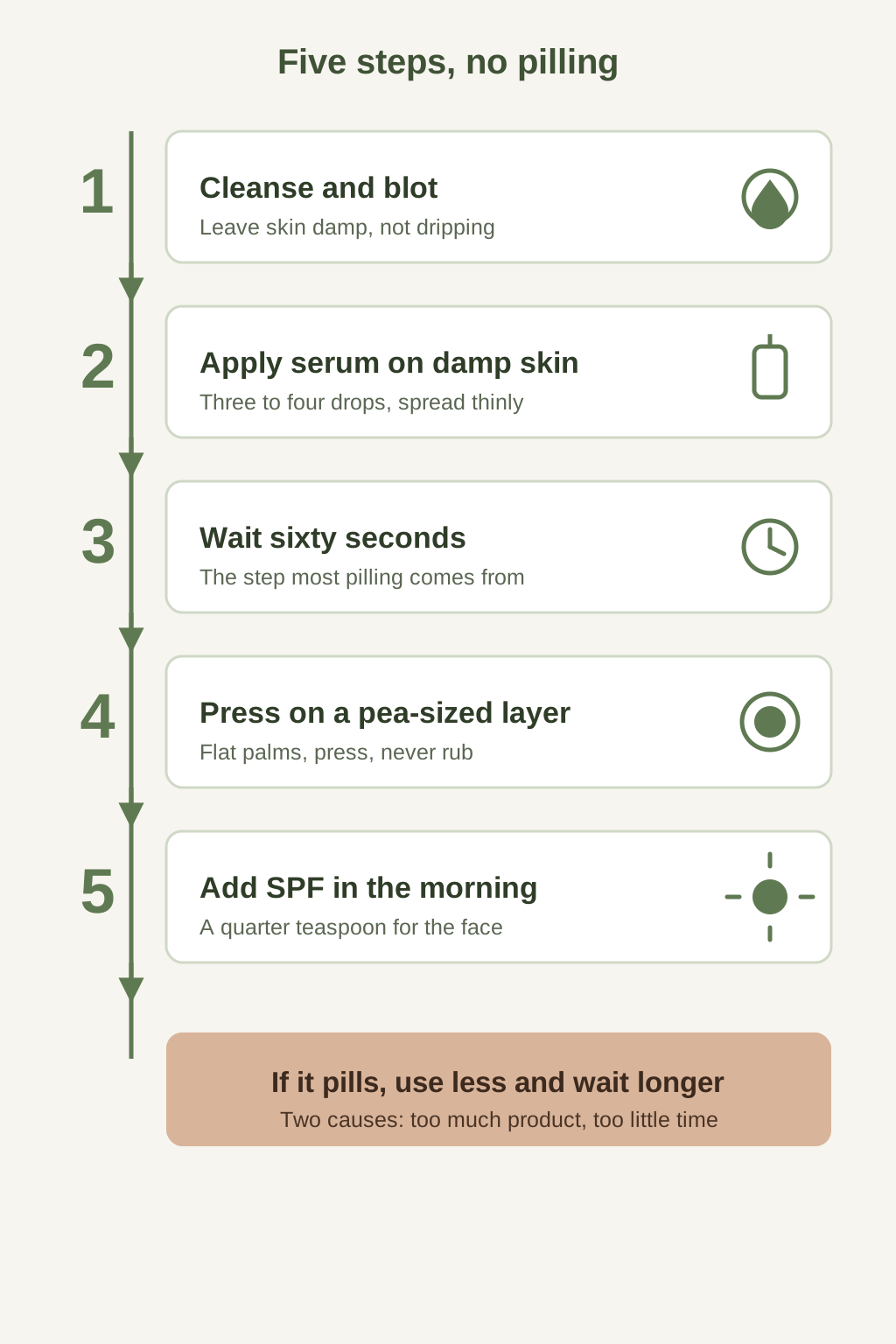
Apply a pea-sized layer to damp skin, wait sixty seconds after a serum, press rather than rub, and finish with SPF in the morning to stop pilling and shine. Five steps in order: cleanse and blot until skin is damp rather than dripping, apply serum, wait 60 seconds, press on a pea-sized layer of an oil free moisturiser for face, then add sunscreen in the morning.
Pilling has two causes and both are fixable without buying anything. Too much product is the first, since a silicone film can only spread so thin before it rolls; too little waiting is the second, because a wet serum and a film-former mixed on the skin form visible flecks within seconds.
When shine returns by mid-afternoon, blot with a tissue and press the area gently rather than adding a second layer, which only puts more film on skin that already has enough.
Three habits undo an otherwise good routine: scrubbing with a cloth or sponge instead of fingertips, stacking two film-formers from different products, and skipping hydration altogether because skin already feels oily. Where each step sits across a full day is mapped in building a morning and night skin care routine.
A one-page ingredient cheat sheet, sized for a phone screen while you read a label in the aisle, with the humectants and film-formers that suit your skin type.
One texture-and-ingredient tip a week, written for people who read labels.
One texture-and-ingredient tip a week. No product dumps.
Thanks — you're on the list.


