

The right fragrance free moisturizer for itchy skin pairs a barrier repair base (ceramides, glycerin, petrolatum or dimethicone) with an itch-calming active such as colloidal oatmeal or 1% pramoxine, and skips fragrance, essential oils, menthol and drying alcohol. Apply it within three minutes of bathing, twice daily, to break the itch-scratch cycle.
What does a fragrance free moisturizer for itchy skin actually need to do?
A fragrance free moisturizer for itchy skin has to rebuild the skin barrier with humectants, emollients and occlusives while adding nothing that can sting, scent or sensitize already irritated skin. Itch usually starts with a leaky outer layer: when the lipids between skin cells thin out, water escapes faster, the surface tightens and microscopic cracks let irritants reach the nerve endings that fire the itch signal.
A good formula does two jobs at once. It puts water and lipids back, and it stops adding new irritants. Three ingredient classes handle the first job:
- Humectants such as glycerin, hyaluronic acid and urea pull water into the top layer of skin.
- Emollients such as ceramides, squalane and fatty alcohols fill the gaps between cells so the surface feels smooth instead of rough.
- Occlusives such as petrolatum and dimethicone form a thin seal that slows evaporation.
A gentle fragrance free moisturizer combines at least one of each, and the label says "fragrance-free" rather than "unscented". The tradeoff is sensory: these formulas smell faintly of their base oils and can feel plainer than scented creams.

For the full selection process on reactive skin, including a label score and a patch test, read our guide on how to choose a moisturizer for sensitive skin.
Why does fragrance make itchy skin worse, and is unscented the same thing?
Fragrance is one of the most common causes of cosmetic contact allergy, and an unscented label can still hide masking fragrance, so only a true fragrance-free formula removes the trigger. A single "parfum" entry can stand for dozens of aromatic chemicals, and once your immune system becomes sensitized to one of them, every exposure can bring back redness and itching for days.
The labels mean different things:
- Fragrance-free: no ingredient was added to give the product a scent.
- Unscented: the product has no noticeable smell, which can mean a masking fragrance was added to cancel the odor of the base.
That gap is why an unscented moisturizer for sensitive skin can still trigger itching. Essential oils are the other loophole: lavender, tea tree, citrus and rose oils are often marketed as "natural" rather than as fragrance, yet they carry the same allergens. Watch for limonene, linalool, citronellol and geraniol near the end of an ingredient list; these are scent compounds that must be named when present over set levels in some markets.
A true fragrance free moisturizer for sensitive skin leaves out added parfum, essential oils and botanical extracts chosen for scent. When a name on the list is unfamiliar, look it up with a skincare ingredient checker before you buy. The limitation: no label rule protects against every allergen, so a patch test still matters.
Trimming the routine to fewer products is the other half of calming reactive skin, a principle covered in our seven rules for calmer sensitive skin.
Which ingredients calm itchy skin, and which ones trigger it?
Ceramides, glycerin, petrolatum, colloidal oatmeal and pramoxine calm itchy skin, while fragrance, essential oils, menthol and denatured alcohol trigger it, and an eight-point label score separates the two in under a minute. Colloidal oatmeal is an FDA-recognized skin protectant, and pramoxine at 1% is an over-the-counter anti-itch active that numbs the nerve endings without the thinning risk of steroid creams.
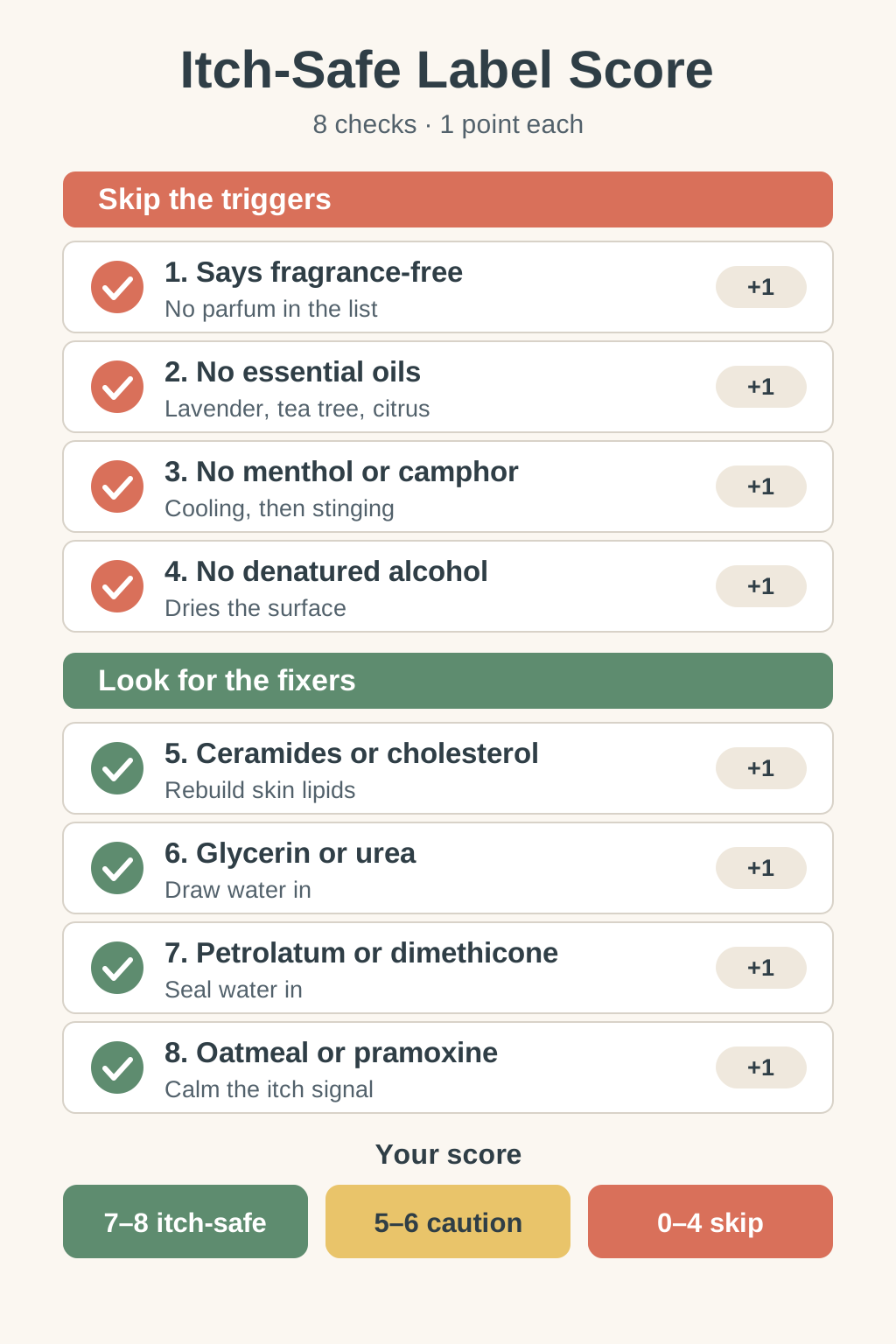
Use the Itch-Safe Label Score: give the product one point for each row it passes.
| Check | What passes | Why it matters for itch |
|---|---|---|
| Skip the triggers | ||
| 1. Says fragrance-free | "Fragrance-free" on the pack, no "parfum" in the list | Removes the most common cosmetic allergen |
| 2. No essential oils | No lavender, tea tree, citrus, peppermint or rose oil | Same allergens as fragrance under a natural label |
| 3. No menthol or camphor | Neither appears in the list | Cooling relief fades in minutes and can sting broken skin |
| 4. No denatured alcohol | No "alcohol denat." or SD alcohol in the first ten ingredients | Dries the surface and worsens water loss |
| Look for the fixers | ||
| 5. Ceramides or cholesterol | Ceramide NP, AP or EOP, or cholesterol | Rebuilds the lipid layer between skin cells |
| 6. Glycerin or urea | Either in the first five ingredients | Draws water into the top layer |
| 7. Petrolatum or dimethicone | Either anywhere in the list | Seals water in for hours |
| 8. Oatmeal or pramoxine | Colloidal oatmeal or pramoxine 1% listed as an active | Directly calms the itch signal |
| Score: 7–8 itch-safe · 5–6 caution, patch test first · 0–4 skip | ||
Fatty alcohols such as cetyl and cetearyl alcohol are different from drying alcohol; they soften skin and do not cost a point. To check a long list quickly, paste it into a free ingredient list analyzer or check ingredient comedogenic ratings for single ingredients. One honest limit: the score flags common triggers, not personal allergies such as lanolin or propylene glycol, which only a patch test or a dermatologist can confirm.
The humectant, emollient and occlusive balance that keeps the score high is explained in our guide to dry skin moisturizers that hold water.
Which fragrance free face moisturizer texture fits your skin type?
Oily skin does best with a lightweight gel, combination skin with a lotion, and dry, itchy skin with a ceramide cream, so the texture of a fragrance free face moisturizer should follow your oil level. Texture is mostly a measure of how much occlusive the formula carries: more occlusive means more water held in, but also more shine and a higher chance of clogged pores.
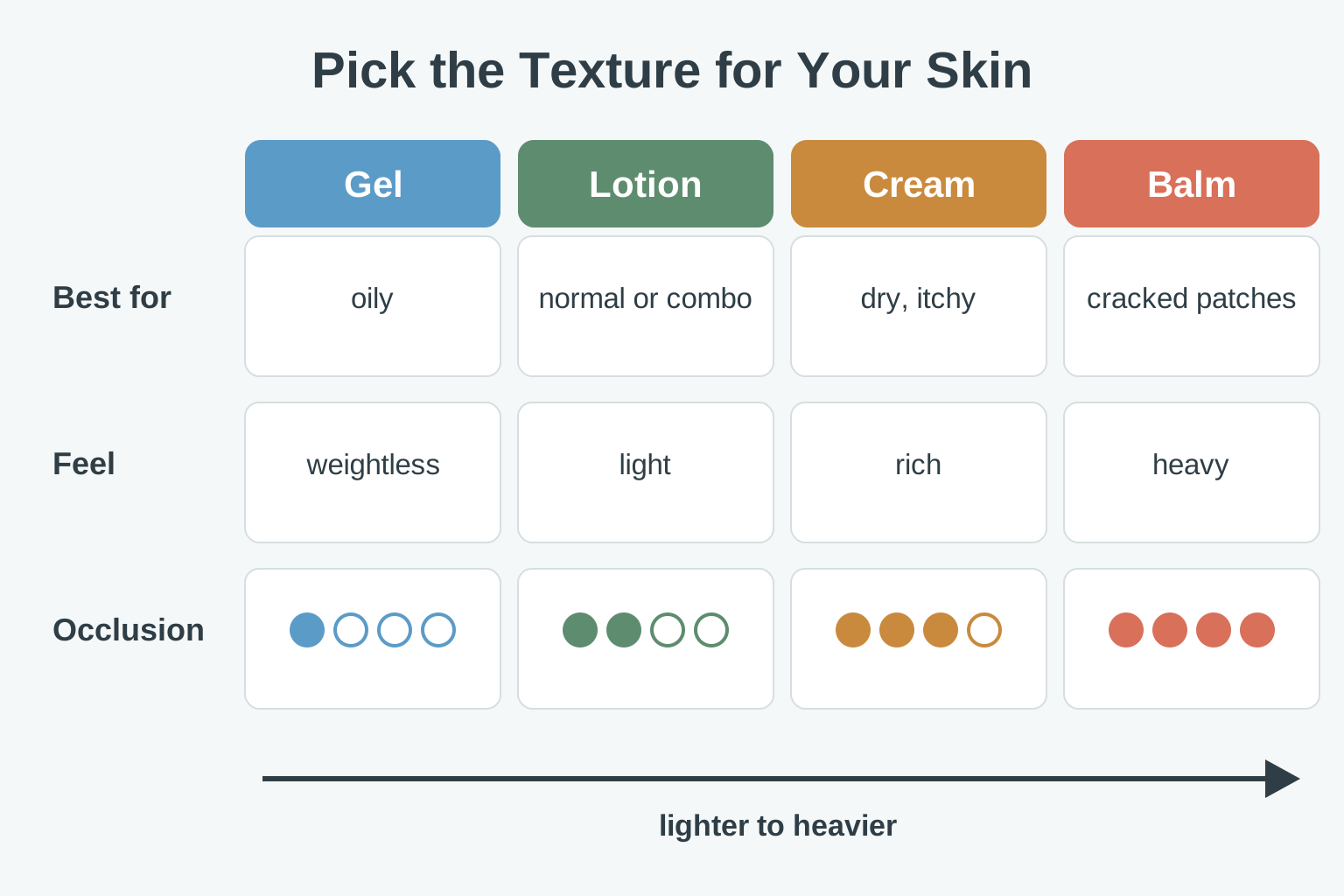
- Gel: a light fragrance free moisturizer that sinks in within a minute; right for oily and acne-prone skin, too thin for flaking patches.
- Lotion: the best fragrance free face lotion for combination skin sits under sunscreen without pilling; it may not last overnight on dry cheeks.
- Cream: a fragrance free facial moisturizer with ceramides and petrolatum for dry, itchy faces; can feel heavy in humid weather.
- Balm: spot treatment for cracked corners of the nose and mouth only.
A fragrance free moisturizer for oily skin should say non-comedogenic and lean on glycerin and niacinamide rather than butters. For more on non-greasy textures, see our guide to choosing a non greasy oil free formula, and for breakout-prone faces, our moisturizer picks for acne prone skin. A fragrance free face moisturizer for sensitive skin around the eyes and nose should also skip exfoliating acids, which sting thin, irritated skin.
Does itchy body skin need a richer unscented moisturizer for dry skin?
Body skin usually needs a thicker unscented moisturizer for dry skin than the face, because shins and forearms have fewer oil glands and lose water faster in cold, dry air. That is why the lower legs are often the first place to itch and flake each winter, followed by forearms and the backs of the hands.
Pump lotions spread easily but carry more water and less occlusive, so their effect can fade within a few hours. Thick creams from a jar or tub, or a petrolatum-based ointment on the worst patches, last through the day. The cost is a slower absorption time of several minutes and a film that can transfer to clothing.
For rough, scaly patches, urea at 10% or lactic acid helps loosen buildup and draw in water. Both can sting on scratched or cracked skin, so save them for intact patches. On flare days, a body cream with pramoxine 1% gives faster relief than plain moisturizer, though it treats the symptom rather than the dryness behind it. Even an unscented formula should still score at least seven on the eight-point Itch-Safe Label Score before it goes on large areas of skin.

For itchy, peeling skin across the whole body in cold months, compare options in our guide to the best lotion for itchy, peeling winter skin.
Is a fragrance free night moisturizer worth adding to your routine?
A fragrance free night moisturizer is worth adding when itching peaks at night or when a retinoid dries the skin, because a richer occlusive layer slows overnight water loss. Water loss through the skin rises in the evening, and anti-inflammatory hormone levels dip, which is one reason itch often feels worst in bed.
At night you can wear textures that would look too shiny under daytime makeup or sunscreen: a ceramide cream with petrolatum, or a thin layer of ointment over moisturizer on the driest spots. If you use a retinoid, apply it first, wait about 20 minutes, then follow with the night cream; the extra layer cuts the peeling and stinging that make many people quit.

Who can skip it: if your daytime cream already scores seven or eight on the label checks and your skin is comfortable by morning, one moisturizer for day and night is enough and saves money. Before buying a separate jar, run through these night cream label checks before you buy.
How do you apply moisturizer to break the itch-scratch cycle?
Apply moisturizer to damp skin within three minutes of a lukewarm bath or shower, at least twice daily, and patch test any new formula for a week before using it everywhere. Damp skin holds water that the moisturizer then seals in; wait longer and that water evaporates, leaving skin drier than before you washed.
- Wash with lukewarm water, not hot, for five to ten minutes, using a mild, fragrance-free cleanser only where you need it.
- Pat dry with a towel, leaving skin slightly damp.
- Apply a gentle fragrance free moisturizer within three minutes: about a fingertip unit per hand-sized area, smoothed in the direction of hair growth.
- Reapply after every hand wash and before bed.
Patch test a new product on the inner forearm or behind the ear twice daily for five to seven days; stop at the first sign of redness or itching. Keep nails short, and use a cool, damp compress for ten minutes instead of scratching during a flare. The limitation: this routine takes about five extra minutes a day, and results usually show after one to two weeks of consistent use.
The cleanser matters as much as the cream; learn how to pick a gentle cleanser that washes without stripping.
Get one practical tip each week for calming itchy, sensitive skin.
One calm-skin tip a week, written for itchy and sensitive skin. No product dumps.
Thanks — you're on the list.
When is itchy skin a reason to see a dermatologist?
See a dermatologist when itching lasts longer than two weeks despite daily moisturizing, keeps you awake, spreads, or comes with a rash, oozing or cracked skin. Those signs point to conditions that a fragrance free moisturizer for itchy skin supports but cannot treat alone.
- Persistent itch with red, scaly patches can be eczema, which often needs a prescription anti-inflammatory cream.
- A rash that appears where a product touched can be allergic contact dermatitis; patch testing in a clinic identifies the exact allergen.
- Yellow crusting, warmth or pus suggests infection and needs prompt care.
- Itch over the whole body with no visible rash can signal an internal cause and deserves a medical check.


