

The best moisturizer for sensitive skin is a fragrance-free cream with a short ingredient list, barrier lipids such as ceramides and cholesterol, and a humectant like glycerin. Skip parfum, essential oils, denatured alcohol and menthol. Score the label on five checks out of 10, then patch test on the inner arm twice daily for 7 to 10 days.
What makes a moisturizer for sensitive skin genuinely gentle?
A genuinely gentle moisturizer for sensitive skin repairs the barrier with lipids and humectants while leaving out fragrance, essential oils and drying alcohol, the triggers most often behind stinging and redness. Sensitive skin is not a skin type in the way oily or dry is. It describes skin that reacts with burning, tightness, itching or flushing to things most people tolerate, and the face is the body site most often affected.
Two mechanisms sit behind that reaction. The outer layer holds fewer ceramides and fatty acids, so water escapes faster and irritants get in more easily. At the same time, nerve endings in the skin fire more readily, which is why a product can sting within seconds and leave no visible mark. The problem is widespread: survey data collected across more than 20 countries suggests a large share of adults describe their skin as at least somewhat sensitive.
That is why the label claim matters less than the formula. A skin moisturizer for sensitive skin marketing claim can sit on a jar that still contains parfum or a botanical extract blend. A gentle moisturizer for sensitive skin earns the description through what it leaves out:
- No added fragrance and no essential oils, the most common causes of cosmetic contact allergy.
- No denatured alcohol high on the list, which speeds water loss.
- A short ingredient list, because every extra ingredient is one more chance to react and one more suspect when you do.
Short lists have a cost: they rarely feel luxurious, and they skip the antioxidant and peptide extras that longer formulas advertise. For reactive skin that trade is usually worth it. If you are still working out what your skin tolerates, the skincare rules for calmer sensitive skin cover how to trim a routine before adding anything new.
Which ingredients belong in a hypoallergenic facial moisturizer?
A hypoallergenic facial moisturizer should combine a humectant such as glycerin, barrier lipids such as ceramides, and a calming agent such as panthenol or niacinamide, without fragrance, essential oils, denatured alcohol or menthol. In the United States, "hypoallergenic" has no federal definition, so the word on the front of the tube guarantees nothing. The ingredient list on the back is the only reliable evidence.
Every moisturizer is built from three ingredient classes, and a hydrating moisturizer for sensitive skin needs all three in balance. A clinical review of moisturizer ingredients explains how each one supports the barrier:
- Humectants such as glycerin and hyaluronic acid pull water into the outer layer.
- Emollients such as squalane and ceramides fill the gaps between skin cells so the surface feels smooth.
- Occlusives such as petrolatum and dimethicone form a thin seal that slows evaporation.
Six ingredients to look for
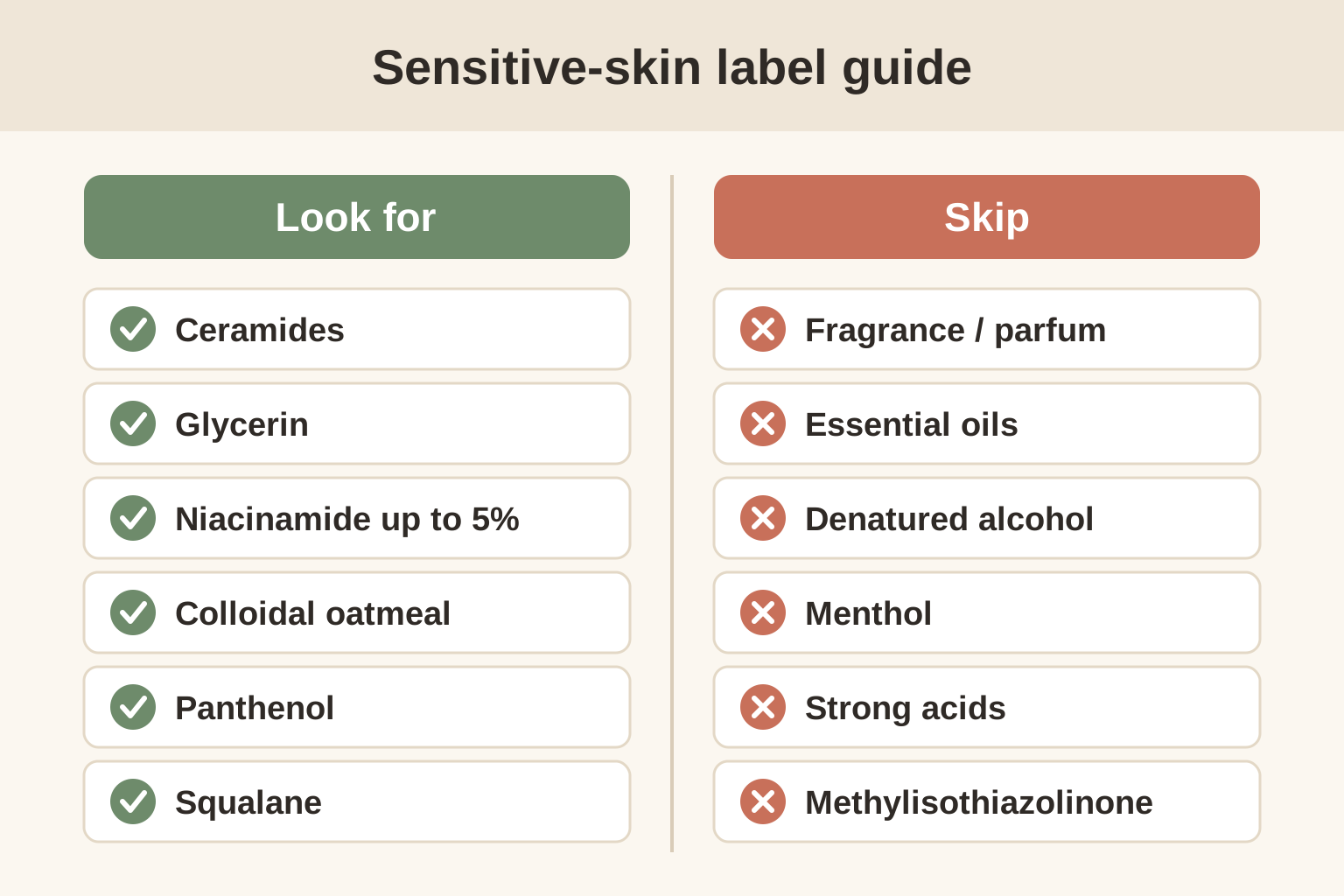
Ceramides rebuild the lipid layer that sensitive skin runs short of. Glycerin hydrates cheaply and is rarely an irritant. Niacinamide up to 5% supports the barrier and eases redness; niacinamide benefits and typical strengths show why higher doses add irritation risk without much extra benefit. Colloidal oatmeal and panthenol soothe itch, and squalane softens without feeling greasy. If you want niacinamide as a separate step, this guide on how to pick a niacinamide serum covers strength and layering.
Six ingredients to skip
Fragrance or parfum and essential oils top the list because they are leading contact allergens. Denatured alcohol and menthol dry and sting. Strong acids such as glycolic acid belong in a separate, occasional step, not in a daily moisturizer. Methylisothiazolinone, a preservative, is a well-documented allergen. One limit applies: a clean list cannot rule out a personal allergy, so a patch test is still required.
How do you score a sensitive-skin label in 60 seconds?
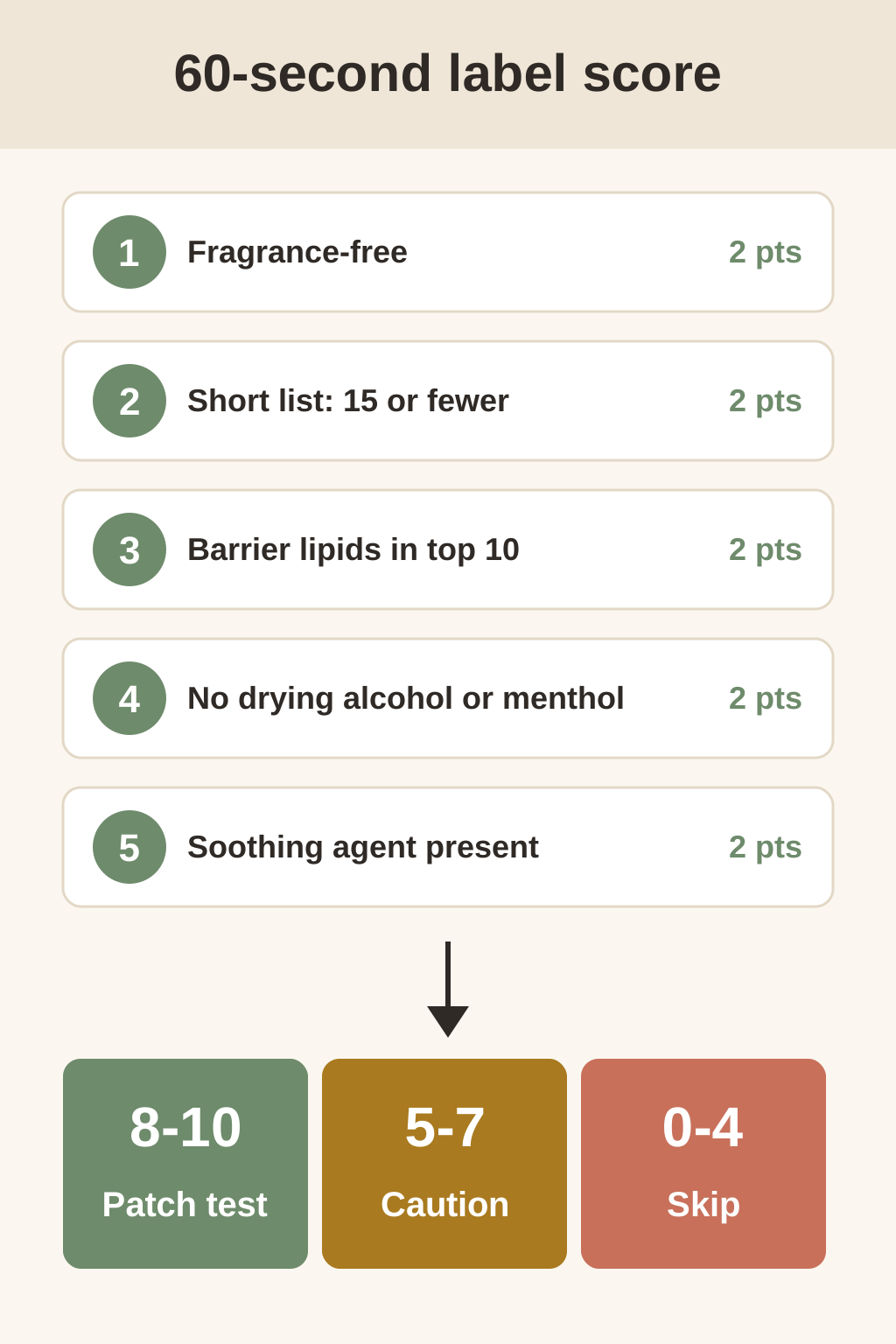
Score the ingredient list on five checks worth two points each: fragrance-free, 15 or fewer ingredients, barrier lipids in the top ten, no drying alcohol or menthol, and a soothing agent; 8 or more earns a patch test. Ingredients are listed in descending order of concentration down to 1%, so the first ten names describe most of what touches your skin.
| Check | 2 points | 1 point | 0 points |
|---|---|---|---|
| 1. Fragrance-free | No parfum, fragrance or essential oils anywhere | Only a masking fragrance listed last | Parfum or an essential oil in the list |
| 2. Short list | 15 ingredients or fewer | 16 to 25 ingredients | More than 25 ingredients |
| 3. Barrier lipids | Ceramides, cholesterol or fatty acids in the top ten | Present, but after the top ten | None |
| 4. No drying agents | No denatured alcohol or menthol | Alcohol present, but after the top ten | Denatured alcohol or menthol in the top ten |
| 5. Soothing agent | Panthenol, colloidal oatmeal, allantoin, centella or niacinamide up to 5% | Only aloe or a plant extract blend | None |
Add the five scores and act on the total:
- 8 to 10: a strong candidate; move on to a patch test.
- 5 to 7: proceed with caution, and only if the lost points are not fragrance.
- 0 to 4: skip it, whatever the front label says.
The rubric is a filter, not a verdict. It cannot measure pH, texture or a personal allergy, and a product scoring 10 can still fail on your skin. It also explains why the best moisturizer for sensitive face use and the best skin cream for sensitive skin on the body often score differently: body creams tolerate more fragrance and longer lists because body skin is thicker and less reactive. Formulas built around hyaluronic acid need one extra check, whether an occlusive seals the water in, which these label checks for a hyaluronic acid moisturizer walk through.
Cream, lotion or gel: which texture suits sensitive skin?
Creams suit dry or reactive sensitive skin because their oil content seals water in with less sting, lotions suit normal skin in humid weather, and gels suit oily sensitive skin that dislikes a film. Texture is set by the water-to-oil ratio. More oil means a better seal; more water and alcohol mean a lighter feel, with a higher chance of stinging on a damaged barrier.
The National Eczema Association's explanation of ointment, cream and lotion textures ranks lotions as the lightest and least sealing, creams in the middle and ointments as the most protective and least likely to sting.
- Choose a moisturizing cream for sensitive skin when you feel tight within an hour of washing, flake in winter, or sting from lighter formulas. The cost is a heavier feel that can pill under makeup.
- Choose a face lotion for very sensitive skin when your skin is normal to slightly dry, the air is humid, or you need something that sits well under sunscreen. It needs reapplying more often in dry air.
- Choose a gel for oily or acne-prone sensitive skin. Gels with high alcohol content fail check 4 of the label score, so read the first ten ingredients. These non-greasy oil free moisturizer formulas show how to tell a light gel from a drying one.
A quick test settles the choice: apply your current moisturizer, wait 30 minutes, then touch your cheek. Tight or rough means move one step richer; shiny or tacky means move one step lighter.
What helps irritated or hypersensitive skin calm down?
Irritated or hypersensitive skin calms fastest when you pause actives, cleanse once a day, and apply a thick, fragrance-free soothing cream with centella, panthenol or colloidal oatmeal twice daily for one to two weeks. The signs of a compromised barrier are specific: stinging from plain water, tightness minutes after washing, a rough patch that will not settle, or redness that spreads after every new product.
If itching is the main complaint, a fragrance free moisturizer for itchy skin with itch-calming ingredients and the right texture can help skin settle during that one-to-two-week reset.
A reset routine for a moisturizer for irritated skin takes three steps:
- Stop retinoids, acids, vitamin C and scrubs for at least two weeks.
- Cleanse at night only, with lukewarm water and a low-foam cleanser; rinse with water in the morning.
- Apply a soothing moisturizer for irritated skin morning and night, and again whenever skin feels tight.
A soothing cream for sensitive skin pairs barrier lipids with a calming agent such as centella asiatica, panthenol, allantoin or colloidal oatmeal, and it usually feels richer than an everyday formula. A moisturizer for hypersensitive skin goes further: it drops botanical extracts altogether, keeps the list very short and often adds petrolatum for a stronger seal. The limit is clear. If redness, scaling or burning lasts beyond two weeks of this routine, see a dermatologist, because rosacea, eczema and contact allergy each need targeted treatment that no moisturizer replaces. When dryness rather than reactivity drives the irritation, these dry skin moisturizers that actually hold water explain how to pick a richer formula.
Which moisturizer fits your type of sensitive skin?
Dry sensitive skin does best with a ceramide cream, oily sensitive skin with an oil-free gel, and extremely sensitive skin with a minimal-ingredient cream of roughly ten ingredients or fewer. A moisturizer for extra sensitive skin leaves out fragrance, botanical extracts, acids and most preservatives. When choosing a moisturiser for extremely sensitive skin or a face cream for extremely sensitive skin, count the ingredients first: ten or fewer narrows down the cause if you do react. Oily, breakout-prone skin has its own rules on texture and pore-clogging oils, covered in these moisturizer choices for acne prone skin.
We may earn a commission when you buy through links on this page, at no extra cost to you.
Combination sensitive skin can split the difference: the gel on the forehead and nose, the cream on the cheeks, ideally from the same fragrance-free line so the label check stays simple.
How do you patch test a daily moisturiser for sensitive skin?
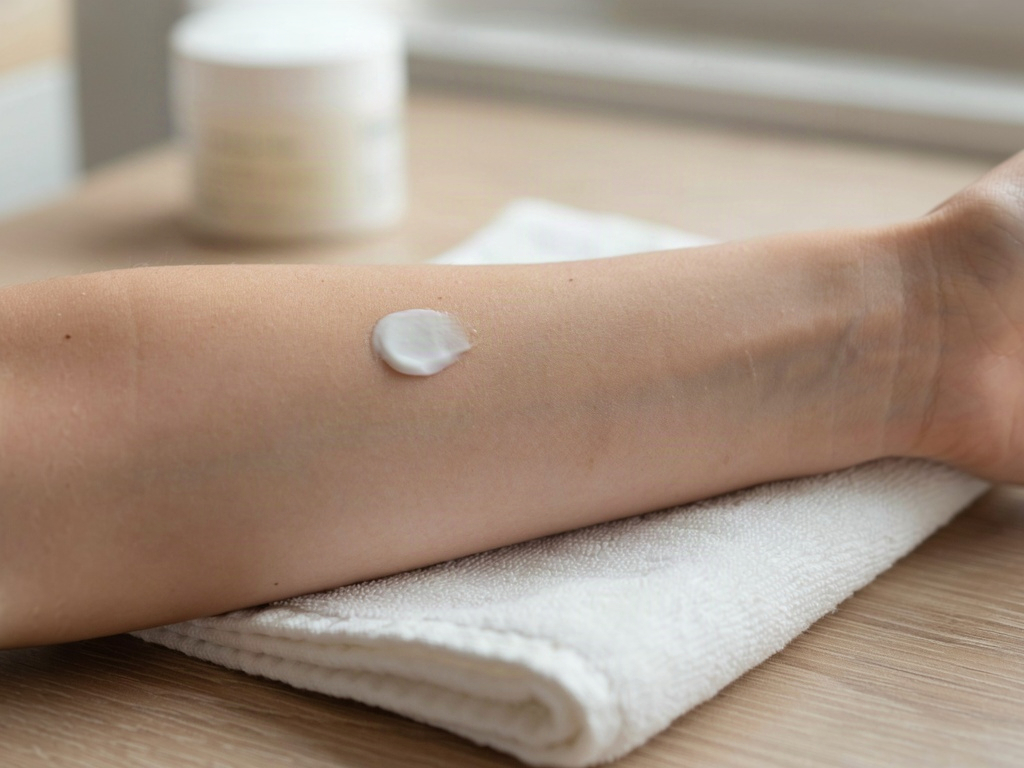
Dab a coin-sized amount on the inner forearm twice a day for seven to ten days, and move it to your face only if no redness, itching or swelling appears. The American Academy of Dermatology's dermatologist patch test instructions uses a hidden spot such as the inner arm or the crease of the elbow, because that skin is thin enough to react but easy to cover.
- Apply a coin-sized amount of the new daily moisturiser for sensitive skin to the same spot, morning and night.
- Leave it on and keep going for seven to ten days; delayed allergies can take several days to show.
- Check daily for redness, itching, swelling or small bumps.
- If the spot stays clear, apply it to one small area of the face, such as beside the jaw, for three more days.
Any reaction means wash the area, stop the product and note the ingredient list so you can spot repeat offenders. Introduce only one new product at a time, with about two weeks between them, or you will not know which one caused a flare. The same test applies to every leave-on product, including your sunscreen that suits reactive skin. The cost is time: a careful switch takes two to three weeks.
Where does a daily facial moisturizer for sensitive skin fit in a routine?
A daily facial moisturizer for sensitive skin goes on right after a gentle cleanse while skin is still slightly damp, then sunscreen follows in the morning; at night it is the final step. Damp skin holds more water, so pat your face with a towel and apply within a minute.
- Morning, three steps: rinse or cleanse, moisturize, then apply sunscreen.
- Evening, two steps: cleanse with a gentle cleanser that will not strip, then moisturize.
Skip toners, essences and facial mists unless one solves a specific problem; each extra layer adds preservatives and another chance to react.
Use a pea-sized amount for a lotion and a slightly larger amount for a cream. Warm it between your fingertips and press it into the skin rather than rubbing, which reduces friction on reactive cheeks. A short routine is a feature for any moisturizer for sensitive skin: fewer products mean fewer triggers and an easier time finding the cause when skin does flare. The tradeoff is slower progress on concerns like dark spots, which you can add later, one product at a time.
Get one practical tip for calmer, less reactive skin in your inbox each week.
One calm-skin tip a week for reactive faces. No product dumps.
Thanks — you're on the list.


