

The best hyaluronic acid moisturizer pairs multi-weight hyaluronic acid with an occlusive and barrier lipids like ceramides, because hyaluronic acid holds water but cannot keep it in skin. Look for hyaluronic acid or sodium hyaluronate in the top five INCI slots, 0.1 to 2 percent, plus glycerin and dimethicone.
What does a hyaluronic acid moisturizer actually do?
A hyaluronic acid moisturizer uses sodium hyaluronate to bind water in the stratum corneum, then relies on occlusives and lipids to stop that water evaporating within the hour. The humectant is the sponge; the occlusive is the lid. Sell one without the other and you get twenty minutes of plumpness and a tight face by lunch.
The beaker number does the marketing. One gram of hyaluronic acid can hold roughly one litre of water in a glass, which is true and almost irrelevant: a pea-sized dose spread over a face delivers a few milligrams across a film a few microns thick, competing with air that is drier than your skin.
That is the practical gap between a hyaluronic moisturizer built as a full formula and a humectant lotion with nothing behind it. Glycerin, hyaluronic acid and water will raise corneometer readings for an hour. Dimethicone, petrolatum or squalane on top of them cuts transepidermal water loss, which is what keeps the reading up at hour four. The dermatology literature is consistent on the pairing: humectants move water toward the surface, and occlusives decide whether it stays.
If you are still deciding between cream, lotion and gel textures across skin types, the face moisturizer buying guide for every skin type covers that groundwork.

How much hyaluronic acid should a face cream contain?
Most tested formulas work between 0.1 and 2 percent hyaluronic acid, so its position in the INCI list tells you more than any headline percentage on the front of the box. Past roughly 2 percent, a face cream with hyaluronic acid turns tacky and pills under sunscreen without holding measurably more water.
Four INCI names all mean the same active at different sizes: hyaluronic acid, sodium hyaluronate, hydrolyzed hyaluronic acid and sodium acetylated hyaluronate. Sodium hyaluronate is the salt form and the one most formulas actually use because it dissolves and spreads better. Seeing two or three of those names is a better signal than seeing one in bold on the carton.
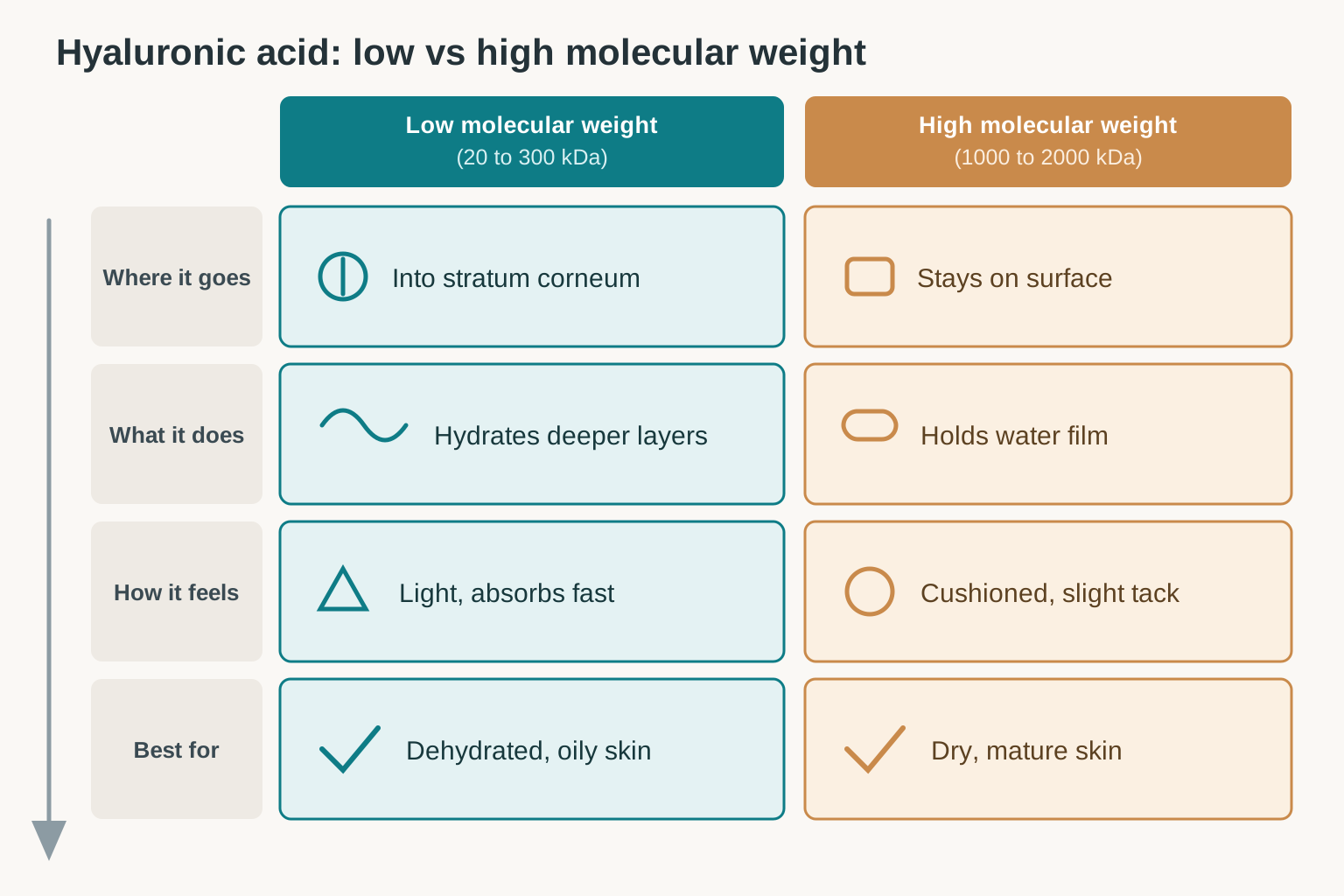
Molecular weight decides where the molecule stops. Fragments between 20 and 300 kDa can move into the stratum corneum; chains above 1000 kDa stay on the surface and hold a film of water there. Both are useful, which is why multi-weight blends outperform single-weight ones in practice. Published molecular weight work supports the surface effect lasting into a second day.
A face cream hyaluronic claim becomes a dusting when the ingredient lands after the preservative, somewhere past the fifteenth slot. That is a fraction of a percent, added for the label. Shoppers typing hydraulic acid moisturizer into a search box are hunting the same molecule with a misspelling, and the same INCI test applies: top five slots or it is decoration. The serum version of this test lives in what to check first in a hyaluronic acid serum.
Which label details separate a real formula from a gimmick?
Score the formula on four label details: where hyaluronic acid sits in the INCI list, whether more than one molecular weight is named, which occlusive seals it, and whether barrier lipids are present. Give each check two points for a clear pass, one for a partial, zero for a miss.
Hyaluronic acid position in the INCI list
Ingredients above 1 percent are listed in descending order, so slot position is a dose proxy. Sodium hyaluronate inside the top five slots means a working concentration; past slot fifteen it is a fraction of a percent. Score two points for top five, one for slots six to ten, zero after that. This check alone kills most shortlists that call themselves the best hyaluronic acid moisturizer.
Two or more molecular weights, not one
A label naming both sodium hyaluronate and hydrolyzed hyaluronic acid covers surface film and stratum corneum together. One name is not disqualifying, but it caps what the formula can do. Phrases like "multi-weight complex" earn the point only when two INCI names back them.
A named occlusive that seals the water in
Find dimethicone, petrolatum, squalane, shea butter or mineral oil in the first ten slots. Without one, the humectant has nothing holding it in place and the formula is a serum wearing a moisturizer's label. Any credible best hyaluronic acid cream for face pairing starts here, and the clinical trials measure the combination, not the humectant alone.
Barrier lipids: ceramides and cholesterol
Ceramides, cholesterol and fatty acids rebuild what hyaluronic acid cannot: the mortar between corneocytes. Compromised skin loses water through gaps, and a humectant does not fill gaps. Expect to pay 30 to 50 percent more for a formula carrying all three, and skip them if your skin is oily and intact, because the lipid load can congest.
| Check | Pass (2) | Miss (0) |
|---|---|---|
| INCI position | Top five slots | Past slot fifteen |
| Molecular weights | Two INCI names | One name only |
| Occlusive | Named in top ten | None listed |
| Barrier lipids | Ceramides plus cholesterol | Neither present |
| Texture | Matches your climate | Fights it year-round |
| Irritants | No fragrance or alcohol denat | Either in top ten |
| Packaging | Tube or airless pump | Open jar |
Ten points or more is worth your money; under six, put it back. Formulas that pass on occlusives but fail on texture suit drier skin, and the oil free moisturizer formulas that stay non greasy explains that trade in detail.
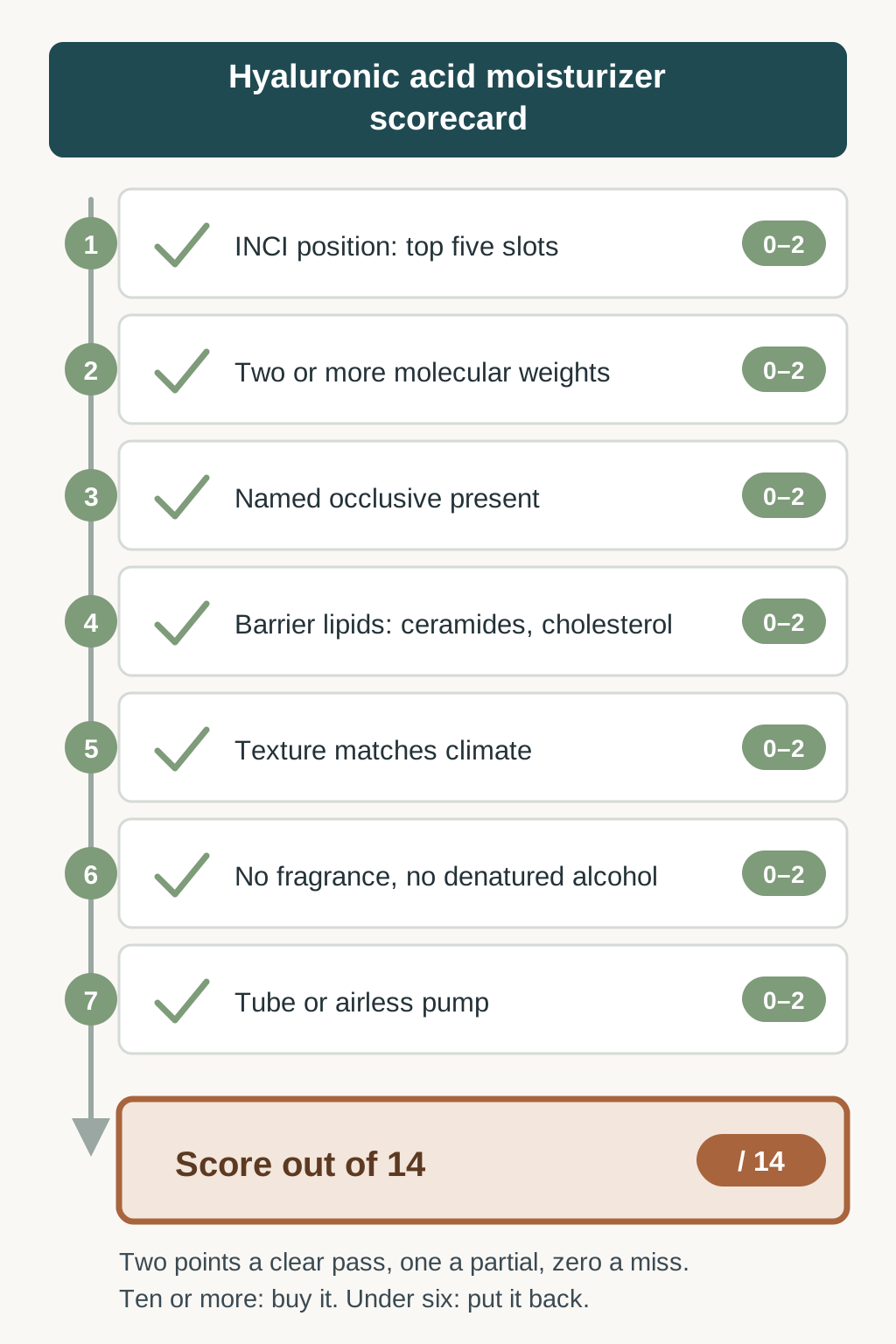
The printable version of these seven checks fits on one page, sized for reading in a store aisle with the jar in your other hand.
How do you match texture, scent and packaging to your skin?
Match texture to climate and oil level, then rule out fragrance, denatured alcohol and open jars, which cost you more comfort than any hero ingredient adds. These three checks complete the scorecard, and they fail more products than the ingredient list does.
Texture matched to climate and oil level
A lightweight moisturizer with hyaluronic acid suits humid summers, oily and combination skin, and anyone layering sunscreen and makeup on top: a gel-cream absorbs in about ten seconds and leaves nothing for foundation to slide on. A face lotion with hyaluronic acid sits between gel and cream and works through spring and autumn for normal skin. Both stop being enough when indoor heating starts, because neither carries the occlusive load that holds water for eight hours. Expect to own two textures if you live somewhere with real winters; one formula year-round means being slightly wrong for four months.
Fragrance and denatured alcohol load
Fragrance-free means no fragrance was added. Unscented can mean a masking fragrance covers a raw-material smell, so the word is weaker than it looks. Parfum, linalool and limonene in the top ten slots are the most common reason a hydrating cream stings on compromised skin. Alcohol denat high in the list speeds absorption and increases water loss as it flashes off, which is the opposite of the job. Both are acceptable in a formula for oily, resilient skin that wants a dry finish, and both are a hard no on reactive skin.
Jar, tube or airless pump
An open jar meets a finger twice a day for ninety days. That introduces skin flora into a water-rich formula and oxidises antioxidants faster, so brands compensate with heavier preservative systems. A tube or airless pump avoids the problem and usually costs a dollar or two more per unit. The jar is still worth it when the texture is a thick balm that will not travel through a pump, and when you use a clean spatula every time, which most people will not.
Dermatology guidance on cream versus lotion versus ointment lines up with this: thicker vehicles hold more water on dry skin. For acne-prone skin the calculus shifts toward non-comedogenic gels, covered in the non comedogenic picks for oily, acne prone skin.

Not sure which texture your skin actually wants? Six questions, two minutes, and you get your skin type, a sensitivity flag and the shelf filtered to match.
Which hyaluronic acid moisturizer fits your skin type?
Dry skin needs a ceramide-rich cream, oily and combination skin a gel-cream, sensitive skin a short fragrance-free formula, and mature skin a hyaluronic acid cream under an occlusive balm. Some links in this list are affiliate links, and a purchase may earn us a commission at no extra cost to you.
A formula that suits one of these skin types will irritate another: the lipid load that rescues dry skin congests oily skin. If flaking rather than tightness is the problem, dry skin moisturizers that hold up narrows the field, and for fine lines the mature skin face cream for fine lines is the closer match.
Where does a hyaluronic acid moisturizer go in your routine?
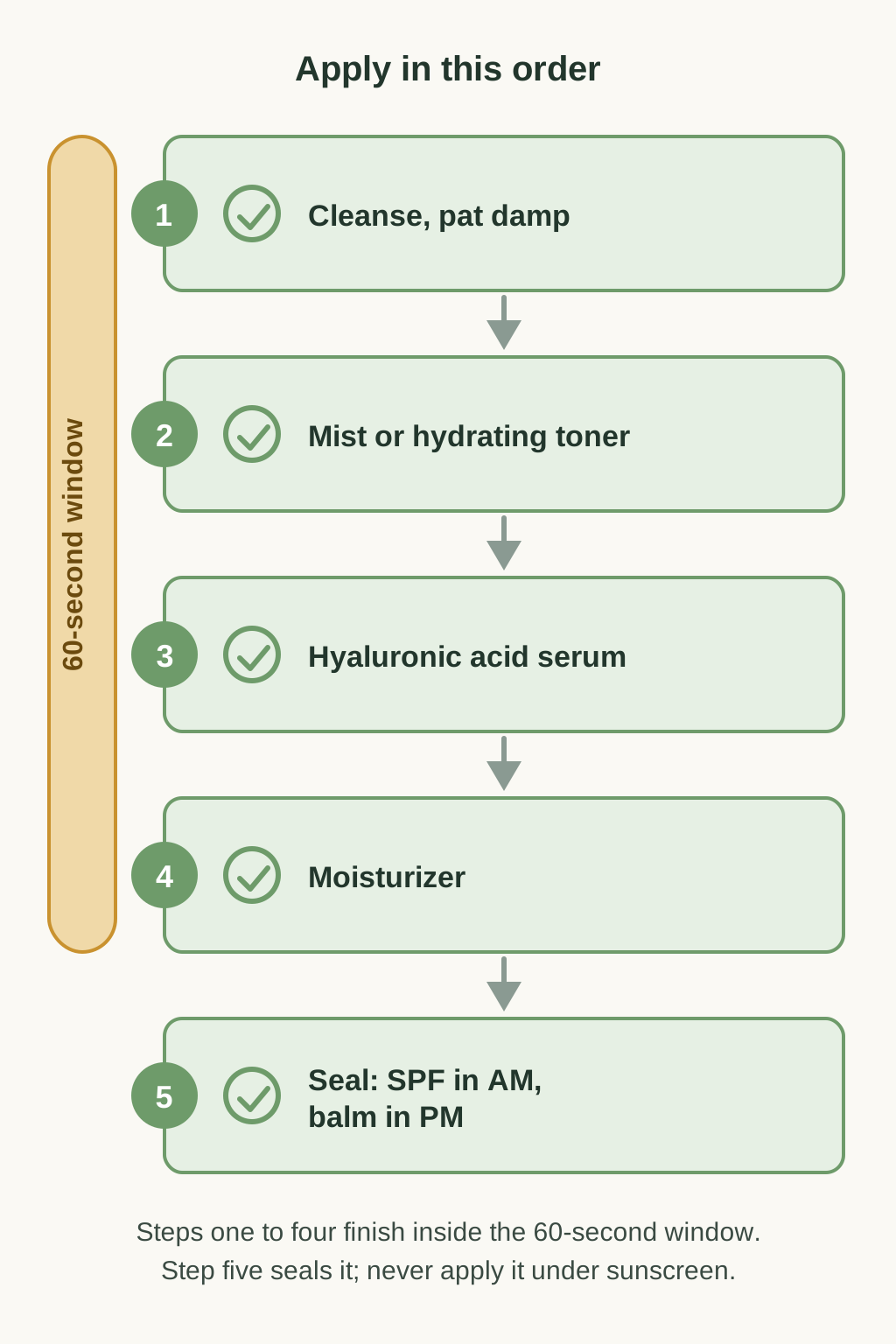
Apply it onto skin still damp from cleansing or toner, within sixty seconds, then seal it with sunscreen in the morning or a richer balm at night. The damp-skin window matters because a humectant binds whatever water is nearest; give it surface water and it stops recruiting from deeper tissue.
The working order is cleanse, mist or tone, hyaluronic acid serum, moisturizer, then seal. A hyaluronic acid moisturizer for dry skin goes on second-to-last, never over sunscreen, and a 50 ml jar at two applications a day lasts roughly eight to ten weeks. Dermatology guidance puts treatment before moisturizer for the same reason: the thinner layer needs skin contact.
What not to stack on the same night: a high-strength AHA or BHA plus retinoid plus a fresh exfoliating toner. Hyaluronic acid is compatible with all of them, but the combined irritation is what breaks the barrier you are trying to hydrate.
Some links here are affiliate links, and a purchase may earn us a commission at no additional cost to you.
The nine-step version of this sequence is in skincare order and which step goes first, and if step two is doing nothing for you, hydrating toners for dry, sensitive skin explains what to look for instead.
What goes wrong with hyaluronic acid in dry indoor air?
In air below roughly 40 percent relative humidity, a humectant can draw water from deeper skin and let it evaporate, so a dry-air routine needs an occlusive top layer. Aircraft cabins run near 10 to 20 percent and heated rooms in winter often sit at 20 to 30 percent, which is where a hyaluronic moisturizer starts to feel tight instead of dewy.
Two fixes, in order of effect. First, never apply it to bone-dry skin in dry air: dampen the face, apply, then cover it within a minute with something that cuts evaporation. On a cold night that means a richer night cream over the hydrating layer. Second, raise the room: a humidifier holding 40 to 50 percent relative humidity changes how every humectant in your routine behaves, and costs less than replacing the products.
Who should skip hyaluronic acid altogether: people whose skin stings on contact with it, which happens with low-weight fragments on an impaired barrier, and anyone whose dryness is really a lipid deficit. Those cases do better on a petrolatum or ceramide-led formula with no humectant chasing water that is not there. A hyaluronic acid moisturizer is a poor rescue product for a cracked barrier.
Night-time formulas carry the heaviest occlusive loads, and night cream checks before you buy lists what to verify before paying for one.
How do you know your moisturizer is working after four weeks?
Judge it on four weeks of evidence: less tightness an hour after application, no flaking at the nasolabial folds, and makeup that stops clinging to dry patches. Four weeks is roughly one stratum corneum turnover, which is the shortest honest window for a barrier claim.
Three concrete markers beat any feeling of hydration. Tightness at the sixty-minute mark should drop, not just at the two-minute mark. Flaking around the nose and mouth should be gone, because those are the first places a failing formula shows. Skin should stop feeling raw for five minutes after cleansing.
If none of that shifts, change one variable: add an occlusive before you buy a different hyaluronic acid moisturizer, since most failures are evaporation rather than dose. And separate hydration from irritation: a flushed, shiny face that feels warm is inflammation, not a glow, and the correct move is to stop the formula for a week rather than layer more over it. That one distinction decides whether the best hyaluronic acid moisturizer for your face is the one you already own.
We publish one practical check like these every week, written the same way.
One honest skincare check a week. No product dumps, no 40-step routines.
Thanks — you're on the list.


