

A glycolic acid toner is a leave-on liquid exfoliant that uses glycolic acid, the smallest alpha hydroxy acid at 76 daltons, to dissolve the bonds holding dead surface cells together. Most sit between 5% and 10% acid at pH 3.5 to 4, used two to four nights a week.
What Is a Glycolic Acid Toner?
A glycolic acid toner is a leave-on liquid that uses 5% to 10% glycolic acid to loosen dead surface cells, rather than hydrating or rinsing the skin. You sweep it on after cleansing and leave it there; nothing is washed off, which is why the percentage on the label actually reaches your skin.
Glycolic acid weighs 76 daltons, the lowest molecular weight of any alpha hydroxy acid. Lactic acid is 90 daltons and mandelic acid is 152, so a glycolic toner moves through the surface layer faster and works deeper at the same percentage. That speed is the benefit and the risk in one molecule.
Three things get called toner and only one of them exfoliates. A hydrating toner adds water and humectants. An astringent strips oil with alcohol or witch hazel. An acid tone step chemically loosens dead cells, which is closer to a peel than to a splash of water.
For the wider picture of what the whole category does, including the non-acid formulas, read face toner benefits and purpose.
Besides the acid, a well-built bottle carries glycerin or another humectant to hold water in, a pH adjuster such as sodium hydroxide to keep the formula in range, and often aloe or a panthenol-type soother to blunt the sting.

How Does Glycolic Acid Toning Actually Work on Skin?
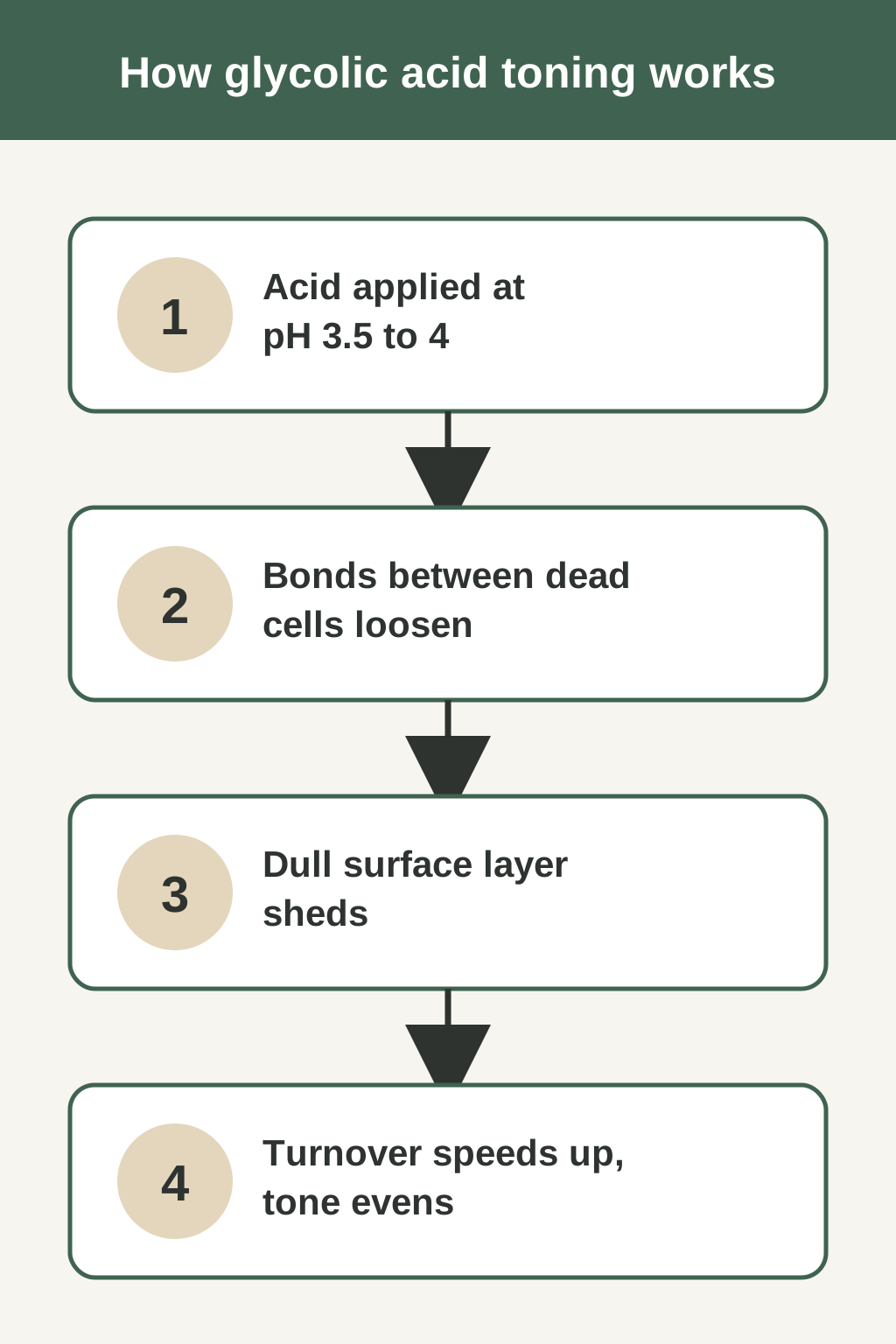
Glycolic acid dissolves the protein bonds holding dead cells to the surface, so the dull layer sheds evenly instead of flaking off in patches. Those bonds are desmosomes, the protein rivets between corneocytes. Weaken enough of them and the top layer releases in one thin, even sheet you never see leave.
pH decides how much of that actually happens. Glycolic acid only works in its free, un-neutralised form, and free acid availability collapses as pH climbs past 4. A 7% formula buffered up to pH 5 to feel gentle is doing a fraction of the work a 5% formula at pH 3.6 does. Percentage without a stated pH is half a number.
Clinical explainers on how glycolic acid loosens dead skin cells describe the same mechanism.
Weeks of consistent glycolic acid toning add slower effects on top of the surface shedding: glycosaminoglycan content rises so skin holds more water, fibroblasts increase collagen signalling, and pigment that sat in clumps disperses more evenly, which is why post-acne marks fade before wrinkles do.
Glycolic toning will not do three things people expect. It will not clear cystic acne, which sits below the layer any AHA reaches. It will not permanently shrink a pore, because pore size is structural. And it is not a retinoid substitute: retinoids change how cells differentiate, while an acid removes cells that are already finished.
Frequency matters more than strength, and how to exfoliate skin safely sets out the schedules by skin type.
Which Strength Should a Glycolic Acid Exfoliator Be?
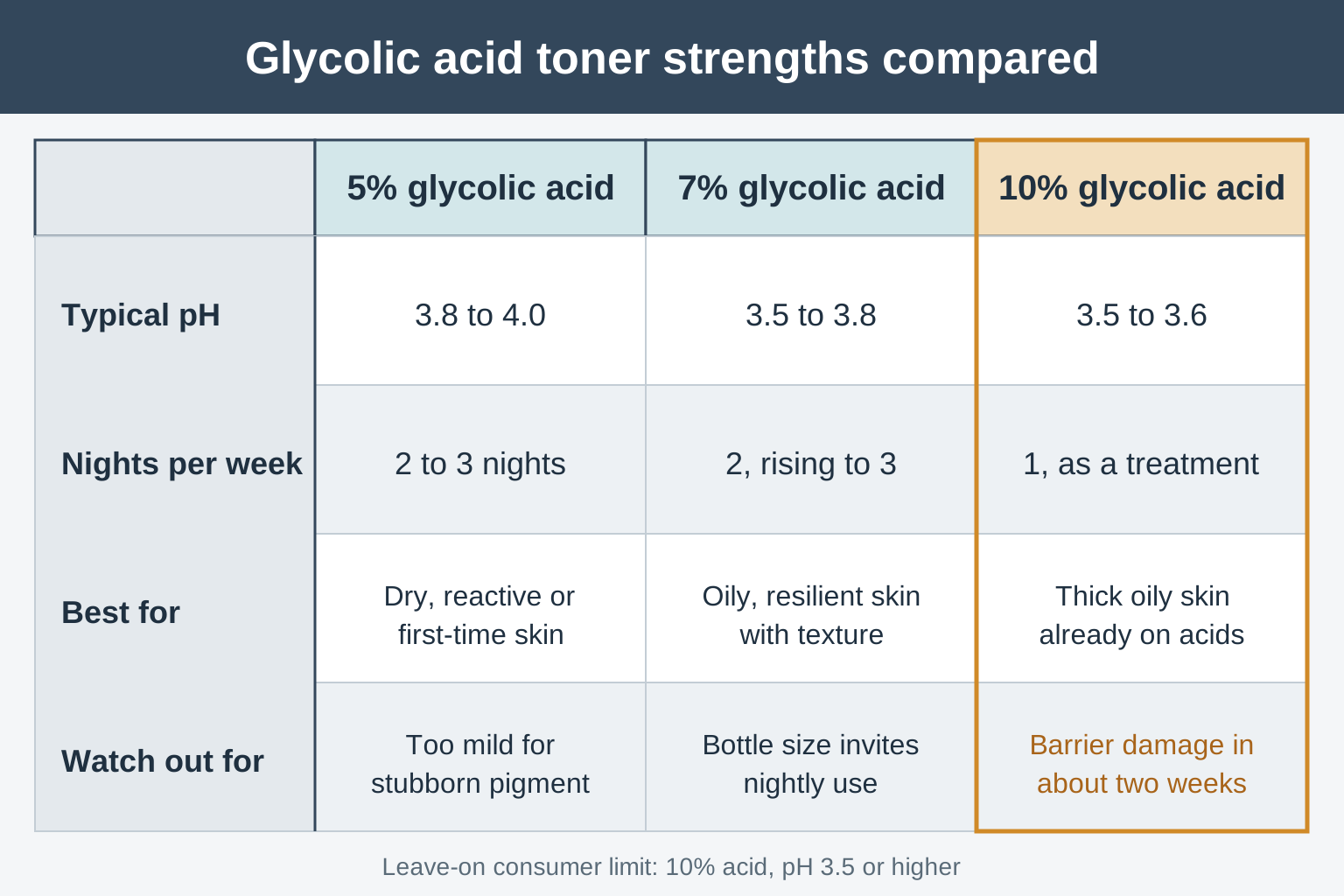
Start at 5% if your skin is dry or reactive, 7% if it is oily and resilient, and treat anything above 8% as a weekly treatment rather than a routine step. A glycolic acid exfoliator sold for home use lands in one of three bands, and the pH moves with the percentage.
| Check | 5% glycolic acid | 7% glycolic acid | 10% glycolic acid |
|---|---|---|---|
| Typical pH | 3.8 to 4.0 | 3.5 to 3.8 | 3.5 to 3.6 |
| Nights per week | 2 to 3 | 2, rising to 3 | 1, as a treatment |
| Best for | Dry, reactive or first-time skin | Oily, resilient skin with texture or marks | Thick, oily skin already using acids |
| Watch out for | Too mild to shift stubborn pigment | Bottle size invites nightly use | Barrier damage within two weeks if over-used |
The ceiling is not arbitrary. Cosmetic safety panels settled on 10% acid and pH 3.5 or higher as the limit for a leave-on consumer product, with sun protection built into the directions. Anything stronger belongs in a clinic, applied for a timed interval and neutralised.
One label trap: a bottle can state 10% total glycolic acid while buffering most of it into a salt, leaving perhaps 4% free acid doing the work. Free acid value is the honest figure, and brands that publish it are usually the ones worth trusting.
Oily skin has a different set of label priorities, covered in choosing a toner for oily, acne-prone skin.
Is the Glycolic Acid 7 Toning Solution Worth Buying?
A 7% glycolic acid toning solution is a genuinely active dose that smooths texture in six to eight weeks, and it is also the single easiest product to over-use. The ordinary glycolic bottle that dominates this search sells 240 ml for the price of a sandwich, at 7% free acid, with amino acids, aloe, ginseng and Tasmanian pepperberry in the base to take the edge off.
Does the ordinary glycolic acid work? Yes, with a caveat worth more than the verdict. Texture and post-acne marks improve measurably over six to eight weeks of twice-weekly use. The failure mode is not weakness, it is enthusiasm: skin looks better at week three, so people go nightly, and by week six they have stinging, shine without oil, and new breakouts.
The toner ordinary shoppers reach for first is over-used for a structural reason. A 240 ml bottle with a flat cap invites pouring rather than dosing, and 240 ml used twice weekly lasts the better part of a year, which feels wasteful. It is not wasteful. It is the correct pace.
Even the manufacturer's own usage guidance for the 7% formula caps it at once or twice a week.
It suits oily, resilient, non-sensitised skin with visible texture or fading marks. Two profiles should start lower: anyone whose face reddens from a hot shower, and anyone whose barrier is already working through winter dryness. Those skins want hydration first and acid second.
Hydration comes from a different formula family entirely, explained in what makes a hydrating toner work.
How Do You Pick the Best Glycolic Acid Toner for Your Skin?
Judge a glycolic acid toner on five label facts: acid position, stated percentage, stated pH, what buffers it, and whether the packaging keeps light out. Everything else on the carton is decoration.
The five label checks
- Acid position. Glycolic acid inside the first four INCI entries means a working concentration; past the midpoint of a long list it is a rounding error.
- Stated percentage. A number on the front, ideally flagged as free acid. No number means the brand has decided you should not compare.
- Stated pH. Between 3.5 and 4.0. A brand that publishes pH has tested it.
- Buffers. Glycerin, panthenol, allantoin or a ceramide blend hold water in while the acid works. Their absence is what makes a cheap formula feel harsh.
- Packaging. Opaque or tinted, with a narrow neck. Clear glass on a bright shelf degrades the soothing extracts long before the acid.
Fragrance and alcohol denat matter more here than in a hydrating formula. An acid has already loosened the barrier when the fragrance molecule lands, so a scent you tolerate in a moisturizer can sensitise you in a toner. Alcohol denat high in the list speeds drying and strips the lipids the acid just exposed.
Price per bottle is the wrong number. A 240 ml bottle used twice weekly, at roughly 2 ml a time, lasts about ten months, so a mid-priced formula often costs less per use than a drugstore one in a 100 ml bottle. Base texture is the last split: watery formulas suit oily skin, gel-textured ones cling long enough for dry skin, and milky glycolic acid toners buffer the sting for reactive skin at the cost of some speed.
Oil control and redness respond better to a different active, and picking a niacinamide serum that works explains which strength earns its price.
Not sure which strength your skin can take? Six questions, two minutes, your skin type and a starting percentage.
How Do You Use a Glycolic Acid Exfoliating Toner Step by Step?
Apply a glycolic acid exfoliating toner at night on dry, cleansed skin with one saturated cotton round, wait a few minutes, then moisturize and use SPF the next morning. The order and the waiting are what separate results from irritation.
The five-step night
- Cleanse and pat dry. Wait 10 to 15 minutes; damp skin drives the acid deeper than intended.
- Saturate one cotton round and sweep it over the face in one pass. Skip the eye area, the nostril creases, the corners of the mouth and anything broken.
- Wait 5 minutes. A brief tingle is normal; burning is a signal to rinse.
- Apply a moisturizer over the top to buffer the acid and replace the lipids it exposed.
- Stop there. No retinoid, no vitamin C, no second exfoliant that night.
Dose control is the whole discipline. One saturated round is about 2 ml, and a second round does not exfoliate twice as well; it doubles the contact time on skin that has already reacted. Over the neck, use whatever is left on the round rather than reloading.
Ramp up on a calendar, not a feeling. Two nights a week for four weeks, then reassess in daylight. Add a third night only if there is no tightness, no stinging under water and no flaking. Most people stall at three, and oily skin occasionally reaches four.
Follow it with a plain moisturizer while the skin is still slightly cool to the touch.
The next morning is not optional. AHA use raises sunburn risk while you are using it and for about a week after you stop, so broad-spectrum SPF 30 or higher goes on every morning of that cycle, reapplied every two hours outdoors.
Pair the routine with your sunscreen and keep it by the door, not in the bathroom.

Where the acid falls among your other products is set out in the correct skincare order, step by step.
Zinc and titanium formulas suit freshly exfoliated skin, and best mineral sunscreen for your face compares them on white cast and texture.
Work out which of your actives can share a night and which cannot, in four steps.
Who Should Skip a Glycolic Exfoliant, and What Goes Wrong?
Skip glycolic acid during an eczema or rosacea flare, on a damaged barrier, while on isotretinoin, or on freshly waxed skin, and stop at the first sign of stinging. Four profiles should not start at all: anyone mid-flare with eczema or rosacea, anyone whose barrier is already stinging under plain water, anyone on isotretinoin or a prescription retinoid, and anyone who waxed, shaved or threaded in the last 48 hours.
Over-exfoliation arrives in a predictable order, and catching it at stage two saves a month of repair. Tightness comes first, then a waxy shine that is not oil, then stinging when water hits the face, then fine flaking around the nose and chin, then diffuse redness, then breakouts that look like acne but are barrier damage.
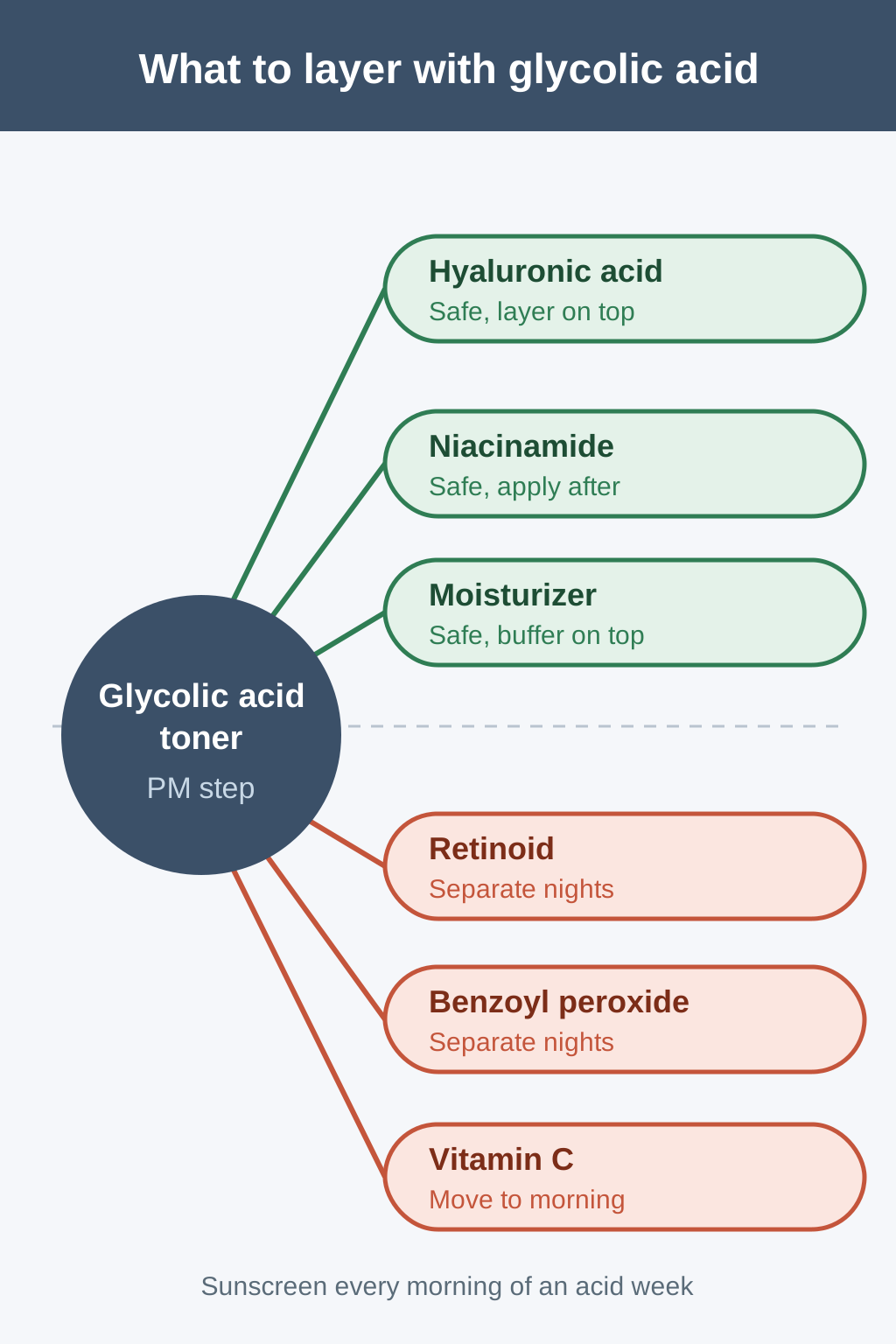
Layering rules are simple. Hyaluronic acid, niacinamide and any moisturizer are safe on the same night, applied after the acid. Retinoids and benzoyl peroxide need their own nights, because stacking two turnover accelerators multiplies irritation without multiplying results. Vitamin C belongs in the morning.
For the other half of that alternating schedule, see retinol serum strengths and night use.
If you have already overdone it, the protocol is boring and it works: stop every active for two full weeks, wash with a non-foaming cleanser, and rebuild with a ceramide moisturizer twice a day. Reintroduce the acid at one night a week.
Dermatology bodies publish the same caution in their dermatologist rules for exfoliating at home without irritation.
Where Can You Buy Glycolic Acid Toners Nearby?
Drugstores and big-box shelves carry the cheapest 5-7% formulas, beauty retailers add testers and returns, and online listings are the only place a stated pH usually appears. A glycolic acid near me search almost always surfaces the pharmacy and supermarket aisles first, which is where the lowest prices sit.
A glycolic acid nearby search filtered to a beauty retailer buys you three things the pharmacy does not offer: a tester to check texture and scent, the full ingredient list readable on the shelf rather than through shrink wrap, and a returns window that covers a reaction.
Check three things before paying in store. Find the batch or period-after-opening mark, because acid formulas that have sat in window light lose their soothing extracts first. Prefer opaque or tinted packaging. And ignore the tester bottle's contents entirely if it has been open for months.
Ordering online wins when you want the larger size, a published pH on the product page, or subscription pricing on a bottle you will genuinely finish in a year.
Get one practical routine change in your inbox each week.
One skincare routine tip a week. No product dumps.
Thanks — you're on the list.
