

A foaming cleanser is a liquid or pump-dispensed face wash whose surfactants, usually cocamidopropyl betaine, sodium cocoyl isethionate or coco-glucoside, whip into lather that lifts sebum, sunscreen and sweat. It suits oily and combination skin best, and the formulas worth buying finish near pH 5.5.
What Is a Foaming Cleanser?
A foaming cleanser is a low-viscosity face wash built on mild surfactants that aerate into lather, either in a pump chamber or between wet palms. The base is mostly water. Into it go a primary surfactant, a secondary one, a humectant such as glycerin, a thickener and a preservative.
Air does the rest. Forcing that thin liquid through a mesh screen in the pump head, or agitating it in wet hands, traps bubbles and turns about 0.4 g of product into a palmful of mousse.
The dispenser changes the texture more than most shoppers expect. A pump-foam bottle pre-aerates a deliberately dilute formula, so the lather arrives light and the dose is fixed. A gel-to-foam liquid is more concentrated and builds a denser, slower-collapsing lather once you work it up yourself, which also makes it easy to use three times as much as you need.
Three surfactant families cover almost every label: betaines such as cocamidopropyl betaine, isethionates such as sodium cocoyl isethionate, and glucosides such as coco-glucoside and decyl glucoside. All three lather without sodium lauryl sulfate. Foam cleansers are one of six wash formats, and six cleanser formats and who each suits covers the five it competes with.
How Does a Foaming Cleanser Actually Clean Your Skin?
Surfactant molecules surround oil and grime in micelles that rinse away in water, and lather is a visible side effect of that chemistry rather than its cause. Each molecule has a water-loving head and an oil-loving tail. Thousands of them cage a droplet of sebum, sunscreen or pollution with their tails inward, and the whole package leaves with the rinse water.
Bubbles form because those same molecules stabilise the film between air and water. That makes lather a sign the surfactant is working at the surface, not a measure of how much oil it has lifted. A high-foaming wash can leave skin squeaky and still have removed less waterproof sunscreen than a near-silent oil balm.
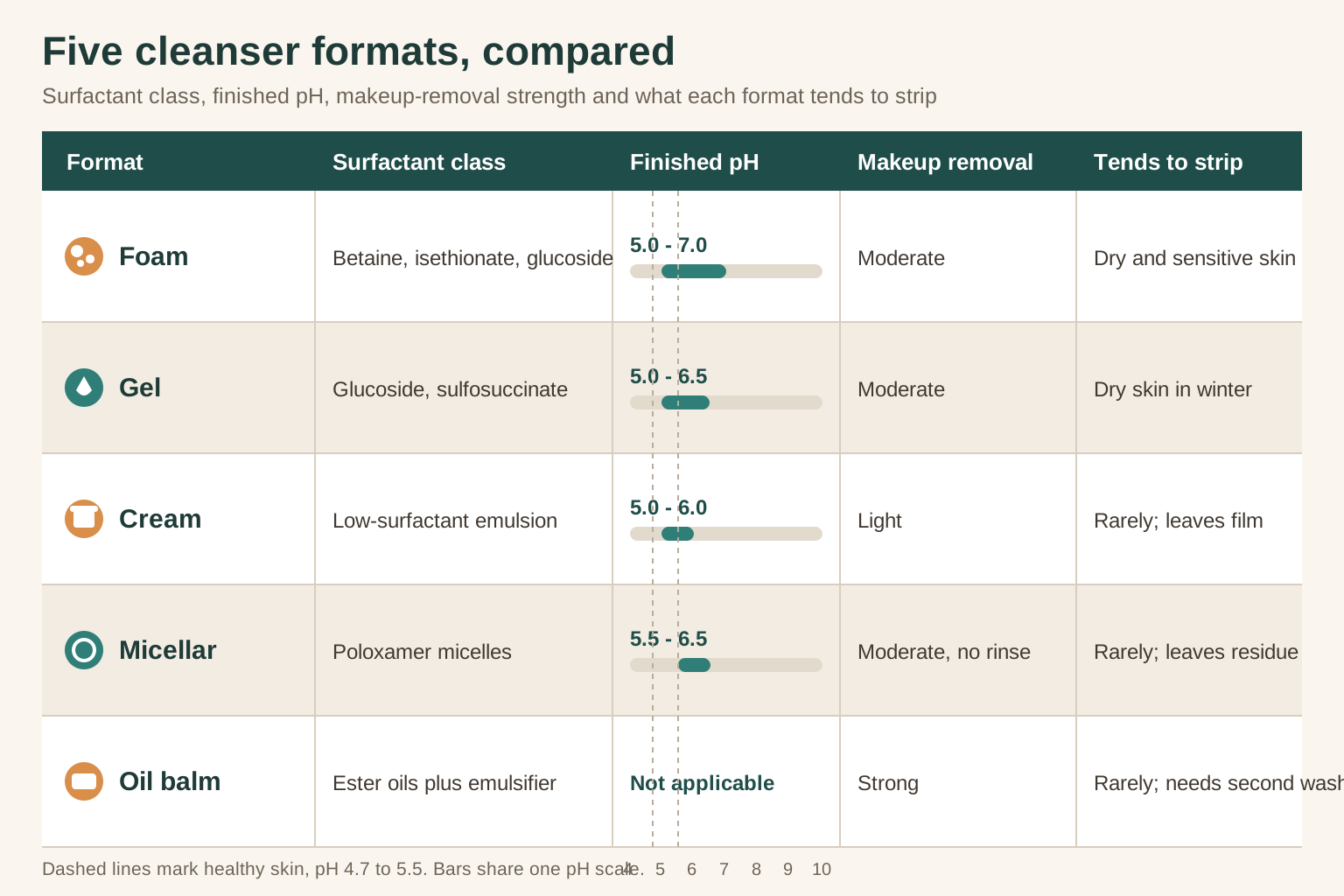
Finished pH is the number that matters. Healthy stratum corneum sits around 4.7 to 5.5, which keeps barrier enzymes and resident bacteria in range. A wash above pH 8 swells keratin, strips the acid mantle, and can take two to six hours to return to baseline.
The cost shows up as transepidermal water loss: wash too long or too hot and measurable water evaporation rises for hours afterwards. If your skin reacts to that easily, the rules for gentle surfactants for sensitive skin apply directly to foam.
Foam, Gel, Cream, Micellar or Oil Balm: Which Cleanser Format Suits You?
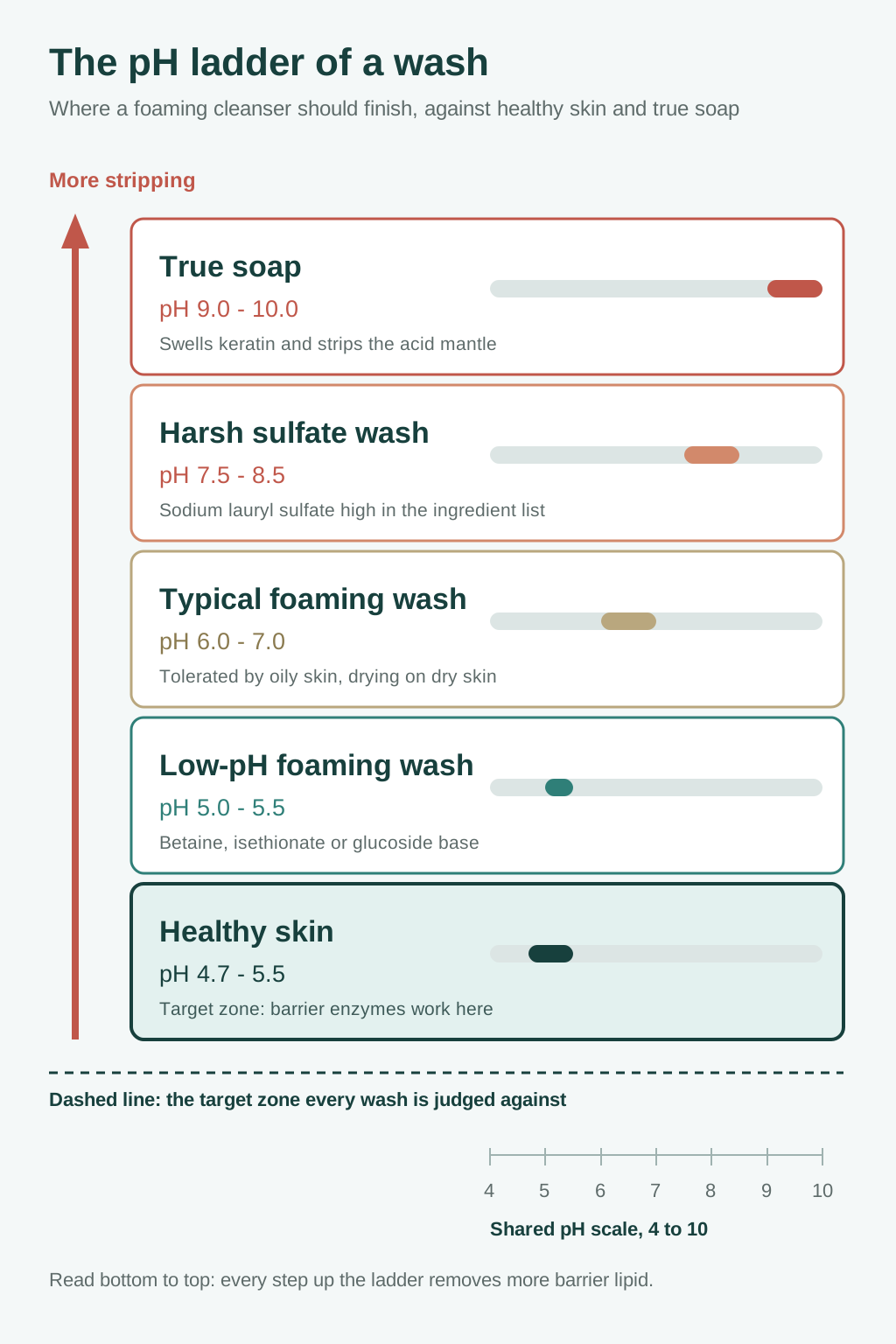
Foam rinses cleanest on oily skin, gel sits in the middle, cream and oil balm leave lipids behind for dry skin, and micellar water is a low-rinse option for quick removal. Scored side by side, the five formats separate on four things: surfactant class, finished pH, how much makeup they shift, and what they take with them.
| Format | Surfactant class | Finished pH | Makeup removal | Tends to strip |
|---|---|---|---|---|
| Foam | Betaine, isethionate, glucoside | 5.0-7.0 | Moderate | Dry and sensitive skin |
| Gel | Glucoside, sulfosuccinate | 5.0-6.5 | Moderate | Dry skin in winter |
| Cream | Low-surfactant emulsion | 5.0-6.0 | Light | Rarely; leaves film |
| Micellar | Poloxamer micelles | 5.5-6.5 | Moderate, no rinse | Rarely; leaves residue |
| Oil balm | Ester oils plus emulsifier | Not applicable | Strong | Rarely; needs second wash |
Where foam cleansers win
Midday shine, a sunscreen film that reapplication has built up over a day, and a morning wash that has to be finished in forty seconds. Foam also spreads without tugging, which suits anyone who cannot stand the drag of a cream wash.
Where foam loses
Winter dryness, retinoid flaking and any barrier that is already compromised. Cost per wash is the quieter drawback: a 150 ml pump delivers roughly 180 presses, so a bottle priced like a 200 ml gel runs out faster.
If dissolving makeup matters more than lather, start with what to check in an oil cleanser instead.
Not sure which column is yours? Six questions, two minutes, your skin type and the one concern that decides the format.
Which Skin Types Do Foam Cleansers Suit Best?
Foam cleansers suit oily, combination and acne-prone skin that produces visible sebum by midday and tolerates a thorough rinse without tightening. On that skin a foaming cleanser clears sebum and the emulsifier film left by sunscreen more completely than a cream wash, which deposits lipids back onto a surface that already has plenty.
For acne-prone skin, pair foam with salicylic acid at 0.5 to 2 percent rather than stacking it with a scrub. Washing more than twice a day is the usual mistake: it does not reduce oil output, and the dryness that follows pushes people into heavier moisturisers that clog. Technique matters more here than strength, which is why picking a cleanser for oily skin starts with frequency before ingredients.
Normal skin often fits foam in humid months and a gel or cream wash from November onwards. Switching formats twice a year is a sign you are reading your skin, not a sign you chose wrong. For a wider view of sebum control, clinical advice on managing an oily complexion is worth reading alongside this.
Who should not start here: eczema-prone skin, rosacea-prone skin, and anyone in the first six weeks of adjusting to a retinoid. All three have a thinner lipid reserve and will feel a lathering wash as tightness within ten minutes.
If you are shopping for a teenager with oily or breakout-prone skin, our comparison of Hello Bubble hair color and Bubble skin care for teens explains how that US teen line works and what it costs.
Is a Foaming Facial Cleanser Too Drying for Dry or Sensitive Skin?
A foaming facial cleanser is only too drying when its surfactants are harsh or its pH is high; a low-pH, sulfate-free formula with glycerin is usually tolerated. The real culprits are sodium lauryl sulfate, a finished pH above 8, and leaving lather on the skin for two or three minutes while you brush your teeth.
What makes a foaming facial cleanser tolerable on reactive skin is specific: a coco-glucoside or sodium cocoyl isethionate base, glycerin or panthenol in the first five ingredients, and no fragrance or essential oil. Those formulas foam a little less dramatically. That is the trade, and it is the right one.
Use the tightness test. Rinse, pat dry, wait ten minutes without applying anything. Skin that feels tight, looks matte in patches or stings under moisturiser has lost too much lipid, and the fix is a shorter contact time before it is a new bottle. The same ten-minute check runs through cleansing dry skin without stripping lipids.
Honest limitation: on actively flaking or eczematous skin, no foam formula beats a cream wash, however gentle the surfactant. Dermatology bodies publishing tips for relieving dry, tight skin after washing put a non-lathering wash and a moisturiser within three minutes ahead of any product swap.
What Should You Check on a Foaming Cleanser Label?
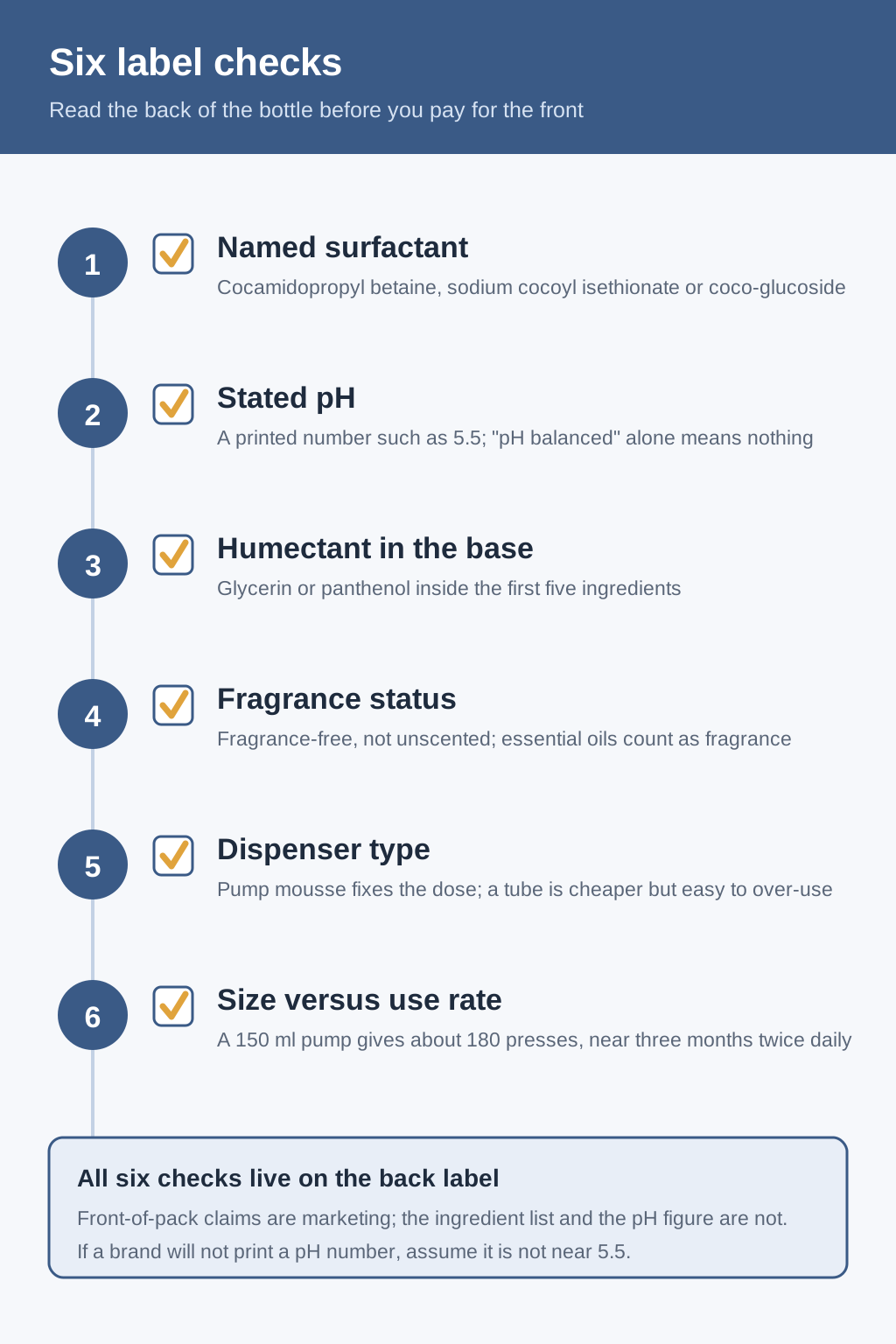
Check the named surfactant, the stated pH, a humectant high in the list, the fragrance status, the dispenser type and the bottle size against how fast you use it. Six checks, all of them on the back of the bottle rather than the front.
Start with the first five ingredients, because they are the formula. You want water, a primary surfactant, a secondary surfactant, a humectant and a thickener. If sodium lauryl sulfate sits in position two, expect a high-pH wash whatever the front label says.
A stated pH is worth trusting when it carries a number, as in "pH 5.5". "pH balanced" without a figure means nothing, because soap at pH 9.5 is also balanced against something. Brands that test finished pH tend to print it.
Fragrance status is the check people skip. "Unscented" can mean a masking fragrance was added to cover a raw-material smell; "fragrance-free" means no fragrance material was added at all. Essential oils count as fragrance, and limonene and linalool are the two most common sensitisers in a foaming cleanser.
Finally, the dispenser. A pump mousse gives you dose control and almost no waste but travels badly and cannot be refilled cleanly. A squeeze tube is cheaper per millilitre and survives a suitcase, but it is easy to dispense twice what you need. If you prefer a tighter checklist, run seven label checks before you buy before you pay.
Four steps narrow the shelf to three bottles that match your skin type, concern and budget.
How Do You Use a Foaming Cleanser Without Stripping Your Skin?
Wet the face with lukewarm water, work one pump of foam for about sixty seconds with fingertips only, rinse fully and pat dry before the next step. Four steps, and the first one is the one most people get wrong.
- Dampen the whole face first. Foam applied to dry skin concentrates surfactant on one patch and drags.
- Dispense one pump of your morning foam cleanser and spread it in three passes: forehead, nose and chin, then cheeks.
- Move in small circles with fingertips for about sixty seconds. No cloths, no brushes.
- Rinse until the slip is gone, then pat dry with a towel you have not used on your hands.
Water temperature is not a detail. Water above roughly 40 degrees Celsius dissolves more surface lipid and raises transepidermal water loss for hours, which is the real source of the tight feeling people blame on the cleanser.
Frequency depends on sebum, not on habit. Twice a day suits oily and combination skin; once at night with plain water in the morning suits dry skin and anyone six weeks into a retinoid. Published dermatologist guidance on how often to wash your face lands in the same place: twice daily, plus after sweating.
Do not stack abrasion on top of surfactant. A scrub, a silicone brush or an acid pad on the same day as two lathering washes is the combination that produces stinging within a week. If breakouts are the reason you are washing twice, an acne face wash that actually works is the better lever.
A printable seven-day tracker for morning and evening washes, for anyone who suspects they are cleansing too often.
Where Does a Foaming Cleanser Fit in Your Routine?
A foaming cleanser goes first in the morning and second at night, after an oil or balm has dissolved sunscreen and makeup in a double cleanse. Morning order is cleanse, treat, moisturise, sunscreen, and foam occupies the first slot because everything after it needs a clean surface to bind to.
At night the order flips. An oil or balm dissolves the lipid-bound filters in a water-resistant sunscreen; foam then clears the emulsifiers that oil leaves behind. Running foam alone usually leaves a film around the hairline and lash line. The full sequence, including where actives sit, is set out in the correct skincare order step by step.
Apply the next step within three minutes, while skin is still slightly damp. A humectant serum draws in that surface water; on bone-dry skin it pulls from deeper instead and can feel tacky.
If twice-daily lather is too much, keep foam for the evening and use a non-lathering cream wash in the morning. The trade is a slightly heavier finish before sunscreen.
When Should You Stop Using a Foaming Cleanser?
Stop when skin stays tight ten minutes after rinsing, stings under moisturizer, flakes around the nose or produces more oil within an hour of washing. Those four signals are over-cleansing, not a product you have yet to get used to.
Run a two-week reset: plain lukewarm water in the morning, a non-lathering wash at night, no exfoliation of any kind. Most skin settles inside ten days. Then reintroduce foam once a day and judge it on the ten-minute tightness test rather than on how clean it feels.
Seasons decide when to switch back. Foam that works in August often needs to drop to one wash a day by December. Honest cost of switching: a cream wash leaves more film, and on acne-prone skin it usually needs a second rinse. Reactive skin does better on the broader approach in calmer routines for reactive skin.
One short email a week, with the cleansing fixes that actually changed something.
One cleansing tip a week. No product dumps.
Thanks — you're on the list.


