

A gentle cleanser is a low-surfactant face wash buffered to pH 4.5 to 5.5 that removes oil and sunscreen without dissolving barrier lipids. Judge one by surfactant class first: sodium cocoyl isethionate, coco-glucoside and amino-acid surfactants clean well, while sulfates and true soap near pH 9 strip skin.
What Is a Gentle Cleanser, and What Makes One Gentle?
A gentle cleanser is a face wash built on mild synthetic detergents and buffered near pH 5, so it lifts oil and sunscreen while leaving the stratum corneum's own lipids in place. True soap is a fatty acid salt that sits near pH 9 and cannot be buffered down without breaking; cleansing cosmetics built on syndets can be acidified to whatever pH the formulator chooses.
Those same traits, a pH near 5 and mild surfactants, are also what to look for in the best face wash for aging skin once you reach 40 and beyond.
The surfactant class does most of the work. Sodium cocoyl isethionate, coco-glucoside, decyl glucoside, sodium lauroyl sarcosinate and the amino-acid surfactants (sodium cocoyl glycinate, sodium lauroyl glutamate) remove sebum with far less protein denaturation than sodium lauryl sulfate, which is the reference irritant in patch-test research for a reason.
The pH target is not a marketing number. Healthy facial skin measures a mean pH of about 5.09, and measured skin surface pH in healthy and acne-prone faces puts acne-prone faces higher, near 6.35. A skin cleanser that lands inside the 4.5 to 5.5 window leaves the acid mantle and its resident flora roughly where they started.
What gentle does not mean: it is not a synonym for fragrance-free, non-foaming or acid-free. A fragranced cream wash can be mild on surfactants and still trigger a reaction, and a clear gel with glucosides can be milder than a thick cream with sulfates. Format tells you texture; the ingredient list tells you behaviour. If reactivity is the deciding factor, start with picking a cleanser for sensitive skin before you compare textures.

How Can You Tell Your Current Wash Is Too Harsh?
Skin that feels tight within five minutes of rinsing, stings under moisturizer or flakes at the nose and jaw is reacting to surfactant damage rather than to dryness alone. The five-minute window matters: normal skin re-equilibrates and feels soft and slightly cushioned, while a stripped stratum corneum keeps contracting as water evaporates out of it.
Four signals, in the order they usually appear:
- A serum or sunscreen that used to feel neutral now stings for 30 to 60 seconds.
- Fine flaking along the nose folds and the jawline, where sebum is thinnest.
- Midday oil rebound on a face that was matte at 9 a.m.
- New rough patches on the cheeks that no moisturizer smooths for longer than an hour.
The mechanism is measurable. Surfactant molecules that stay in the stratum corneum insert into its lipid lamellae and disorder them, which is why transepidermal water loss stays raised for days after a single strong exposure; how surfactants disturb stratum corneum lipids tracks that disruption down to the lipid packing.
This is why a good gentle cleanser fixes more than a richer cream can when the wash is the cause: you can layer a lightweight moisturizer over damaged lipids twice a day and still lose water through them. Change the wash and give it three days. By day three a gentle skin cleanser should leave skin comfortable bare, with no tightness before you apply anything. Oily skin has its own version of this trap, covered in oily skin washing without stripping sebum.
The 7 Label Checks That Separate Gentle Cleansers From Marketing
Seven label checks decide whether a bottle is genuinely mild: surfactant class, stated pH, fragrance, humectant position, alcohol, barrier lipids and any declared acid percentage. Score each one 0, 1 or 2 for a 14-point total: eleven or higher is worth buying, eight to ten is a compromise, below eight put it down. Run it across the top skin cleansers in any aisle and the gap between genuinely gentle cleansers and gentle facial cleansers that only say so on the carton becomes a number.
| Check | 0 points | 1 point | 2 points |
|---|---|---|---|
| 1. Surfactant class | Sulfate or soap first | Sulfate below position five | Isethionate, glucoside or amino-acid |
| 2. Stated pH | None stated, foams hard | None stated, low foam | Printed, 4.5 to 5.5 |
| 3. Fragrance | Parfum plus limonene or linalool | Parfum only | No parfum, no essential oil |
| 4. Humectants | None | One above the preservative | Two above the preservative |
| 5. Alcohol and counter-irritants | Alcohol denat. in the top five | Menthol or witch hazel present | Neither present |
| 6. Barrier lipids | None | One lipid, low in the list | Ceramides, cholesterol or squalane |
| 7. Declared acid | Acid present, no percentage | Percentage on the website only | Percentage printed on the pack |
Surfactant class in the first five ingredients
The first five ingredients carry roughly 80% of the formula by weight, so that is where the cleaning system lives. Sodium cocoyl isethionate, coco-glucoside and sodium lauroyl glutamate score two. A soap base such as sodium palmate scores zero, whatever the front label promises.
A stated pH between 4.5 and 5.5
A printed pH is a formulator's commitment and the single fastest check. Brands that skip it are usually foaming with a soap or a high-pH syndet blend. Score one point for an unstated pH on a low-foam cream and zero for an unstated pH on something that lathers thickly.
No fragrance, parfum or essential oils
Fragrance contact allergy runs at roughly 4.5% in the general European population and up to about 20% among dermatitis patients patch-tested to fragrance mix I, which is why how common fragrance contact allergy really is is worth reading before you accept a scented wash. Limonene and linalool on the list are oxidised fragrance allergens, not bonuses.
Two humectants listed above the preservative
Glycerin, panthenol, betaine or sodium PCA sitting above phenoxyethanol means they are present at percentages that survive the rinse, roughly 1% and up. One humectant earns a point, two earn two. Humectants below the preservative are typically under 0.5% and function as label decoration.
No denatured alcohol, menthol or astringent extract
Alcohol denat. in the top five accelerates lipid extraction, while menthol, camphor and witch hazel create a cooling sensation that reads as clean and adds irritation. None improves sebum removal at cleanser contact times.
Barrier lipids present: ceramides, cholesterol, squalane
Rinse-off lipids deposit a fraction of what a leave-on cream does, but the fraction offsets some of the extraction the surfactants cause. Ceramide NP, cholesterol or squalane anywhere in the list earns a point; two of the three earns two.
Any exfoliating acid declared with a percentage
A wash with salicylic acid, glycolic acid or gluconolactone and no printed percentage could be 0.5% or 2%, and that difference decides whether it suits daily use. Undeclared acid scores zero; a figure buried on the brand site scores one. If makeup is the real problem, an oil step serves you better first, as dissolving makeup with an oil balm sets out.
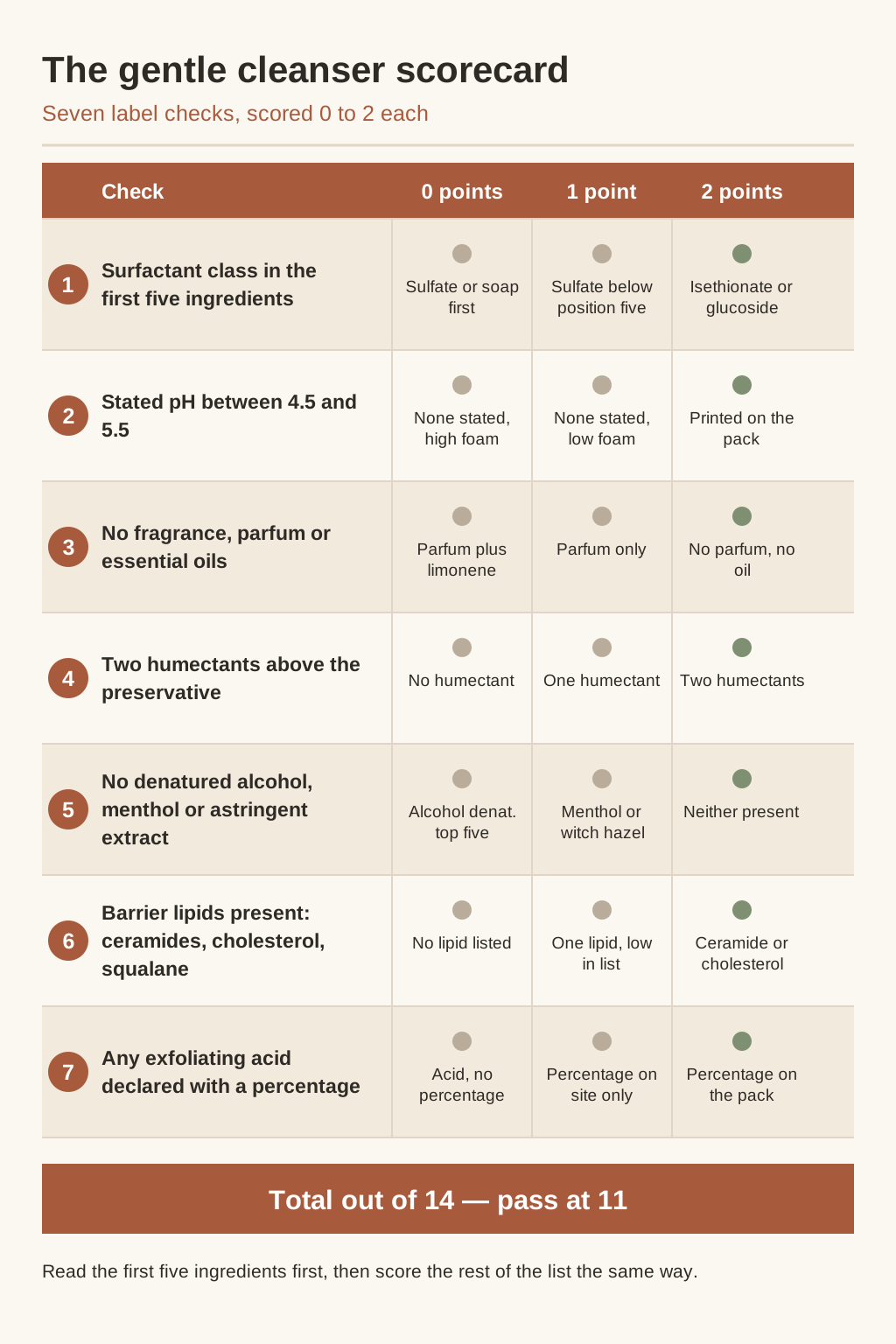
The same seven checks fit on one printable page, with the passing and failing ingredient names spelled out, for anyone who would rather not memorise them.
Which Cleanser Format Fits Your Skin Type?
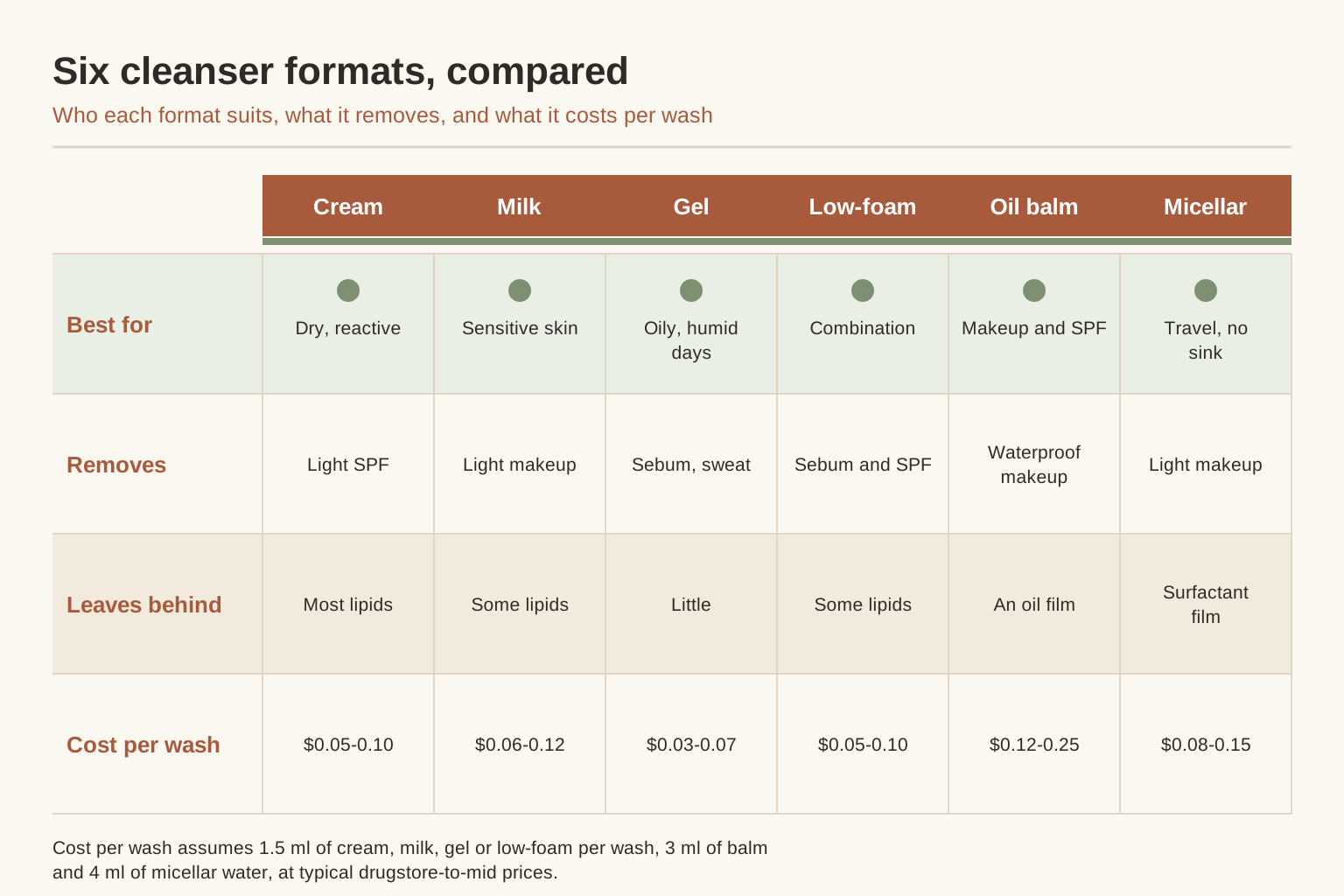
Cream and milk formats suit dry or reactive skin, gel and low-foam suit oily skin, and an oil balm handles sunscreen and makeup before a second, milder wash. Format changes two things that matter: how much surfactant reaches the skin per wash, and how much of what it loosens gets rinsed away versus wiped away.
If tightness after rinsing is your main complaint, a face wash for dry skin goes further into pH, barrier lipids and which cream or milk texture matches how dry your skin actually runs.
A face wash cream carries its surfactants in an emulsion with fatty alcohols and glycerin, so at an identical pH it deposits more residual lipid than a high-foam gel does. That residue is why a gentle face wash in cream form leaves dry skin comfortable and leaves oily skin feeling coated by lunchtime. Micellar water is the mildest of the six and the weakest on sunscreen; it also demands a cotton pad, which adds friction.
Cost per wash separates the formats more than price per bottle does. A 236 ml pump at 1.5 ml per wash gives about 157 washes; a 100 ml balm at 3 ml per wash gives 33. Thick creams get over-dispensed, so real-world cost per wash for a cream typically runs 30% to 50% above the arithmetic.
Who each one is wrong for: oil balms feed malassezia, so they are a poor choice during a fungal acne flare; high-foam gels are wrong for anyone whose skin tightens in five minutes; micellar water is wrong as the only cleanse on a sunscreen day. The format-by-format detail lives in six face wash formats compared.
Not sure which of the six formats matches your skin? Six questions, about two minutes, and you get your skin type, a sensitivity flag and the format that fits both.
Which Cleanser for Textured Skin Actually Smooths Bumps?
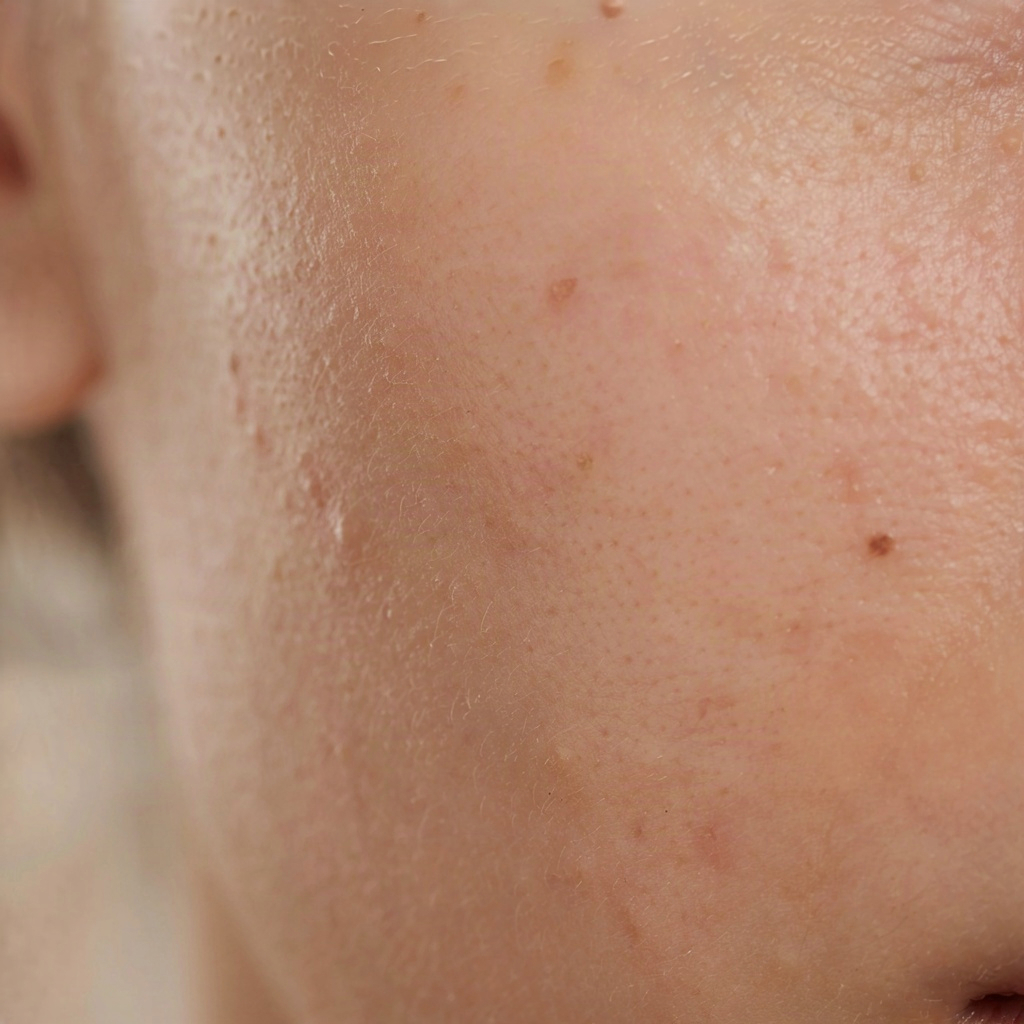
A cleanser for textured skin works by keeping the barrier intact so leave-on acids and retinoids can resurface, not by scrubbing with grit or holding acid on the face. Roughness has at least three causes, and they do not share a fix: closed comedones are plugged follicles, post-acne roughness is disorganised repair collagen, and keratin plugs on the cheeks and arms are follicular hyperkeratosis.
Contact time is the hard limit. A wash sits on skin for 20 to 60 seconds, and acids need minutes at a controlled pH to do meaningful desmosome work, so a wash-off acid delivers a fraction of what the same acid delivers in a leave-on. Treat any acid in a cleanser as a small bonus, never as the exfoliating step.
Within that limit, gluconolactone or a declared 0.5% to 2% salicylic acid in a low-foam base does something real: it keeps follicle openings clearer between treatment nights and reduces how often you need a stronger leave-on. What it will not do is flatten a closed comedone in a week. Layer it against a plan, which is what gentle exfoliation for smoother texture sets out, and if breakouts rather than texture are driving the search, acne wash actives that clear breakouts is the better starting point.
There is a point where the right move is to stop exfoliating for two weeks and let a plain skin cleanser carry the routine: when roughness is spreading, when skin stings under water, or when the texture appeared after you added a second acid.
How Should You Use a Gentle Cleansing Face Wash?
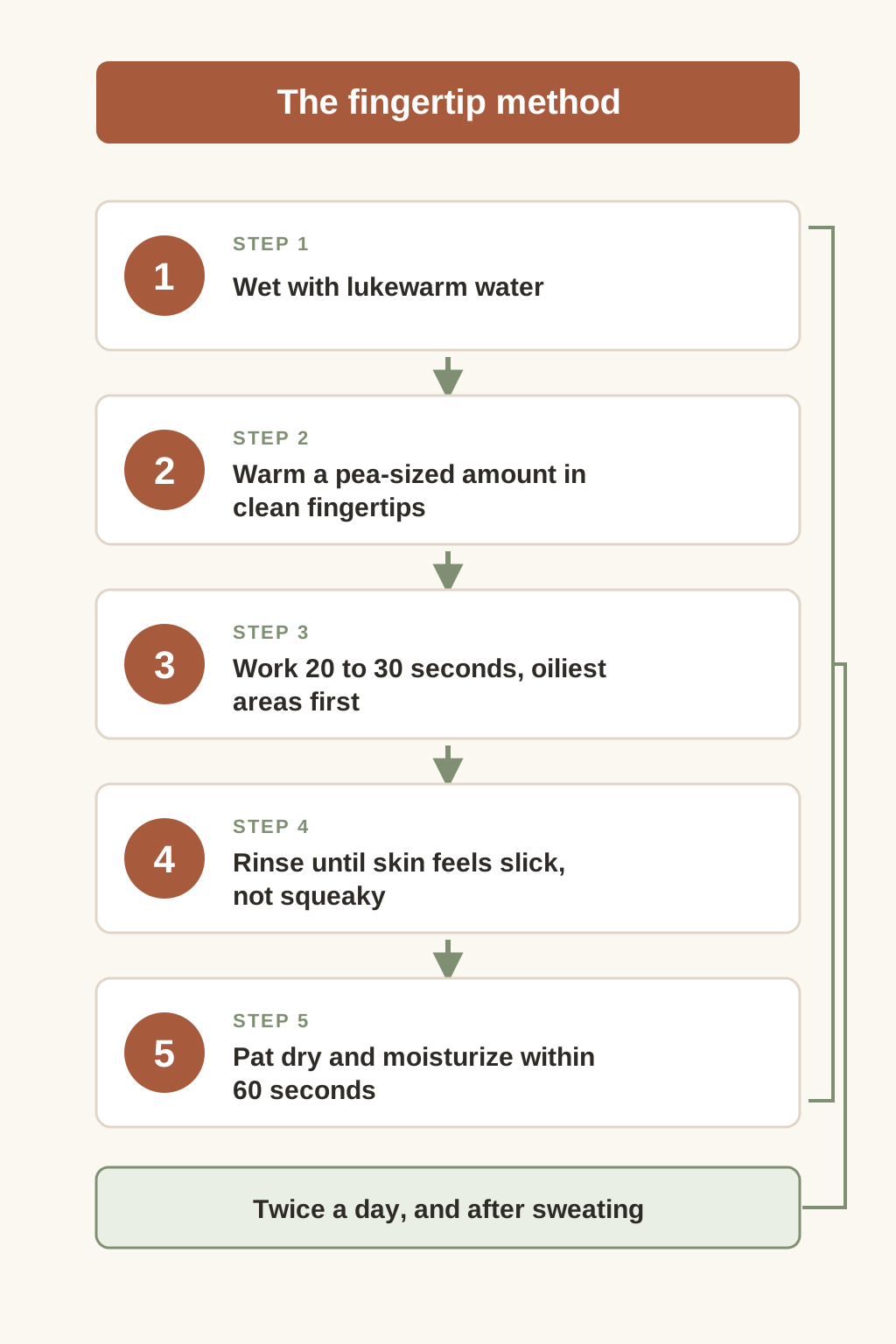
Wet skin with lukewarm water, work a pea-sized amount over the oiliest areas with fingertips for 20 to 30 seconds, rinse, then pat dry and moisturize within a minute. Five steps, no tools. Fingertips move enough surfactant across the face, and every cloth, brush or mesh sponge adds friction that a gentle cleansing face wash was formulated to avoid.
- Wet with lukewarm water, roughly body temperature; hot water accelerates lipid loss.
- Warm a pea-sized amount, about 1.5 ml, between clean fingertips.
- Work it for 20 to 30 seconds, starting on the T-zone and finishing on the cheeks.
- Rinse until skin feels slick rather than squeaky, about 15 seconds.
- Pat dry with a clean towel and apply moisturizer inside 60 seconds, while skin is still damp.
Twice a day plus after heavy sweating is the ceiling, which matches dermatology guidance on washing your face. A third wash removes the sebum the first two triggered the skin to replace, and the rebound gets faster each time. If your skin runs oily, a pea of your gel cleanser in the evening does more than two washes of anything harsher.
The squeaky fresh wash feeling is a warning sign, not proof of cleanliness: it is the sound of a stripped stratum corneum with no residual lipid film. Aim for soft and slightly cushioned instead. Second cleanses earn their place on nights with mineral sunscreen or long-wear makeup, where an oil or balm step comes first and the mild wash follows; on a bare-skin day, one wash is enough. What comes next is a judgment call that what a toner actually does post-cleanse answers in detail.
Where Does Cleansing Sit in the Rest of Your Routine?
Cleansing sets the pH and hydration state every later step builds on, which is why a milder wash often raises how much active skin tolerates without any product being added. Skin sits at its most permeable in the 60 seconds after a rinse, which is both the opportunity and the risk.
The order that follows a rinse is fixed by physics, not fashion: humectants on damp skin first (glycerin, panthenol, hyaluronic acid), then water-based actives, then emollients and occlusives to slow the water back out. An acid or retinoid applied to skin that is still wet penetrates faster and stings more, so wait two to three minutes.
The tolerance effect is the practical payoff. People who switch from a sulfate foam to a pH 5 syndet routinely move from retinoid twice a week to four nights, because the barrier is not already compromised when the retinoid lands. The wash is also the cheapest variable in the routine, which makes it the first thing to change when a working routine stops working.
Timing around real life: shower after a workout and let that be the second wash rather than an extra one, rinse chlorine off with water alone if your face is not oily, and treat a makeup day as one oil step plus one mild wash, never three cleanses. The full sequence, morning and night, is laid out in building a full skin care routine, and if dryness persists after the wash is fixed, moisturizers that hold water in dry skin covers the leave-on side.
How Do You Switch Cleansers Without a Flare-Up?
Swap the wash alone for 14 days with every other product held fixed, patch test on the jawline for three nights first, and judge by tightness and flaking rather than day-one feel. One variable at a time is the only way to know what caused a change, and 14 days covers roughly one full stratum corneum turnover cycle.
The patch test: apply the new wash to a coin-sized area along the jawline, leave it 60 seconds, rinse, and repeat for three consecutive nights. Reactions to surfactants and fragrance usually appear by the third exposure, and the jawline shows them without putting your whole face at risk.
During the 14 days, record two things each evening: minutes until tightness after rinsing, and whether any flaking is visible. Both numbers should trend down. Purging, if it happens, is limited to areas that already break out and shows up in the first 10 days as small uniform papules; irritation appears anywhere, including places you never break out, and comes with stinging or a diffuse flush.
The stop rule is simple: two consecutive nights of stinging, or any new rash, and the previous wash comes back the same day. Good gentle cleansers do not need a break-in period. If two candidates both pass 14 days, keep the one with the lower cost per wash and the printed pH.
One note a week, on the wash and barrier side of skincare, if you want the next round of testing as it lands.
One cleanser or barrier tip a week. No product dumps.
Thanks — you're on the list.


