

The best face wash for aging skin is a non-foaming cream or milky cleanser with a pH near 5, mild surfactants such as glucosides or cocamidopropyl betaine, and ceramides or glycerin to protect a thinning barrier. Mature skin makes less oil and holds less water, so the deciding factor is what the cleanser leaves behind, not what it strips.
What makes a face wash right for aging skin?
A face wash suits aging skin when it removes sunscreen, makeup and oil while leaving the skin's own lipids and water in place, because mature skin produces less sebum and repairs its barrier more slowly. Sebum output falls steadily from the mid-20s, and the outer layer holds fewer ceramides and less natural moisturizing factor, the salts and amino acids that bind water.
That shift changes how the best face wash for aging skin should be judged. A wash that felt fine at 25 can leave a 55-year-old face tight within ten minutes, because surfactants dissolve the same lipids the skin now struggles to rebuild.
Three signs tell you a cleanser for aging skin is too harsh:
- Tightness that lasts more than a few minutes after you pat dry.
- Flaking around the nose, chin or hairline by midday.
- Stinging when you apply a moisturizer or serum afterward.

Keep expectations realistic. An anti aging face wash sits on skin for roughly 60 seconds before you rinse it away, so it cannot fill wrinkles or rebuild collagen. Its real job is protective: clean without damage so the leave-on products that follow, such as the best face cream for aging skin you already use, land on a calm, intact barrier.
Which ingredients should a cleanser for mature skin contain?
A cleanser for mature skin should pair mild surfactants such as glucosides or betaines with humectants like glycerin and barrier lipids like ceramides, and skip sodium lauryl sulfate, high alcohol and heavy fragrance. Surfactants are the cleaning agents, and their strength decides most of the outcome.
Surfactants. Look for coco-glucoside, decyl glucoside, cocamidopropyl betaine or sodium cocoyl isethionate near the top of the list. Sodium lauryl sulfate binds to skin proteins and is a standard irritant in patch-test research, which is why a facial cleanser for aging skin should avoid it.
Humectants and lipids. Glycerin and hyaluronic acid draw water back in while you rinse; ceramides, cholesterol and squalane replace some of the lipids the wash removes. A panel of dermatologists reached the same conclusion in a dermatologist consensus on gentle cleansers for mature xerosis, recommending mild-surfactant cleansers with barrier lipids for skin over 50.
pH. Healthy skin sits around pH 4.7 to 5.5. A facial cleanser for mature skin in that range disturbs the acid mantle less than a bar soap at pH 9 to 10, which can leave skin reactive for hours. Few labels print pH, so a list of seven label checks for a gentle cleanser helps you judge the formula from its ingredients instead.
Skip: sodium lauryl sulfate, denatured alcohol high on the list, strong added fragrance and gritty scrubs. Save actives such as retinol and peptides for leave-on products; the anti aging serum ingredients that reduce wrinkles work best when they stay on skin for hours, not seconds.
Which cleanser format works best on mature skin?
Cream, milky and balm cleansers work best on most mature skin because they lift oil-based grime with little lather, while gels suit oily skin over 40 and high-foam washes strip the most. Format is a shortcut to surfactant strength: the more foam a product builds, the more lipid it usually removes.
- Cream and milky lotion cleansers suit dry and normal mature skin. They rinse clean with lukewarm water or a soft cloth and leave a slight cushion behind. Limitation: they rarely remove waterproof mascara in one pass.
- Cleansing balms and micellar water dissolve long-wear makeup and water-resistant sunscreen. Balms need a thorough rinse or a second light wash on oily skin.
- Gel cleansers still make sense as a face wash for mature skin that turns shiny by noon, or in hot, humid months.
- Foaming washes feel the cleanest, but lather is a property of the surfactant, not a sign of a cleaner face.
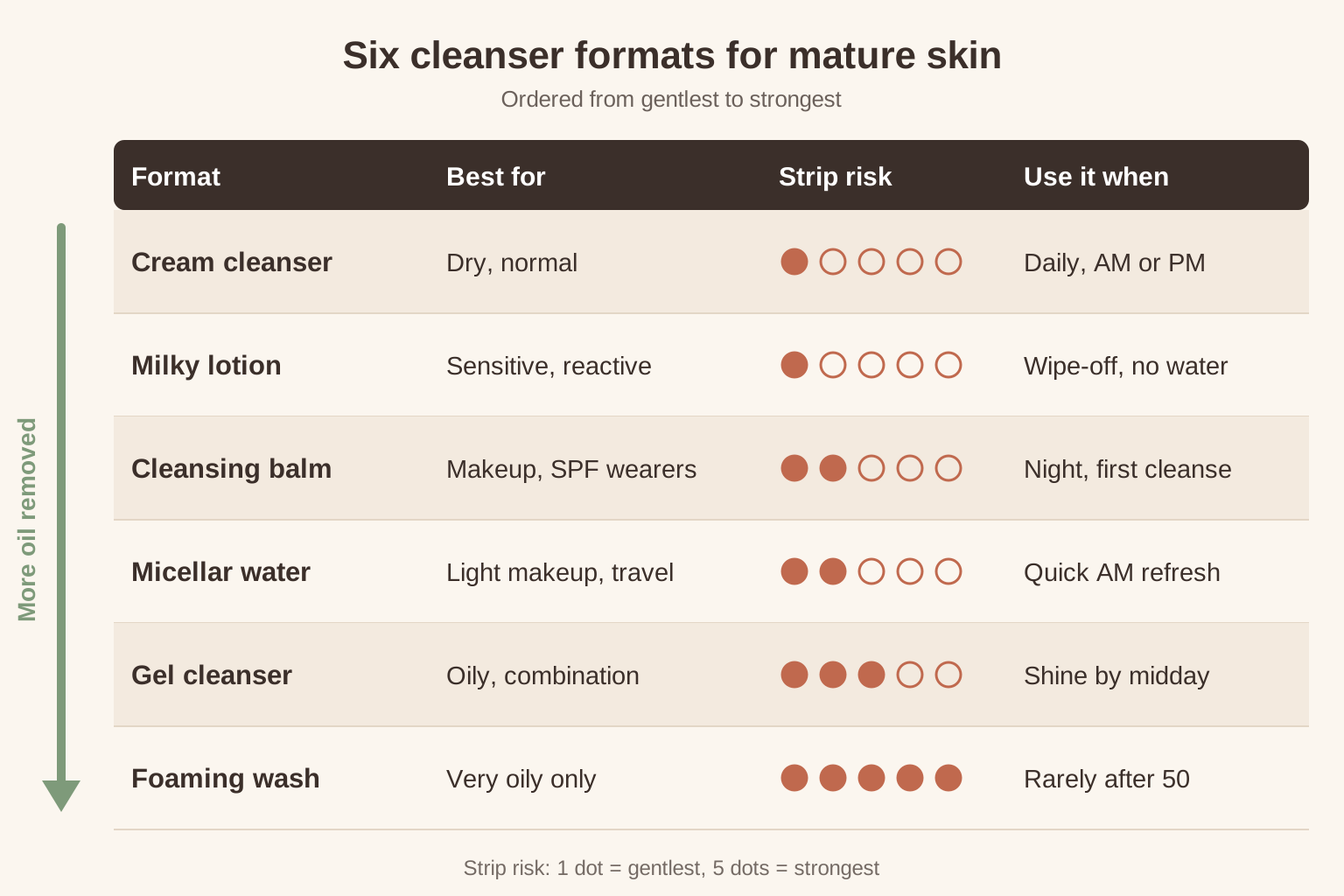
Match the format to how your skin feels two hours after washing, not to how it feels at the sink. A full comparison of six face wash types and who each suits adds powder and oil cleansers to the picture, with the pH and surfactant rules behind each.
What is the best cleanser for mature skin by skin type?
The best cleanser for mature skin matches your skin type: ceramide cream for dry skin, mild glycolic wash for dull texture, light gel for oily skin, fragrance-free milk for sensitive skin, balm for heavy makeup.
Disclosure: we may earn a commission on purchases made through these links.
The best face wash for mature skin leaves your face soft two hours after the evening wash. Still dry with a cream formula? Read up on cleansing dry skin without stripping .
Not sure which skin type you have now? Six questions, two minutes, your skin type and top concern.
How should you wash your face in your 40s, 50s and 60s?
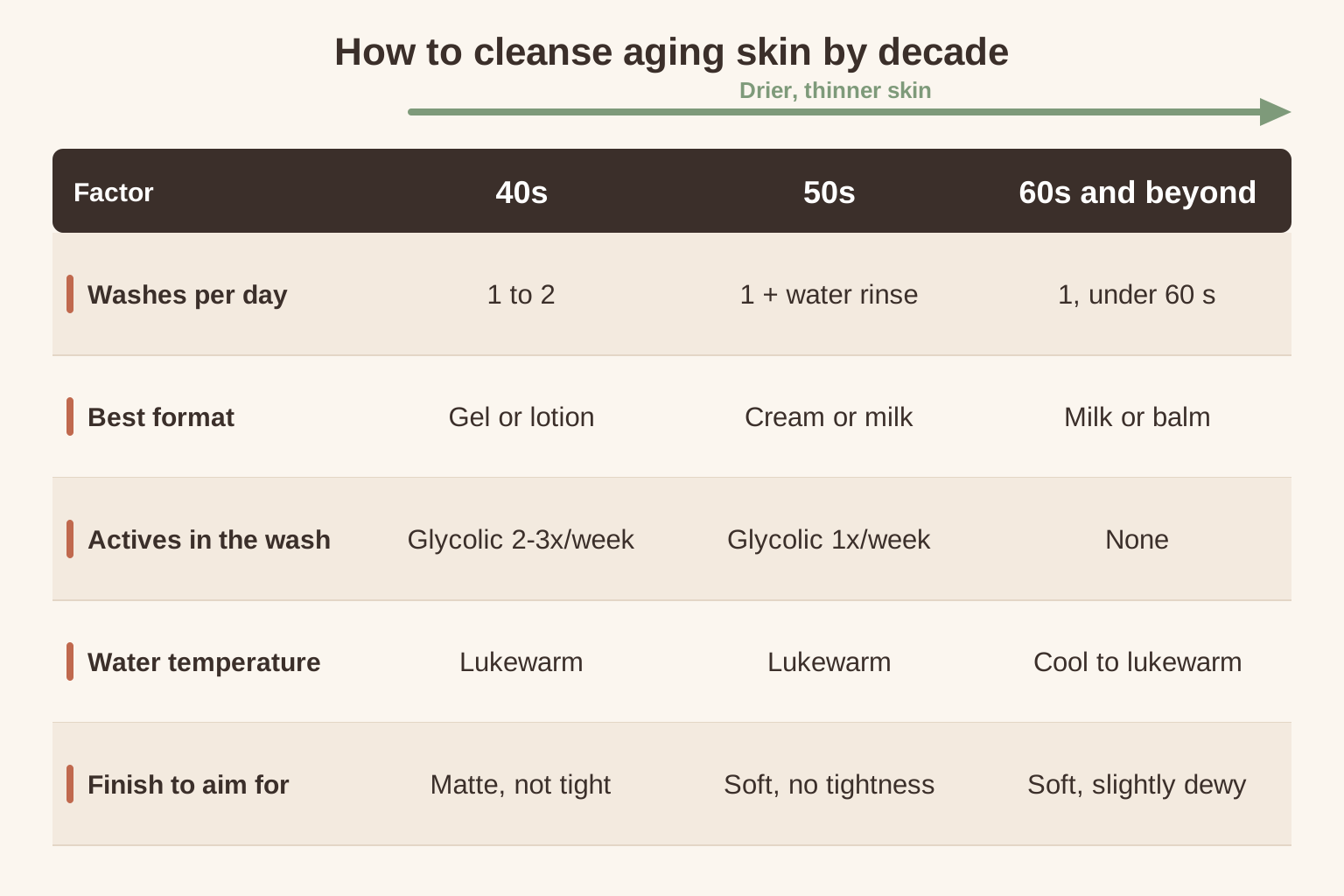
Wash once or twice daily with lukewarm water in your 40s, move to one full cleanse at night plus a water rinse or milky wash in the morning in your 50s, and keep every wash under a minute after 60. The pattern follows how fast oil and water levels drop with each decade.
40s. The best face wash for women over 40 often still has to manage shine and occasional breakouts while early fine lines appear. A gentle gel or lotion cleanser twice a day works, with a glycolic wash two or three evenings a week.
50s. Estrogen loss around menopause dries skin quickly. The best face wash for women over 50, and the best facial cleanser for women over 50, is usually a cream or milk used once at night, with only a water rinse in the morning.
60s and beyond. Skin is thinner and slower to heal. Keep contact time under 60 seconds and pat, never rub. A systematic review of skin integrity in older adults of 33 studies found gentle cleansers paired with humectant or occlusive moisturizers protected aged skin best.
| Factor | 40s | 50s | 60s and beyond |
|---|---|---|---|
| Washes per day | 1 to 2 | 1 plus a water rinse | 1, under 60 seconds |
| Best format | Gel or lotion | Cream or milk | Milk or balm |
| Actives in the wash | Glycolic 2 to 3 times a week | Glycolic once a week, if tolerated | None |
| Water temperature | Lukewarm | Lukewarm | Cool to lukewarm |
| Finish to aim for | Matte, not tight | Soft, no tightness | Soft and slightly dewy |
The best cleanser for aging skin is only the first step; the order of everything after it is covered in the guide to building a skin care routine in the right order .
Is an anti wrinkle cleanser with retinol or acids worth using?
An anti wrinkle cleanser with glycolic acid can smooth rough texture over weeks, but retinol and peptides rinse off too fast to change wrinkles, so they belong in a leave-on serum or cream. Contact time is the problem: a 60-second wash delivers a small fraction of the dose a serum delivers overnight.
Acids are the exception because they work on the surface. A glycolic or lactic acid wash loosens the bonds between dead cells, so dull, rough mature skin looks smoother after three to four weeks of use two or three times a week.
Limitations apply. If you use retinol at night, keep an acid wash to the mornings or to retinol-free nights, or the combination can cause peeling. Hormone-driven dryness also changes the math: research on how menopause changes skin links falling estrogen to thinner, drier skin, and on that skin an exfoliating anti aging face wash can do more harm than good. For gentler options, see the guide to exfoliating skin safely by skin type .

Which washing habits make older skin look older?
Hot water, double cleansing every morning, scrubbing brushes, and leaving skin bare for more than a minute after washing all pull water and lipids from older skin and make fine lines look deeper. Even the gentlest face wash for older skin fails when the habits around it are harsh.
- Hot showers and long washes: heat melts barrier lipids; keep water lukewarm and the face wash under a minute.
- Over-cleansing: a full double cleanse belongs at night only, after makeup or sunscreen.
- Rough cloths and spinning brushes: friction on thin skin causes redness and micro-tears.
- Waiting to moisturize: apply moisturizer within a minute of patting dry to trap water.
If redness persists despite gentle habits, the guide to choosing a cleanser for sensitive skin explains which formulas calm reactive faces.
Get one practical, mature-skin routine tip in your inbox each week.
One mature-skin routine tip a week. No product dumps.
Thanks — you're on the list.


