

What a face toner actually does for your skin
The word toner covers two products that have almost nothing in common. Until the late 1990s a toner was an astringent: denatured alcohol and witch hazel, sold to strip the oily film that harsh bar soaps left behind. The toner skin toner sold today is the opposite product — a water-thin hydrating step designed to put something back rather than take it away. Both still sit on the same shelf under the same word, which is why two people can use "toner" and mean opposite things.
A toner for face use is a leave-on liquid you apply to damp skin, ideally within about 60 seconds of rinsing, before anything thicker. Nothing rinses off. That timing is the whole mechanism: humectants such as glycerin, butylene glycol and hyaluronic acid pull water inward, and they work best when there is still surface water available to pull.

A modern facial toner does three measurable things: it adds a thin layer of humectants, it delivers low-dose actives (niacinamide, PHAs, panthenol) in a vehicle light enough to layer, and it returns your skin surface to its naturally acidic pH after cleansing. It does not deep clean — that was your cleanser's job, and the current dermatology position on cleansing is a gentle, non-abrasive, alcohol-free formula, as set out in dermatologist guidance on gentle face washing.
It also will not permanently shrink pores. Pore size is largely genetic and sebum-driven; astringents temporarily swell the pore rim so the opening looks smaller for an hour or two. And it never replaces a moisturizer, because water you add without an occlusive on top evaporates within minutes. If you want the longer background before you shop, start with what a face toner is and what it is for.
The formula families hiding behind facial skin toners
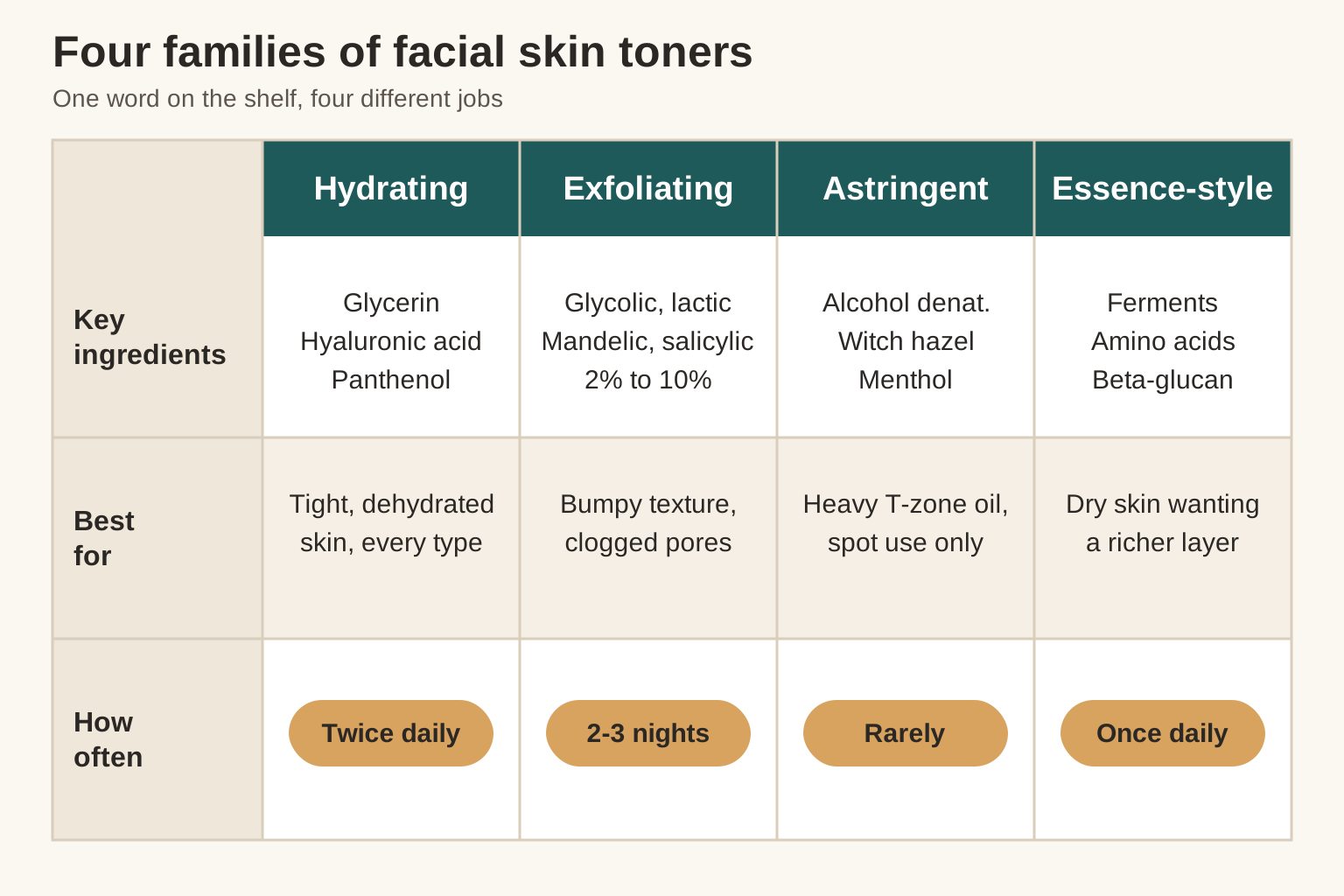
Facial skin toners split into four families that behave differently enough that swapping one for another can trigger a week of irritation. The category name on the bottle tells you almost nothing, so the ingredient list has to.
The exfoliating family is the one where strength and pH decide everything, so read how to choose a glycolic acid toner before you commit to a 5-10% AHA formula.
Hydrating toners
Humectant-led, no acids above trace levels, safe twice a day. Glycerin usually sits in the top five ingredients. These are the layerable ones — pat on two or three passes if your skin drinks the first.
Exfoliating toners
Glycolic, lactic, mandelic or salicylic acid at 2% to 10%, formulated at a low pH so the acid stays in its active free form. Two to three nights a week is the ceiling for most people, and never on the same night as retinol.
Astringent toners
Alcohol denat., witch hazel distillate, sometimes menthol. They degrease fast and feel satisfying on a hot day, which is exactly why people overuse them into a damaged barrier. If your reason for buying one is midday shine, the more durable fix is covered in toner for oily skin: what to check before buying.
Essence-style toners
The thickest of the four, often with fermented ferments, amino acids or beta-glucan, poured into the palms and pressed in rather than wiped. Slower to absorb, and the most expensive per ounce.
A bottle labelled toner face toner can belong to any of these four. The European face tonic tradition sits in the astringent camp — herbal, often alcohol-carrying, designed to be swept off with cotton — while the Korean-style hydrating toner is a palm-pressed hydration step with no removal stage at all. Same shelf, opposite intent.
Low pH is not automatically hostile: a randomized evaluation of low-pH products and the skin microbiome found that 28 days of products formulated below pH 5 did not destabilise the resident skin flora. The risk in an exfoliating toner comes from the acid dose and how often you use it, not from acidity itself.
Matching a toner to combination, normal or textured skin
The best toner for combination skin has a harder job than an oily-skin formula, because it has to satisfy two zones with opposite needs in one pass. An oily-skin toner can be uniformly degreasing. A combination formula cannot, or the cheeks pay for the T-zone.

Here is the test for whether a toner for combination skin is balancing or stripping: apply it, wait ten minutes, and touch your cheeks before you touch your nose. Cheeks that feel tight, papery or faintly itchy mean the formula is degreasing indiscriminately, even if your T-zone feels excellent. That tightness is the barrier signal, and it shows up days before visible flaking does.
Choosing a skin toner for combination skin is usually a compromise you resolve by zone, not by bottle. Pick a humectant-led formula for the whole face, then use an acid or clay step on the nose and forehead only, two nights a week. A face toner for combination skin should hydrate the cheeks without leaving occlusive weight along the nose — if it feels tacky after 60 seconds, it is too heavy for the T-zone.
Toner for normal skin is maintenance rather than correction. The shortest ingredient list generally wins: water, a humectant, a soothing agent, a preservative. Paying for eleven botanical extracts buys you eleven more chances to react.
Toner for textured skin means scheduled chemical exfoliation, never scrubbing. Bumpy cheeks and clogged texture respond to a 5% to 7% AHA used twice weekly over eight to twelve weeks. The cost is real: the FDA finding that alpha hydroxy acids raise UV sensitivity — UV reddening sensitivity rose 18% after four weeks of AHA use — so daily sunscreen is not optional alongside one. If you have been reaching for a physical scrub instead, compare the tradeoffs in gentle face scrub and exfoliator guide.
Not sure which of the four families your skin is asking for? Six questions, two minutes, your skin type and one toner family to shop.
How to read a toner label before you pay for it
Ingredients are listed in descending order by weight down to 1%, after which the order is arbitrary. So the first five entries decide what the product actually is, and everything below them is mostly positioning — the green tea extract advertised on the front is frequently present at a fraction of a percent.
That rule matters most for humectants, because glycerin sitting near the top separates a real hydrator from scented water, which is the first of seven label checks for choosing a hydrating toner for dry skin.
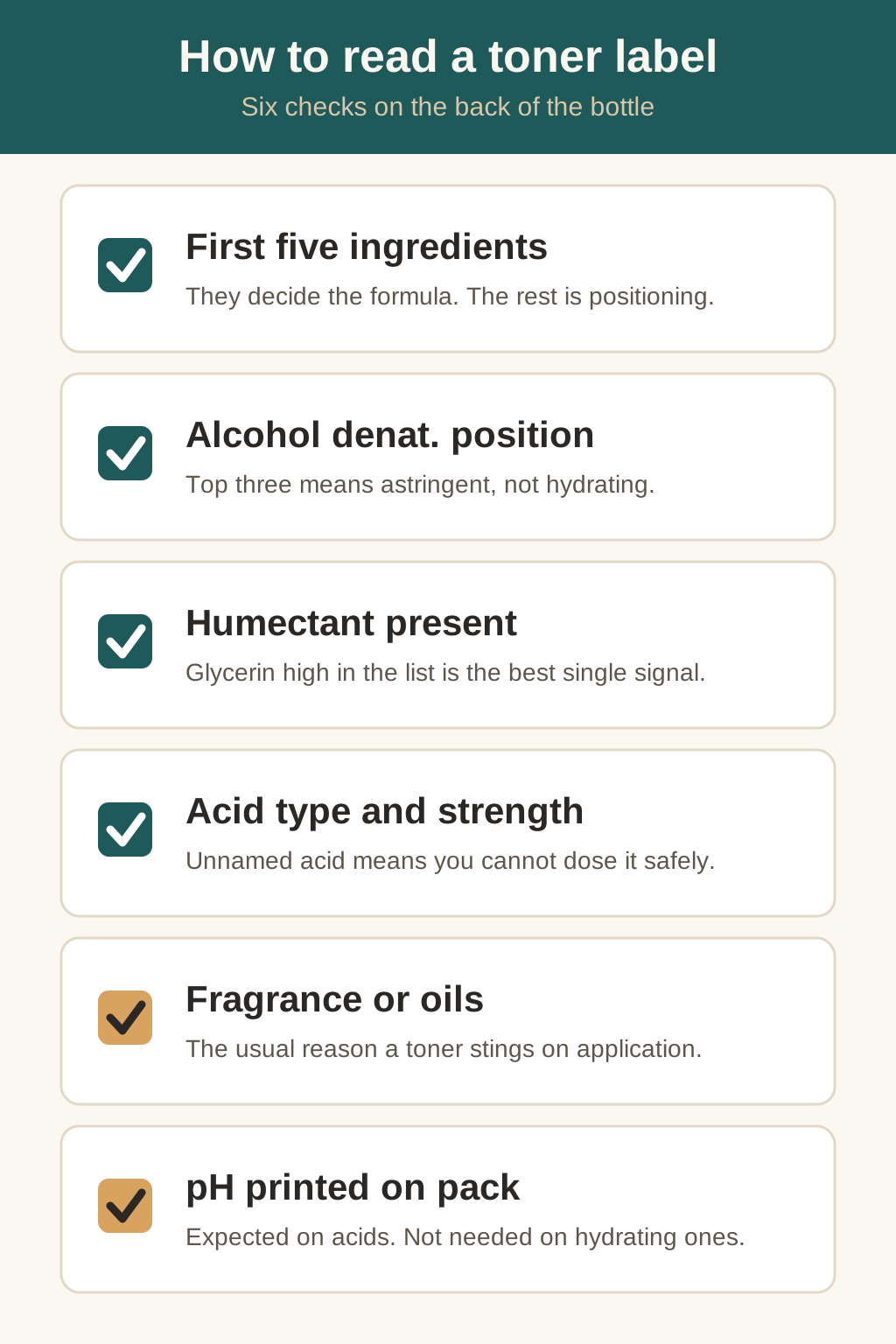
- Alcohol denat. in the top three is an astringent signature. A genuinely lightweight hydrating toner leads with water plus glycerin or a glycol, and keeps alcohol below the 1% line if it uses any at all.
- A named humectant in the first five is the single most reliable predictor that the product will still feel comfortable in month three.
- Acid type and strength on the front. If a brand exfoliates but will not name the acid or its percentage, you cannot dose it safely.
- Fragrance, essential oils and witch hazel distillate are worth the risk only if you enjoy the ritual and your skin is genuinely non-reactive. On sensitised or rosacea-prone skin they are the usual reason a toner stings on application.
Toner brands print pH on acid formulas because efficacy depends on it, and stay quiet about it on hydrating ones because nothing hangs on the number. Absent pH on an exfoliant is a real information gap; absent pH on a hydrating toner is not.
Last, check price per fluid ounce rather than price per bottle. A toner is dispensed by the handful, so a 250 ml bottle at a mid price often beats a 100 ml bottle at a low one. Concentration matters more than volume, though: a comparative study on glycerin concentration and moisture retention shows glycerin's moisture-retention capacity climbing steadily with concentration up to about 60%, which is why a small, well-dosed bottle can outperform a large, watery one.
Best toners by skin type, concern and budget
These five picks each solve a different problem — one per skin situation, not five versions of the same water-thin formula. Some links below are affiliate links, and we may earn a commission if you buy through them at no extra cost to you.
What separates the best brightening toner from a formula that only adds temporary slip is a named active at a stated percentage — most often niacinamide at 4% to 5%. The mechanism is documented: the clinical evidence behind niacinamide for pigmentation traces its effect on melanosome transfer and barrier lipids. If you want that active at a working dose rather than a toner-level trace, a serum is the better delivery vehicle — see choosing a niacinamide serum that works.
The best cheap toner is judged on exactly the same ingredient list as the expensive one, so turn both bottles around and compare the first five entries. A drugstore skin toner genuinely competes on hydrating formulas, where glycerin costs pennies and the formula is simple. It competes less well on two things: high-percentage acids buffered to a reliable pH, and elegant textures that absorb in seconds instead of sitting tacky.
How to use a toner so it earns its place
Apply within about 60 seconds of rinsing, while skin is still visibly damp. Then serum, then moisturizer. Skin that has fully air-dried gives humectants nothing to draw on, and a toner applied to bone-dry skin can actually pull water up from deeper layers and let it evaporate.
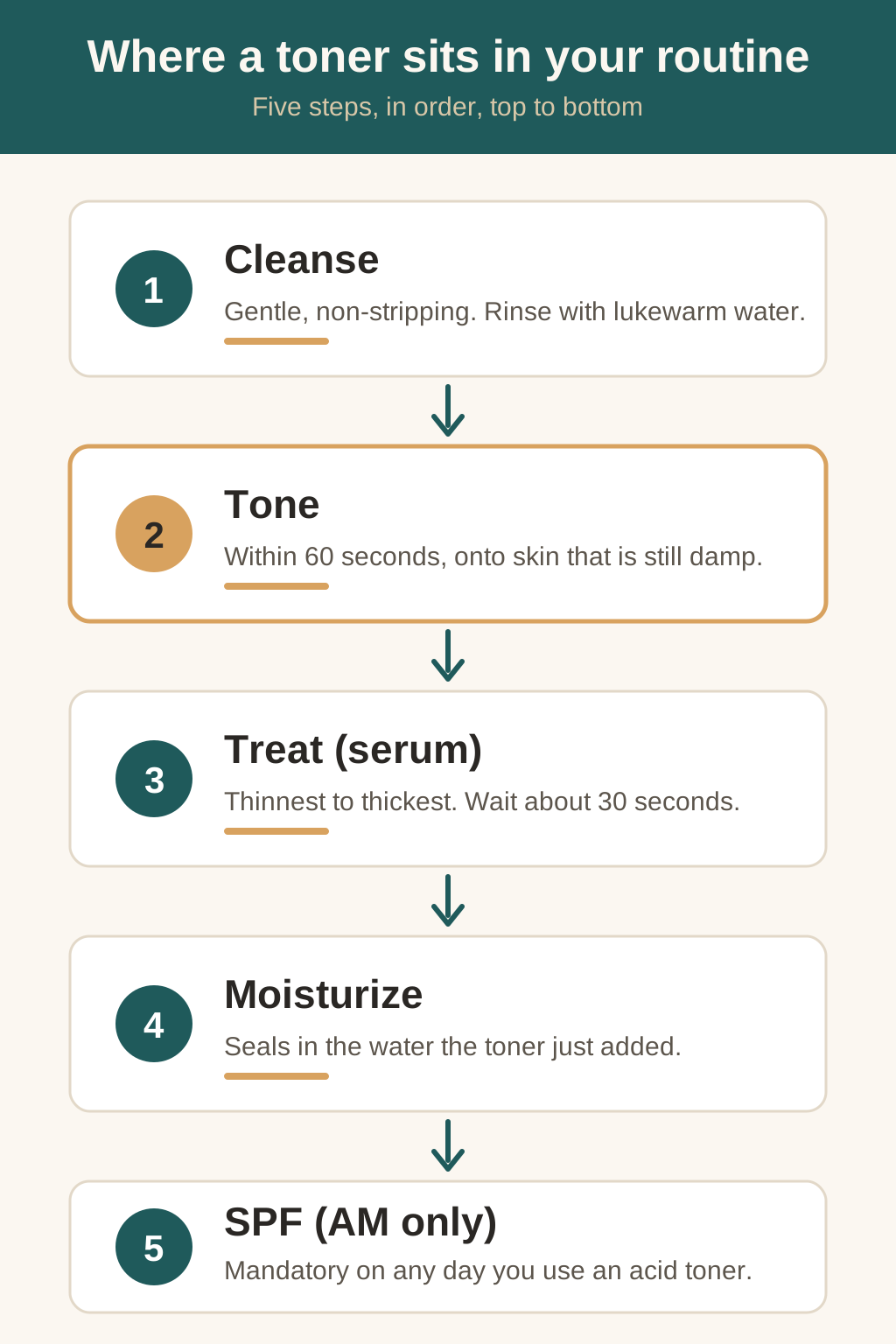
The step before this one sets up everything: rinse with a gentle, non-stripping cleanser so your toner is adding hydration rather than repairing damage the cleanser caused.
Palms beat cotton pads for anything you want to keep. A saturated cotton round holds roughly half of what you pour onto it, so cotton is for removal days — when you actually want to lift residual grime or sunscreen — and palms are for hydration days.
Frequency is where most damage happens. Hydrating formulas: twice daily, indefinitely. Exfoliating formulas: two to three nights a week, and never doubled up with retinol. Astringents: as a spot treatment on the T-zone, not a full-face habit.
Toner glowing claims only convert into visible results when the moisturizer that follows seals the water in — a humectant with no occlusive above it is a 20-minute effect. If the sequencing is the part that keeps tripping you up, work through how to build a skin care routine in the right order, or watch the order applied in real time below.
A printable seven-day AM and PM tracker, built so you can see at a glance which nights the toner changes — useful if you are adding an exfoliating formula for the first time.
When to skip toner and the mistakes that cause irritation
Stacking an exfoliating facial toner with retinol on the same night is the most common route to a compromised barrier. Both accelerate cell turnover through different mechanisms, and the combined effect is not additive but multiplicative: stinging, tight shine, then flaking about four days later. Alternate nights, or drop one.

Skin that is healing after a procedure is the clearest skip. Standing periprocedural guidance is to pause toners entirely and use only a pH-balanced cleanser and a neutral moisturizer until the barrier is intact, because toners lengthen healing time and provoke irritation on compromised skin.
Three signals mean you are over-toning: tightness within minutes of application, stinging on skin that did not sting last month, and new flaking along the jaw and around the nostrils. Stop for two weeks — cleanser, moisturizer, sunscreen only — and reintroduce a single hydrating formula.
And sometimes the honest answer is none at all. Sensitive and rosacea-prone skin often does better with a three-step routine and no toner, because every extra leave-on product is another chance to react. That is a valid outcome, not a failure. The full framework is in seven rules for calmer sensitive skin.
Toner questions readers actually ask
Do you need a toner at all?
Only if it does a job your cleanser and moisturizer are not already doing — extra hydration, scheduled exfoliation, or a light active you would not otherwise apply. Otherwise it is a fourth product doing a third product's work.
Does the toner skin toner naming difference matter?
Not on the label, only in the formula. An essence is generally thicker and more active-dense than a toner, but several products sold as toners are essences by texture, so read the ingredient list rather than the noun.
How long before you see results?
Hydration shows in about two weeks; tone and texture take eight to twelve. A toner for face use cannot replace a serum, because the concentrations that change pigmentation or texture rarely survive in a formula thin enough to pour.
One practical toner note a week, straight to your inbox.
One skincare tip a week. No product dumps.
Thanks — you're on the list.
