

Sunscreens containing zinc oxide use one mineral filter that covers UVB and UVA out to roughly 380 nm. Pick broad-spectrum SPF 30 or higher with 15 to 25% zinc oxide, the ceiling the FDA proposed. Tinted formulas with iron oxides erase white cast on medium and deep skin.
What Are Sunscreens Containing Zinc Oxide?
Sunscreens containing zinc oxide are over-the-counter drug products whose active filter is zinc oxide, a mineral that sits on the stratum corneum and blocks both UVB and most UVA. They are regulated as drugs, not cosmetics, which is why the back of the bottle carries a Drug Facts panel listing the active percentage.
A sunscreen containing zinc is called inorganic because the filter is a metal oxide powder dispersed through an emulsion. It forms a film on the surface instead of dissolving into the upper skin layers the way avobenzone or octocrylene do, which is why a mineral formula rarely stings the eyelids.
The practical difference shows up in wear. Sunscreens with zinc do not photodegrade the way avobenzone can, so intact film means intact protection two hours later. The film does rub off mechanically, so a towel, a collar or a sweaty forehead removes it faster than a chemical filter.
A zinc based sunscreen is the default recommendation for reactive skin, rosacea, skin healing from a laser or peel, and infants older than six months, because there is no absorbed filter to provoke stinging or contact dermatitis. The honest cost: at the same SPF, a mineral film is thicker, slower to disappear and needs a good twenty to thirty seconds of rubbing. If you want to see how the format problem gets solved for daily wear, our guide to the best mineral sunscreen for face works through lighter options.

How Does Zinc Oxide SPF Actually Block UV Rays?
Zinc oxide absorbs most of the ultraviolet energy that hits it and scatters the rest, covering roughly 290 to 380 nm, which is the whole UVB band plus UVA2 and part of UVA1. The "physical blocker reflects light like a mirror" description is wrong: absorption does the large majority of the work.
That 380 nm reach is the reason sun protection zinc gets recommended for photoaging and melasma, and why zinc oxide sun protection is the default advice after a peel or laser. Titanium dioxide, the other approved mineral filter, starts thinning out near 350 nm, which leaves a slice of UVA1 under-covered. UVA1 reaches the dermis, degrades collagen, and barely varies between 9 a.m. and 4 p.m. or through window glass.
The zinc oxide spf number on the front of the bottle measures one thing only: how much longer UVB takes to redden your skin compared with bare skin. It says nothing about UVA. The "broad spectrum" phrase is what carries the UVA information, because a product can only print it after passing a critical wavelength test — one reason why broad-spectrum coverage matters more than a high SPF number.
Read a zinc spf label in three moves: the SPF figure, the words broad spectrum, and water resistance stated as 40 or 80 minutes. Anything claiming waterproof is mislabeled. For what higher numbers buy you, we break down what the SPF number actually means and where the curve flattens.
One number reframes everything else: SPF is tested at 2 mg of product per square centimetre of skin, a visibly thick coat. Most people apply a quarter to half of that, and protection drops roughly with the square of the shortfall.
Zinc Oxide vs Titanium Dioxide: Which Mineral Filter Do You Need?
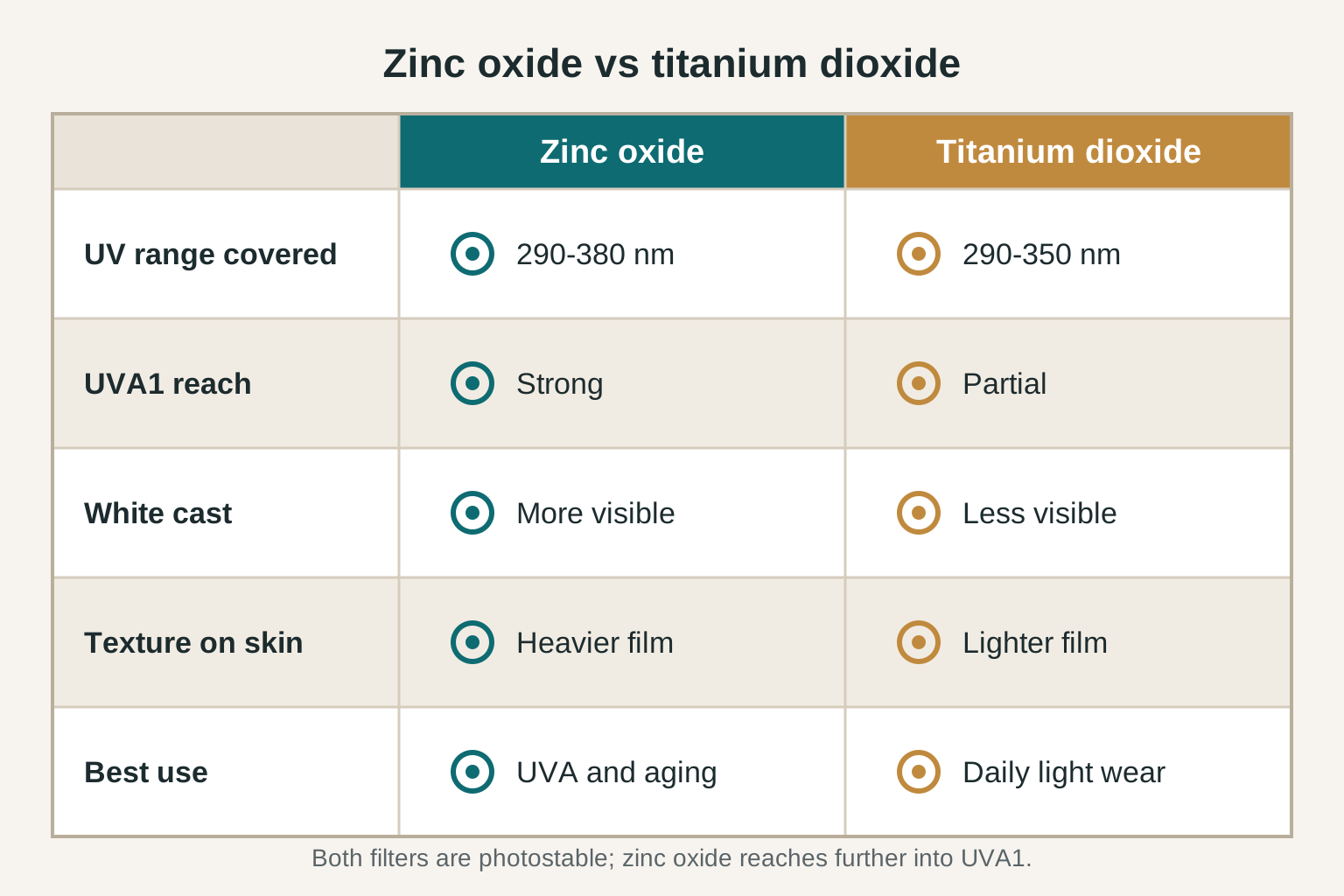
Zinc oxide covers more of the UVA band, titanium dioxide is lighter and less chalky, so blended formulas exist to buy the UVA reach of one and the wearability of the other. Choosing between them is a texture decision as much as a protection decision.
Compared side by side, a sunblock with zinc oxide or titanium dioxide splits like this: zinc reaches to about 380 nm and titanium to about 350 nm; zinc leaves a heavier white cast at the same percentage; titanium spreads thinner and sets faster; both are photostable, so neither degrades in sunlight. Titanium's weakness above 350 nm is not theoretical — that is exactly the band associated with collagen breakdown and pigment darkening.
A sunscreen with zinc and titanium often hits a higher SPF at a lower total mineral load, because the two powders have different particle sizes and pack into a more continuous film than either alone. Less total powder means less cast for the same number on the bottle.
A suntan lotion with zinc oxide and titanium dioxide earns its place in three situations: long water exposure, surf and paddle sports where reapplication is awkward, and high-altitude snow where UV intensity climbs roughly 10% per 1,000 metres of elevation and reflects back off the surface.
The tradeoff is real. Blended mineral formulas feel heavier, usually cost more per ounce than a single-filter lotion, and pill more readily when layered under silicone-based makeup. Before you buy either type, run through our broad spectrum label checks before buying so the front-of-pack claim matches the Drug Facts panel.
How Much Zinc Oxide Should a Mineral Sunscreen Contain?
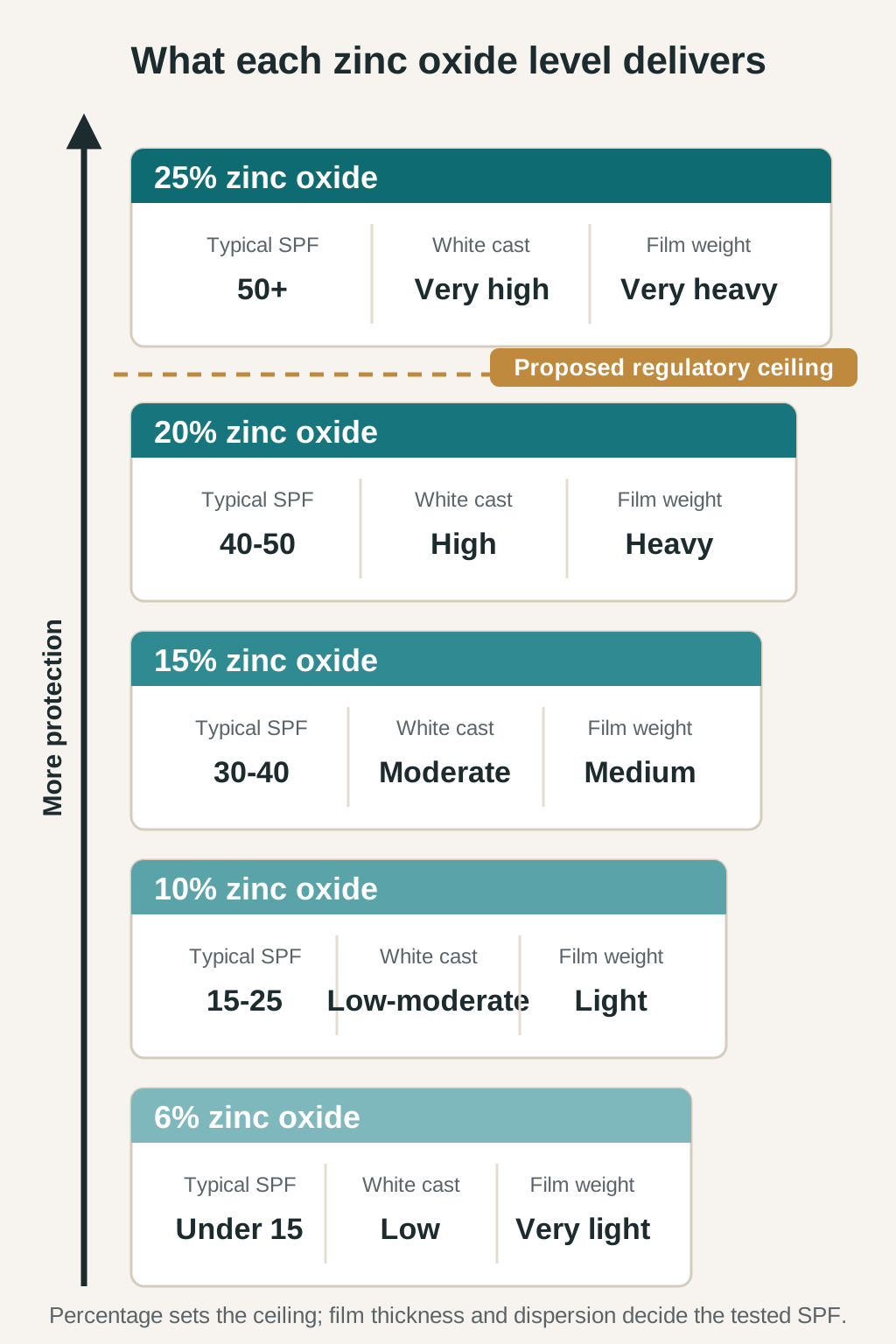
Aim for 15 to 25% zinc oxide for broad-spectrum SPF 30 or higher; under 10% rarely carries a mineral formula on its own, and 25% is the proposed regulatory ceiling. The percentage sits in the Drug Facts panel, directly beside the word "Purpose".
| Zinc oxide | Typical SPF band | White-cast risk | Film weight |
|---|---|---|---|
| 6% | Under SPF 15 alone | Low | Very light |
| 10% | SPF 15 to 25 | Low to moderate | Light |
| 15% | SPF 30 to 40 | Moderate | Medium |
| 20% | SPF 40 to 50 | High | Heavy |
| 25% | SPF 50+ | Very high | Very heavy |
That 25% figure is not marketing. Regulators set it while reviewing safety data, and you can read the FDA's proposed 25% ceiling for mineral sunscreen actives in the agency's own words. Zinc oxide and titanium dioxide are the only two filters given that standing.
Percentage alone will not predict SPF. Film thickness, dispersion quality, the emulsifier system and particle size all move the tested number, so a well-dispersed 15% formula can out-test a badly made 20% one.
Spotting a good sunscreen with zinc oxide means reading three lines together: active percentage, broad-spectrum claim, water resistance in minutes. Our walkthrough of how to read the active ingredients panel on a sunscreen label shows where each of those sits on the bottle.
One check separates a genuinely mineral sunscreen with zinc oxide from a hybrid: scan the actives for avobenzone, octisalate or octocrylene. Comparing sunscreens with zinc oxide by active percentage beats comparing words like clean or reef friendly, which carry no testing requirement. If you would rather get SPF from a moisturizer, our guide to a daily SPF moisturizer for your face covers that route.
Not sure whether your skin wants a 15% gel-cream or a 20% lotion? Six questions, two minutes, your skin type and the finish that suits it.
Which Zinc Oxide Sunscreen Suits Your Skin Type?
Match the formula to your skin rather than the brand: sensitive skin wants fragrance-free single-filter zinc, oily skin wants a mattifying gel-cream, and deep skin tones want a tint. The best zinc oxide sunscreen for you is the one you will reapply. Skin type decides the finish; SPF only sets the ceiling. A zinc sunscreen for face needs a lighter, faster-setting film than a body lotion at the same SPF.
Zinc oxide spf face lotions win in three places a thick body zinc sunblock fails: under makeup, on eyelids where a heavy film creases, and on freshly shaved skin. Water resistance in 80 minutes is worth paying for if you swim, but it comes from film-forming polymers that feel tacky in humidity. If your skin flares easily, our roundup of sunscreen for sensitive, reactive skin narrows the field further.
The links in this list are affiliate links, and we may earn a commission if you buy through them at no extra cost to you.
How Do You Stop Zinc Sunblock From Leaving a White Cast?
Pick a tinted or micronized formula, apply in two thin layers instead of one thick one, and give the film thirty seconds of blending before anything goes on top. The cast is optical, so the fix is particle size and film thickness.
A zinc oxide sunblock looks white because the particles that scatter ultraviolet light also scatter visible light. Larger particles scatter more of the visible band, which is why the whitest formulas are often the non-nano ones marketed as gentlest.
A tinted sunscreen with zinc oxide solves this with iron oxides: the warm pigments absorb the blue-white scatter and block visible light in the 400 to 500 nm range that worsens melasma on deeper skin tones.
Choosing a tinted zinc oxide sunblock shade is a jawline test, never a wrist test: your wrist is usually two shades lighter and cooler than your face. Swatch along the jaw, step into daylight, and check for a line at the border.
If a zinc based sunblock still ghosts in photographs, three fixes work in order: warm the product between your fingertips, apply two thin layers with a thirty-second pause, and skip silicone primers, which repel the water-based film and cause pilling. The limitation: a tint fixes the cast but narrows your shade options and transfers onto white collars. Our tinted sunscreen buying guide compares shade ranges in detail.
The link in this card is an affiliate link, at no extra cost to you.

Is Non-Nano Zinc Oxide Safer Than Nano Zinc Oxide?
On intact skin the safety gap is small: measured zinc in the living epidermis after nanoparticle sunscreen use sits about 25 times below the level that harms skin cells in the lab. Non-nano is a particle-size claim, not a safety certificate.
Non-nano means the primary particles measure above 100 nm. A mineral sunscreen with non nano zinc oxide therefore scatters more visible light and sits higher on the skin, which changes how it looks and feels far more than how it protects.
The penetration evidence is specific. Nanoparticles stay within the stratum corneum rather than crossing it, while a small amount of dissolved zinc ion reaches the viable epidermis at roughly 1 microgram per millilitre — you can read measured zinc levels in human epidermis after nanoparticle sunscreen use and see the figure in context.
The genuine caveat is broken skin. When the barrier is impaired by shaving, eczema or sunburn, epidermal zinc concentrations rise steeply, and that is the one scenario where a non-nano or a chemical-free ointment format makes sense.
The texture cost is the part nobody advertises: a thicker sun cream zinc film that needs more rubbing, shows more cast and takes longer to set. Aerosol and loose-powder formats are the one place particle size deserves real caution, because inhalation is a different exposure route from skin and has never been part of the topical safety data.
Absorption is a far bigger question for the other filter class, and what the FDA testing actually found is laid out in our breakdown of chemical sunscreen absorption and safety.
Since both forms are mineral filters, readers weighing safety can also review how to pick a safe mineral sunscreen, which explains the zinc oxide labels worth trusting.
How Much Zinc Sunscreen Do You Need Per Application?
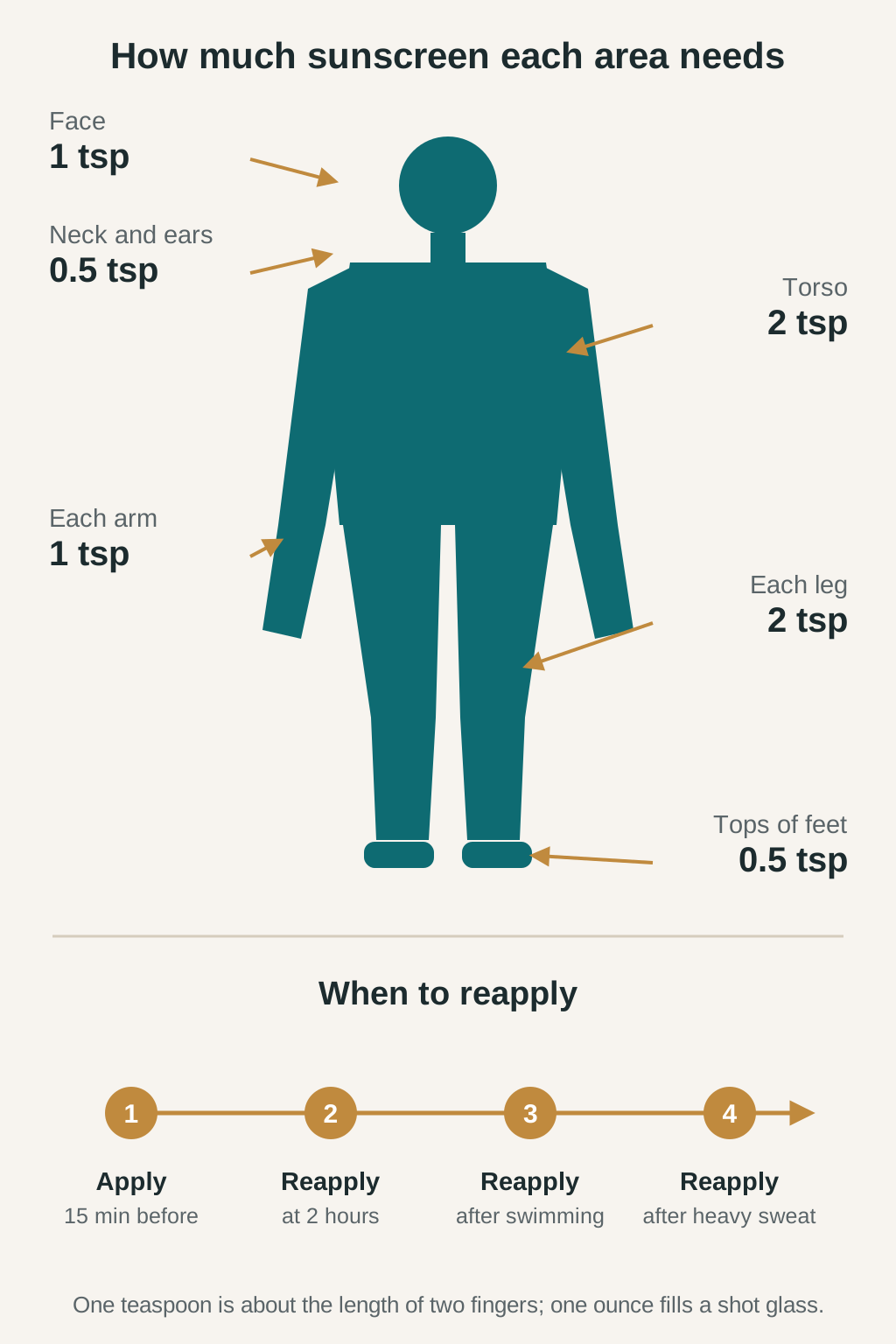
Use about one teaspoon for the face and one ounce, a shot glass, for exposed body skin, applied fifteen minutes before you go out and reapplied every two hours. Those figures come straight from how much sunscreen dermatologists say to use, and they trace back to the 2 mg per square centimetre used in SPF testing.
Underapplication is the biggest gap between label and reality. Apply half the tested dose of sun lotion with zinc and you keep roughly a third of the labeled protection. A bottle that lasts all summer is evidence of a problem, not thrift.
Reapplying a sunscreen lotion with zinc over makeup is where most routines break. A pressed mineral powder or a stick reapplies without disturbing the base, but neither delivers a full dose, so treat them as top-ups rather than replacements. For a long day on the sand, a dedicated body sunscreen is easier to use generously than a small face tube.
The areas people miss with suntan lotion with zinc are predictable: ears, the hairline, the back of the neck and the tops of the feet. Lips need their own product, and our guide to lip balm with real sun protection explains why a plain balm is not enough.
A beach-day plan for sun tan lotion with zinc is arithmetic: four people, one ounce each, reapplied every two hours across five hours means roughly 10 to 12 ounces. Apply sunscreen with zinc 15 minutes before you leave so the film has time to set and will not slide off on the first towel.
Want the exact amount for today's outing and a reapply schedule that matches it?
What Should You Check Before You Buy?
Check five things on the bottle: the mineral filter, its percentage, a broad-spectrum claim, water resistance in minutes, and whether the finish is tinted or untinted. Those five lines predict daily wear better than any review score.
Then match the format to the habit: a stick reapplies at noon without a mirror, a lotion covers a body economically, and a gel-cream is what people actually wear daily. Our where sunscreen sits in your skincare order places it last in the morning steps.
A mineral formula is the wrong call for deep skin tones with no tinted option, heavy-sweat sport where the film slides, and anyone who will not use a full dose. A chemical filter applied generously beats a zinc lotion applied sparingly.
Get one practical sun-protection tip each week, with no product dumps.
One sun-protection tip a week. No product dumps.
Thanks — you're on the list.


