

Broad spectrum is a regulated claim: the sunscreen passed a critical wavelength test at 370 nm or above, so it filters UVA as well as UVB. Pair that claim with SPF 30, which screens about 97 percent of UVB, and a water resistance rating of 40 or 80 minutes.
What does broad spectrum mean on a sunscreen label?
Broad spectrum is a regulated claim meaning the product passed a critical wavelength test at 370 nm or higher, so it filters UVA alongside UVB.
The test is mechanical, not editorial. A lab spreads a measured film of the product, reads how much ultraviolet light it absorbs from 290 to 400 nm, then finds the wavelength under which 90 percent of the total absorbance area falls. If that point falls at 370 nm or deeper into UVA, the words may be printed. If it falls short, printing them is a labeling violation.
That threshold exists because the two bands do different damage. UVB runs 290 to 320 nm and is the burning band, and it is the only band an SPF number is measured against. UVA runs 320 to 400 nm, reaches the dermis, drives pigmentation and collagen loss, and passes through ordinary window glass with most of its intensity intact.
Asked plainly — what does broad spectrum sunscreen mean — it means one film handles both bands, so a high number on the front is not carrying the whole job alone.
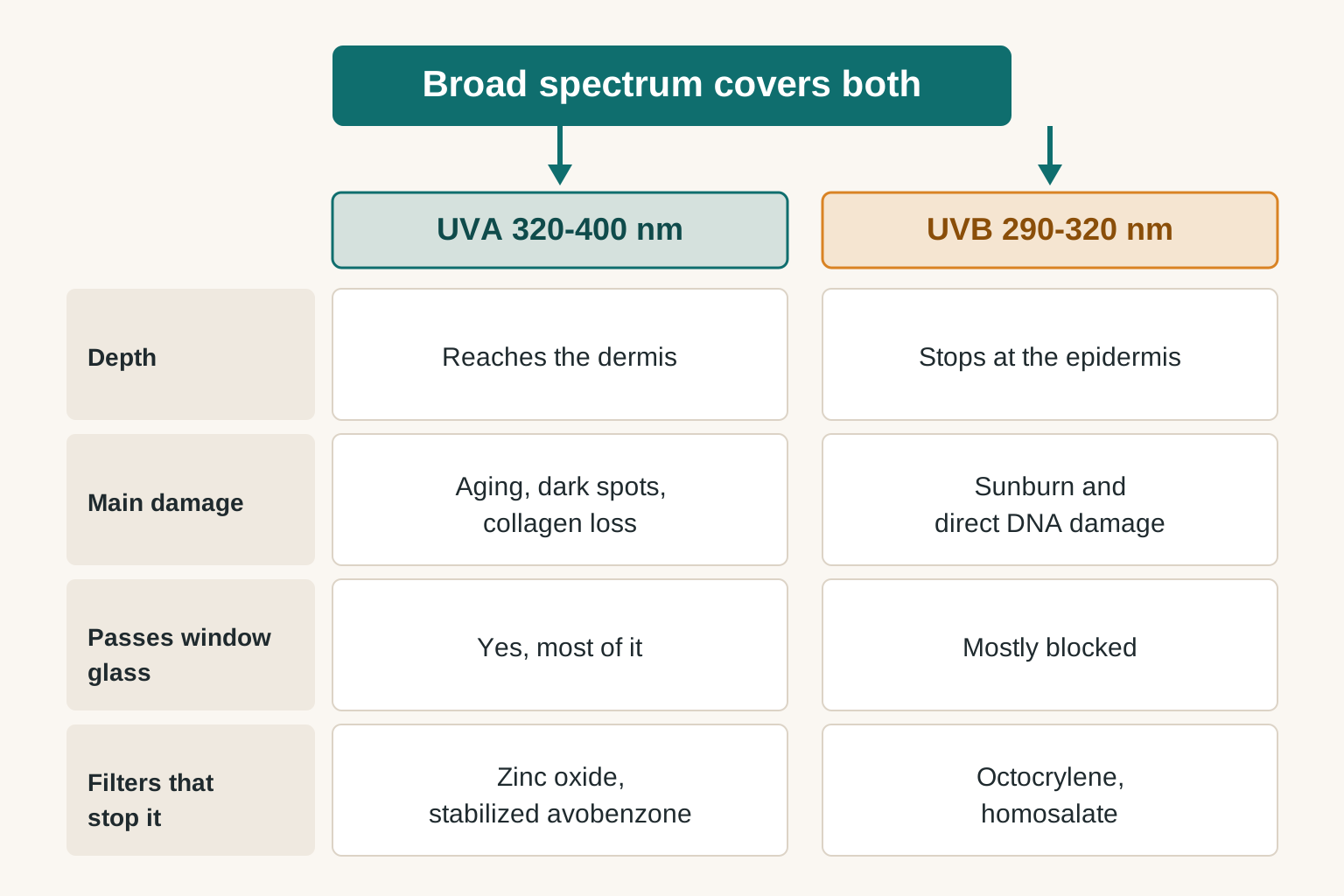
One honest limit: the claim is pass or fail, with no grade attached. It confirms UVA coverage cleared the bar, never by how much, which is why the filter list still deserves a read and why how UV filters absorb and scatter ultraviolet light is worth understanding before you compare two bottles that both carry the wording. For the wider buying decision, choosing an SPF that actually protects works through the rest of the tradeoffs.
Why does a broad spectrum sunscreen with spf 30 or higher matter?
SPF 30 filters roughly 97 percent of UVB, and the broad spectrum mark adds the UVA coverage that an SPF number on its own never promises.
The sunscreen broad spectrum spf pairing on a label is two separate test results printed side by side. SPF is a burn-time ratio from human testing; broad spectrum is an instrument reading of absorbance spread. Neither one substitutes for the other.
The percentages flatten fast. SPF 15 filters about 93 percent of UVB, SPF 30 about 97 percent, SPF 50 about 98 percent. Read as transmitted light instead, the picture sharpens: SPF 15 lets through roughly 1 photon in 15, SPF 30 about 1 in 30. Doubling the number halves what reaches you, even though the percentage barely moves.
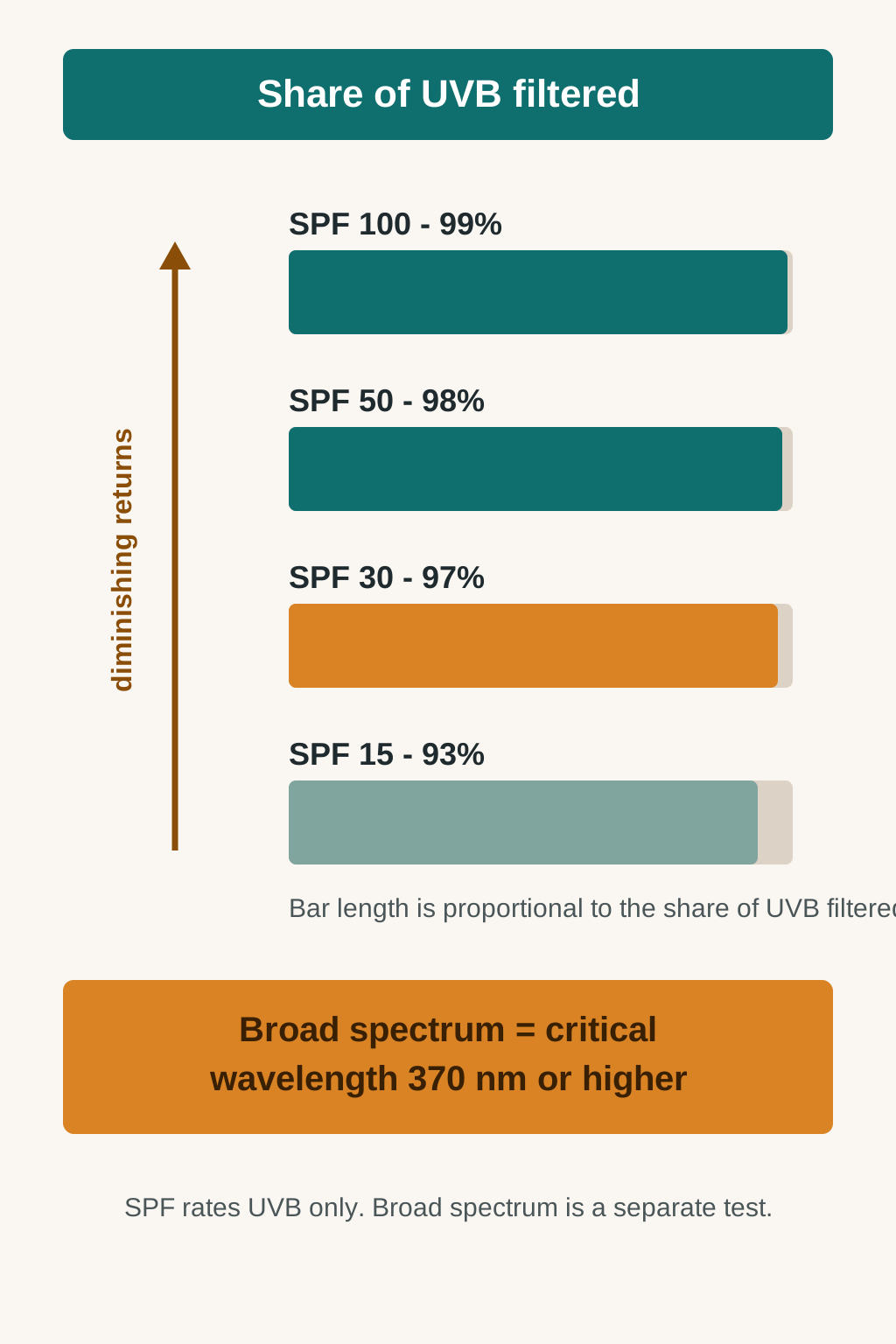
SPF 30 is the practical floor for one blunt reason: laboratories test at 2 mg per square centimeter, and most people apply a quarter to a half of that. Applied thin, an SPF 30 behaves closer to an SPF 10. Starting at 30 leaves headroom for the way people actually apply sunscreen, which is the failure mode no formula fixes. If the number itself is the part that confuses you, what the SPF number on suntan lotion means unpacks the scale in detail.
Which printed claims prove broad spectrum protection before you pay?
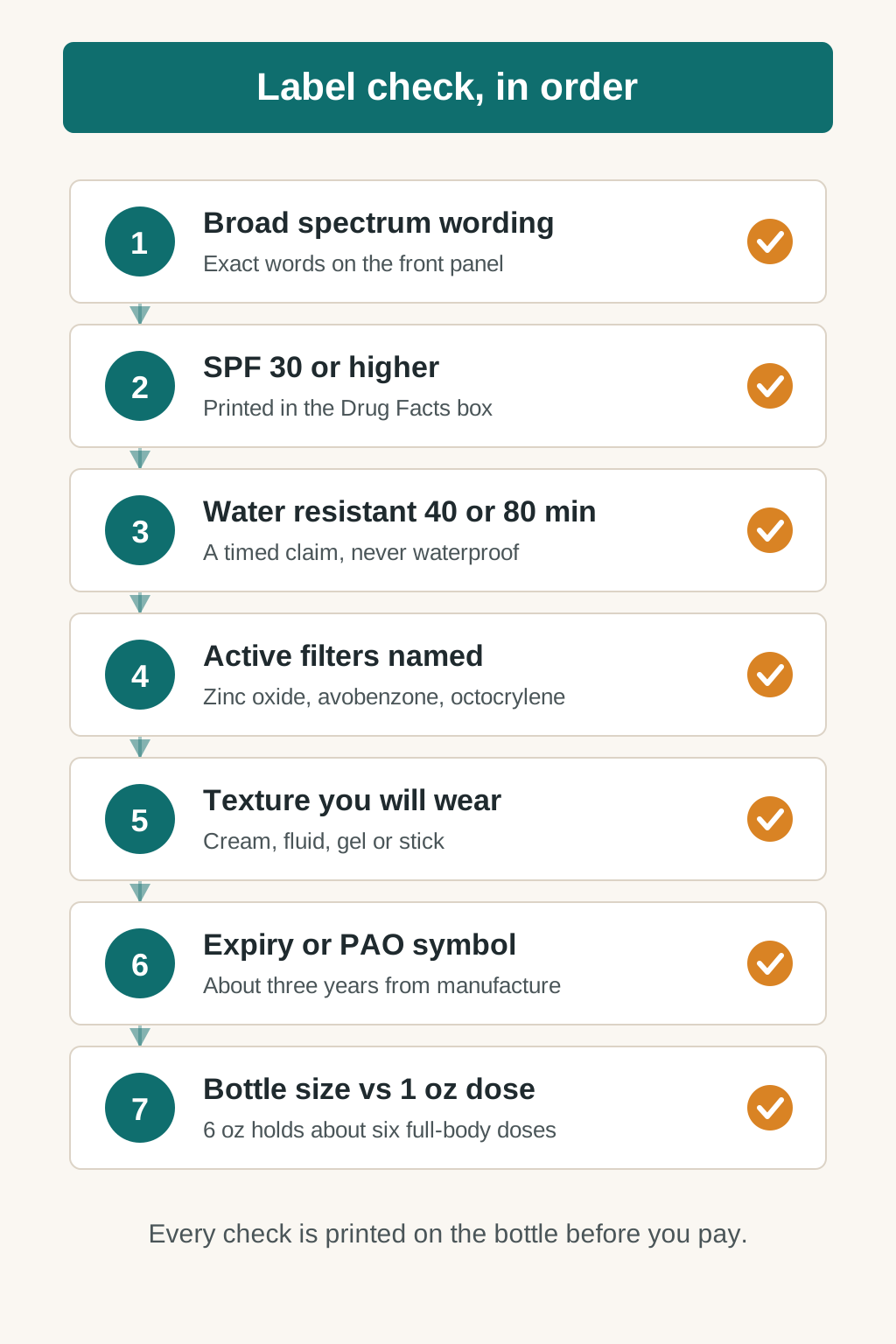
Four printed claims settle it: the broad spectrum wording, an SPF of 30 or higher, a 40 or 80 minute water resistance rating, and a named active filter list.
All four live on the bottle in the store, and three of them sit on the back in the Drug Facts panel rather than in the marketing copy on the front. Sunscreen is regulated as an over-the-counter drug in the United States, so that panel follows a fixed format you can scan in about twenty seconds.
Broad spectrum wording on the front panel
A sunblock with broad spectrum wording printed on the front panel has cleared the 370 nm critical wavelength test, because the phrase is not decorative language a brand may add at will. Look for the exact words next to the SPF number, not for softer substitutes such as "full spectrum," "UVA/UVB defense" or "total protection," none of which carry a defined test behind them. If the front panel only implies coverage, treat the product as SPF-only.
SPF 30 or higher in the Drug Facts box
The SPF printed in the Drug Facts box is the tested value, and 30 is the floor worth paying for on a face you expose daily. Anything labeled SPF 2 to 14 must also carry a skin cancer warning, which is a useful signal in itself. The tradeoff at 30 and up is cosmetic: higher filter loads often mean a heavier feel or more visible cast, which is the cost of the extra margin.
Water resistance rated at 40 or 80 minutes
Water resistance is printed as a timed claim of 40 or 80 minutes, and nothing else is permitted. No sunscreen may be sold as waterproof or sweatproof, because the terms overstate what any film survives. Treat the rating as a reapply alarm rather than a durability score: 80 minutes in water means the clock restarts at 80 minutes, not that the product holds until you leave the pool.
Active UV filters named on the ingredient panel
The active ingredients list names every filter and its percentage, which is where UVA coverage is actually built. Zinc oxide, titanium dioxide and avobenzone are the UVA workhorses; octocrylene and homosalate mainly cover UVB and often serve to stabilize avobenzone. A list carrying only UVB filters with a broad spectrum claim deserves a second look, and choosing an SPF that actually protects goes deeper on filter combinations.
Which formula details decide whether you wear it every day?
Texture, expiry date and bottle size decide whether the sunscreen is applied at a full dose, and a bottle left in the drawer protects nobody.
A broad spectrum sunscreen lotion you dislike wearing becomes an under-applied sunscreen inside a week. The three checks that follow are about compliance, and compliance is where most real-world protection is won or lost.
Texture and finish matched to your skin type
Format decides how much you are willing to put on. Fluids and gels absorb in seconds and suit oily or acne-prone skin that turns shiny under a cream. Richer creams hold water in and suit dry or mature skin. Sticks are for ears, hairlines and touch-ups, not for a full face dose, because it is nearly impossible to lay down 2 mg per square centimeter with one. Tinted formulas hide cast on deeper skin tones; the tinted sunscreen buying guide covers shade matching.

Expiration date or period-after-opening symbol
Sunscreen carries a real expiry date because it is a drug, and the typical shelf life is three years from manufacture. Heat shortens it. A bottle that spends a summer in a car cycles between 30 and 60 degrees Celsius, which degrades organic filters faster than the printed date assumes. A formula that has separated, thinned or turned yellow has already changed, whatever the date says.
Bottle size that supports a full-body dose
Bottle size is a protection decision disguised as a price decision. A full-body application is about 1 ounce, so a 6 ounce bottle holds roughly six of them, which is a single beach day for two people. Buying the small travel size for a week of daily body coverage guarantees rationing, and rationed sunscreen is thin sunscreen. Larger broad spectrum sunscreens cost more per purchase and less per application.
Mineral or chemical filters: which broad spectrum protection sunscreen suits your skin?
Mineral filters sit on the surface and suit reactive or post-procedure skin, while chemical filters absorb UV and vanish faster on deeper skin tones.
Zinc oxide and titanium dioxide work by absorbing and scattering ultraviolet light at the surface, and zinc alone covers the full UVA range, which is why a broad spectrum protection sunscreen for sensitive skin usually leans on it. The cost is optical: mineral particles reflect visible light too, which is the white cast.
Organic filters such as avobenzone, octocrylene and homosalate absorb UV and release it as heat. They disappear on skin, including deeper tones, but avobenzone degrades within hours of sun exposure unless it is paired with a stabilizing partner filter, so the combination matters more than any single name on the list.
Tinted formulas add iron oxides, which extend coverage into visible light; iron oxides and visible blue light attenuation research measures how much of the 415 to 465 nm band they hold back, which matters for melasma. For a mineral-first shortlist, mineral sunscreen for face, what works narrows it further.
Neither camp wins outright: mineral formulas are calmer on reactive and post-procedure skin but harder to blend, and chemical formulas cosmetically elegant but more likely to sting around the eyes. A one-page filter reference is easier than memorizing eight ingredient names.
SPF 30 or SPF 50: how much extra protection do you really get?
SPF 50 filters about 98 percent of UVB against SPF 30's 97 percent, a one-point gap that matters mainly for long outdoor days and photosensitive skin.
Stated as transmitted light, the gap is larger than the percentages suggest: SPF 30 lets through about 1 part in 30, SPF 50 about 1 part in 50. Over six hours on open water that difference accumulates, which is why an spf 50 sunblock earns its price on hiking days, at altitude where UV rises roughly 10 percent per 1,000 meters, and on medication that raises photosensitivity, such as doxycycline or isotretinoin.

Past that point the curve flattens. A broad spectrum spf of 100 filters about 99 percent, one point more than 50 for a much heavier film, which is why United States labels cap the printed claim at SPF 50+. The better trigger for stepping up is conditions rather than ambition: a UV index of 6 or higher, the 10 a.m. to 4 p.m. window, and reflective ground such as water, sand or snow, all of which public health sun safety recommendations treat as the high-risk combination. If the scale itself still feels arbitrary, what the SPF number on suntan lotion means explains how the ratio is derived.
How much sunscreen do you apply, and how often do you reapply?
Adults need about 1 ounce, a shot glass, for the body and a teaspoon for the face, reapplied every two hours outdoors.
The face measure has a simpler version: two full finger-lengths of product squeezed from the tube, index and middle finger, which lands close to the tested 2 mg per square centimeter. Most people apply between a quarter and a half of that, which is the single largest gap between the SPF on the label and the SPF on the skin, and dermatologists' guidance on applying enough sunscreen puts the body figure at roughly a shot glass.

Apply 15 minutes before going outside so the film sets, and cover the places that get skipped: ears, hairline, the back of the neck, the tops of the feet and the backs of the hands. Lips need their own product, since a film wears off a mouth within an hour; SPF lip balm for real lip protection covers what qualifies.
Outdoors, reapply every two hours, and immediately after swimming, heavy sweating or towel drying. A broad spectrum sun tan lotion at the beach runs on the same clock as everything else, with the 40 or 80 minute water resistance rating setting the shorter limit. For the body, a full-size body sunscreen is the practical bottle to keep in the bag, because a face-size tube empties in two applications.
Working out the dose and the reapply time for one specific outing takes four inputs.
Best broad spectrum sunscreens for sensitive, oily and dry skin
The right pick follows skin type: mineral formulas for reactive skin, gel fluids for oily skin, and richer lotions for dry skin.
Each pick is chosen for one angle, not ranked against the others, and every one clears the same floor: broad spectrum wording, SPF 30 or higher, and a printed water resistance rating. This section contains affiliate links, and a purchase made through them may earn a commission at no extra cost to you.
Whichever you choose, patch test on the jawline for two days before committing to a full face, since filter reactions show up as a delayed flush rather than an immediate sting. Skin that reacts to almost everything deserves a narrower shortlist, and sunscreen picks for sensitive skin is built around that constraint.
One practical tip a week is enough to keep a sun routine from drifting.
One sun-protection tip a week. No product dumps.
Thanks — you're on the list.


