

Chemical free sunscreen means a mineral-only formula: zinc oxide, titanium dioxide, or both, and no oxybenzone, avobenzone, octinoxate or homosalate. Choose broad spectrum SPF 30 or higher, at least 15% non-nano zinc oxide, 80-minute water resistance, and apply a quarter teaspoon to your face every two hours.
What Does Chemical Free Sunscreen Actually Mean?
Chemical free sunscreen is shelf shorthand for a mineral-filter formula, because zinc oxide and titanium dioxide sit on the skin surface instead of absorbing into it like organic filters. The phrase is chemically illiterate and everybody uses it anyway: zinc oxide is a chemical compound, ZnO, mined and milled before it ever reaches a bottle.
What shoppers mean is narrower and more useful. A non chemical sunscreen lists one or two mineral actives in its drug facts panel and nothing else. The organic filters it leaves out are the ones that generated the headlines: oxybenzone, octinoxate, homosalate, octocrylene and avobenzone.

So treat "chemical free spf" and "sunscreen natural" as retail language rather than regulatory categories. Neither phrase is defined by the FDA, neither is audited, and neither tells you how much UVA protection is in the bottle. Only the actives panel settles it, and it takes four seconds to read.
If you want the other side of the argument in detail, the full picture of chemical sunscreen ingredients and what absorption data shows is worth reading before you throw out a bottle you already own. Regulators have been explicit about which filters clear the bar: the two UV filters the FDA recognizes as safe and effective are the two minerals, while the rest sit in a category awaiting more data.
That awaiting-data status is not the same as a finding of harm. Reviews of the clinical record, including evidence on sunscreen safety and skin cancer prevention, keep landing on the same conclusion: sunscreen use lowers squamous cell carcinoma and melanoma risk, and the measured blood levels of organic filters have not been tied to a health outcome. Choosing mineral is a preference you are entitled to, not a rescue from a proven danger. The cost of that preference is texture, cast and price, and those are the real decisions.
Mineral or Organic Filters: Which One Is the Healthy Sunscreen?
Mineral filters scatter and absorb ultraviolet light at the skin surface and hold FDA safe-and-effective status, while most organic filters work inside the skin and still owe regulators safety data. The mechanism difference is smaller than the marketing suggests. Zinc oxide absorbs most of the UV that hits it and reflects a minority; organic filters absorb UV and shed it as low-grade heat.
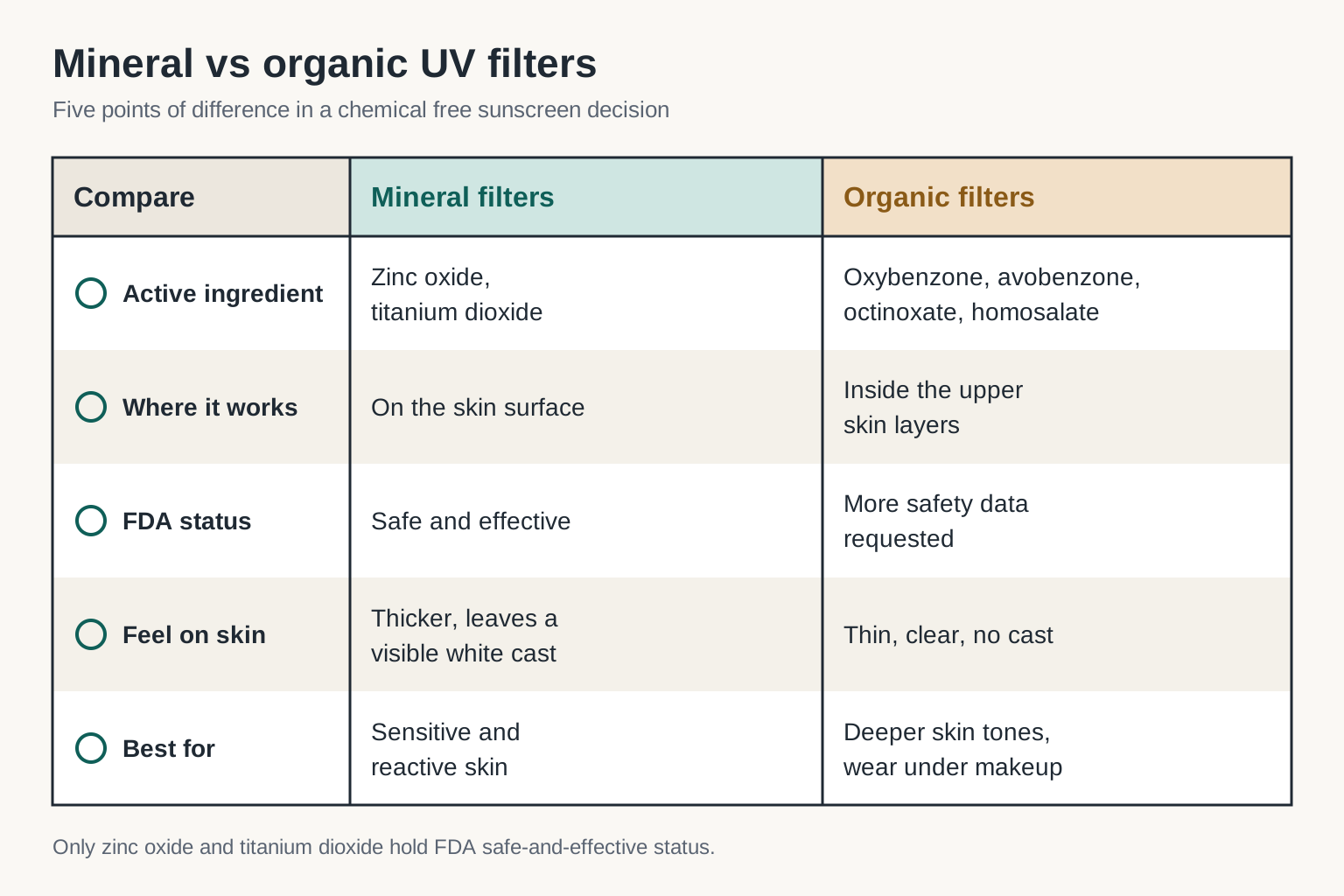
The regulatory split is what makes a healthy sunscreen claim defensible at all. In the FDA's 2019 review of 22 filters, only titanium dioxide and zinc oxide were classed as generally recognized as safe and effective. Twelve widely sold organic filters were placed in a category needing more absorption and safety data, and two were removed outright.
Clinicians reading the same evidence do not all land on mineral. a cancer center verdict on mineral versus chemical filters leans mineral on the strength of the physical barrier; the dermatology literature summarised in how UVA and UVB reach skin and what sunscreen labels changed stresses that the filter you reapply beats the filter you admire.
Here is what a chemical free sunblock actually buys you, and what it charges for it.
- Less stinging around the eyes, which matters for rosacea, eczema and post-procedure skin.
- No waiting period: mineral works on contact rather than after 15 minutes of film formation.
- A visible white or grey cast, worst on deeper skin tones and worst in photographs.
- A thicker, draggier texture that pills more readily over silicone primers.
- A higher price per ounce for equivalent SPF, typically a third to double.
A sun lotion without chemicals is not automatically stronger, either. Non chemical spf tops out around SPF 50 in practice because stacking more zinc thickens the formula past the point anyone will wear it. If you want the plain-English version of SPF arithmetic, how to choose an SPF that actually protects covers the numbers without the brand noise. Anyone who has abandoned mineral twice over greasiness should consider a hybrid instead: a filter you wear daily outperforms a purer one that lives in a drawer.
How Do You Spot the Best Chemical Free Sunscreen on a Label?
Read the actives panel, not the front label: zinc oxide or titanium dioxide alone, broad spectrum, SPF 30 or higher, a stated non-nano claim and 40 or 80 minute water resistance. The front of a bottle sells; the drug facts panel on the back is the only part held to a standard.
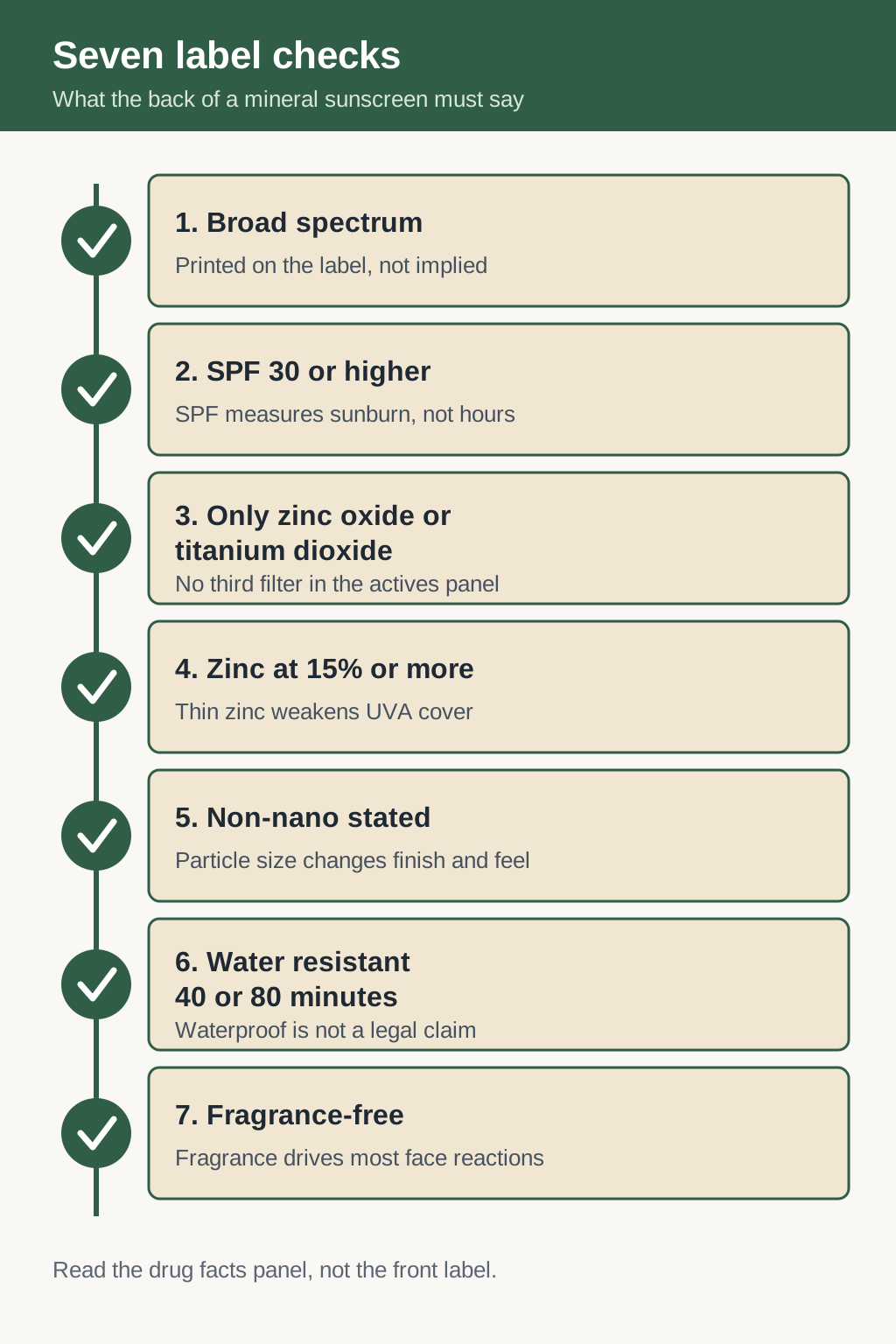
Work the panel in this order. First, the active list: the best chemical free sunscreen names zinc oxide, titanium dioxide, or both, with no third filter hiding at the end. Second, the zinc percentage. Below roughly 15% zinc, UVA coverage thins out even when the SPF number stays high, because SPF is a UVB measurement.
Third, confirm "broad spectrum" is printed, not implied, and that the SPF value is 30 or more. is a sunburn test, not a clock, so a higher number buys margin for under-application rather than extra hours. Fourth, water resistance reads as 40 or 80 minutes; "waterproof" is not a legal claim.
Fifth, look for a stated non-nano particle size. Particle size changes finish and inhalation risk rather than safety on intact skin, and is worth knowing before you pay a premium for the wording. Sixth, scan the inactive list for fragrance and essential oils. Seventh, find a batch or expiry date you can actually read.
Two traps unseat a best sunscreen without chemicals claim. One is a hybrid panel behind a botanical front label, where avobenzone appears third. The other is an undisclosed SPF booster that lifts the tested number without adding UVA cover. Run the seven checks and a best non chemical sunblock decision takes under a minute at the shelf. For the deeper version of check three, broad spectrum label checks for SPF 30 or higher walks the wording line by line, and what the SPF number on suntan lotion really means explains why the top of the SPF range flattens out.
Keep the filter families straight at the shelf with a single printable page.
Which Natural Sunscreen for Face Fits Your Skin Type?
Match the format to your skin: fluid zinc lotions suit oily skin, richer creams suit dry skin, single-filter fragrance-free formulas suit reactive skin, and tinted fluids suit deeper tones. Facial skin is roughly half the thickness of skin on the back, so it shows cast, shine and pilling long before a body lotion misbehaves.
If breakouts are your main concern, the same format logic points to the best sunscreen for acne prone skin, where non-comedogenic carriers and a matte finish matter as much as the filter.
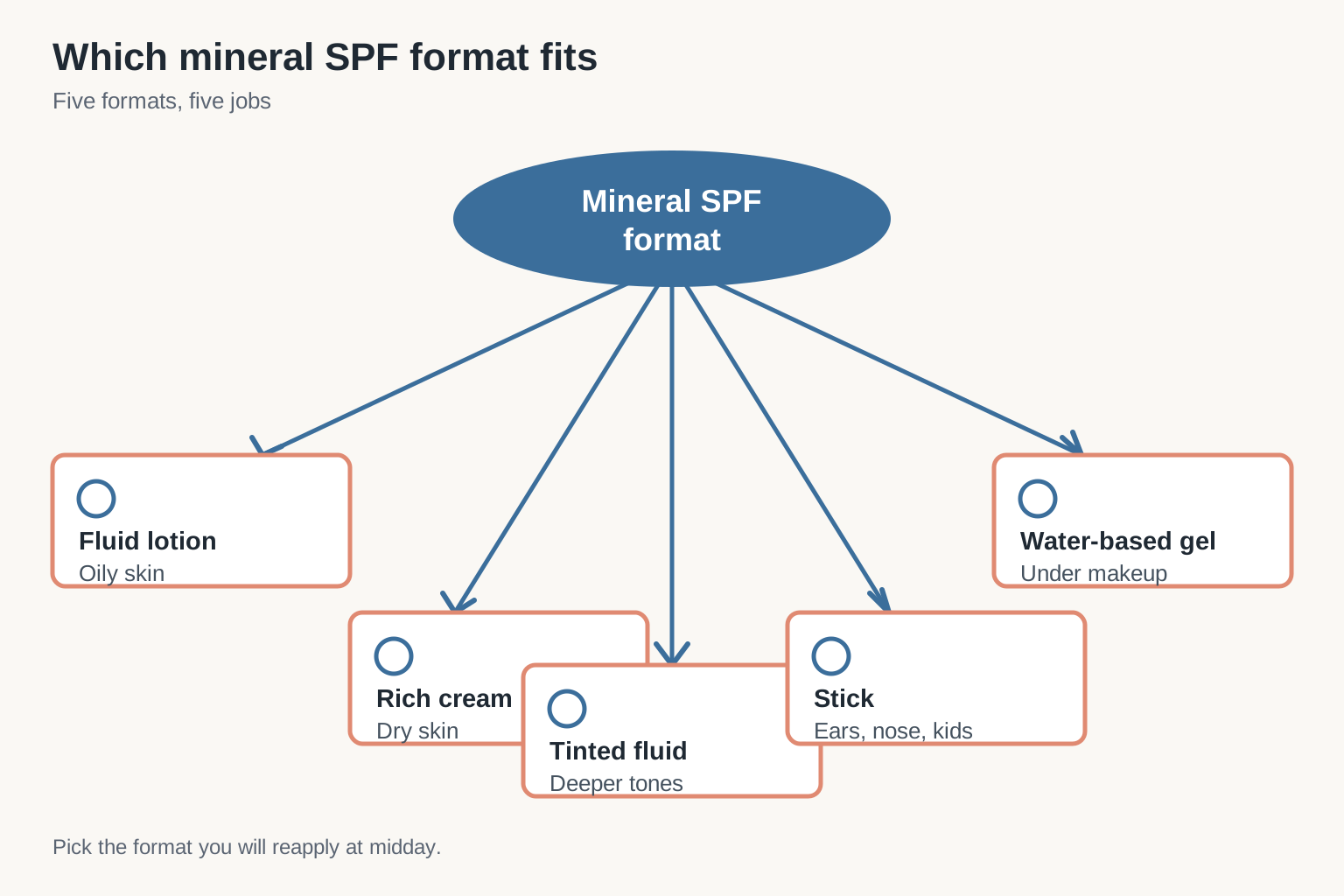
Oily and combination skin does better with a fluid or water-phase zinc lotion that sets matte in about 60 seconds. Dry skin wants a cream base with glycerin or squalane, because a thin fluid clings to flaking and emphasises it. Reactive skin should start with a single mineral filter, no fragrance, no essential oils.
A non toxic face sunscreen is also where plant oils in the inactive list earn or lose their place. Coconut and cocoa butter change finish and comedogenicity; they do not change UV protection. If you break out along the jaw within two weeks of switching, the inactive list is the suspect, not the zinc.
Zinc itself stays where you put it. In isotope-tracing work such as measured zinc levels in skin after mineral sunscreen use, particles remained in the outermost layer and the dissolved zinc crossing into living epidermis sat below the skin's own background level.
Patch test a best organic sunscreen for face candidate on the jawline for three consecutive days before committing it to your whole face. Then fix the order: moisturiser, 60 seconds of absorption, then a best non toxic sunscreen for face layer pressed on in two thin passes. Makeup goes on after another minute. Deeper reading on texture matching sits in mineral sunscreen for face picks by skin type, and if your skin flushes easily, sunscreen choices for sensitive, reactive skin is the more cautious starting point.
Not sure which texture your skin is asking for? Six questions give you a skin type, a sensitivity flag and a matching mineral finish.
Which of the Best Natural Sunscreens Suit Face and Body?
The strongest mineral options divide by need: matte for oily skin, tinted for deeper tones, fragrance-free for reactive skin, water-resistant cream for swimming, and a large tube for family days. Ranking the best natural sunscreens one to five hides the only question that matters, which is whether you will reapply the thing at 2 p.m.
A best rated natural sunscreen that leaves cast under office lighting or pills under foundation gets skipped at midday, and a skipped layer is SPF 0. A best organic natural sunscreen label describes sourcing and inactive ingredients; it says nothing about UVA strength. Treat best clean sunscreens here as a working definition: mineral actives only, fragrance-free, no undisclosed boosters. Even among best organic sunscreens with identical zinc percentages, finish and price per ounce diverge sharply.
We may earn a commission on purchases made through the links below, at no extra cost to you.
Finish matters more than ranking, so compare the two variables that decide wearability: tinted sunscreen options with a matte finish for the cast problem, and zinc oxide sunscreens and non-nano labelling for what the percentage on the panel is really telling you.
Is a Non Toxic Suntan Lotion Enough for a Full Beach Day?
A mineral body lotion covers a beach day only at about one ounce per full-body application reapplied every two hours, which empties a three-ounce tube in a single afternoon. Run the arithmetic before you pack: six hours on sand is three applications, so one adult needs roughly three ounces of non toxic suntan lotion for one day.

A chemical free sun tan lotion still needs the rest of the system. No SPF number cancels the 10 a.m. to 4 p.m. window, and UPF fabric, a three-inch hat brim and an umbrella do the heavy lifting that product cannot. Pack the lotion as the layer that covers what fabric and shade leave exposed.
For reapplication over sand and salt, a best natural suntan lotion in cream form beats a mist every time: cream grips damp skin, while a mist lands unevenly on a breezy beach and pulls grit into the film.
Sprays deserve blunt treatment. A best non toxic sunscreen spray is difficult to apply at the full tested dose, mineral aerosols raise an inhalation concern that creams do not, and the benzene recall that pulled aerosol SPF sprays from shelves showed how fast an aerosol format can go wrong. If you want a spray for topping up legs and backs, spray your mineral lotion into your palm first, then spread it by hand. A best spray sunscreen face claim is almost always the wrong tool for a face, where you cannot see coverage and you will inhale the overspray.
Water is the other variable. A chemical free suntan lotion matters most in enclosed bays and reef water: oxybenzone build-up measured in a Hawaii swimming bay found a single day of swimmer traffic leaving residues that lingered up to 50 hours. Lips need their own product, and SPF lip balm that stays put on lips explains why a lotion smeared on lips lasts minutes.
Watching someone layer mineral SPF is faster than reading about it.
Do Water-Based Mineral Formulas Feel Lighter on Skin?
Water-based mineral formulas suspend zinc in a water phase, so they feel lighter and look less shiny, but they rub off sooner and demand stricter reapplication. A sunblock water based formula swaps the oil or wax carrier for water plus a dispersant, which is why it spreads thinner and dries down instead of sitting glossy.

The trade-off is mechanical. Without a wax film, the layer is easier to abrade with a towel, a mask strap or a sleeve, and water resistance ratings skew to 40 minutes rather than 80. Expect to pay more per ounce than a best organic sunblock in classic cream form, for less staying power.
The reader who gains most is the one who quit mineral over greasiness: combination and oily skin, makeup wearers, and anyone whose SPF used to slide into their eyes by noon. The reader who should skip it is the open-water swimmer. On the arithmetic behind SPF ceilings, why SPF numbers above 50 add very little is a useful corrective to chasing SPF 100.
Layering decides whether it pills. Water-phase zinc fights silicone primers and unabsorbed vitamin C serums, so give each layer a full minute, skip the primer under it, and press rather than sweep. If your morning already runs long, moisturizer with SPF for everyday wear is the shortcut worth considering.
How Much Chemical Free Sunscreen Do You Need Per Application?
An adult needs about one ounce for the whole body and a quarter to half teaspoon for the face, applied 15 minutes ahead and reapplied every two hours outdoors. SPF is tested at 2 mg of product per square centimetre of skin, and almost nobody applies that much.
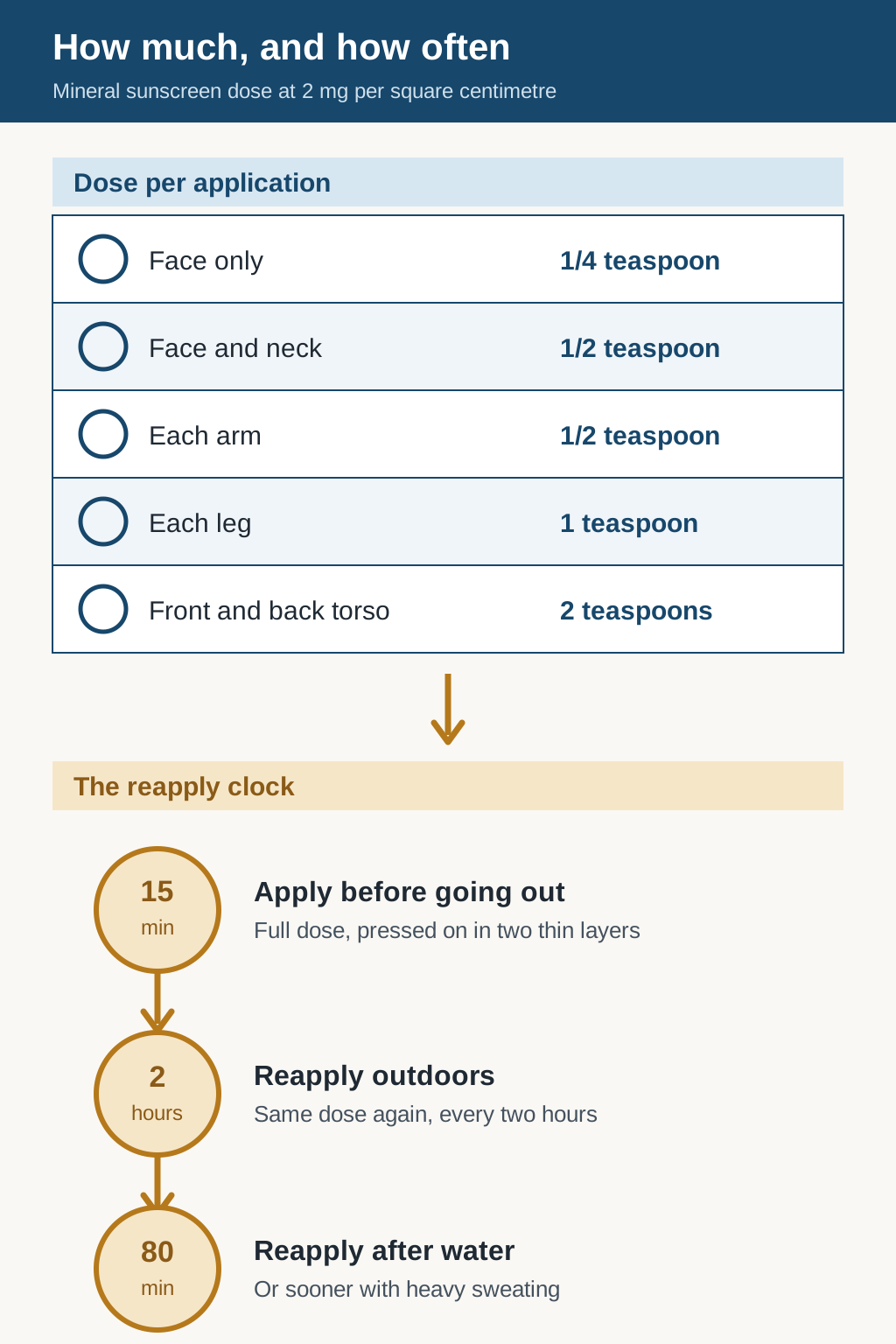
Under-application does not scale politely. Spread half the tested dose and an SPF 30 label behaves closer to single-digit protection, because the relationship between film thickness and protection is non-linear. the shot-glass rule for covering an adult body is the measure most people recognise.
| Area | Dose per application |
|---|---|
| Face only | About a quarter teaspoon |
| Face and neck | About half a teaspoon, or two finger-lengths |
| Each arm | About half a teaspoon |
| Each leg | About one teaspoon |
| Front and back torso | About two teaspoons |
Set the clock as well as the dose: on 15 minutes before you go out, again at the two-hour mark, and immediately after 80 minutes in water or heavy sweating. Sticks and tinted fluids deliver far less product per pass, so a stick needs four slow passes over the same patch and a tinted fluid needs two full layers to reach the same thickness. In a routine, that is where your daily face SPF goes on last, before makeup.
Guessing teaspoons gets old by day three, so put your own numbers in.
How Do You Stop White Cast and Pilling From Mineral SPF?
White cast comes from zinc particles scattering visible light, so tinted or micronized formulas, two thin pressed layers and a 60-second wait between them fix it without cutting the dose. One thick layer rubbed in circles leaves far more cast than the same amount applied in two passes.

Four fixes keep the dose intact: choose a tinted or micronized formula, warm the product between fingertips for five seconds, press it on instead of rubbing, and wait a minute between layers. Thinning the layer with moisturiser works visually and costs you protection, so leave that one alone.
Pilling has a different cause. Little rolls of product come from silicone-heavy primers and half-absorbed serums underneath, not from the zinc itself. Removal matters too: a water-resistant mineral film resists a foaming wash, which is why oil cleanser that dissolves mineral sunscreen at night is the first step of a double cleanse rather than an optional extra.
What Should the Best Affordable Sunscreen Cost Per Ounce?
Price per ounce decides value, because a large body tube usually costs far less per ounce than a small face tube and a freely reapplied formula protects more. Divide the price by the ounces on the label before you compare anything else; a best affordable sunscreen often loses on shelf price and wins on the division.
The practical move is buying two sizes: a large body tube you use generously, and a small face formula chosen for finish. The costs that are not money deserve naming too — white cast, thicker texture, more reapplication effort, and a shorter water-resistance window. Shade, UPF fabric and timing reduce how much product the day needs at all, and shade, UPF clothing and the rest of a sun-safety routine ranks those habits by impact, which is why sun protection belongs in where sunscreen fits in a daily skin care routine rather than in a beach bag.
One practical sun-protection note a week, if that is useful.
One sun-protection tip a week. No product dumps.
Thanks — you're on the list.


