

The best sunscreen for acne prone skin is a fragrance-free, non-comedogenic broad-spectrum SPF 30 to 50 fluid or gel: zinc oxide for reactive skin, modern chemical filters like Tinosorb S for invisible wear. The deciding factor is texture, because heavy occlusive carriers, not the UV filters, trigger most breakouts.
What actually makes a sunscreen acne safe?
A sunscreen counts as acne safe when its filters do not sting, its carrier base is free of heavy occlusive oils, and its finish dries down thin enough to skip without feeling greasy. Three variables decide the outcome and only one of them is printed on the front of the carton.
The UV filter sets sting risk. The carrier base, meaning the oils, esters and silicones that suspend that filter, sets clogging risk. The finish sets whether you are still wearing the bottle in August or have quietly abandoned it on the shelf.
"Non-comedogenic" carries no legal definition and no mandatory test behind it, so any brand may print it on any carton. The honest signal sits lower down, in the ingredient list, where the first five entries tell you what the formula is mostly made of.
Score a candidate out of ten before you spend anything. Every acne safe sunscreen worth keeping clears eight of these ten points:
| Check | What earns the 2 points |
|---|---|
| Filter type | Does not sting broken or freshly treated skin |
| Carrier oils | No pore-clogging oils in the first five ingredients |
| Finish | Dries down flat in under sixty seconds |
| SPF and broad spectrum | SPF 30 to 50 with stated UVA protection |
| Reapply practicality | You will genuinely top it up at midday |
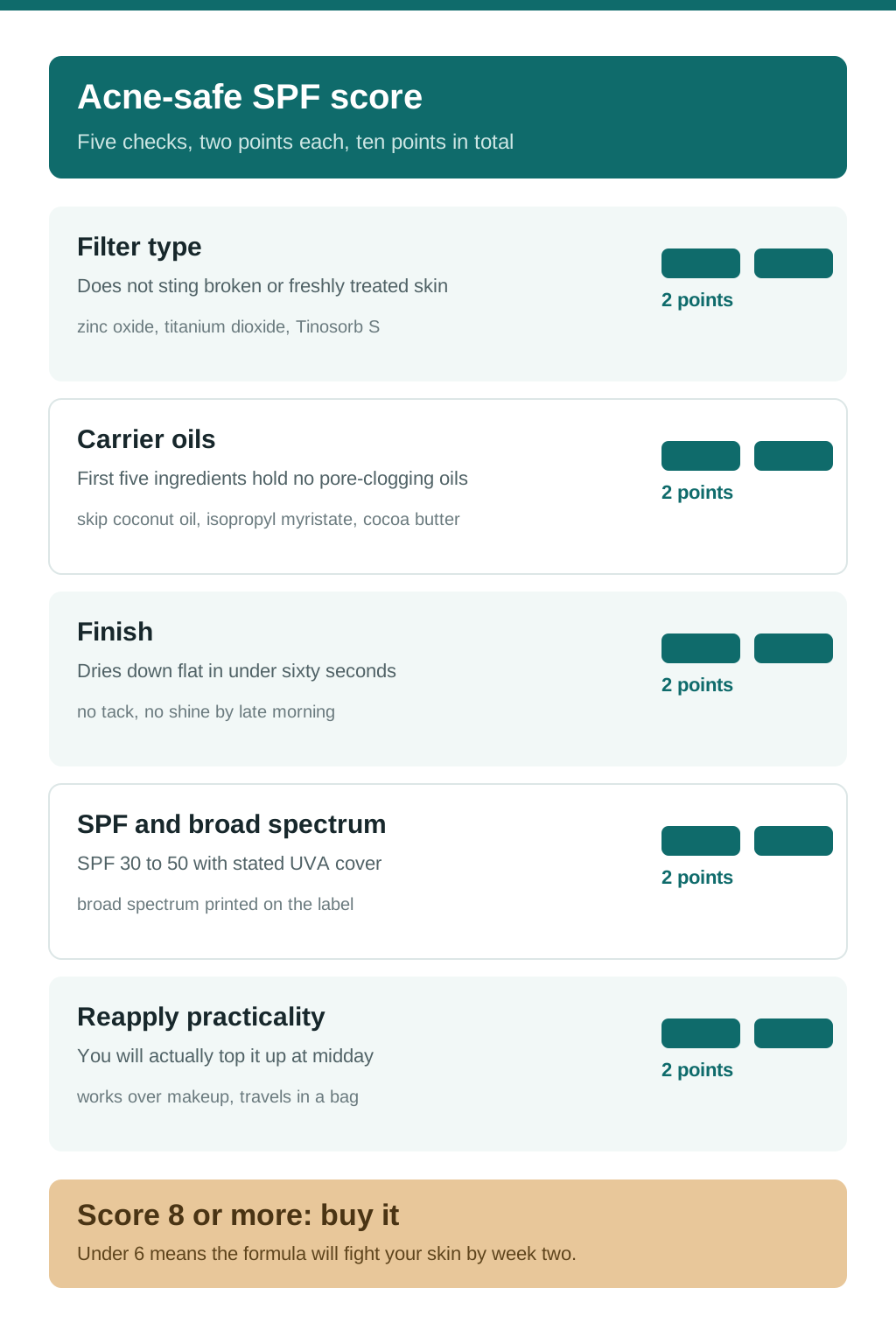
That scorecard also explains why the best spf for acne prone skin is broad spectrum SPF 30 to 50 rather than the largest number on the shelf. SPF 30 filters roughly 97 percent of UVB and SPF 50 roughly 98 percent, so the extra point of protection costs you a heavier filter load and the richer carrier needed to suspend it. The American Academy of Dermatology sunscreen guidance sets the same floor: SPF 30 or higher, broad spectrum, water resistant.
Skipping SPF has a specific cost on acne-prone faces. Ultraviolet light darkens the brown marks a healed spot leaves behind, so post-inflammatory hyperpigmentation that would fade in three months can stretch past a year. Across every price band, the formulas that work share the same shortlist: a stated SPF, a short carrier list and a finish you tolerate. For a line-by-line walk through the Drug Facts panel, the broad spectrum SPF 30 label checks go deeper than the front of the box ever will.
Mineral or chemical filters: which is the best sunscreen for acne?
Neither filter family is inherently acne safe: mineral formulas sting less on active breakouts, while chemical filters wear invisibly and reapply cleanly, so the carrier base decides the outcome. The marketing war between the two families distracts from the part that actually clogs pores.
Zinc oxide and titanium dioxide are particles. They sit on the surface and scatter ultraviolet light rather than being absorbed, which is why they rarely sting skin that is cracked, freshly exfoliated or mid-breakout. Zinc oxide also carries mild anti-inflammatory activity, documented in dermatology literature on topical zinc.
Modern chemical filters work differently. Tinosorb S, Uvinul A Plus and octocrylene absorb ultraviolet energy and release it as heat, so they can be formulated at low viscosity and disappear completely on every skin tone. A clinical review of ultraviolet exposure and sunscreen use sets out how each class is measured and where real-world protection falls short of the label.
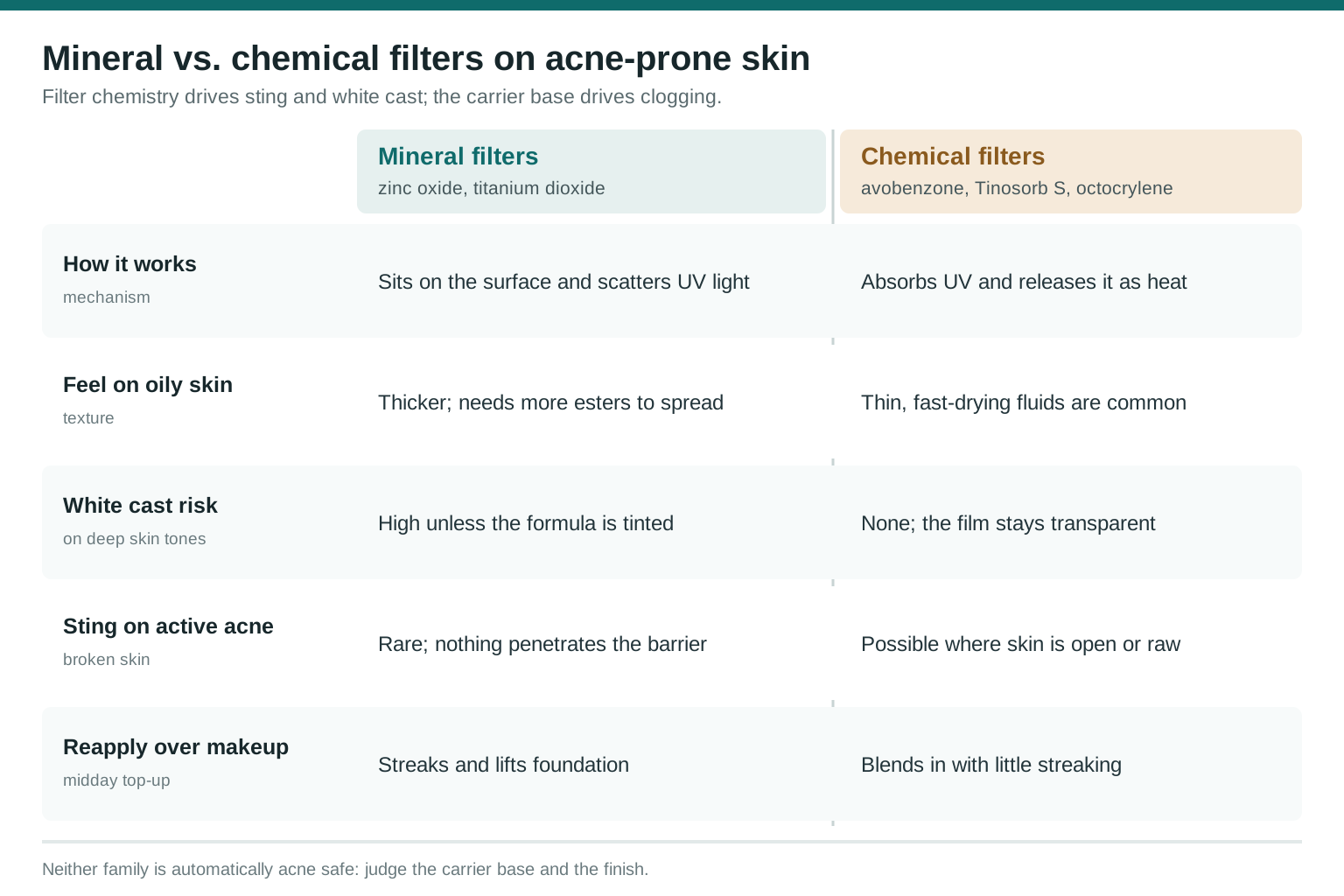
Here is the trade-off almost nobody states plainly. A mineral sunscreen for acne prone skin needs 15 to 25 percent zinc oxide by weight to reach SPF 50, and that much powder will not spread on its own. Formulators add dispersing esters and emollients to make it glide, and those esters, not the zinc, are the comedogenic half of the bottle. The same pigment load drives white cast and the grey-pink flashback that shows up in photographs on deeper skin tones.
Chemical filters win on three jobs: reapplying over makeup without streaking, disappearing on medium and deep skin, and surviving a humid commute. Mineral wins when your skin reacts to everything or you are mid-flare with open lesions. Our guide to picking a mineral sunscreen for the face compares the zinc grades that cast least.
Whichever family you try, patch test on the jawline for five consecutive nights before committing a full face. Five nights is long enough to catch irritation, short enough that one bad formula costs you nothing.
Which ingredients belong in acne safe sunscreens, and which do not?
Look for zinc oxide, niacinamide, silica and dimethicone high on the list, and skip sunscreens whose first five ingredients include coconut oil, isopropyl myristate, cocoa butter or added fragrance. Reading an ingredient list takes thirty seconds once you know what you are scanning for.
Four ingredients earn their place. Niacinamide at 2 to 4 percent calms redness and dials back sebum output. Zinc oxide protects and soothes at once. Silica blots oil through the day. Dimethicone gives an instant dry-touch slip without the heavy, waxy film that butters leave behind.
The carriers linked with closed comedones are a short, memorable list: coconut oil, isopropyl myristate, isopropyl palmitate, cocoa butter and the heavier cetyl esters. None of them is poison, and plenty of people wear them happily. On a face that already clogs, they stack the odds against you. Research on topical and oral research on zinc in dermatology explains why the zinc itself behaves so differently from the base it travels in.
Three more aggravators deserve a mention. Added fragrance is the most common cause of irritant reactions in any sunscreen for blemish prone skin. Denatured alcohol high in the list dries the barrier, which triggers rebound oil. Essential oils, citrus ones especially, can sensitise skin that is already inflamed.
The thirty-second method: read the first five ingredients to learn what the formula is mostly made of, then read the last three to catch fragrance and preservatives. Everything in between is usually emulsifiers and chelators like phenoxyethanol or disodium EDTA, which you can ignore. That single habit separates genuinely acne safe sunscreens from the ones that only claim it on the carton. The same scan works on the zinc oxide sunscreen formulas and on the chemical sunscreen filters and safety.
Which texture and finish suit a face sunscreen for acne prone skin?
Thin fluids and gels suit oily, breakout-prone skin because they dry down in under a minute, while rich creams and balms hold sweat against the skin and feel heavy by midday. Texture is the variable most people get wrong, and the one they feel every single day.
Ranked for oily skin, the shelf runs: watery fluid, gel, serum-lotion, then cream. A fluid delivers the same roughly 0.35 grams per face as a cream but spreads it into a thinner film, so it dries without the occlusive drag that traps sebum and sweat under a warm helmet or mask.

Matte finishes are not automatically better. Silica-mattified formulas look powdery and grey over dry patches and flaking retinoid skin, so if you peel in winter, a satin finish photographs far better. Sticks and sprays reapply beautifully but deliver uneven coverage on the first layer, which is the layer that counts.
Judge a good sunscreen for acne prone skin on the four-hour shine test, not the first five minutes. Anything feels light at minute one. If you need blotting paper before lunch, the carrier is too rich, regardless of what the box claims. A lighter base pairs well with an oil free moisturizer for shiny skin underneath, and our tinted SPF buying guide covers shade-matching in detail.
Tinted mineral formulas solve a specific problem: iron oxides neutralise the red and brown of post-acne marks and block visible light, which drives pigmentation on medium and deep skin, so you can skip a separate foundation layer.
Best sunscreens for acne prone skin, matched to your main concern
Match the pick to the concern that actually bothers you: white cast, midday shine, retinoid sensitivity, sweat resistance or congestion, because no single SPF wins on all five at once. Ranking brands against each other hides that trade-off; ranking by problem exposes it.

One honest caveat before the list: a sun cream for spot prone skin that performs on a dry, calm winter day is not the same bottle you want in August humidity, so the best facial sunscreen for acne prone skin is often two bottles rather than one. Some links below are affiliate links; a purchase may earn this site a commission at no extra cost to you.
Reactive skin that burns and breaks out in equal measure is a different brief again, and our sensitive skin sun protection picks narrow the field further.
How much acne prone sunscreen do you need, and how often should you reapply?
One face needs roughly a quarter teaspoon, or half a teaspoon with the neck and ears, applied in two thin passes and refreshed every two hours of real sun exposure. Dose is where most protection is quietly lost.
Laboratory SPF ratings are measured at 2 milligrams per square centimetre. On an average adult face, that works out to about a quarter teaspoon, or roughly 1.2 grams. Typical real-world application lands near half that.
Halving the dose does not halve the protection, because the relationship is closer to exponential than linear. At a thin smear, an SPF 50 label can behave like single-digit SPF, which is why dose beats label number every time.
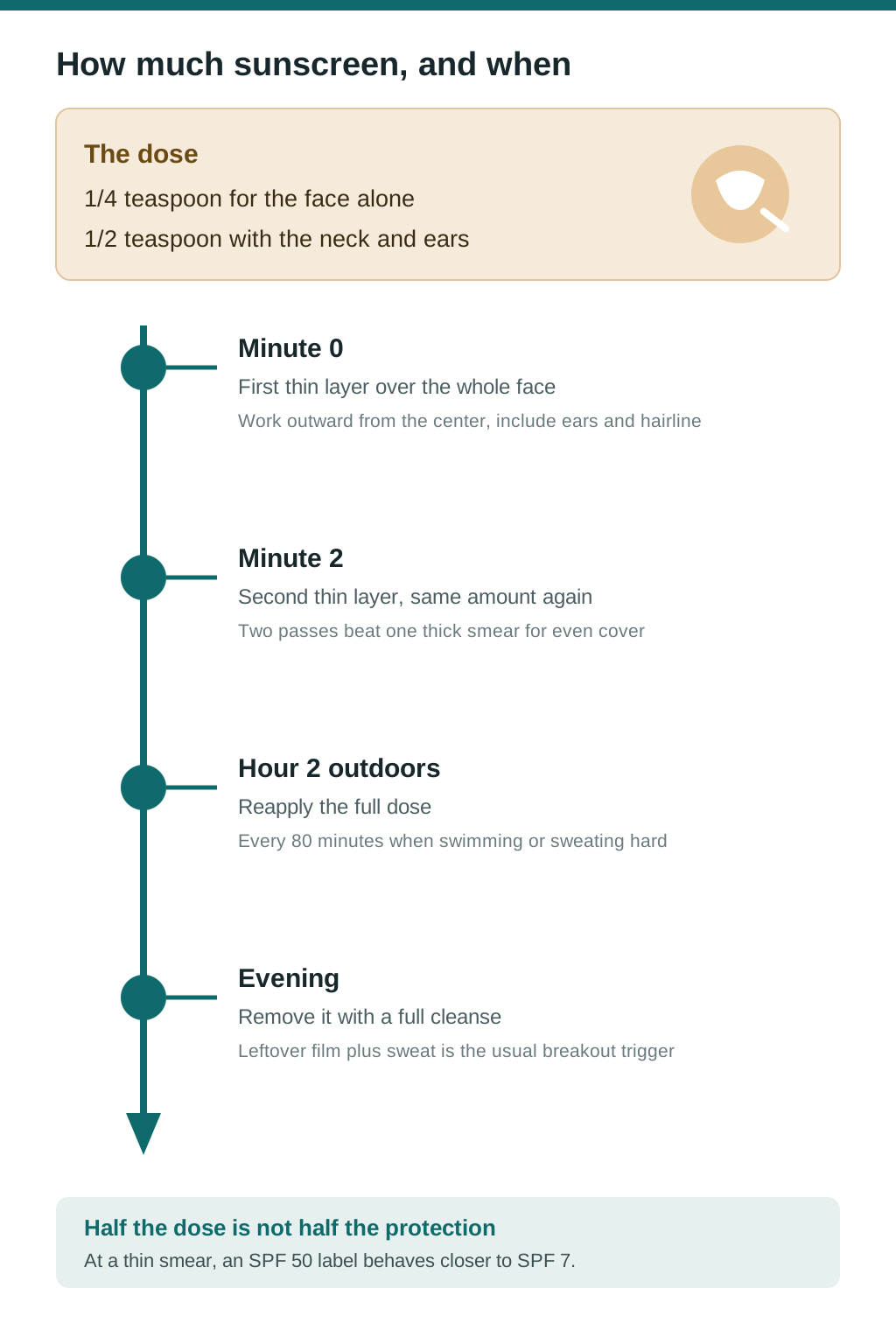
The two-layer method solves it without the greasy feel: one thin pass, sixty to one hundred and twenty seconds of drying, then a second thin pass. Two thin coats reach the tested dose and still dry flat. Reapply every two hours outdoors, and every eighty minutes when swimming or sweating hard. The FDA guidance on reading a sunscreen label explains what the water-resistance minutes on the bottle actually certify.
Over makeup, a cushion compact carrying a rated SPF is the most reliable top-up. A mineral powder is better than nothing but almost never applied thickly enough to count as a full layer. An acne safe face sunscreen also needs removing properly at night, so build it into a fixed sequence; our guide to skin care routine order and steps sets out where each step lands.
How do you layer SPF with retinoids, benzoyl peroxide and acids?
Sunscreen goes last in the morning, after a water-based treatment has dried for about sixty seconds, and benzoyl peroxide moves to the evening so it cannot oxidise the filters. Order matters more than the number of products.
The morning sequence runs cleanse, water-based treatment, sixty-second wait, optional moisturizer, then SPF. Thin textures go first because a thick one blocks whatever follows. On oily skin you can often drop the moisturizer entirely and let a cushioned sunscreen do both jobs; if your skin tightens by noon, a light moisturizer belongs in step four.
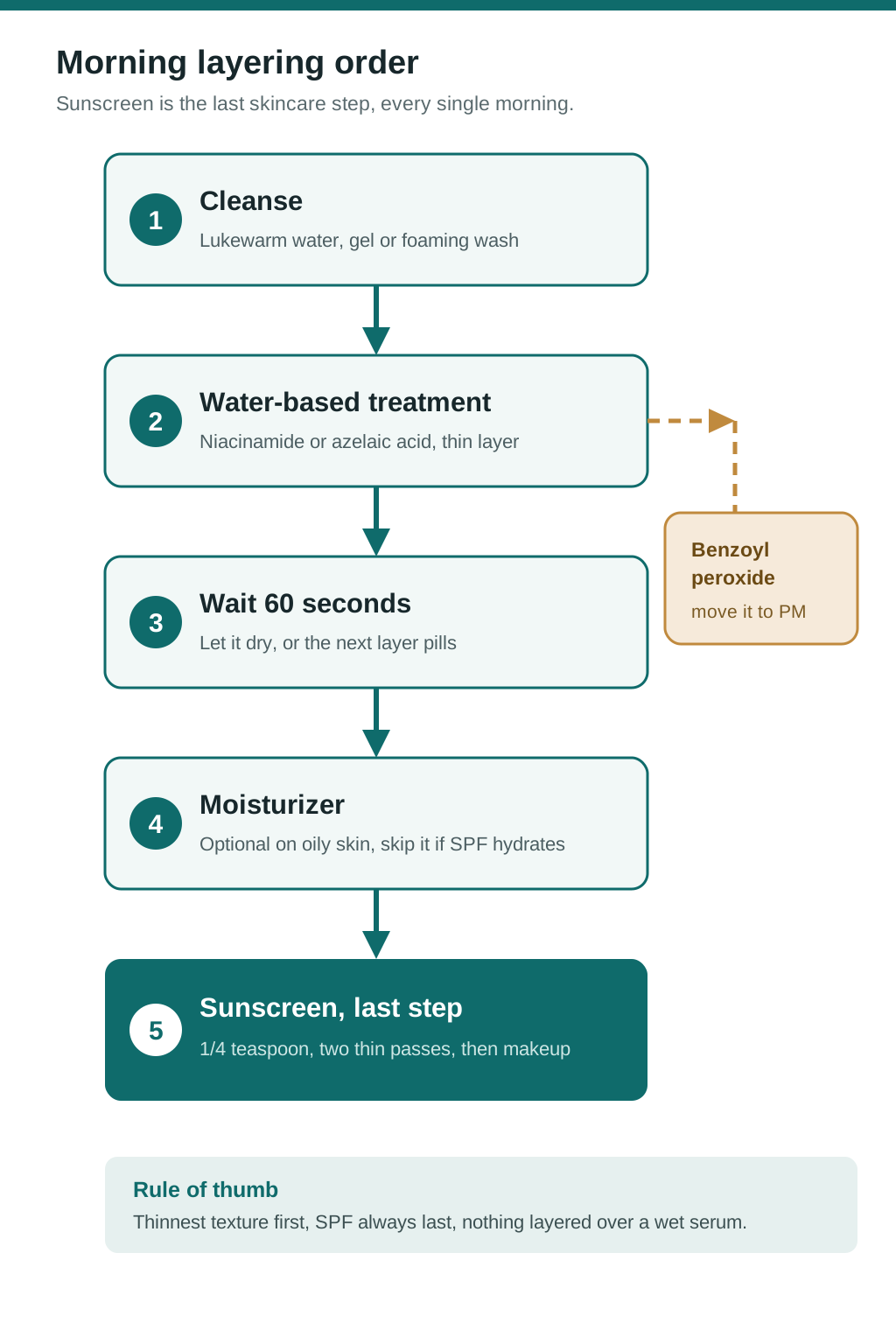
Benzoyl peroxide is the one real conflict. It oxidises some chemical filters, degrading protection, and the pale residue it leaves can look grey where the two pill together. Move it to the evening, or separate the two by at least an hour.
Retinoids and acids thin the stratum corneum, which measurably raises UV sensitivity for weeks. That makes a daily layer of the best sunscreen for acne prone skin non-negotiable rather than optional while you are on them. Tretinoin and adapalene go at night, azelaic acid works in either slot, and prescription clindamycin sits comfortably under SPF in the morning.
The sixty-second wait stops pilling. Layering over a still-wet humectant serum does not; the water lifts the film into little rolls. A salicylic acid wash is the easiest acid to keep in this routine, and our salicylic acid cleanser checks explain which concentrations suit daily use.
Is your sunscreen for pimples really the cause of the breakout?
Most sunscreen-blamed breakouts trace back to incomplete removal, trapped sweat or fragrance irritation rather than comedogenic filters, and the timing of the spots tells you which one it is. Three different mechanisms get filed under the same complaint.
True comedogenic clogging produces closed comedones that surface seven to fourteen days after you start a product. Irritant folliculitis from fragrance or alcohol shows up as uniform small bumps within forty-eight hours. Sweat trapped under an occlusive film appears fastest of all, usually along the jaw and hairline after a hot day.
Incomplete removal is the most common culprit by a wide margin. Sunscreen film is built to resist water, so a splash of water will not shift it; a proper wash with a gel cleanser at night does more for clarity than switching formula.
Test one variable for two full weeks before you judge it. Swapping three products at once guarantees you learn nothing. If nodular or cystic lesions persist past eight weeks of careful routine, that is a dermatologist visit, not a formulation problem. Abandoning SPF to fix a sunscreen for pimples complaint costs you a year of fading on every mark you already have.
One short email a week on what actually works for breakout-prone skin.
One tested skincare tip a week. No product dumps, no hype.
Thanks — you're on the list.


