

Dry eye treatment works by fixing one of two failures: too little tear water, or a blocked oil layer that lets tears evaporate. Nearly 16.4 million Americans have dry eye, and most start with preservative-free artificial tears, lid warming, prescription cyclosporine or lifitegrast, then punctal plugs or thermal pulsation.
What Does Dry Eye Treatment Actually Have to Fix?
Dry eye treatment has to fix one of two mechanisms: tear glands producing too little water, or blocked eyelid oil glands letting the tear film evaporate too fast. The tear film is three layers thick: an inner mucin layer that grips the cornea, a middle water layer from the lacrimal glands, and a thin outer lipid layer secreted by dozens of meibomian glands along each lid margin. Volume keeps the surface cushioned; the lipid film stops that volume from flashing off between blinks.
Aqueous-deficient dry eye means the water layer runs short, the pattern seen in Sjogren syndrome and with several drug classes. Evaporative dry eye means the oil layer has failed because the gland openings are plugged, and it drives most chronic cases. That is why artificial tears alone so often plateau after three or four weeks: a drop replaces water the glands never stopped making.
Symptoms separate the two reasonably well. All-day burning, grittiness and a sandy feeling that spikes in wind or air conditioning points to a water shortage. Vision that smears and then clears for a second after a hard blink points to an unstable oil layer. Watery eyes mislead people constantly: reflex tearing is a dry eye symptom, not evidence against the diagnosis.
Five factors change the plan before you buy anything: age over 50, female sex, contact lens wear, screen work that cuts blink rate by roughly half, and medications including isotretinoin, antihistamines and some antidepressants. Dryness is also one of the most common eye complaints there is, and how many Americans live with dry eye puts the figure near 16.4 million US adults. If your discomfort arrives with pain, discharge or blurred vision that blinking never clears, check it against eye diseases and the symptoms that signal each one first, because those belong to a doctor rather than a drop.
How Do You Compare Dry Eye Treatment Options?
Compare dry eye treatment options on four axes: the tear layer each one targets, out-of-pocket cost, how many weeks until relief, and the limitation it carries. Price alone ranks nothing useful. A $12 bottle of preservative-free tears and a $900 thermal pulsation session fix different failures, so the expensive one is wasted money when the cheap one matches your mechanism.
| Option | What it targets | Typical cost | Time to relief | Main limitation |
|---|---|---|---|---|
| Preservative-free artificial tears | Water layer | $12-$25 per box | Minutes, repeated | Wears off in under an hour |
| Lipid emulsion drops | Oil layer | $15-$30 | Days to 2 weeks | Brief blur after each drop |
| Overnight gel or ointment | Overnight exposure | $10-$20 | 1-3 nights | Blurs vision for minutes |
| Moisture chamber eyewear | Overnight evaporation | $25-$120 | First night | Useless if lids close fully |
| Warm compress plus lid hygiene | Blocked glands | $0-$40 | 2-4 weeks, daily | Needs 10 minutes every day |
| Omega-3 supplements | Claimed oil quality | $15-$40 monthly | Not demonstrated | Matched placebo in trial |
| Cyclosporine or lifitegrast drops | Surface inflammation | Prescription, varies | 30-90 days | Burning or metallic taste |
| Varenicline nasal spray | Natural tear reflex | Prescription, varies | 1-4 weeks | Sneezing, throat irritation |
| Punctal plugs | Tear drainage | Often insured | Same day | Watery overflow, plug loss |
| Thermal pulsation or IPL | Blocked glands | $400-$900 per session | 2-6 weeks | Rarely covered by insurance |
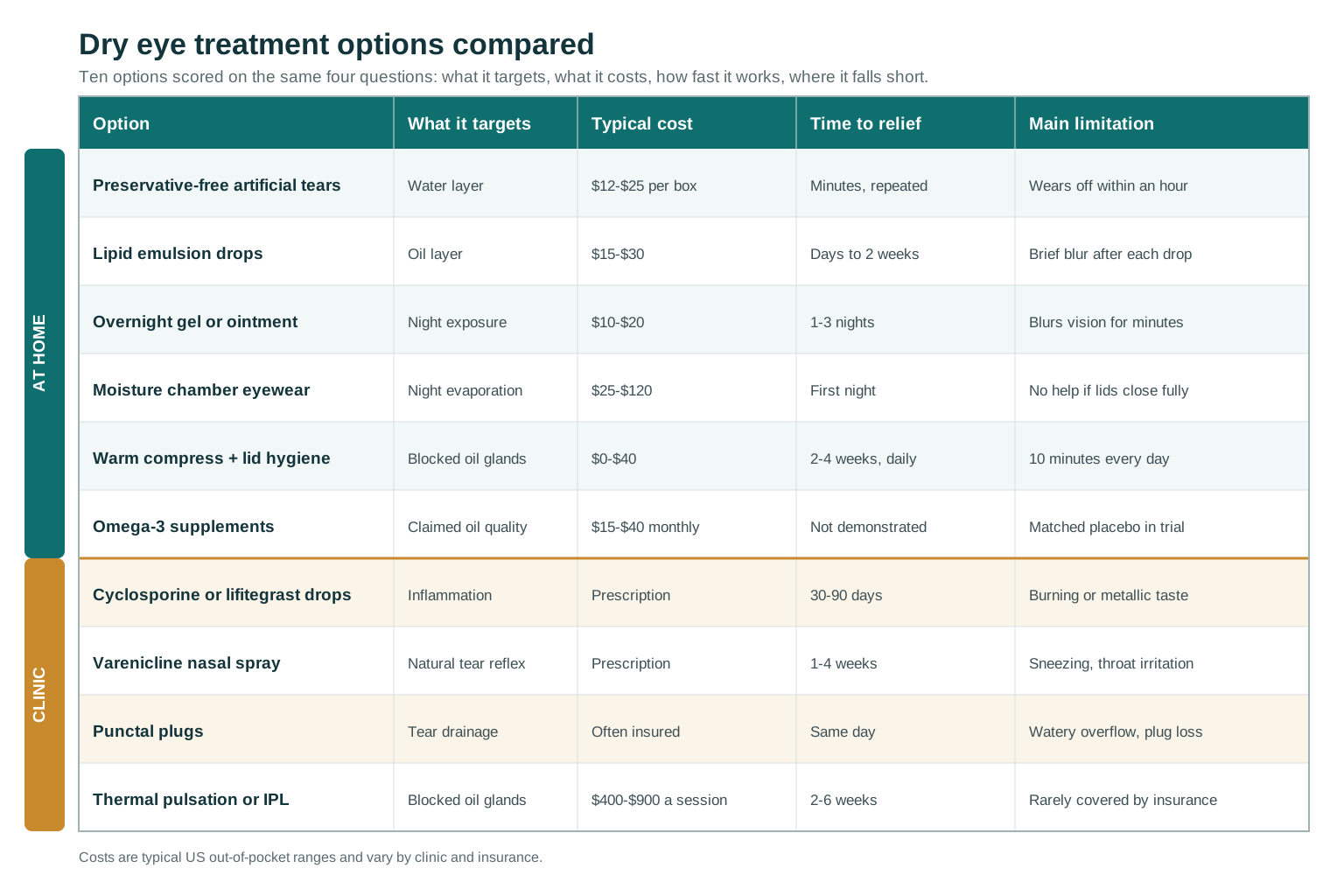
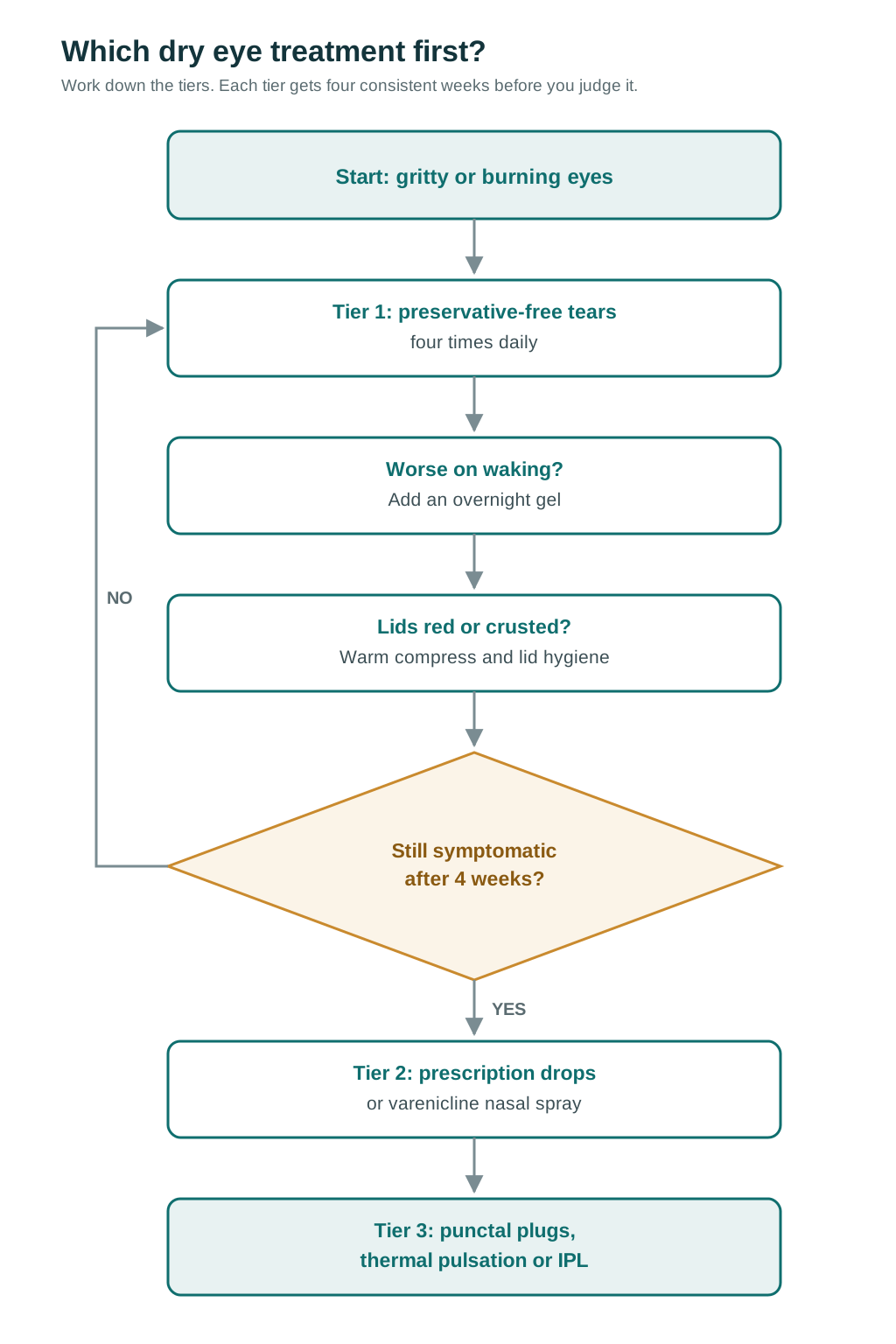
Give each tier four weeks of consistent use before you judge it. Anti-inflammatory drops need 30 to 90 days to show their effect, so a verdict on day five measures nothing but your patience. One honest caveat about self-assessment: in a 12-month randomized trial, more than half the participants on an inert placebo reported substantial improvement, so a single good week never proves a treatment works.
The best treatment for dry eyes, judged honestly, is the cheapest option that holds your symptoms under roughly 3 out of 10 through a full working day. Puffiness, shadowing and crepey skin around the eye are separate problems with separate fixes, covered in under-eye bags treatment that actually works.
Which Over-the-Counter Drops Work, and When?
Over-the-counter drops split into two jobs: preservative-free aqueous tears replace missing water, and lipid emulsion drops rebuild the oil layer that stops evaporation. Buying by shelf position or by the word "intensive" on the carton gets this wrong roughly half the time, because the two formats treat opposite failures.
Preservative-free artificial tears
These are single-use vials or a multi-dose bottle with a one-way valve, containing a humectant such as sodium hyaluronate, carboxymethylcellulose or glycerin. They hold water against the ocular surface and cushion it between blinks. Dose them whenever symptoms rise, which for moderate dry eye means four to six times a day.
The preservative question decides the format. Benzalkonium chloride, the common preservative in bottled drops, is itself toxic to surface cells with repeated exposure, so once you pass four doses a day the preservative-free version stops being a luxury. The tradeoff is real: vials cost two to three times more per dose and generate a small pile of plastic. The deeper limitation is pharmacokinetic, and it explains why so little of an eye drop reaches the ocular surface: only about 1 to 5 percent of an applied drop reaches the target tissue, so technique and frequency beat formula shopping. Close the eye for 30 seconds after instilling, and press the inner corner to slow drainage.
Lipid-replacement emulsion drops
These carry an oil phase, usually mineral oil or a phospholipid, dispersed in water. They sit on top of the aqueous layer and slow evaporation, which is the right tool when your vision smears between blinks and your lid margins look thickened. The logic is the same one behind how dry skin moisturizers hold water: a humectant draws water in, an occlusive layer keeps it from leaving.
Who they are not for: anyone who needs crisp vision in the next two minutes, since the emulsion blurs for 30 to 60 seconds. And no over-the-counter drop treats inflammation, so the best treatment for dry eyes with red, crusted, inflamed lid margins is not on this shelf at all.
Why Are Dry Eyes Worse at Night, and What Helps?
Dry eyes worsen at night because tear output falls during sleep and some people sleep with their lids slightly open, so overnight ointment, sealed eyewear and humid air do the work. Every dry eyes at night treatment that earns its place does one of three things: it adds a thicker lubricant, it seals the eye, or it stops room air drying the surface. There is a simple test for this pattern: if the worst 20 minutes of your day are the first 20 after waking, and things ease once you are up and blinking, the damage is happening overnight.
Overnight gel and ointment
Ocular gels and petrolatum-based ointments are far thicker than daytime drops, which is the point. They stay on the surface for hours instead of minutes and physically block evaporation through the night. A ribbon of ointment goes inside the lower lid, then a few blinks spread it.
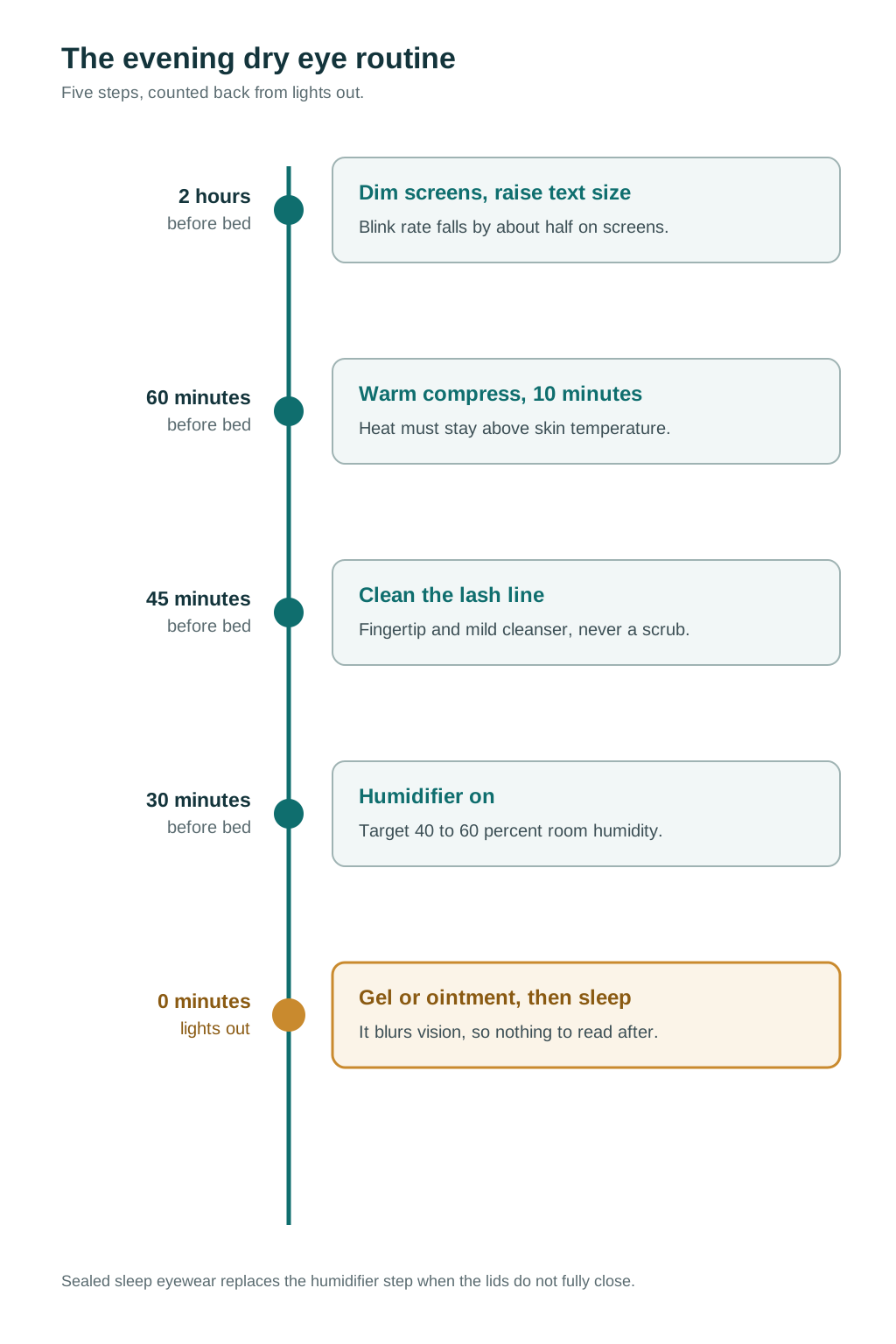
Timing matters more than brand. Both formats blur vision for several minutes, so they go in after your last screen and last page of reading, not before. Ointment is not for anyone who may need to drive or get up to a child during the night, and a gel is the lighter compromise for those nights.
Moisture chamber sleep eyewear
These are padded goggles or sealed sleep masks that trap a humid pocket of air against the eye. For nocturnal lagophthalmos, where the lids do not close fully, they solve the actual problem: the exposed strip of cornea no longer meets dry room air for seven hours.
They are the wrong purchase if your lids close completely, and even the comfortable ones take a week to get used to. Bedroom air does the other half of the job: run a humidifier to hold 40 to 60 percent relative humidity, and move the bed out of the direct path of a ceiling fan or an air vent. The occlusion principle is the one behind an overnight lip mask that seals water in, and the same thinking shapes a best night lotion for overnight hydration.

Which Dry Eye Alternative Treatment Claims Hold Up?
Among home options only warm compresses with lid hygiene have consistent evidence; omega-3 supplements matched placebo in a 535-person, 12-month randomized trial. That gap between the two most-recommended home remedies is the most useful thing to know before you spend anything.
Warm compress and lid hygiene
Meibum, the oil in your lid glands, is a wax that thickens and plugs the gland opening. Sustained heat melts it so a blink can express it again. The dose is 10 minutes of heat that stays above body temperature, followed by a gentle sweep along the lash line to clear what came out.
The detail that decides whether this works is heat retention. A washcloth from the tap drops below skin temperature in about 90 seconds, which does nothing to wax, so use a microwavable bead mask or rewet the cloth three times. For the cleaning step, a mild fragrance-free cleanser on a fingertip along the lash base is enough; scrubbing the lid margin with anything abrasive makes inflammation worse. Related habits matter here too: heavy or old eye makeup blocks the same gland openings, so gentle eye makeup remover formats and cleansing without stripping your skin barrier both feed back into gland health. The cost of this treatment is not money, it is 10 minutes a day forever: stop for a month and the glands reblock.
Omega-3 supplements
The theory is sound and the trial result is not. In a 12-month randomized study of 535 people, 3 grams of fish-derived omega-3 daily produced 13.9 points of symptom improvement against 12.5 points for an olive oil placebo, a difference that was not statistically significant, as the omega-3 supplement trial that found no benefit describe. Oily fish twice a week is still a reasonable diet; a $30 monthly supplement is not reliable therapy, and high doses interact with anticoagulants.
Two things to skip outright: castor oil or any undiluted oil dropped into the eye, and herbal rinses with no sterility standard. Flaky skin on the lid and under-eye area is a separate problem that needs a fragrance-free cream kept well off the lid margin, where it cannot reach the tear film at all.

A seven-day printable tracker, scored 0 to 10 morning and evening, is what turns four weeks of compresses into evidence you can show an eye doctor.
When Do You Need Prescription Drops or a Nasal Spray?
Prescription treatment is the next step when inflammation drives the dryness: cyclosporine and lifitegrast calm the surface, and varenicline nasal spray triggers natural tear production. The trigger for escalation is specific: four weeks of correct lubrication and lid care with symptoms still above 3 out of 10, or lid margins that stay red and thickened.
Cyclosporine or lifitegrast drops
Cyclosporine 0.05 percent suppresses the T-cell activity that keeps the ocular surface inflamed, so the eye's own tear production can recover. Lifitegrast 5 percent blocks a different step in the same pathway. Neither is a lubricant; both are disease-modifying drops dosed twice daily.
The timeline is what makes people quit. Cyclosporine benefits appear around day 30 and a 90-day course is usually needed before a fair verdict, while up to 17 percent of patients report burning on instillation, which is the most common reason for stopping. Lifitegrast moved dryness scores 9.92 points on a 0-to-100 scale by day 84 in pooled trial data, with dysgeusia, a metallic taste reaching the back of the throat, as its standout side effect. A broader clinical review of advances in dry eye disease treatment sets out those numbers alongside the trial sizes behind them.
Varenicline nasal spray
This one works from an unexpected direction. Sprayed into each nostril twice daily, it stimulates the trigeminal nerve pathway that drives basal tear secretion, so the eye produces its own complete tear film, oil and mucin included, instead of receiving a substitute.
It suits people who cannot tolerate drops, who wear makeup, or whose hands make instillation awkward. The costs are sneezing, throat and nose irritation and coughing, which are common enough to end treatment for some, and it is the wrong choice for anyone unwilling to dose a nasal spray twice a day indefinitely. A short course of topical steroid is sometimes added for a flare; it is a bridge rather than a plan, because long use raises eye pressure and cataract risk. Chronic rubbing and inflammation also darken the thin skin around the eye, a cosmetic layer that a circle eye cream for dark circles addresses on its own terms.
What Happens in In-Office Dry Eye Therapy?
In-office dry eye therapy either keeps tears on the eye with punctal plugs or reopens blocked oil glands with thermal pulsation and intense pulsed light sessions. Which one you are offered depends entirely on whether your problem is volume or blockage.
Punctal plugs
The punctum is the small drain at the inner corner of each lid. A plug closes it so the tears you do make stay on the eye longer. Fitting takes minutes, usually without anesthetic, and most clinicians start with dissolvable collagen plugs for a few days as a trial before placing silicone ones.
They are frequently covered by insurance, which makes them the cheapest meaningful escalation for aqueous-deficient dry eye. The failure modes are mundane: watery overflow when drainage is now too slow, plugs that fall out unnoticed, and occasional irritation at the lid corner. Plugs do nothing for blocked oil glands, so they are the wrong first move for evaporative dry eye.
Thermal pulsation and intense pulsed light
Thermal pulsation devices warm the gland bed from the inner lid surface and massage the melted oil out in a single 12-minute treatment. Intense pulsed light works on the lid skin instead, collapsing the inflamed vessels that feed gland dysfunction, and it was FDA-cleared for dry eye in 2021.
Published figures for what these cost are specific: around $900 for a LipiFlow session, $600 to $700 for TearCare or iLux, and about $400 for a 10-minute intense pulsed light session, typically four sessions a year, with studies reporting six months to a year of relief per thermal pulsation treatment; what in-office dry eye devices cost per session lists them device by device. Intense pulsed light suits fair to medium skin tones and carries more pigment risk on darker skin. None of this is usually covered by insurance, and none of it replaces the daily routine: the glands reblock within months if lid hygiene stops. Puffiness around the lid is a different complaint entirely, with its own shortlist in puffy eyelid cream worth buying.
When Should You See an Eye Doctor About Dry Eye?
See an eye doctor when four weeks of consistent drops and lid care leave symptoms above 3 out of 10, or immediately for pain, light sensitivity or vision that will not clear. The four-week line matters because it separates a treatment that needs more time from a mechanism nobody has identified yet.
Book within the week for any of these: vision that does not clear with blinking, new light sensitivity, a foreign-body sensation that persists for hours, thick discharge, or pain rather than discomfort.
An exam adds measurements self-care cannot produce: tear osmolarity, tear break-up time, meibography that photographs which glands survive, and lid eversion to see the gland openings directly. Those numbers decide whether you need volume, oil or anti-inflammatory treatment.
Bring two things. The first is a four-week symptom log with daily scores. The second is your full medication list, because antihistamines, beta blockers, isotretinoin, diuretics and antidepressants are common hidden drivers that no drop will out-compete. Meibomian gland loss does not reverse, so the real cost of waiting is permanent tear-making capacity, not just another month of discomfort.
One practical email a week on eye and skin care, if you want the next guide when it lands.
One evidence-checked eye and skin care tip a week. No product dumps.
Thanks — you're on the list.


