

An eye illness is any disease of the eye or visual pathway that changes how you see or how the eye feels. The most common are refractive error, dry eye disease, cataract, glaucoma, age-related macular degeneration and diabetic retinopathy; cataract and uncorrected refractive error alone account for most of the world's vision impairment.
What Counts as an Eye Illness?
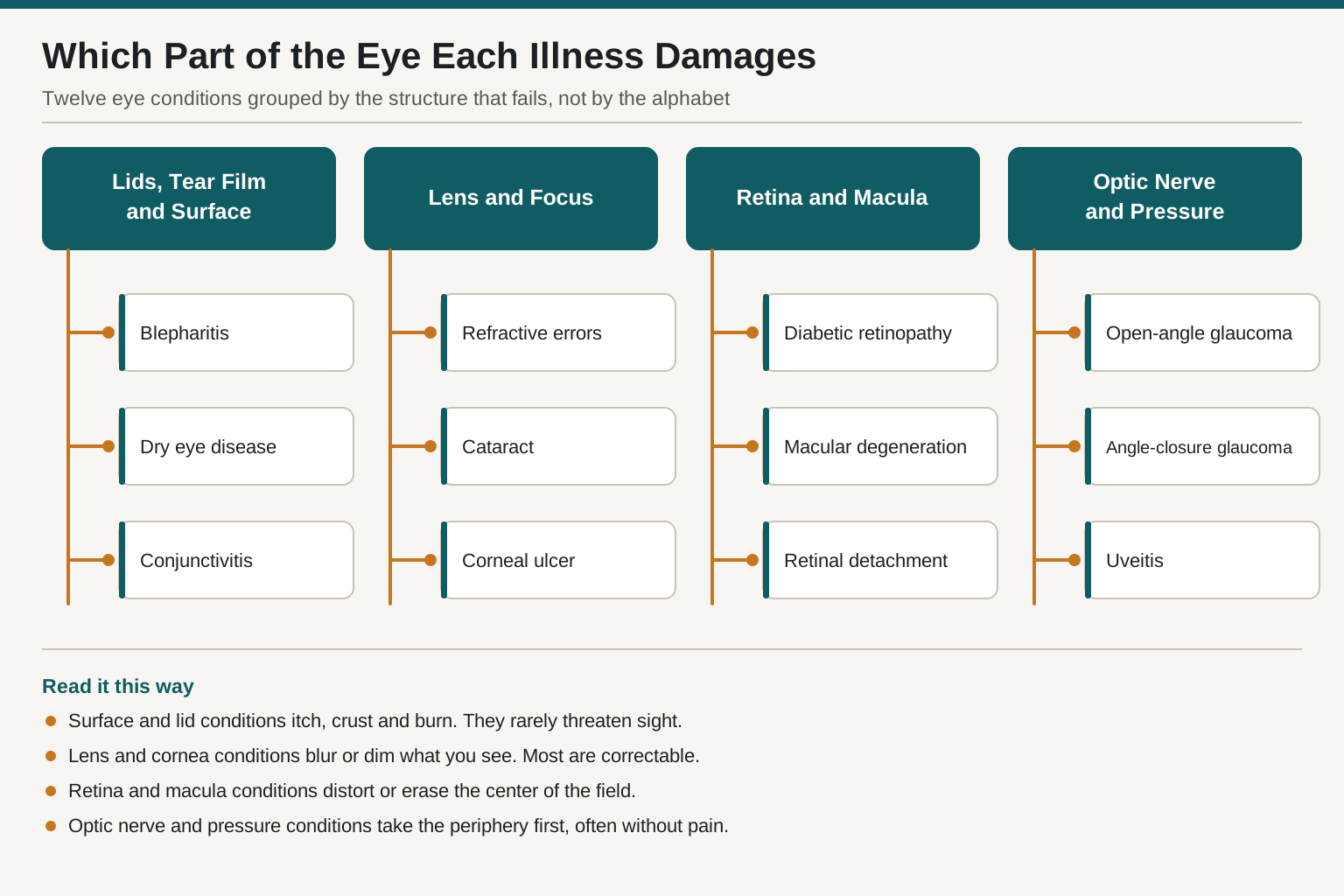
An eye illness is any disease of the eye, eyelid, tear film, optic nerve or visual pathway, and this list sorts them by the structure they damage. A clinical index runs to roughly 40 named entries, from a blocked eyelid oil gland to a retina peeling away from its blood supply.
Anatomy sorts better than the alphabet. A lid-margin problem itches and crusts. A lens problem dims and yellows. An optic nerve problem takes peripheral field quietly and painlessly. Once you know which structure is involved, the symptom points at the shelf instead of sending you through 40 entries.
The vocabulary gap costs people days. Clinicians write ocular disease and code by structure, while searchers type disorder eyes, eye conditions or eye diseases and land on an alphabetical sweep with no triage attached. an optometry association index of eye and vision conditions covers the full sweep, and the ordering is exactly wrong for something that started this morning.
Cosmetic and medical blur at the eyelid. Shadowing and puffiness under the eye are skin thickness, pigment and fat-pad anatomy rather than ocular disease, so what a dark circle cream can actually fade is a different question from whether the eye itself is inflamed. That boundary is why this eye illness list starts with anatomy.
Which Eye Symptoms Mean You Should See a Doctor?
See a clinician the same day for sudden vision loss, a curtain or shadow in your field, new flashes with floaters, halos, or eye pain with nausea. Those five eye symptoms separate damage from irritation, and every one of them has a mechanism behind it: retinal traction, a pressure spike, or inflammation inside the eye.
Speed of onset predicts risk better than discomfort does. A corneal scratch hurts enormously and heals in two days; open-angle glaucoma never hurts at all and takes 40 per cent of the optic nerve fibres before a field test flags it. Sort eye illness symptoms and eye ailments symptoms by how fast they arrived, not by how loud they are.
The slow half of the list gets missed. Night glare around headlights, colours washing toward beige, contrast fading so text needs more light, and a stubborn need to hold a phone further away are vision changes that arrive over months.
Single-eye losses are the hardest symptoms of vision problems to notice, because the other eye fills the gap seamlessly. Cover one eye for ten seconds, read a line of text, then swap — that thirty-second check catches eyesight issues that both-eyes-open vision hides for years. Eye issues symptoms and eye problems symptoms in one eye only always deserve an appointment.
Puffiness and watering without any change in acuity usually sit on the skin side of the ledger; under-eye bag treatment options address that, not the eye itself. Nothing here replaces an examination by an optometrist or ophthalmologist.
Which Are the Most Common Eye Problems?
The four most common eye problems are refractive error, dry eye disease, conjunctivitis and blepharitis, and all four are treatable without lasting damage when caught early. A four-entry eye problems list beats an alphabetical index here, because these four common eye conditions account for the large majority of optometry appointments that are not routine screening.
Because dry eye disease responds well to the right approach, it helps to see the dry eye treatment options compared before you settle on drops, plugs or in-office therapy.
Refractive errors
The eye focuses light in front of the retina (myopia), behind it (hyperopia), unevenly along one axis (astigmatism), or loses near focus with age (presbyopia). Blur is constant at one distance and clears instantly with the right lens. Cost: a new prescription every one to two years, and presbyopia keeps progressing until the mid-sixties regardless of what you buy.
Dry eye disease
The tear film breaks up too fast, usually because meibomian glands in the lid margin secrete thickened oil. It burns worse late in the day, in wind and air conditioning, and paradoxically makes eyes water. A warm compress held for ten minutes softens that oil; a five-second rinse does nothing. Drops manage it, they do not cure it.
Conjunctivitis (pink eye)
Inflammation of the clear membrane over the white of the eye, from virus, bacteria or allergen. Viral cases are watery, often start in one eye and stay contagious for up to two weeks. Bacterial cases produce yellow discharge that seals lashes overnight. Allergic cases itch fiercely and affect both eyes equally.
Blepharitis
Chronic inflammation of the lid margin, with flaking at the lash line, morning crusting and a gritty feeling. It is the most common eye illness that never fully resolves — it is managed, not cured. Clean the lash line daily with a low-surfactant cleanser on a soft cloth, working along the margin rather than scrubbing the lid. Skipping a week undoes about a month of progress.
Lid hygiene is only useful when the cleanser is mild enough to use every single day; a gentle cleanser that will not strip skin is the relevant standard for skin this thin. For how these eye problems are tracked at population scale, see the common eye disorders public health agencies track.

Which Eye Diseases Cause Permanent Vision Loss?
Cataract, open-angle glaucoma, age-related macular degeneration and diabetic retinopathy cause most of the world's blindness, and three of the four damage sight before you notice. These common eye diseases anchor any serious eye diseases list, and they are the four that belong at the top of a short 10 diseases of the eye roundup.
Cataract
The lens proteins clump and scatter light, so vision dims, yellows and glares at night. It is the single largest cause of blindness worldwide, with roughly 94 million people affected, and it is the one entry here that surgery fully reverses: the clouded lens comes out, an implant goes in. Act within months, not hours — but untreated cataract keeps thickening.
Open-angle glaucoma
Drainage slows, pressure rises and optic nerve fibres die from the periphery inward. Around 7.7 million people are blind from it. There is no pain and no early blur, which is why it is found on examination rather than reported by patients. Treatment holds the line; nerve fibres already lost never return.
Age-related macular degeneration
The macula, the few millimetres of retina handling reading and faces, degenerates. Straight lines bend, a grey patch settles in the centre, peripheral vision stays intact. About 8 million people have vision impairment from it. The wet form responds to injections given every four to twelve weeks — an ongoing commitment, not a one-off fix.
Diabetic retinopathy
High blood glucose damages retinal capillaries, which leak, close off, and then grow fragile new vessels that bleed. It is the leading cause of blindness in working-age adults in the United States and affects roughly 3.9 million people globally with vision impairment. Annual dilated screening catches it while laser and injections still work.
The global ranking of these vision diseases is set out in global causes of blindness and vision impairment. Trend data for the eye illnesses that cause blindness sits in the 2020 global study of avoidable blindness, which found blindness rates falling 15 per cent per head while absolute cases rose 11 per cent as populations aged. Cumulative ultraviolet exposure is one of the few shared risk levers across the eye diseases that cause loss of vision, and broad spectrum SPF label checks apply to the thin skin around the orbit as much as to the face.
Which Eye Conditions Need Same-Day Care?
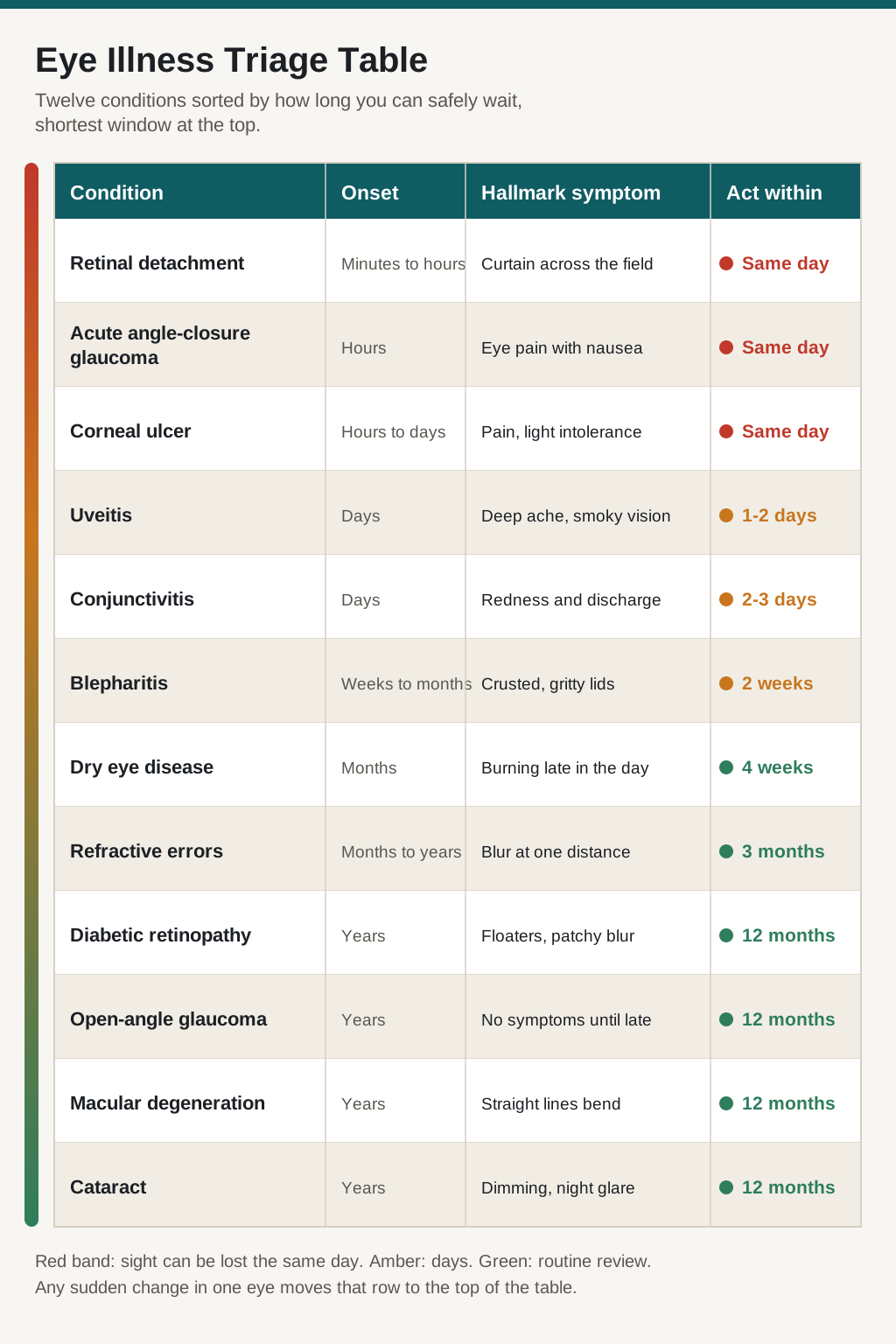
Retinal detachment, acute angle-closure glaucoma, corneal ulcer and uveitis are eye emergencies: each can cost permanent vision within hours to days without treatment. In a full list of eye disorders and diseases these four eye ailments sit scattered between B and U, which is why alphabetical indexes are dangerous for anyone in a hurry.
Retinal detachment
The retina separates from the wall of the eye. The warning sequence is a burst of new floaters, arcs of light in the peripheral field, then a grey curtain that advances across vision. Surgery within 24 hours of the macula detaching preserves far more acuity than surgery a week later. Act within hours.
Acute angle-closure glaucoma
The drainage angle closes abruptly and pressure can triple in an hour. The presentation is unmistakable: severe aching eye and brow pain, nausea or vomiting, rainbow halos around lights and a hard, red eye with a mid-dilated pupil. Optic nerve damage begins within hours. Emergency department, not a next-week appointment.
Corneal ulcer (keratitis)
An infected crater in the cornea, most often in contact lens wearers who slept in lenses or rinsed a case with tap water. Pain is sharp, light is intolerable, and a white spot may be visible on the cornea. Scarring across the visual axis is permanent. Same-day slit-lamp examination and cultured drops.
Uveitis
Inflammation inside the eye, often linked to autoimmune disease. Deep ache, extreme light sensitivity, redness concentrated around the iris and vision like looking through smoke. Untreated, it drives secondary glaucoma and cataract. It needs steroid drops on a tapering schedule within 24 to 48 hours, plus a search for the systemic cause.
Three things to do before you reach the clinic: take contact lenses out and leave them out, do not patch or bandage the eye, and do not rub it. If a chemical splashed in, irrigate with clean water for 15 minutes on the way. These vision issues justify an emergency department when no eye clinic can see you the same day, because every one of these eye conditions is measured in hours.
When Do Eye Symptoms Come From Your Skincare?
Eyelid itching, stinging and watering that starts within days of a new product is usually contact irritation from fragrance, retinoids or acids, not an eye disease. The eyelid is the thinnest skin on the body at roughly 0.5 mm, and it reacts to concentrations the cheek tolerates without complaint.
Three triggers account for most cases: fragrance and essential oils, which are classic contact allergens; retinoids, which migrate toward the lash line on the tear film hours after application; and acids applied close enough to the orbital rim to creep. Searching 10 diseases of the eye with pictures will not resolve any of them, because a contact-irritant reaction looks like mild conjunctivitis in every photograph.
Product-driven eye problems differ from the common ophthalmic problems a clinician diagnoses at the slit lamp in one testable way: they clear on withdrawal. Stop every eye-area product for two weeks, then reintroduce one item every four days and note the day symptoms return. Apply to the orbital bone, not the lid, and keep a full centimetre from the lash line. Timing and strength matter more than brand here, which is what retinol strength and safe layering rules covers. If puffiness rather than stinging is the complaint, how to judge a puffy eye cream sets out what a formula can and cannot change.
How Do Eye Exams Catch Disease Before Symptoms?
A dilated exam, tonometry, OCT scan and visual field test detect glaucoma, macular degeneration and diabetic retinopathy years before the first symptom reaches your vision. Each instrument answers a different question about eye diseases, and none of them substitutes for another.
A dilated fundus exam shows the retina and optic disc directly, catching haemorrhages and detachment risk. Tonometry measures intraocular pressure. An OCT scan images retinal layers to micrometre resolution, revealing macular thinning and fluid long before straight lines bend. A visual field test maps the blind spots that peripheral nerve loss carves out.
Cadence follows risk. Every two years is the baseline for adults with no symptoms, moving to annual from roughly age 60. Anyone with diabetes, raised pressure, or a first-degree relative with glaucoma or macular degeneration needs a dilated exam every year from diagnosis.
Pressure alone is a poor screen. Normal-tension glaucoma damages the optic nerve at readings inside the normal range, so an ocular disease screening that stops at a pressure number misses it entirely — the optic nerve has to be imaged and the field mapped. A pressure check at an optician counter is a starting point, not a clearance for eye conditions of the nerve.
How Do You Lower Your Risk of Vision Loss?
Four habits carry most of the risk you can control: ultraviolet exposure, smoking, uncontrolled blood sugar and skipped eye exams. Smoking roughly doubles the risk of macular degeneration; every percentage point off long-term blood glucose lowers retinopathy risk measurably.
For ultraviolet load, wear lenses rated to block UV up to 400 nm — tint depth tells you nothing about that rating — and add a brimmed hat, which blocks light coming over the top of the frame. Sunscreen belongs on the orbital bone and the temples, stopping short of the lid margin where it stings.
Screen habits protect the tear film rather than the retina. Blink rate falls by around half during focused screen work, so every 20 minutes look 20 feet away for 20 seconds, and keep room humidity over 40 per cent. Around the eye, tolerance decides adherence, and choosing sunscreen for sensitive skin is the filter worth applying. Fold these steps into building a daily skin care routine rather than starting a separate one; a routine with fewer steps is the one that survives. None of it reverses existing damage, and none of it replaces the annual exam that catches eye diseases that cause loss of vision while they are still silent — or explains vision changes and new eye symptoms that have already arrived.
One practical eye-area check a week, if you want the habits without the product noise.
One eye-area skincare check a week. No product dumps.
Thanks — you're on the list.


