

A cream eyebag product works only when it matches the cause: caffeine at 1-3% drains morning fluid, peptides and retinol thicken thin eyelid skin over 12 weeks, and niacinamide fades pigment, with one 2025 six-week trial measuring a 47.9% drop in under eye hyperpigmentation. Hollows need filler, not cream.
What does a cream eyebag product actually do?
A cream eyebag product changes the skin over the bag, by holding water, calming inflammation and building collagen, but it cannot move the fat pad that creates the bulge. What you see in the mirror is one of four things stacked on top of each other: a pad of orbital fat that has pushed forward through a loosening septum, fluid that pooled overnight, melanin sitting in the skin, or a hollow at the tear trough that throws a shadow across the cheek.
A topical reaches the top 0.5 mm. That is enough to hold water in the stratum corneum, raise collagen density over three months, and lighten pigment. It is not enough to reposition fat or fill a hollow, and no ingredient list changes that.
Texture decides more than the label suggests. An ointment for puffy eyes is built on petrolatum or heavy esters: it seals water in for hours, which suits flaking, tight lids, but it carries a low active load and migrates toward the lash line while you sleep. A lotion or gel-cream absorbs in under a minute and can carry more water-soluble active, at the cost of a shorter hold.
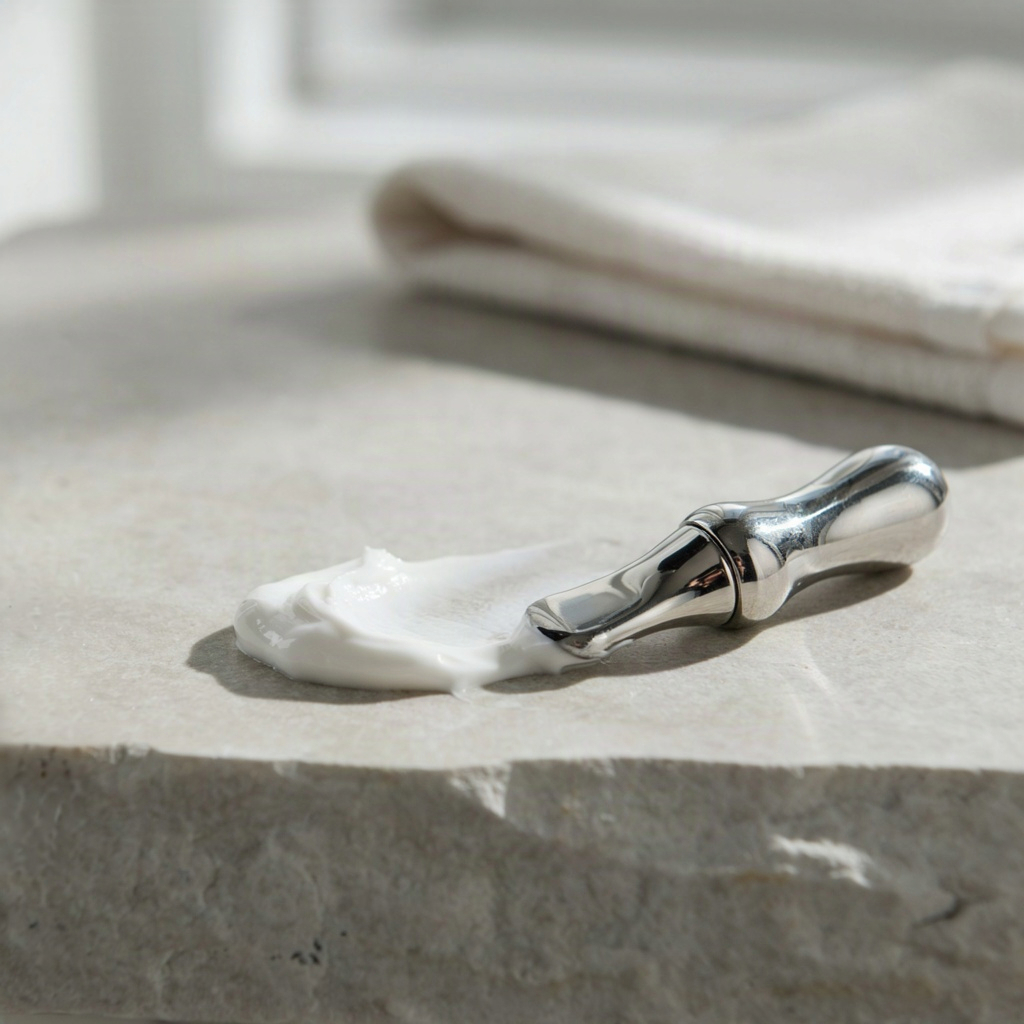
Eyelid skin runs about 0.5 mm thick against roughly 2 mm on the cheek, with fewer sebaceous glands and a thinner barrier. That single number explains why a face cream that feels fine on your jaw stings here, and why the fragrance that was invisible elsewhere turns into a red, scaly ring. For the wider picture on what shifts a lower lid, read under the eye bags treatment that actually works.
What causes eye bags, puffiness and dark circles?
Eye bags come from four separate mechanisms, fluid pooling overnight, orbital fat pushing forward, melanin pigment and blue vascular shadowing, and only the first and third respond to a cream. Sorting yours takes about thirty seconds and saves you a year of buying the wrong thing.
Fluid is the reversible one. Lying flat for seven hours lets interstitial fluid settle in the loose tissue of the lower lid; a salty dinner, alcohol or an allergy flare raises the volume. The swelling peaks within an hour of waking and falls through the morning as you stand upright and the lymphatics drain. If your reflection at 7 a.m. and 11 a.m. look different, that is fluid.
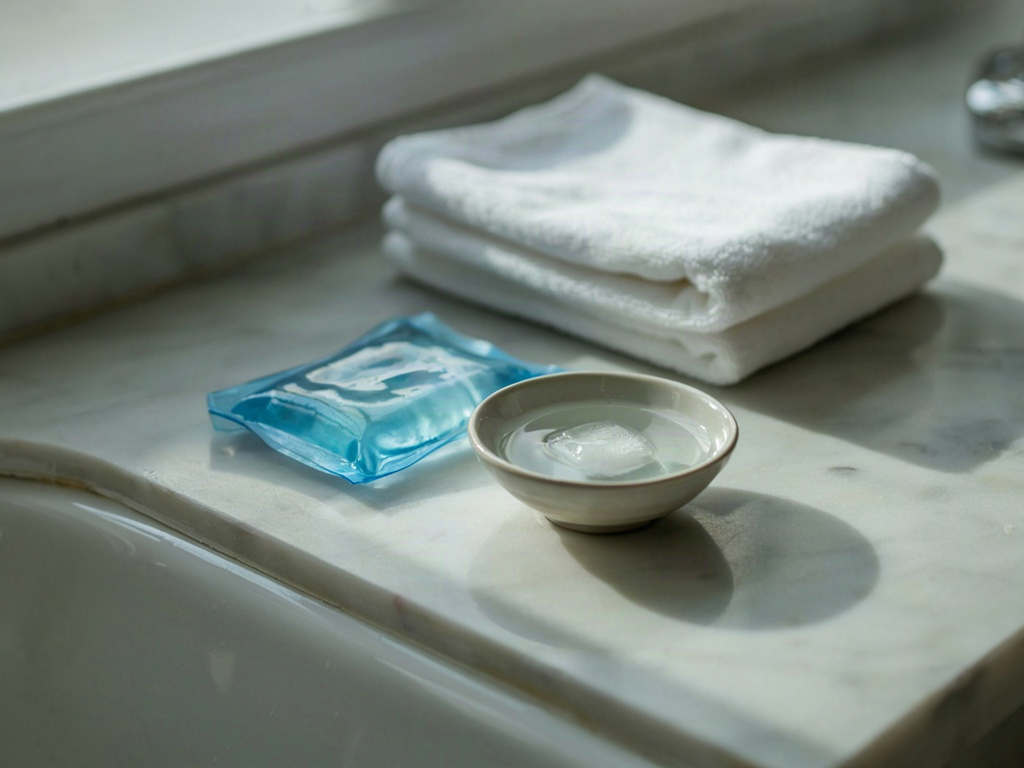
Orbital fat is the fixed one. The orbital septum weakens with age and the fat behind it herniates forward, producing a bulge that looks identical at breakfast and at midnight. Pigment is usually constitutional or post-inflammatory, common in medium and deeper skin tones, and it darkens with sun and with rubbing. Vascular shadowing is the blue-grey cast of the underlying venous plexus showing through skin that has thinned, which is why it deepens when you are tired and dehydrated.
Run the mirror test before you shop. Press gently under the eye: if the darkness lifts, it is vascular. Stretch the skin sideways: if the color stays, it is pigment. Tilt your chin down under a ceiling light: a shadow that appears only in top light is a hollow, not a stain. Choosing an eye cream for eye bags starts here, because under eye puffiness products are formulated for fluid and pigment. They do nothing for herniated fat, and nothing for a tear trough hollow, and a formula sold on all four claims is diluted across all four. For the mechanism in clinical detail, see a dermatology review of what causes infraorbital dark circles.
Pigment has its own playbook, and it is a slower one: how to choose the best circle eye cream.
Which actives belong in a good eye cream for dark circles and puffiness?
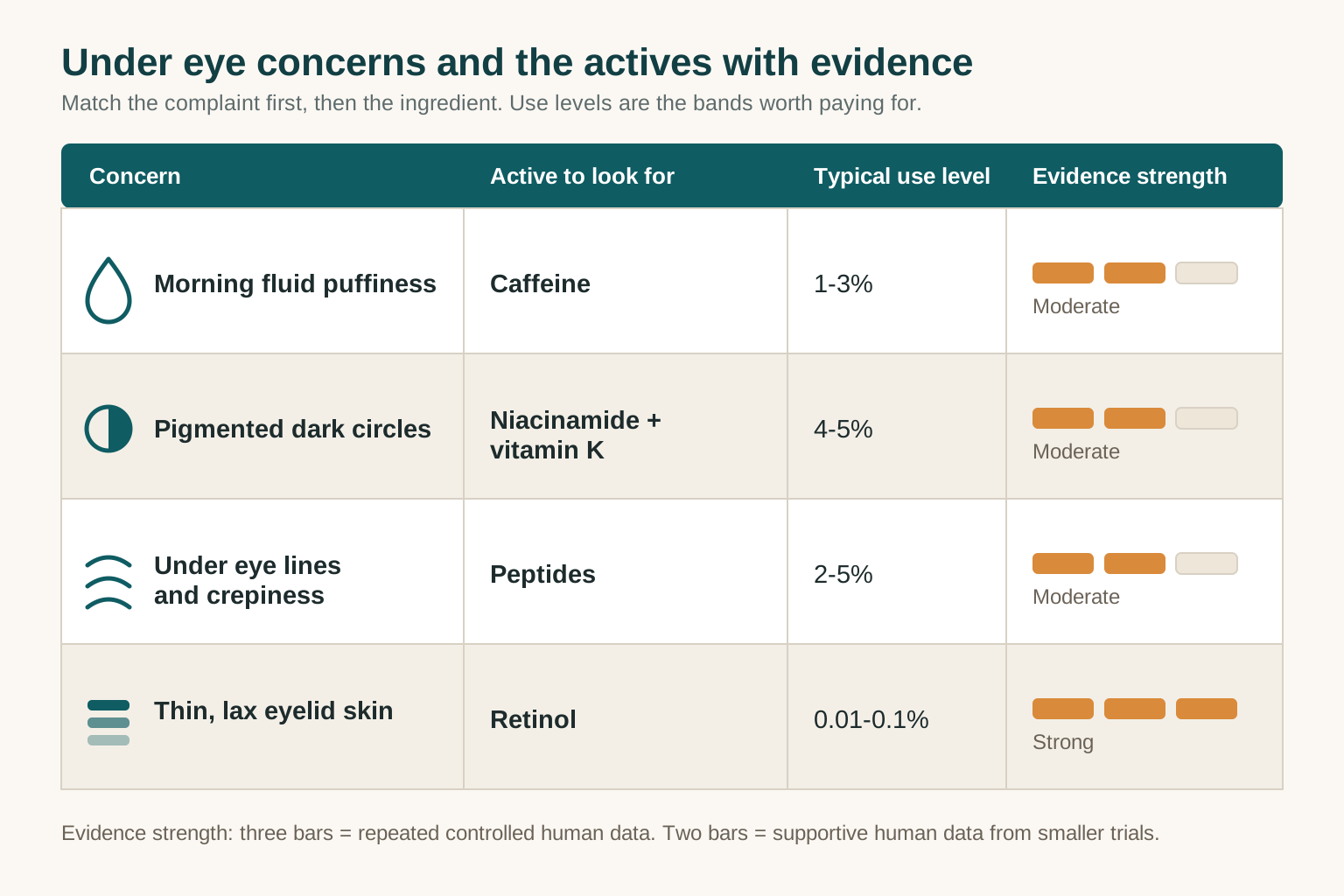
Four actives carry real published evidence for the under eye area: caffeine for fluid, peptides for lines, retinol for skin thickness and niacinamide with vitamin K for pigment. Everything else on a puffy eye cream carton is vehicle, humectant or marketing, and cosmeceutical reviews of the periorbital area keep landing on this same short list: the evidence behind caffeine and peptides on eyelid skin.
Caffeine at 1-3%, high on the INCI list
Caffeine constricts superficial vessels and stimulates lipolysis, shifting fluid and softening the blue cast for a few hours. A best depuffing eye cream uses roughly 1 to 3 percent, which in practice means caffeine sits in the first third of the ingredient list. The limitation is honest: the effect resets overnight, so this is a morning tool, not a cure, and it does nothing for a hollow.
Peptides for under eye lines
Signal peptides such as palmitoyl pentapeptide and copper tripeptide tell fibroblasts to lay down collagen, typically at 2 to 5 percent of a finished formula. That makes peptides the realistic route for an under eye lines cream: they build structure without the irritation budget retinol demands. They are slow, though, and do nothing for fluid on the morning you start.
Retinol dosed for thin eyelid skin
Retinol has the strongest evidence for thickening thin, lax lid skin while fading pigment, which is why eye cream for dark circles and wrinkles formulas lean on it. The eye-area band is 0.01 to 0.1 percent, a tenth of what a face serum runs; going higher buys flaking rather than speed. Anyone pregnant, or mid-flare with eczema, should skip it. dermatologist guidance on starting retinol without irritation covers the ramp-up. The wider version of the same active is covered in our retinol serum guide to choosing and using retinol.
Niacinamide paired with vitamin K
Niacinamide at 4 to 5 percent interrupts melanosome transfer, and vitamin K supports clearance of extravasated blood pigment, so the pairing covers both brown and bruise-toned circles. A 2025 open-label study of a niacinamide-led formula measured a 47.9 percent reduction in under eye hyperpigmentation over six weeks of twice-daily use: a 2025 six-week trial measuring under eye pigment change. It is single-arm data, so treat the number as a ceiling, not a promise. Our niacinamide serum buying advice explains what a usable percentage looks like.
Two rules follow. A puffy eye cream is only as good as its lowest-dosed hero active, so read INCI position, not the front panel: anything listed after phenoxyethanol sits in tenths of a percent. And eye cream puffiness wrinkles claims stack four promises onto one 15 ml jar, which rarely doses any of them properly. Timeline: fluid in minutes, pigment in six weeks, an eye cream for puffy eyes working on texture in a full twelve.
We earn a commission on products bought through our links, at no cost to you.
Keep the four actives, their use levels and their layering rules on one printable page.
What should you check on the label and the packaging?
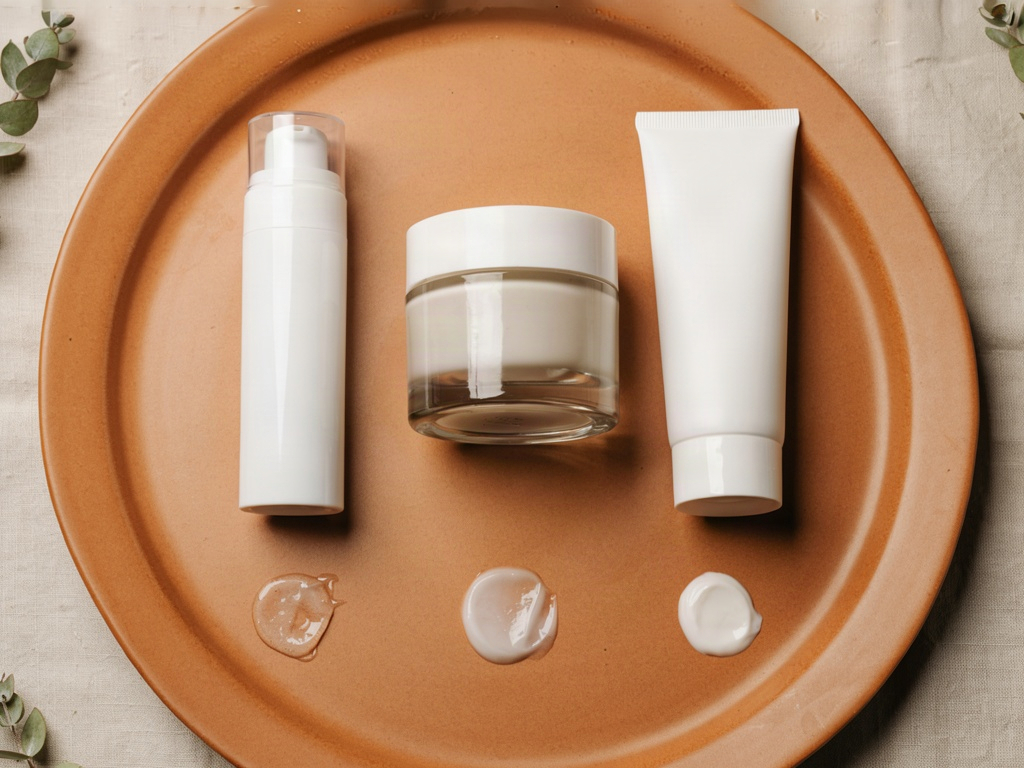
The label decides tolerance and the packaging decides potency: a fragrance-free base, an opaque airless container and a realistic 90-day window matter more than the front-panel claim. Roundups of the best rated eye cream for dark circles and puffiness rank by brand and by price, and top eye creams lists almost never print a concentration, so these three checks are what is left to judge on.
Fragrance-free and ophthalmologist-tested
Fragrance, essential oils such as limonene and linalool, and denatured alcohol are the three commonest triggers of eyelid dermatitis, and eyelid skin reacts at concentrations the rest of your face tolerates. "Unscented" is not the same claim: it can mean a masking fragrance was added. Look for "fragrance-free" plus an ingredient list with no parfum entry. "Ophthalmologist-tested" means the formula was assessed for tolerance near the eye; it is a safety signal, not an efficacy one, and it costs you nothing to insist on.
Airless pump or cooling metal tip
Retinol and vitamin C oxidize on contact with air and light. An airless pump in an opaque tube keeps a retinol usable to the last dose; an open jar you dip a finger into loses potency every morning and gains whatever is on your hands. A chilled metal applicator tip is not an active, but cold constricts vessels on contact and the ritual roughly doubles the odds you actually apply the product daily. The trade-off is cost: airless packaging adds a few dollars, and a metal tip is easy to lose.
A 90-day trial window before you judge
Give any formula 90 days before you decide. Collagen turnover sets the floor, so texture and fine-line change cannot show up faster no matter what the carton claims. Price per milliliter is the number that matters here, not the shelf price: a 15 ml jar used twice daily lasts about three months, which is exactly one trial. The best eye cream for puffy eyes dark circles is the one you finish, and the best eye cream to reduce puffiness is useless half-used at the back of a drawer.
Crepiness that has already set into folds is a different job, covered in our guide to an eye cream for creases and fine lines.
We earn a commission on products bought through our links, at no cost to you.
Eye cream or eye serum for bags under eyes?
Choose a serum when your lids are oily or milia-prone and you want a higher active dose; choose a cream when the skin is dry, crepey and loses water through the day. The two formats are not competing versions of the same product. They are different delivery systems with different jobs.
If your skin is dry and loses water across the whole face, not just under the eyes, see how to choose a hyaluronic acid moisturizer that actually seals the water in.
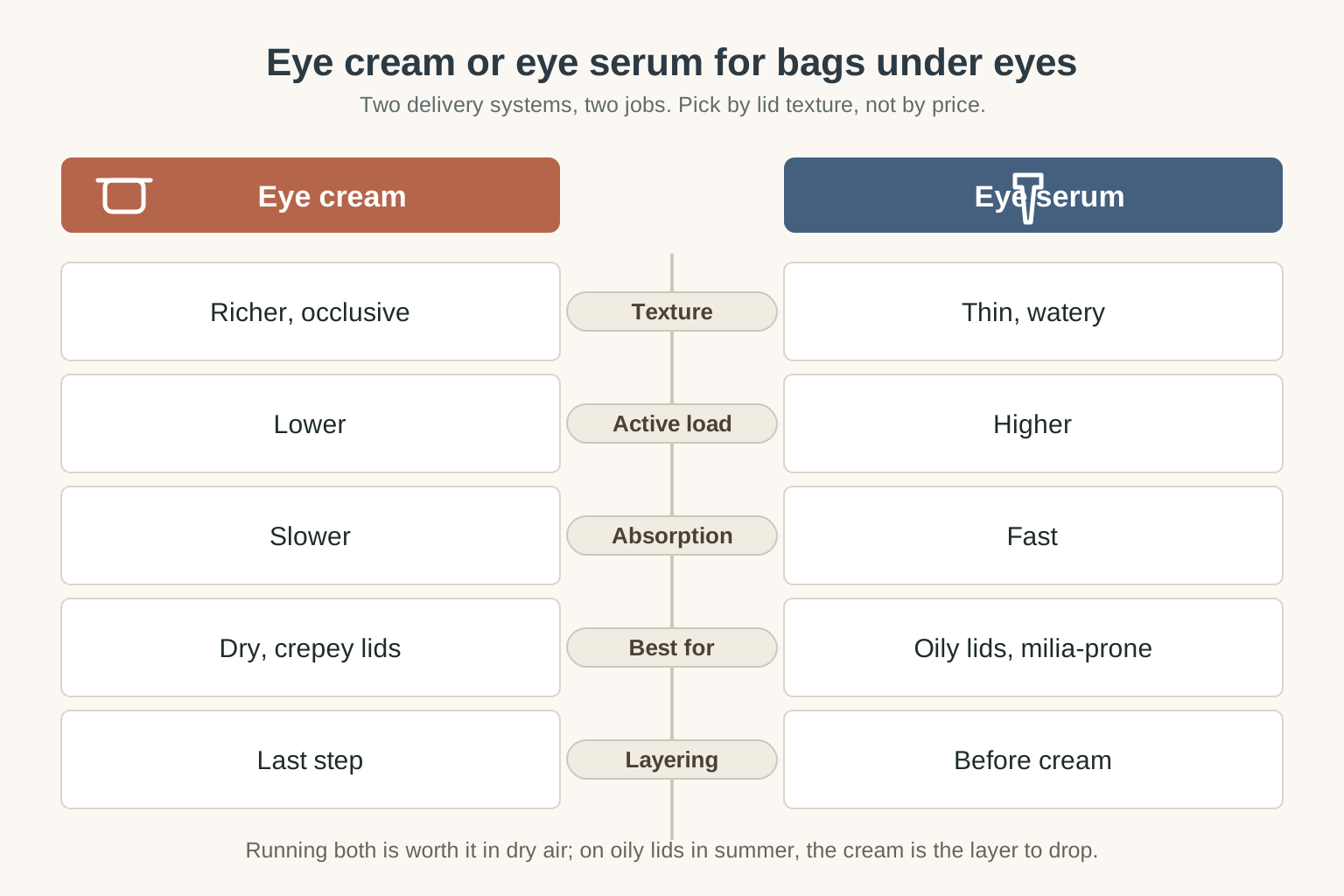
A serum is mostly water and humectant with a high active load and almost no occlusive, so it sinks in within a minute and leaves no film. That is why an eye serum for dark circles under eyes suits lids that already run oily, or that throw milia when anything rich sits on them. A cream carries emollients and occlusives that hold water in for hours, which is what dry, crepey skin needs and what a serum alone cannot do.
Layering order is simple: the best serum for under eye bags goes on first, onto clean skin, and the cream seals it. Running both is worth it in winter or in a dry office; in summer, on oily lids, the cream is the layer to drop. An eye cream for puffy eyes and dark circles that promises to replace both usually under-doses one of them, because a single base cannot be simultaneously thin enough to carry 5 percent niacinamide comfortably and rich enough to stop transepidermal water loss overnight. Pick the best product for dark circles and puffy eyes by your lid's texture and your climate, not by the price band.
Four questions narrow the shelf to three products matched to your own skin type, concern and budget.
We earn a commission on products bought through our links, at no cost to you.
How should you apply under eye products so they work?
Tap a rice-grain amount along the orbital bone with your ring finger, a centimeter below the lash line, caffeine in the morning and retinol two to three nights a week. Quantity and placement change the result more than the formula does, and both are free to fix.
Apply onto clean skin: if you wore mascara or liner that day, compare eye makeup remover formats and who they suit and lift the pigment off before you tap anything on.
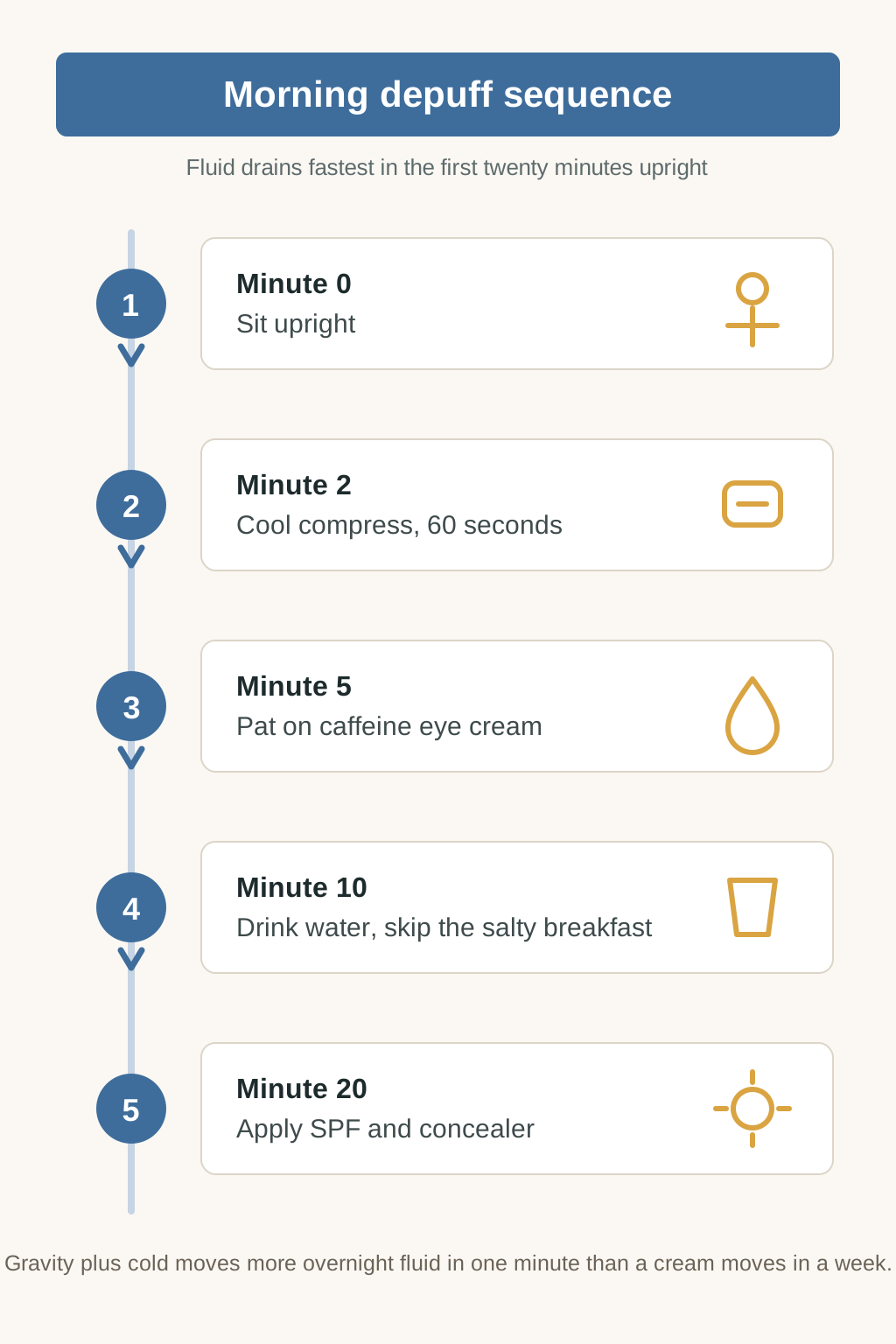
Use roughly a grain of rice per eye. The ring finger applies the least pressure of any digit, so it taps rather than drags; dragging stretches lax skin and can worsen the crepe you are treating. Stay a full centimeter below the lash line. Product applied closer migrates into the tear film overnight through the meibomian glands, which is a common cause of the morning swelling people blame on the cream itself.
Order matters. A face eye cream goes after water-based serums and before your moisturizer and SPF, so nothing occlusive blocks it and nothing acidic sits under it. Split the actives by time of day: caffeine in the morning when fluid is highest, retinol at night. Weave the retinol in slowly with a low-dose retinol eye product, two nights the first fortnight, three after that.
- Applying to damp skin under a heavy occlusive traps water and looks like puffiness by mid-morning.
- Using a face-strength retinol on the lid buys flaking, not speed.
- Switching formulas every three weeks means never completing a single collagen cycle.
The best eye depuffer is sequence plus temperature, not a separate gadget: sit upright, hold a chilled compress for sixty seconds, then apply. Cold plus gravity moves more fluid in that minute than most under eye products move in a week, and it costs nothing. Where each step belongs across the whole routine is set out in skincare order and what goes first.
Because those retinol nights are also when the rest of your face repairs, it helps to know how to pick the best night cream to layer around the orbital bone without creeping into your eyes.
When do eye bags need more than a baggy eye cream?
See a clinician when the bulge stays constant all day, the hollow casts a shadow in flat light, or the swelling is sudden, one-sided or painful. Those three signals mark the edge of what any topical can reach.
A bulge identical at 7 a.m. and 10 p.m. is herniated orbital fat. A shadow that persists when you stretch the skin and stays under diffuse light is volume loss at the tear trough. Lid skin that does not spring back within a second when pinched has lost elastic recoil. None of those change with a baggy eye cream, whatever the concentration.
What clinics offer maps onto those three findings: hyaluronic acid filler rebuilds the tear trough and lasts nine to eighteen months; radiofrequency or fractional laser tightens lax skin over three to six sessions; lower-lid blepharoplasty repositions or removes the fat pad and is the only durable answer to a true bag. Each costs real money and carries downtime, and filler placed badly in a thin lid leaves a visible blue tint.
Sudden, one-sided or painful swelling is a medical question, not a cosmetic one, and belongs with a doctor that same week — it can point to infection, thyroid eye disease or a kidney issue rather than sleep debt. In the meantime, sleeping with your head raised on an extra pillow, cutting evening sodium and treating an untreated allergy move the daily baseline further than upgrading from a $30 jar to a $90 one. Set the ceiling honestly: a good topical buys you smoother texture, a brighter tone and slightly thicker skin. It does not buy you a new lower lid.
One practical under eye tip a week, with the study behind it.
One under eye tip a week, backed by a study or skipped entirely.
Thanks — you're on the list.
Because sudden, one-sided or painful swelling can signal something beyond cosmetic puffiness, it helps to recognize the eye diseases and their symptoms that need an eye exam rather than a cream.


