

A lip mask is a leave-on occlusive treatment worn overnight or for 20 minutes that traps water in lip skin, which has no oil glands and a stratum corneum only three to five cell layers thick. The best lip mask for dry lips combines petrolatum or lanolin with humectants such as hyaluronic acid.
What Is a Lip Mask, and How Is It Different From a Lip Balm?
A lip mask is a thick leave-on treatment that seals lip skin under an occlusive film, unlike a lip balm you reapply every hour or two. The difference is dwell time and film thickness, not magic ingredients. A stick balm deposits a thin, waxy layer that gets eaten, licked, kissed and wiped away; a lip mask is dosed once and left to sit for hours.
Lip skin earns that treatment. The vermilion — the coloured part of the lip — carries no sebaceous glands and no sweat glands, so it produces none of the oil film that protects cheek skin. Its stratum corneum runs roughly three to five cell layers thick against about sixteen on the face. Thin barrier plus zero oil output means water escapes faster there than almost anywhere else on the body, which is why lips chap first in January and last in July.

A lip moisturizer mask sits between a balm and a plain ointment. It is heavier and wetter than a stick, usually a jar or squeeze tube of balm, butter or gel, and it holds a glossy film for six to eight hours instead of forty minutes. A pure ointment seals harder but feels greasy and carries almost no humectant; a mask trades some of that seal for slip and comfort.
Reach for a dry lip mask when reapplying balm has stopped keeping up — when lips flake by mid-morning, split at the corners, or sting under lipstick. If a single morning application still carries you to dinner, you do not need a mask; you need a better daytime stick. For that job, start with our dermatologist-approved chapstick for dry lips and save the mask for nights when lips are genuinely damaged.
Why Does an Overnight Lip Mask Beat Daytime Reapplication?
Overnight works because lips lose water fastest during sleep, and an uninterrupted seven-hour seal gives occlusives time that daytime reapplication never matches. Transepidermal water loss rises through the night across all skin, and lips have no oil film to slow it. A seal applied at 11 p.m. is still working at 6 a.m.
If daytime reapplication is still your fallback, run through the label checks for a lip balm for chapped lips so the balm you reach for actually seals between coats.
Compare the arithmetic. A daytime balm survives perhaps forty minutes of talking, drinking and eating, so holding a continuous film from 8 a.m. to 8 p.m. would take roughly eighteen applications, and almost nobody manages more than five. An overnight lip mask needs one application and then faces no coffee cup, no napkin and no lunch. Contact time, not concentration, is what rebuilds a chapped lip.
Formulation follows from that. A lip sleeping mask is deliberately tacky so it grips rather than transfers; a nighttime lip mask can afford a texture that would feel unwearable at a meeting. Expect some shine on a pale pillowcase in the first week, which washes out of cotton at 40°C. Satin and silk hold it longer and may need a pre-treat.
A night lip mask is not for everyone. Mouth breathers dry the film out from underneath and often wake with the centre of the lower lip still cracked; a humidifier does more for them than any jar. Anyone who has reacted to flavouring, menthol or cinnamon-type compounds should treat a flavoured mask as an eight-hour patch test they did not consent to, and pick an unflavoured formula instead.
Which Lip Mask Format Should You Choose?
Choose a balm-style jar for nightly repair, a hydrogel sheet for a twenty-minute rescue, and an ointment tube for cracked corners and split skin. The five common formats separate cleanly once you score them on the four things that actually change your experience: how well they seal, how long they stay on, how much lands on the pillow, and what each use costs.
| Format | Occlusion | Wear time | Pillow mess | Cost per use |
|---|---|---|---|---|
| Balm-style sleeping mask | High | 6–8 hours | Moderate | Low |
| Hydrogel lip mask sheet | Medium | 15–20 minutes | None | High |
| Overnight ointment tube | Very high | 7–8 hours | High | Very low |
| Tinted gloss mask | Low | 2–4 hours | High | Medium |
| Daytime lip balm | Low | 30–60 minutes | None | Very low |
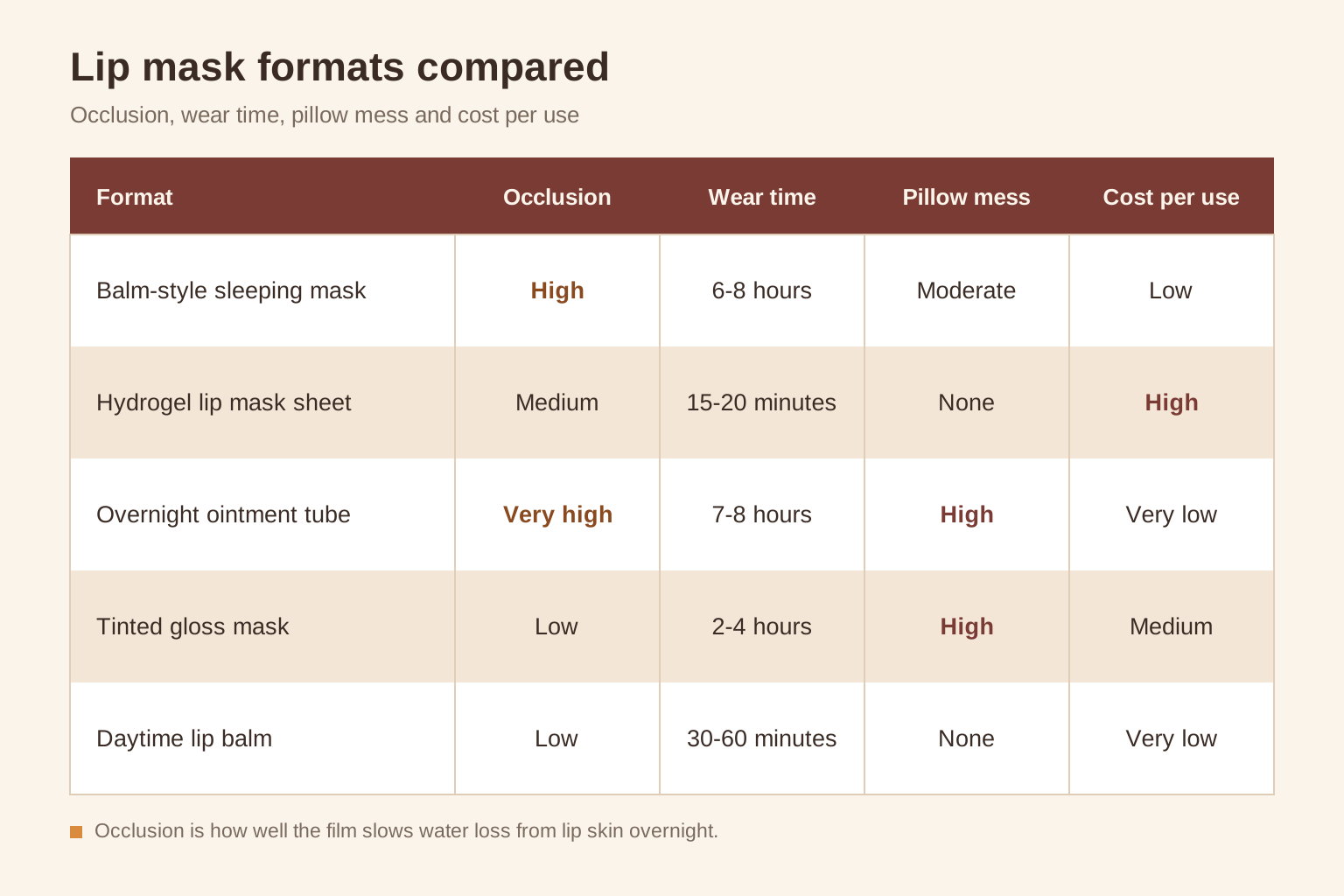
A lip mask sheet beats a jar exactly once: when you have twenty minutes and a photograph, a lipstick or an interview coming. The hydrogel patch holds a humectant-soaked film flat against the lip and floods the surface, but it seals nothing once removed, and single-use packaging makes it the most expensive option per wear. Keeping a hydrogel lip patch in the fridge is a sensible occasional tool, not a nightly habit.
Jar versus tube is a hygiene and dosing question. A jar lets you see and control the dose but invites fingers, so it collects skin flora over a three-month life; a tube or wand dispenses a consistent pea-sized amount and stays cleaner, at the cost of squeezing out too much when the tube is new. Match a hydrating lip mask to damage severity: an overnight lip treatment in ointment form for split corners, a balm jar for general flaking, a gel for simple tightness.
Humectant content is what stops a seal from feeling like wax. The same logic runs through facial hydration, and our hyaluronic acid serum buying checks covers how molecular weight changes what a humectant does.
Some product links in this guide are affiliate links, and a purchase may earn this site a commission at no extra cost to you.
Seven Checks Before You Buy the Best Lip Mask
Seven checks decide whether a lip mask repairs or simply sits there: occlusive base, humectant partner, fragrance load, texture, applicator hygiene, irritant actives and SPF placement. Run them against the ingredient list on the back of the box, in that order, and most of the shelf disqualifies itself in under a minute.
Check the occlusive base
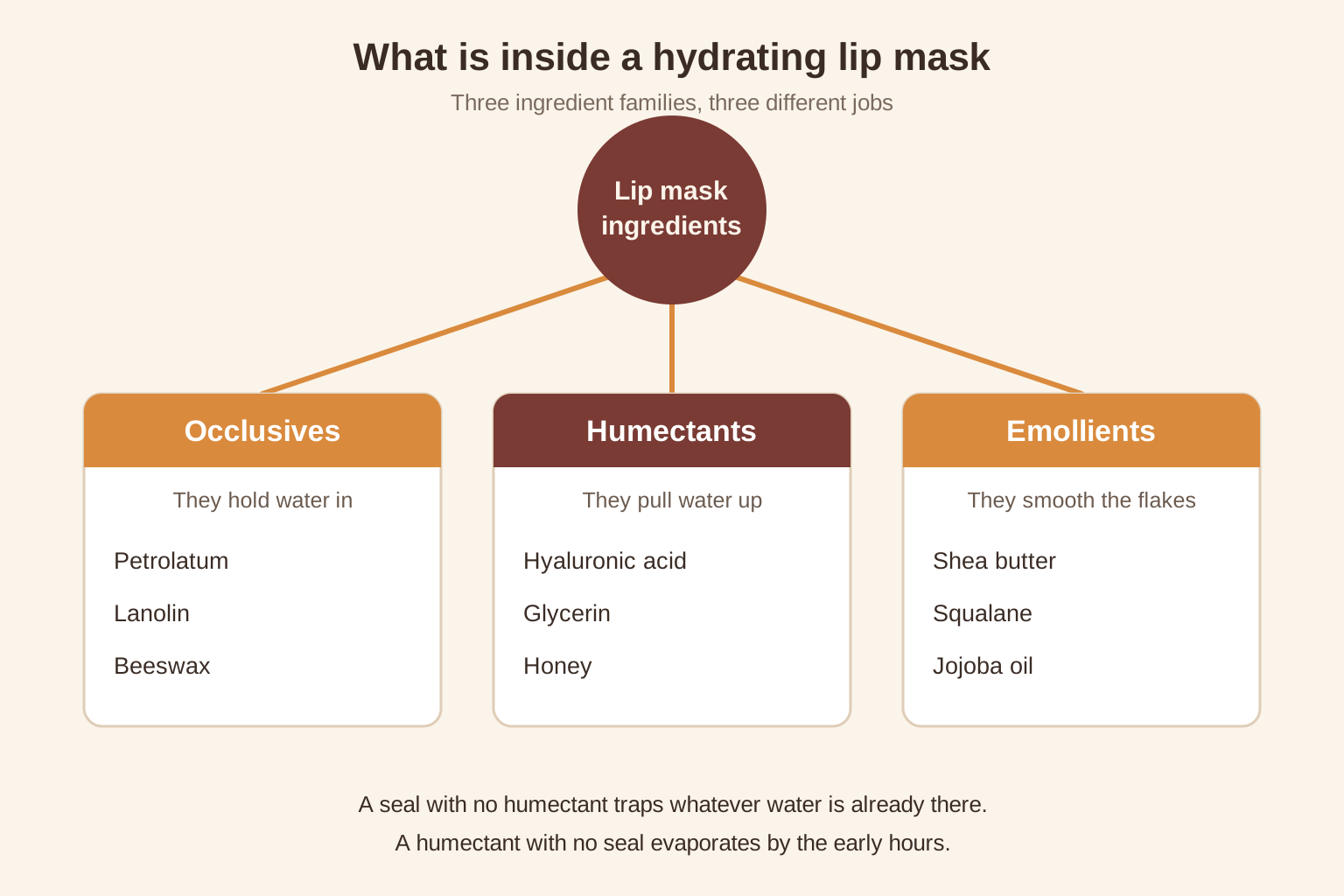
Look for petrolatum, lanolin, beeswax, candelilla wax or a heavy plant butter inside the first five ingredients. Petrolatum reduces water loss through skin by around 98 percent, which no botanical oil matches; lanolin is the runner-up and absorbs better. A formula whose first five ingredients are water, glycerin and extracts will feel pleasant and evaporate by 2 a.m.
Check for a humectant partner
A seal alone traps whatever water is already there. Glycerin, hyaluronic acid, sodium PCA or honey pull water up into the stratum corneum so the seal has something to hold. What separates good lip masks from sticky ones is that pairing, not a longer ingredient list — two well-chosen humectants beat eleven marketing extracts at 0.01 percent.
Check the fragrance and flavor load
Flavouring is the single most common cause of lip irritation, and an overnight mask gives it seven hours of occluded contact — the same conditions a dermatologist uses for a patch test. If a lip mask for dry lips stings on application, that is information, not "activation". Unflavoured formulas exist in every price band and cost nothing extra.
Check the texture and slip
Press a tester between finger and thumb and pull apart. A mask that strings and stays tacky will grip through the night; one that feels slick and silicone-smooth will migrate into the lip lines and onto the pillow within two hours. Tackiness is the trade: it works better and feels worse, and that is a fair deal after dark.
Check the applicator and jar hygiene
A jar dipped with a finger every night for three months becomes a warm culture medium, particularly if you have had a cold sore. Prefer a tube, a wand, or a jar you dose with a small metal or silicone spatula. Discard any lip product that changes smell, separates, or has been used during an active cold sore.
Check for menthol, camphor and phenol
These deliver a cooling tingle that reads as effectiveness and is actually mild irritation. Camphor and phenol are drying on a barrier already missing its oil layer, and salicylate flavourings add a second irritant. A mask that cools is the wrong tool for a lip that is already cracked; save those textures for a plumping product you wear for an hour.
Check where SPF belongs in your day
Sun protection belongs in the daytime half of your routine, not in the overnight jar. UV exposure is a primary driver of chronic lip chapping and of actinic cheilitis, so an SPF 30 stick used every morning does more preventive work than any night product. Our SPF lip balm sun protection guide explains which filters survive eating and drinking.
Check your shortlist against clinical guidance as well as marketing copy: dermatologist tips for healing chapped lips name the same irritants — menthol, camphor, phenol and flavouring — that these seven checks screen out.
Take the seven checks with you as a one-page ingredient sheet, sorted by whether your lips are chapped, dull or sensitive.
Best Lip Mask Picks for Three Common Lip Problems
Three picks cover the problems people actually bring to a lip mask: chapping and flaking, sensitivity and stinging, and overnight shine that survives a pillowcase. Each is scored on one rubric — seal strength first, irritant load second, dose control third, cost per night fourth — so the pick that wins on comfort can still lose on repair.

Some links in this roundup are affiliate links, and a purchase may earn this site a commission at no extra cost to you.
Compare the rubric against independent overnight lip mask reviews before buying, since testers who wear a product for a month catch transfer and separation problems that a single night hides.
Answer four questions and get a shortlist of three lip masks matched to your lips, texture tolerance and budget.
How Do You Apply a Lip Sleeping Mask at Night?
Soften with a gentle exfoliant, blot lips dry, apply a pea-sized amount just past the lip line with a clean spatula, then leave it undisturbed. Five steps, about ninety seconds, and the last one does most of the work.
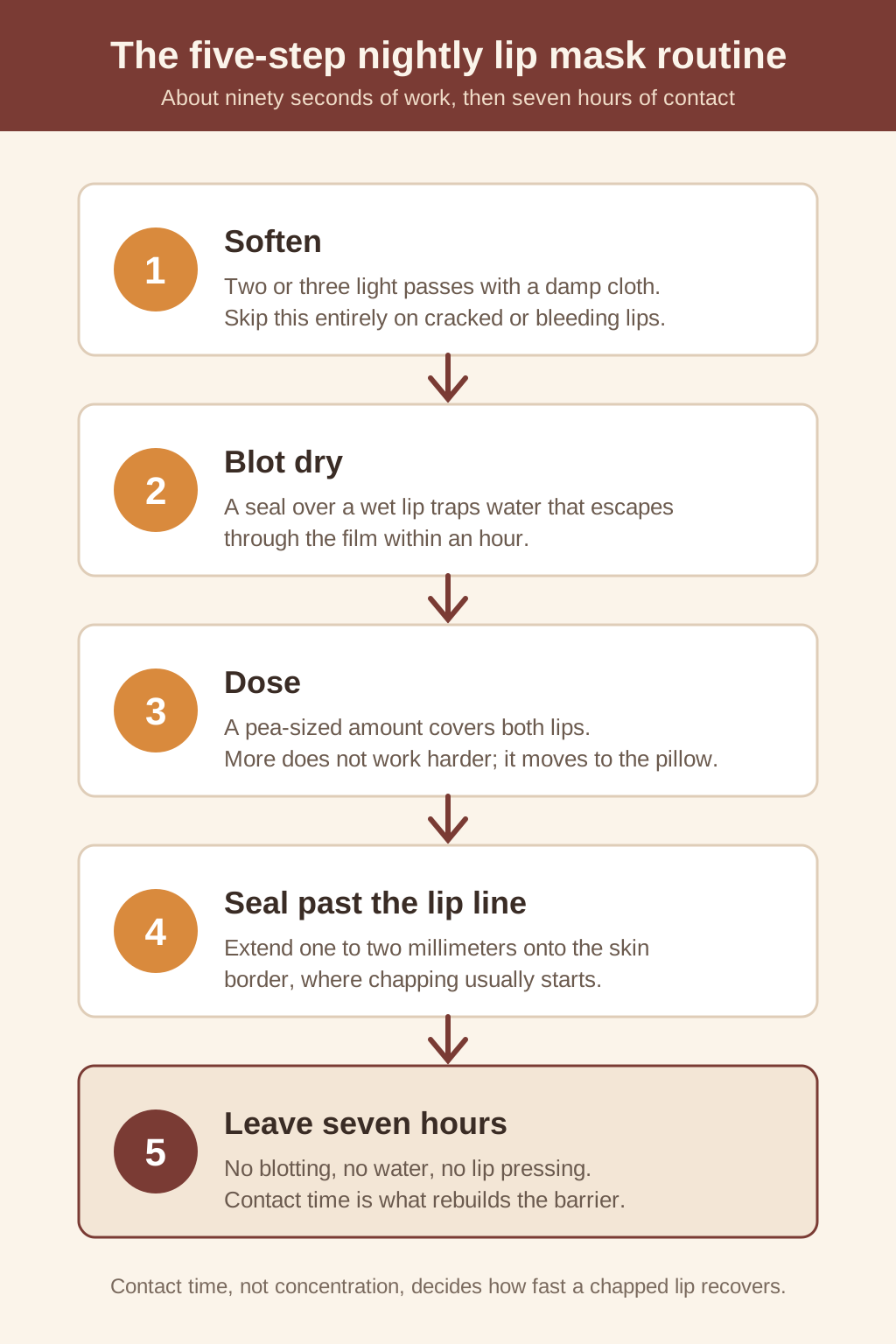
- Soften. Two or three light passes with a damp washcloth lift loose flakes. Skip this entirely on cracked or bleeding lips, where friction makes the split wider.
- Blot dry. An occlusive over a wet lip traps surface water that evaporates through the film within an hour. Dab with a tissue first.
- Dose. A pea-sized amount covers both lips. An intensive overnight lip treatment does not work harder in larger amounts; excess simply migrates onto the pillow.
- Seal past the lip line. Extend one to two millimetres onto the skin border, where chapping starts and most people stop applying.
- Leave it seven hours. No blotting, no water, no lip pressing. The film needs continuous contact.
A "lip sleeping mask nourish" claim describes the extracts, not the mechanism. Berry, shea or vitamin extracts sit at fractions of a percent; the petrolatum, lanolin or wax doing the sealing sits near the top of the list. Read the claim as flavour and marketing, and judge the product on its base.
Daytime is a different job. Carry a daytime lip balm and reapply after meals, because a night mask cannot cover the twelve hours you spend eating and talking.
If transfer bothers you, apply twenty minutes before bed so the film sets, and use a cotton pillowcase you can wash hot. For flakes that refuse to lift, our how to exfoliate lips without damage covers how much friction lip skin tolerates before it makes things worse.
Korean, Vegan and Watermelon Lip Masks: What Actually Differs?
Format, formula and scent are three separate choices: hydrogel versus balm, beeswax-free versus not, and fruit-scented versus unflavored. Shoppers often treat those three labels as competing products when they describe different axes entirely.
A korean lip mask usually means one of two formats: a single-use hydrogel patch, or the glossy balm jar that made the category mainstream. Both are format decisions. K-beauty formulas tend to lean on glossy, tacky textures with higher humectant loads and fruit scenting, which is a house style rather than a different mechanism of action.

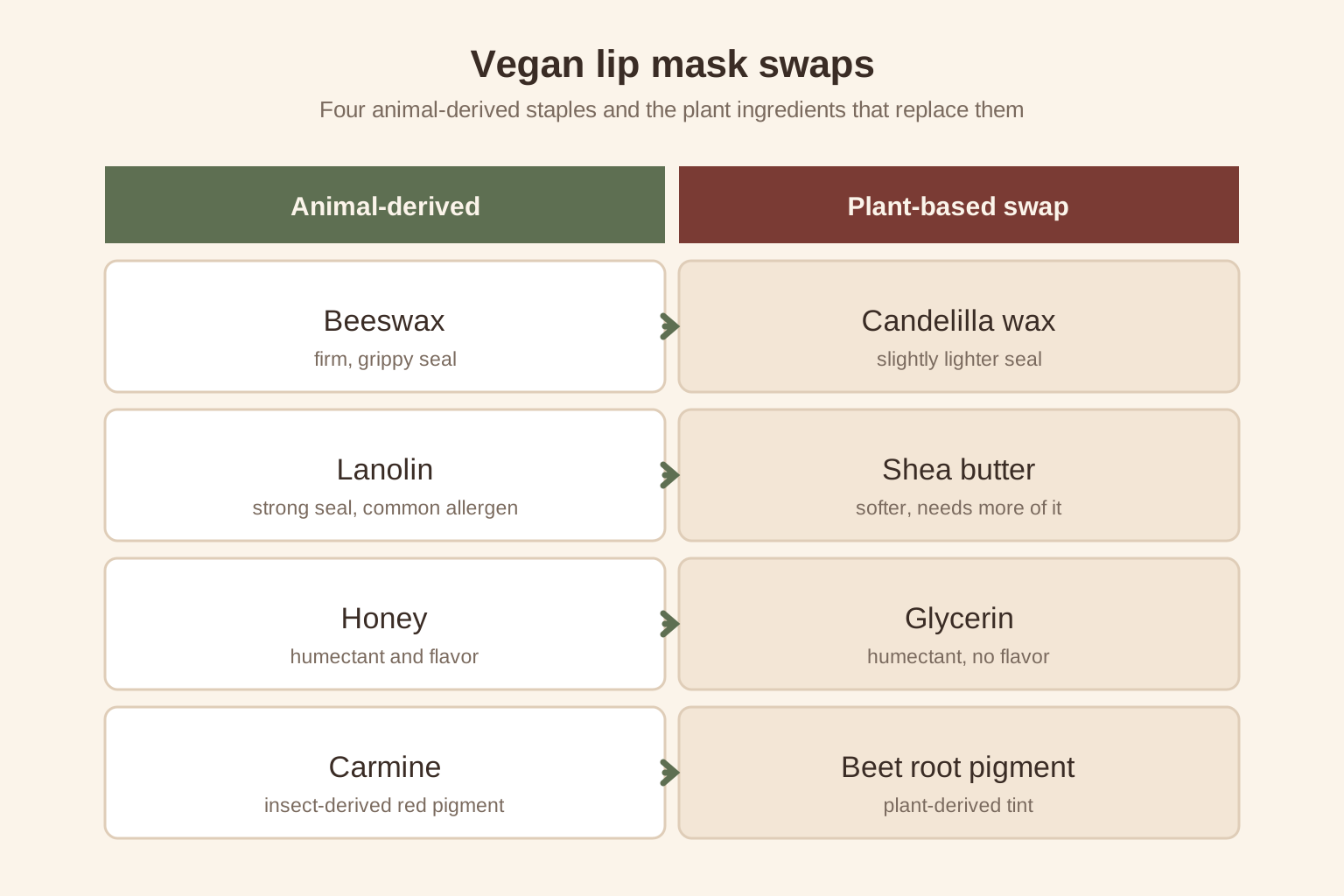
A vegan lip mask is a formula decision, and it comes down to four swaps: beeswax becomes candelilla wax, lanolin becomes shea butter, honey becomes glycerin, and carmine becomes beet root or iron oxide pigment. Candelilla seals slightly less than beeswax, so a vegan formula often compensates with a higher butter percentage and a thicker texture.
For brand-level checks on animal-derived ingredients, consult cruelty-free and vegan lip mask alternatives, since "cruelty-free" and "vegan" are separate claims that do not always travel together.

A watermelon lip mask is a scent and tint decision. No fruit extract hydrates a lip; the base does that, and the watermelon note simply makes the jar pleasant to use nightly, which matters more than it sounds when compliance decides the outcome. The trade-off is real: flavouring is the most common lip irritant, so scented versions are the wrong pick for reactive lips.
The search for the best laneige lip mask flavor is really a question about which scent someone will use every night, since the berry, vanilla and watermelon versions share one balm base. Pick the scent you will not get bored of, or skip scent entirely if your lips sting.
What Stops a Night Lip Mask From Working?
A lip mask fails when lips are licked, when bedroom air is dry, when the formula is flavored, or when the real problem is cheilitis. Each failure has a fix that costs less than another jar.
Licking is the biggest one. Saliva evaporates in seconds and carries amylase and lipase that degrade the lip's own barrier, so a lick-heavy habit can strip a film faster than any occlusive rebuilds it. Mouth breathing does the same thing all night. Bedroom humidity under about 30 percent dries the film from above; a humidifier at 40 to 50 percent is often the fix people skip.
Timescale is where overnight lip mask reviews mislead. A single-night verdict measures how a product feels, not what it repairs, because a damaged barrier needs roughly two to four weeks to normalise. Judge a mask on flaking and splitting at day fourteen, not on morning-after softness.
A laneige lip mask review, or any single review, is one data point from one person's lips and climate. Read a batch of them for patterns instead of verdicts: repeated reports of stinging, repeated mentions of transfer, repeated complaints about a scent change after reformulation. Those patterns predict your experience far better than a star rating does.
Some cracking is not chapping at all. Splits at the mouth corners that persist for weeks suggest angular cheilitis, which involves yeast or bacteria and needs a clinician; an itchy, scaling rash that appears after a new product suggests allergic contact cheilitis. Over-exfoliation causes its own version, which is why our sugar scrub recipes made at home caps scrub frequency. Clinical reviews of what lip licking does to the lip barrier set out how the habit turns a seasonal chap into a self-sustaining dermatitis.
How Do You Keep Results Once Your Lips Recover?
Taper to three nights a week once flaking stops, keep a daytime occlusive with SPF, and treat any relapse as a prompt to check triggers. A hydrating lip mask is a repair tool with a maintenance setting, not a product you need at full dose forever.
Daytime carries the preventive load: an SPF 30 lip stick reapplied after meals prevents the UV damage that starts the next chapping cycle. If flaking returns, audit before you add — a new toothpaste with sodium lauryl sulfate, a flavoured balm, a course of isotretinoin or a dry office are more likely culprits than an underperforming mask.
Keep lip care proportionate to the rest of your routine. A mask three nights a week and a daytime stick is a complete lip plan for most people; anything more competes for attention with steps that do more. If you are also chasing volume rather than repair, our lip plumpers that actually work separates temporary irritant plumping from genuine hydration, and building a skin care routine in order shows where a lip step fits without crowding the rest.
One practical tip a week, aimed at the routine you already have.
One lip and skin care tip a week. No product dumps.
Thanks — you're on the list.


