

Chemical sunscreen uses organic UV filters - avobenzone, octocrylene, homosalate, oxybenzone - that absorb ultraviolet energy and release it as heat. The FDA permits 17 sunscreen filters in the United States and has asked for more absorption data on twelve of them, yet no human study ties everyday chemical sunscreen use to disease.
What is chemical sunscreen, and how does chemical SPF work?
Chemical sunscreen uses organic carbon-based filters such as avobenzone and octocrylene that absorb ultraviolet photons and shed the energy as heat, which is why the film needs about 15 minutes to start working. Every one of those filters is built around a conjugated ring that accepts a photon, jumps to an excited state, then falls back and releases the difference as warmth far too small to feel on skin.
That 15-minute wait is not a marketing flourish. Pull on a shirt or get in the water before the film levels out and you drag it into fabric in patches, so the dose you measured stops matching the protection you get.
Single filters versus filter stacks
Chemical SPF reaches the shelf two ways. Single-filter formulas, usually homosalate or octinoxate, are cheap and handle UVB competently while leaving a long-wave UVA gap. Stacks of four to six filters, built around avobenzone with octocrylene holding it photostable, are what carry a defensible broad spectrum claim.
Three label words decide whether a bottle earns your money. Broad spectrum means the formula cleared a critical wavelength test at 370 nm or higher. Photostability describes whether a filter survives the energy it just absorbed instead of degrading in an hour. Percentage caps tell you how much of each active the FDA allows. Chemical sunscreens are not one product; the filter list is the product, and our broad spectrum label checks walk through each of those claims in label order.

Which filters show up in a chemical sunscreen ingredient list?
A chemical sunscreen label names its active filters with percentages, and in United States formulas those are usually avobenzone, octocrylene, homosalate, octisalate, octinoxate, oxybenzone and ensulizole. The percentage caps are fixed by monograph: avobenzone to 3%, octocrylene to 10%, homosalate to 15%, octisalate to 5%, octinoxate to 7.5%, oxybenzone to 6% and ensulizole to 4%.
Coverage splits sharply inside that list. Homosalate, octisalate and ensulizole are UVB workhorses with almost no UVA reach. Octinoxate adds a little short UVA. Avobenzone is the only monograph filter that covers UVA out to roughly 370 nm, and it degrades by about a third within an hour of sun unless octocrylene is formulated alongside it to absorb and dissipate that energy. That pairing is why you rarely see avobenzone travel alone.
The inactive half of the bottle
Chemical sunblock ingredients that sit under the active panel change the experience more than most people expect. Alcohol denat gives the fast, matte dry-down that oily skin likes and that dry skin finds stripping. Dimethicone and film formers buy water resistance for 40 or 80 minutes. Fragrance is the single most common contact allergen in sun care and buys nothing.
Suntan lotion ingredients follow a different brief again: heavier emollient oils, fewer filters, and frequently no UVA stabilizer, which is fine on a shoulder and congesting on a face. Worth watching is bemotrizinol, approved in 2026 as and photostable out to 400 nm, which closes the long-wave UVA gap the monograph list never did. Before any of that matters, check the number on the front, which our SPF numbers decoded breaks down in plain arithmetic.
Mineral sunscreen vs chemical sunscreen: what is the real difference?
Mineral sunscreen scatters and absorbs ultraviolet light with zinc oxide or titanium dioxide sitting on the surface, while chemical filters absorb it inside a thin film, which changes feel and tint far more than protection. Zinc oxide particles stay largely on the stratum corneum and are not measurably absorbed into blood; organic filters work from within the film itself, which is also why they are detectable in plasma after heavy use.
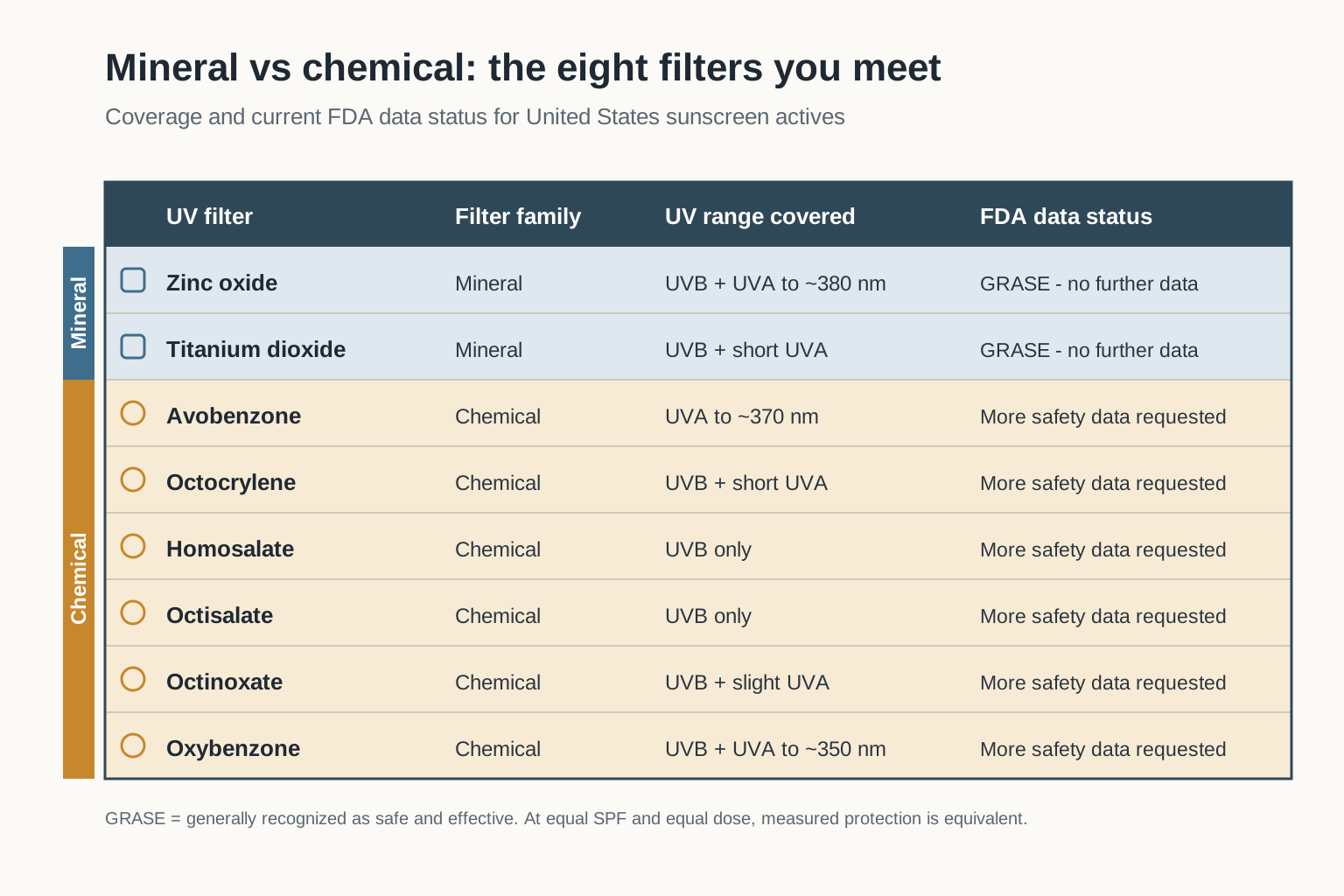
Put the eight filters you will actually meet side by side and physical vs chemical sunscreen stops being a slogan and becomes a shopping decision.
| UV filter | Filter family | UV range covered | FDA data status |
|---|---|---|---|
| Zinc oxide | Mineral | UVB and UVA to ~380 nm | GRASE, no further data requested |
| Titanium dioxide | Mineral | UVB, short UVA | GRASE, no further data requested |
| Avobenzone | Chemical | UVA to ~370 nm | Additional safety data requested |
| Octocrylene | Chemical | UVB, short UVA; stabilizes avobenzone | Additional safety data requested |
| Homosalate | Chemical | UVB only | Additional safety data requested |
| Octisalate | Chemical | UVB only | Additional safety data requested |
| Octinoxate | Chemical | UVB, slight short UVA | Additional safety data requested |
| Oxybenzone | Chemical | UVB and UVA to ~350 nm | Additional safety data requested |
What mineral versus chemical sunscreen changes day to day is finish, tint, water behavior, reapplication friction and cost per ounce. Mineral formulas run $2 to $4 more per ounce, leave a cast, and shed faster against a towel. Organic films go on clear, hold up in water, and need a 15-minute head start.
The chemical versus physical sunscreen protection myth is worth killing outright: at the same labeled SPF and the same 2 mg per square centimeter dose, measured protection is equivalent. Hybrids split the difference, pairing 5% to 10% zinc oxide with two or three organic filters for a sheer finish on reactive skin, and our guide to zinc oxide formulas covers how much zinc is worth paying for.
Are chemical sunscreens safe, or is sunscreen toxic?
The FDA still permits 17 sunscreen filters and calls chemical sunscreens safe to keep using, while requesting more absorption data on twelve of them, and no human study links everyday use to disease. The 2019 and 2020 maximal-use trials are the source of the headlines: oxybenzone, avobenzone, octocrylene and ecamsule all crossed 0.5 ng/mL in plasma after four days of whole-body application at full dose.
That number is a regulatory trigger, not a toxicity limit. Any compound detected above 0.5 ng/mL requires a nonclinical safety assessment before the agency will sign it off as generally recognized as safe and effective. Detection is the finding. Harm was not measured, and the agency told people to keep using sunscreen while the data is gathered. The same point runs through a CMAJ review of sunscreen efficacy and filter absorption .
What the oxybenzone argument actually rests on
Rodent studies that showed endocrine effects used oral doses orders of magnitude above human topical exposure; one widely cited estimate puts the gap at the equivalent of 277 years of daily sunscreen use. There is no human outcome data attached to it. Regulators in the United States, the European Union and Australia have all left oxybenzone on the approved list.
Weigh that against the other side of the ledger. The Nambour randomized trial in Queensland cut invasive melanoma incidence by about half over its follow-up, and squamous cell carcinoma incidence fell roughly 40% in the daily-sunscreen arm. Asking whether sunscreen is dangerous puts a hypothetical against a documented group-one carcinogen that reaches you every cloudless morning.
Beach-aisle formulas deserve a harder look before you accept that suntan lotion safe means protective: many carry two UVB filters, no UVA stabilizer and no printed critical wavelength, so the SPF number is honest while the UVA coverage is thin. If a formula stings or flushes your face, our sensitive skin picks start from tolerance instead of SPF.
Is there really a sunscreen that is bad for you?
No sunscreen sold in the United States is proven harmful, though PABA and trolamine salicylate were struck from the monograph, and the genuinely bad choice is the bottle that stays in the drawer. Those two filters are the honest answer for anyone asking whether sunblock is bad for you: PABA produced a high rate of contact and photocontact dermatitis, trolamine salicylate raised salicylate absorption concerns, and both were removed as not generally recognized as safe and effective.
The 2021 benzene recalls get misread constantly. Benzene is not and never was an approved sunscreen filter. It turned up as a contaminant in specific aerosol batches, traced to propellant supply, and the response was a batch recall rather than a filter ban.
What actually makes a formula wrong for your skin
Four things do the damage, and none of them is the filter family. Added fragrance, the top contact allergen in sun care. Alcohol content high enough to strip a compromised barrier. An SPF under 30, which collapses fast once you under-apply. A UVA gap, visible as a missing critical wavelength claim. A fifth is behavioral: a texture you dislike enough to skip.
So the practical routine beats a brand blacklist. Patch test a new formula on the jawline for three nights, check the active panel for one UVA filter, and read the inactives for fragrance before you commit. Treat whether chemical sunscreen is bad as a question about the individual formula, because the filter family is sound and the finishes are where the trouble lives. If you want a shortlist to start from, read choosing sunscreen that protects , and for pigment that doubles as a UVA barrier, tinted sun protection is the companion read.
Are mineral sunscreens better for sensitive and acne-prone skin?
Mineral sunscreens irritate reactive skin less because zinc oxide and titanium dioxide stay on the surface, but they leave a white cast and rub off faster, so better depends on your skin rather than on chemistry. Patch-test registries bear this out: zinc oxide and titanium dioxide almost never appear as contact allergens, while octocrylene and oxybenzone are the two filters dermatology clinics see implicated most often in photoallergic reactions.
The cost is real and worth stating plainly. Mineral sunscreen versus regular sunscreen means a visible cast on medium and deep skin, more drag during application, pilling under foundation, and faster removal by a towel or a sweaty hairline.
On acne-prone skin the filter is rarely the problem. Zinc oxide is mildly astringent and can calm an inflamed patch, but the thick occlusive vehicle it needs is what congests pores. A lightweight organic formula in a fluid base frequently breaks skin out less than a heavy mineral cream.
One vocabulary note saves confusion: physical and mineral describe the same two filters, and nano versus non-nano zinc changes the white cast and the texture, not the protection. For finishes that stay invisible, see mineral face SPF without white cast .

Physical sunblock vs chemical sunblock: which should you buy?
Pick physical sunblock when skin stings, flushes or is healing, and pick chemical SPF when you need a clear, sweat-resistant film that sits under makeup or survives swimming. The decision is situational, not moral, and five situations settle almost every case.
- Healing, laser-treated, rosacea-prone or stinging skin: mineral, for the thinner allergy record.
- Swimming, running, long heat: organic filters, which bond into a water-resistant film instead of sitting on top of sweat.
- Under foundation: organic or a sheer hybrid, because mineral grit pills under a brush.
- Deeper skin tones: tinted mineral or an untinted organic formula, never unpigmented zinc.
- Children under six months: shade and fabric first, mineral after that.
Wear time runs the other way from reputation. A surface film of zinc comes off on a towel, a shirt collar or a wet forearm faster than an absorbed organic film does, so physical SPF often needs the earlier touch-up even though it protects from the second it lands.
Where physical sunblock wins outright is that immediacy: full protection on application, no 15-minute wait, and no photostability question to worry about. For mixed needs, most people end up with two bottles rather than one compromise, which is exactly how our daily sunblock routine is built.
How much chemical sunscreen do you need, and how often should you reapply?
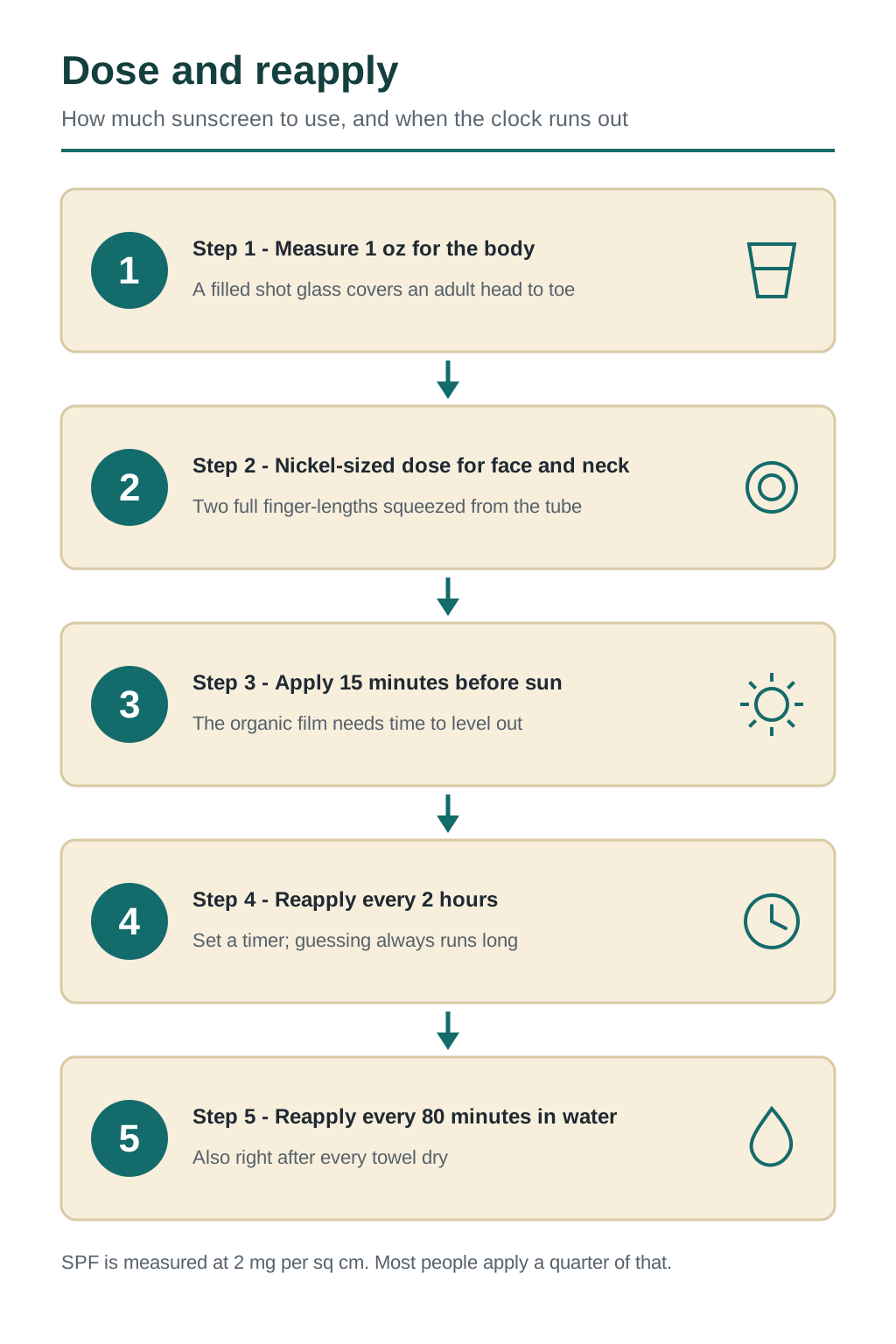
An adult needs roughly one ounce of sunscreen for the whole body and a nickel-sized amount for face and neck, reapplied every two hours and every 80 minutes in water. One ounce is a filled shot glass; the face shortcut is two full finger-lengths squeezed from the tube.
Under-dosing is where label numbers die. SPF is measured in the lab at 2 mg per square centimeter, and most people apply a quarter to a half of that, which drops an SPF 50 to something closer to the low teens in practice. Doubling your dose does more for you than doubling the SPF number. A dedicated body sunscreen in a large bottle makes a full ounce feel affordable instead of precious, and that is the whole trick.
Set the clock rather than guessing: every two hours of exposure, every 80 minutes in water or heavy sweat, and immediately after toweling. Sticks and tinted powders handle touch-ups over makeup. Lips and ears are the two most-missed sites, and lip balm UV defense closes the first of them. Heat degrades filters, so a bottle left in a hot car is a bottle to replace. The dose and timing match the FDA's own sunscreen dose and reapplication guidance . The chemical SPF debate matters far less than the habit: the bottle you actually reapply is the one that protects you.
One sun-protection fact a week, no product dumps.
One sun-protection fact a week. No product dumps.
Thanks — you're on the list.


