

Why face sunblock sunscreen is the step that pays off daily
Roughly 80% of the visible aging most people blame on genetics comes from ultraviolet exposure, and no serum reverses it as cheaply as a face sunblock sunscreen prevents it. Retinol repairs slowly and costs a nightly irritation budget; sunscreen simply stops the damage from being written in the first place. That makes it the highest-return single product in any spf skincare shelf.
UVA is the reason daily spf for face is not a summer-only habit. It stays roughly constant across the year, passes through cloud cover and through untreated window glass, which is why drivers accumulate more pigmentation on the side of the face that faces the door. An overcast commute still delivers a measurable dose.

The catch is behavioral. A sun protection lotion for face that pills under foundation, stings the eyes or leaves a grey film gets used for a week and then migrates to the back of a drawer, and a bottle you avoid protects nothing. Texture is a compliance feature, not a luxury.
This guide works through the parts that decide whether you wear it: how the two filter systems behave, which label claims are meaningful, what changes for reactive skin, how cast and tint interact with skin tone, and the dose and reapplication rhythm that gets you the protection printed on the tube. UV intensity also swings by several hours of the day, so it helps to know when UV rays are strongest before you plan a lunch break outdoors.
Chemical and mineral filters behind every broad spectrum sunblock face label
A lightweight chemical sunscreen uses organic molecules — avobenzone, octocrylene, and in newer formulas Tinosorb and Uvinul filters — that absorb UV photons and release the energy as a trivial amount of heat. Because the filters dissolve into the base, the film can be thin, clear and cosmetically invisible, which is why almost every sunscreen that disappears on skin is built this way.
Readers who would rather avoid organic filters entirely should see how to pick a safe sunscreen built on zinc oxide alone.
Mineral filters work differently. Zinc oxide and titanium dioxide sit largely at the surface, scattering and absorbing UV. Particle size decides the cast: coarse particles bounce visible light as well as UV and read as chalk, while micronised grades cut the cast but need higher loading to reach the same SPF. Zinc is also a poor sensitiser, which is why it dominates shortlists for reactive skin. If you want the full comparison, our guide to a mineral sunscreen for face that actually works covers the trade-offs formula by formula.
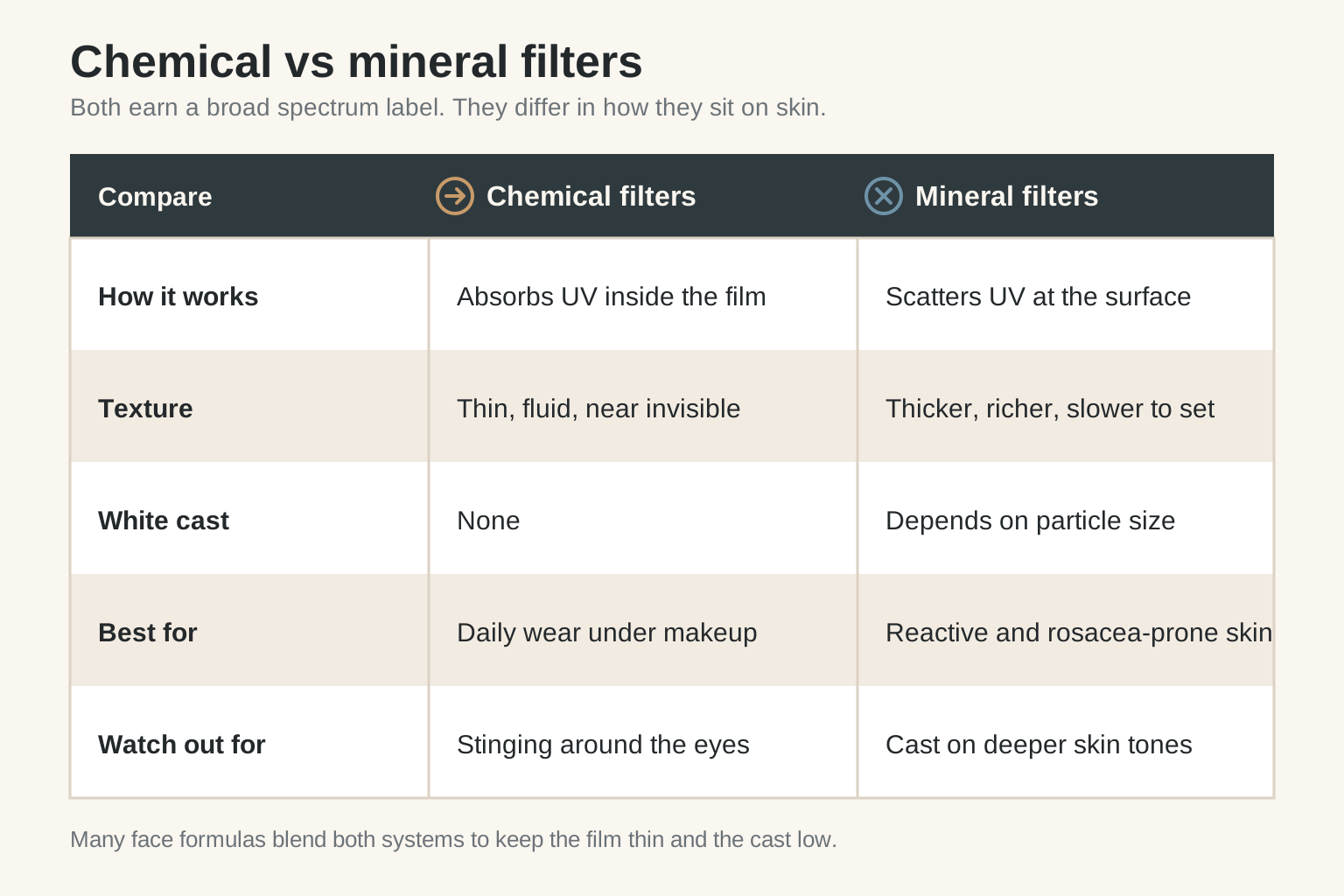
A broad spectrum sunscreen for face has passed a critical wavelength test, meaning its protection extends far enough into the UVA range to earn the claim. The SPF number alone tells you almost nothing about UVA: it is a sunburn measurement, and sunburn is mostly UVB. Two products can share SPF 50 and differ substantially in UVA cover, which is why the phrase on the front matters more than the digits. The the labeling rules behind broad spectrum claims spell out what a manufacturer has to prove before printing it.
One label myth is worth retiring. Facial sunblock and facial sunscreen are the same regulated category, sold under whichever word the marketing team preferred; "sunblock" does not mean total blocking, and any broad spectrum sunblock face formula still lets some UV through. The word on the tube tells you nothing about performance.
Whichever filter system a formula uses, the label is what proves the UVA side is covered, so run through these broad spectrum sunscreen label checks before you trust a bottle daily.
What separates a good face sunscreen from one you abandon
Start with the floor: SPF 30 daily, and a spf 50 sunscreen for face when you are outdoors for hours, near reflective water or snow, on photosensitising medication, or actively treating melasma. The jump from SPF 30 to 50 raises filtered UVB from about 97% to about 98%, which sounds trivial and matters mainly because most people apply too little — a higher label gives you headroom for imperfect application, at the cost of a slightly heavier film.

Finish claims need translating. A non greasy face sunscreen usually means the base leans on volatile silicones or alcohol that flash off and leave a dry-touch film; a non oily sunscreen for face often adds silica or starch to mop shine for two or three hours. Both trade slip for comfort, and on dry skin the same formula can feel tight by mid-afternoon.
A water based sunscreen for face — the light, watery essences popular in Asian formulations — layers more predictably under makeup because there is less film-former to roll up when a brush passes over it. Pilling is usually a mismatch between a silicone-heavy serum underneath and a water-based lotion on top, not a fault of either product.
Before you write off any face spf on a single wear, check three things on the back: fragrance high in the list, denatured alcohol in the first five ingredients, and heavy film formers that need a full minute to set. Give it three days and the right waiting time. It also helps to know what the SPF number really means, and dermatology bodies publish clear dermatologist criteria for selecting sunscreen that cut through the marketing.
Not sure which texture your skin will tolerate? Six questions, two minutes, and you get your skin type plus the finish that suits it.
Best facial sun creams by skin type and finish
One pick per skin type or concern, judged on three things only: how the film sits after twenty minutes, which filter system it uses, and whether reapplying it over the top is bearable. Rankings that ignore the third criterion recommend products people apply once and never again. Some links below are affiliate links; if you buy through them we may earn a commission, at no extra cost to you.
Two notes before you buy. The best lightweight sunscreen for face is whichever one you will reapply, so a top facial sunscreen you find sticky is the wrong pick even with the best lab data. And any light sunscreen for face only reaches its labelled figure at the full dose — spread a lightweight sunscreen for face thin and you land nearer a third of the number on the tube.
Best facial sunscreen for sensitive skin: fewer filters, fewer flare-ups
A facial sunscreen for sensitive skin usually lands on zinc oxide, no fragrance, no essential oils and a short preservative system. The logic is subtraction: fewer ingredients means fewer candidates when something goes wrong, and zinc is among the least sensitising filters available.
If zinc is the filter your skin tolerates, the percentage on the label and the particle size matter more than the brand, which is why it helps to know how to pick a zinc oxide sunscreen.

Test before you commit. Apply any candidate for the best face sunblock for sensitive skin to the same spot along the jaw for five consecutive days, then judge. A single patch test on the inner arm misses delayed reactions, and the jaw is thin-skinned enough to behave like the rest of the face.
Learn to tell stinging from allergy. Transient stinging usually appears within a minute, fades in ten and points to a compromised barrier or a low-pH layer underneath. True contact allergy shows up hours later as itch, defined redness and small bumps that persist. That distinction saves you from discarding half the best facial sunscreens for sensitive skin over a barrier problem you can fix with a bland moisturizer for a week.
Rosacea-prone skin and post-procedure skin end up on the same shortlist as the best face sunscreens for sensitive skin, because both react to heat and to friction as much as to ingredients: press the product on, do not rub it. See our fuller roundup of the best sunscreen for sensitive skin for the specifics, and the background on how mineral and chemical filters differ on reactive skin.
In practice the best sunblock for sensitive face is the boring one that stays on for eight hours without rebound redness. If a product performs beautifully for two hours and then makes you flush, it has failed the only test that counts.
White cast, tint and the myth of sunscreen for white skin
Cast is physics, not demographics. It comes from mineral particle size and pigment load scattering visible light along with UV, so a formula that looks invisible on fair skin can look ashy on deep skin. That makes sunscreen for white skin a marketing frame rather than a formulation category: the same tube behaves differently on different tones because of how the film reflects light, and nothing about the filters is tone-specific.
Iron oxide tints solve the problem twice over. Pigment cancels the grey veil, and iron oxides also absorb visible light and near-infrared, which measurably reduces pigment worsening in melasma and post-inflammatory marks — the one situation where a tinted facial sunscreen outperforms an untinted one with identical SPF.
Camera flash exposes the difference fastest. Photograph an untinted mineral layer on deep skin and the veil shows as a grey overlay; on fair skin the same film reads as a slight matte finish, which is why reviews split so sharply on the same product. Our tinted sunscreen buying guide lists which shade ranges actually cover deeper tones.
A tinted sunblock for face can replace foundation when you want evenness rather than coverage, and cannot when you need to conceal acne marks or want a shade match at the jawline — most tinted SPFs ship in three to six shades against a foundation range of thirty.
Some links below are affiliate links; if you buy through them we may earn a commission, at no extra cost to you.
How much lightweight spf to apply, and when to reapply it
SPF is tested at 2 mg per square centimetre. For a face that is about a third of a teaspoon; for face, neck and ears, a level teaspoon. The practical version is the two-finger rule: squeeze a line along the length of your index and middle fingers and use all of it. Most people apply between a quarter and half of that, which is why a lightweight spf on the shelf becomes something closer to SPF 15 on the skin.
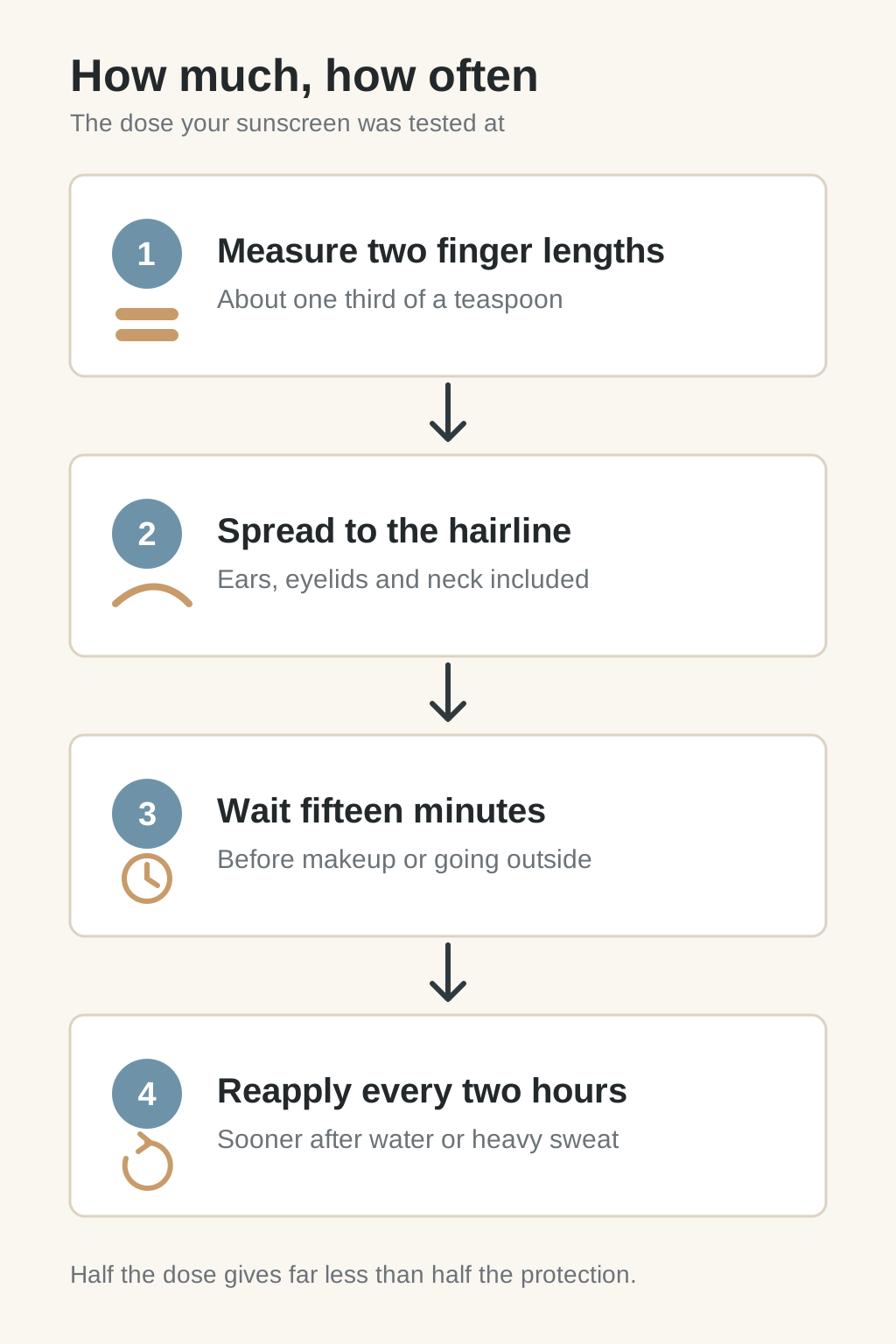
Outdoors, reapply every two hours, and after 40 or 80 minutes in water or heavy sweat depending on the water-resistance claim. A desk-bound day is different: if you leave the building twice, one top-up before the afternoon walk does more than four ritual reapplications you resent. The published guidance on how much sunscreen an adult actually needs is the reference point.
Over makeup, each method costs something. A stick delivers the closest thing to a real dose but drags foundation; a powder is comfortable and almost never applied thickly enough to count; a mist is the easiest to underapply of the three, so treat it as a partial top-up rather than a fresh layer. Keeping a small tube of face sunscreen in a bag makes the two-hour rule realistic on days out.
Underapplication is the reason a good everyday sunscreen for face disappoints. Protection does not fall linearly with dose: halve the amount and you lose far more than half the benefit, so the fix is almost never a higher number on the label — it is more product from the tube you already own.
Not sure how much you need today, or how often to top up?
Fitting daily spf for face into the routine you already follow
Sunscreen goes last in the morning spf skincare order: cleanse, treat, moisturize, then sunscreen, then makeup. Nothing hydrating goes on top of it, because a cream applied over the film disturbs the even layer the filters depend on.
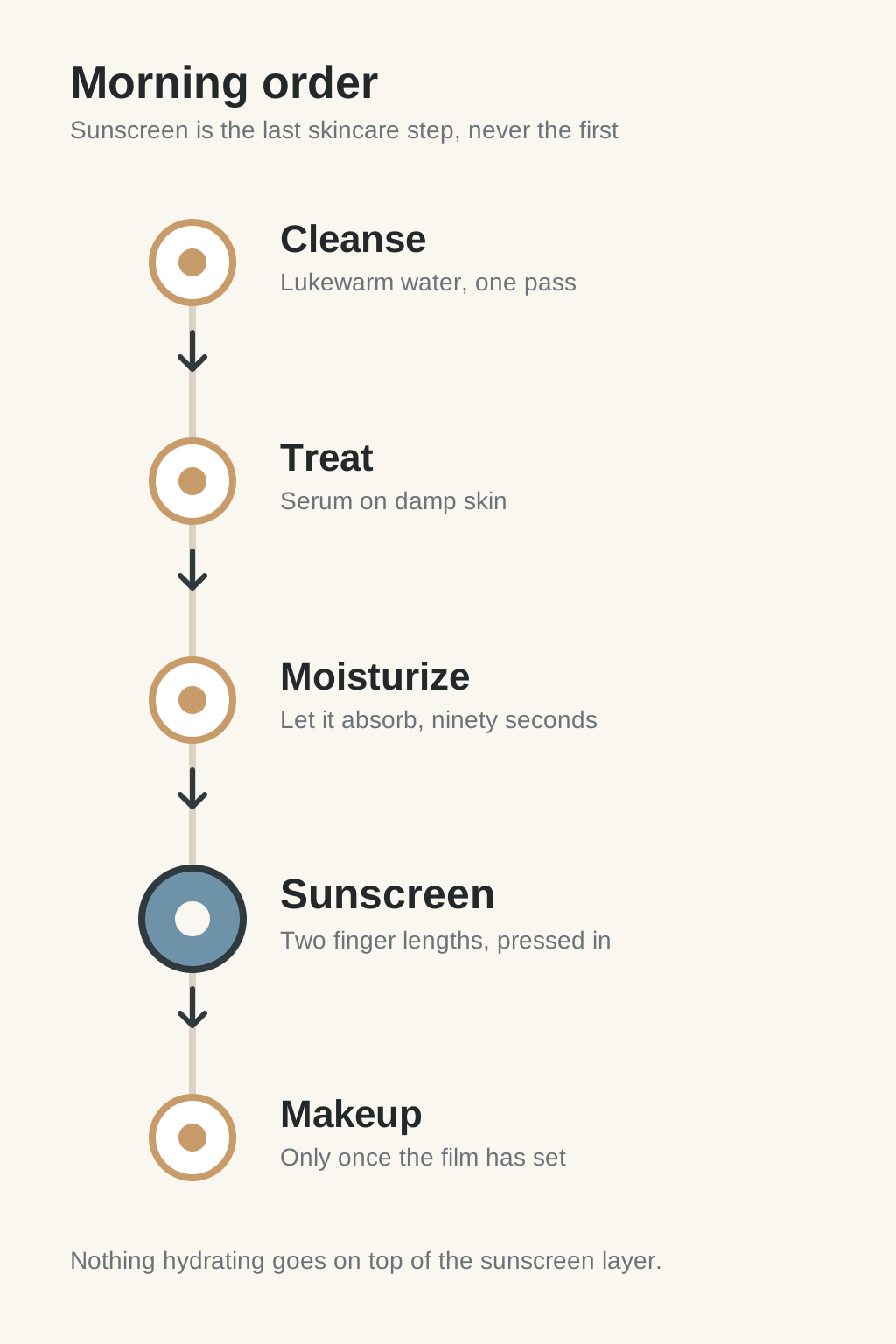
Wait 60 to 90 seconds between moisturizer and SPF, and another minute before makeup. Two habits cause almost all pilling: applying over a moisturizer that has not absorbed, and rubbing rather than pressing. Pat the sunscreen in with flat fingers in one pass and stop touching it.
Keeping daily spf for face going in winter is a placement problem, not a motivation problem. Store the tube next to your toothbrush, not in a drawer, and treat it as the step that ends the morning routine. If you are still assembling the rest, our walkthrough on how to build a skin care routine sets the order, and the guide to a face moisturizer for every skin type covers the layer directly underneath.
Face sunscreen questions readers ask most
Does an SPF moisturizer count on its own?
Only if you apply it at sunscreen dose, which almost nobody does with a moisturizer. Used as a moisturizer — a thin, blended layer — it behaves like a good face sunscreen applied at a quarter strength. It is a reasonable floor on an indoor day and not enough for an afternoon outside.
Does sunscreen expire?
Yes, and the printed date assumes sane storage. Filters degrade faster with heat, so a tube that spent a summer in a car glovebox at 50°C should be replaced regardless of the date. A separated or newly grainy texture is the visible signal.
Does facial sunblock cause breakouts?
Sometimes the formula is the problem, but more often the culprit is incomplete removal: a water-resistant film needs an oil or balm cleanser, and a single pass of gel cleanser leaves residue behind. Change the cleanse before you change the sunscreen.
Get one practical sunscreen and skincare tip each week, nothing else.
One sunscreen and skincare tip a week. No product dumps.
Thanks — you're on the list.


