

Tinted chapstick carries a fraction of a lipstick's pigment, so the shade you see in the tube lands as a wash tinted by your own lip color. Undertone decides the direction, rose and berry on cool, brick and terracotta on warm, and depth decides how strongly it reads.
What does tinted chapstick actually put on your lips?
A tinted chapstick lays down a wax-and-oil balm base carrying a small pigment load, so it hydrates like a balm and leaves a sheer wash of color. Two things happen in one swipe, and they are worth separating.
The base does the conditioning work: humectants such as glycerin draw water in, emollients like shea butter and castor seed oil smooth the surface, and waxes or petrolatum slow evaporation. The pigment rides on top of that base, and because it is dispersed rather than packed, light passes through it to the lip underneath. That single difference in pigment density is what separates a tint from a lipstick, a gloss and a stain, and it drives everything else about how the stick behaves.
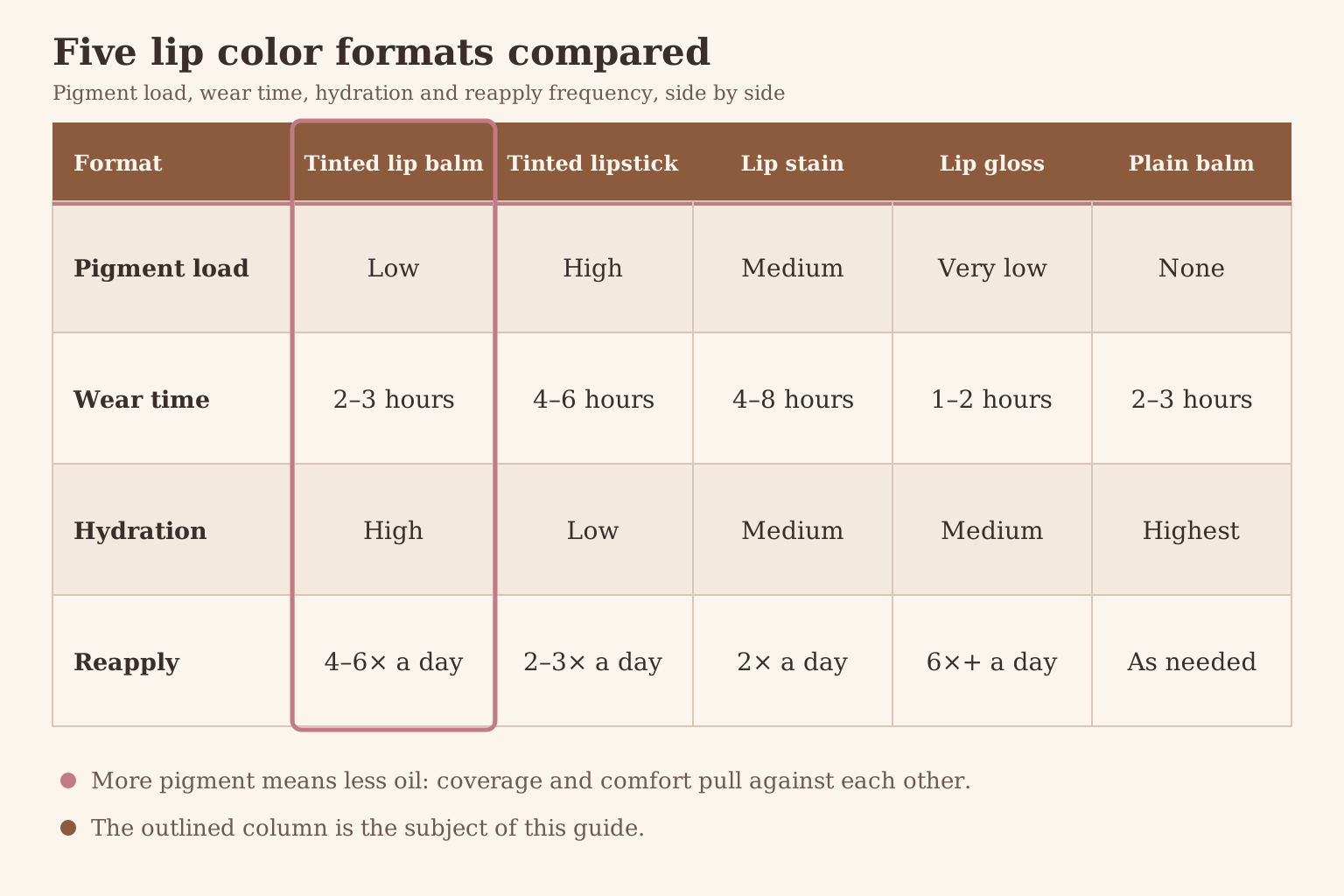
Lips also behave unlike the rest of the face. They have no oil glands and a thin surface layer, and in vivo measurement of the lip barrier measured their moisturizing factors, ceramides and water loss directly. Colored chapstick therefore fades in two to three hours while eating and drinking strip it faster still, which is normal for the format rather than a fault. Tinted lip products that promise all-day color at this pigment level are promising something wax cannot deliver. On lips that are already splitting, a dermatologist-approved chapstick for dry lips earns its place before any shade decision.
Why does the same shade look different on everyone?
Your natural lip color sits under the tint and mixes with it, so one stick can read as a nude on one person and a plum on another. Sheer pigment is translucent by design: what you see is the shade plus whatever it is sitting on.
That is the opposite of how tinted lipstick behaves. A lipstick carries enough pigment to hide the lip and show its own color almost unchanged; a sheer colored lip balm shows roughly a tenth of that coverage, so the lip underneath keeps most of its vote. Deeper lips shift sheer shades the most, which is why a pale pink can land as a warm brown.
Two more variables move the result. Blood flow changes lip color through the day, so the same tint reads cooler on cold hands-in-pockets mornings than after a run. Surface texture matters as well: a smooth lip reflects evenly and reads lighter, while flaking scatters light and deepens patches.
Dye-based formulas add a time dimension. A lip stain lip balm often drifts warmer or cooler across the first hour as the dye binds, so judge a stain forty minutes after application rather than at the mirror. If texture rather than color is what you are chasing, how lip plumpers actually work is a separate mechanism with separate tradeoffs.
How do you find the best lip balm color for your undertone?
Match undertone first and depth second: rose and berry suit cool undertones, brick and terracotta suit warm, and depth sets how strongly the shade reads. Undertone is the direction; depth is the volume.
Two quick reads give you the direction. Look at the veins on the inside of your wrist in daylight: predominantly blue or purple suggests cool, green suggests warm, a mix suggests neutral. Then hold silver and gold against your jaw, and notice which one makes your skin look rested rather than grey. Pick the best lip balm color from that family and you avoid the sallow-looking mismatches.

Depth is where most shade disappointments happen. The best lip moisturizer with color for fair lips is often two shades too light to register on deep lips, and the fix is depth rather than a different hue: stay in the same undertone family and go darker. Swatch a lip moisturizer with color on the lip itself, never the wrist, because wrist skin has none of the pigment that does the mixing.
Two shades carry most of the year: one within two steps of your natural lip for daily wear, one deeper for evenings. The same undertone logic governs tinted sunscreen for your face, so a shade family that works on your face usually works on your lips.
Affiliate disclosure: we may earn a commission from purchases made through our product links, at no extra cost to you.
How much color will actually show up?
Judge what a single pass leaves behind, because a tint that needs three passes to register is a gloss carrying a color name. One swipe is the honest measure of payoff.
Run the test twice. On a neutral surface, a good tinted lip balm leaves a continuous band of color rather than a wet shine with a hint of pink. On the lip, one pass should already shift the shade visibly in a mirror at arm's length. Anything needing repeated layers will also need repeated reapplication all day.
Finish changes the reading as much as pigment does. Sheer finishes let the lip through and forgive uneven edges. Satin finishes reflect more light, photograph better and show every flake. Stain finishes dry down matte and read strongest of the three. The best tinted balm is the finish you stop blotting off within the first week, because a satin you keep dabbing down was never the right finish.
Light is the last trap. A best tinted chapstick chosen under bright store lighting can look like nothing at an office desk, so check a swatch near a window and again indoors before committing. Loose surface skin flattens payoff too, which makes how to exfoliate lips without damage worth reading before you blame the shade.
Five short questions narrow the shelf to three sticks that match your lips, your undertone and your budget.
How long does the color stay put?
Expect two to three hours from a waxy sheer tint and four or more from a dye-based hybrid, with eating resetting both. Time alone is not what removes color.
Fat does most of the damage. Oil in food dissolves the wax layer holding pigment in place, which is why a tint survives a glass of water but not a slice of pizza. Hot drinks soften the film, pressing lips together redistributes it, and a single napkin takes off more than two hours of wear.
Transfer follows the same rule in reverse. A thick layer has more material to leave on a cup rim; two thin layers bond better and transfer less. If marks on glassware bother you, the fix is a lighter hand rather than a different tinted lip balm.
Dye-based hybrids buy their extra hours differently. The stain component bonds to the surface and keeps a flush of color after the balm phase has worn off, so what fades is the shine and the depth rather than the shade itself.
Build the reapply around meals instead of mirror checks: after lunch, after coffee, before leaving in the evening. Honest wear claims are a quality signal, so treat the best tinted lip balm as the one quoting hours rather than all day. Sun protection does not survive on that schedule either, which is why SPF lip balm sun protection needs its own two-hour rhythm outdoors.
Does adding pigment make a balm less moisturizing?
Slightly: pigment displaces part of the oil and wax phase, so a tinted stick carries a little less occlusive material per swipe than a clear one. The gap is real but small, and it is predictable.
Every percent of iron oxide, mica or dye takes volume that would otherwise hold emollients. A moisturizing tinted lip balm compensates by keeping its occlusives high in the ingredient list, and dermatologist guidance on healing chapped lips names petrolatum, shea butter, ceramides and dimethicone as the ones that do that work. A hydrating tinted lip balm keeps those regardless of which shade is in the tube.
The practical answer is to split the day. Run a tinted lip moisturizer while you are awake and want color, then use an untinted occlusive overnight when nobody is looking and repair matters more. An overnight lip mask for sealing in moisture does that job better than asking one stick to cover both shifts.
Affiliate disclosure: we may earn a commission from purchases made through our product links, at no extra cost to you.
How do you apply a tint so the color sits evenly?
Soften flakes, blot the surface dry, press color on in two thin layers instead of one thick swipe, and reapply after food or coffee. The sequence takes under a minute.
- Soften. Hold a damp cloth against the lips for 20 seconds, then wipe gently in one direction. Loose skin comes away; attached skin stays.
- Blot. Pat the surface dry. Pigment slides on a wet lip and pools at the inner edge, which is where patchy centres come from.
- Press. Dab color on with the bullet or a fingertip, wait 30 seconds for the wax to set, then add a second thin layer.
- Reapply. Top up after anything oily, which dissolves the film holding the color.
Pressing beats swiping for one mechanical reason: a dragged bullet catches loose skin, lifts it and carries pigment away with it, leaving dark edges and a pale middle. Dabbing deposits color without moving the surface it is sitting on.
Layering order settles the rest. Sun protection goes on first in the morning and gets a minute to set, then the best tinted lip moisturizer goes on top. Repair belongs at night, so smooth on a thick overnight lip treatment after your last drink of the evening and leave it alone until morning.
If you prefer to prepare lips at home rather than buying a scrub, DIY sugar scrub recipes at home cover ratios gentle enough for weekly use.
When does a tint stop being the right choice?
A tint stops working on cracked lips, when you need opaque coverage for photographs, and when heat has softened the bullet into a dragging mess. Each of those has a different fix.
Broken skin takes pigment unevenly: color collects in the splits and makes them darker and more obvious than bare lips would be. Repair first with an unscented occlusive for a week or two, and what the chapped lips label should list is the shortlist to heal with before color comes back.

Heat is the quiet failure. A stick left in a car or a sunny bag softens, drags instead of depositing, and a tube that has melted once never sets back to its original firmness. Two limits are worth stating plainly: sheer coverage will not hide pigmentation or scarring, and topping color up over sun protection thins that layer rather than renewing it. Research on sun damage to the lower lip, including clinical work on sun damage to the lower lip, tracks how clinicians grade that damage once it shows, and a white or scaly patch or a sore that has not healed in three weeks belongs in front of a clinician rather than under a tint.
One practical lip and skin care tip lands in your inbox each week.
One lip and skin care tip a week. No product dumps.
Thanks — you're on the list.


