

A makeup remover is a cleanser built to dissolve pigment, silicone and wax that water alone leaves behind. For most faces, an oil-based cleansing balm removes the most in one pass, including waterproof mascara; micellar water suits sensitive or reactive skin because it works at skin pH, roughly 4.5 to 5.5.
What Is a Makeup Remover and How Does It Work?
A makeup remover is a cleanser whose oils or micelles bind to pigment, wax and silicone so they lift away instead of sitting on the skin. It is built around solvency rather than foam, which is why a remover can clear a full face without ever lathering.
Plain water fails on modern makeup by design. Long-wear foundation and waterproof mascara are built on film formers such as dimethicone, trimethylsiloxysilicate and acrylate copolymers, polymers chosen precisely because water beads off them at the eight-hour mark. Rinsing moves sweat and loose powder; it leaves the film in place.
Three mechanisms do the actual work. An oil phase dissolves the waxes and silicones it chemically resembles. Micelles, spherical clusters of surfactant, trap soil in an oily core and carry it off on the pad. A microfiber weave lifts pigment mechanically, using thousands of split fibres instead of chemistry.
Removal is a separate step from cleansing, not a synonym for it. Skipping it leaves a thin residue of pigment and film former across the face, and that residue blocks whatever serum follows: a water-based niacinamide or hyaluronic acid layer cannot reach skin through a silicone film. For the washing step that follows removal, dermatologists are consistent about technique, and dermatologist guidance on gentle face washing is unambiguous: fingertips, lukewarm water, no washcloth, no scrubbing.
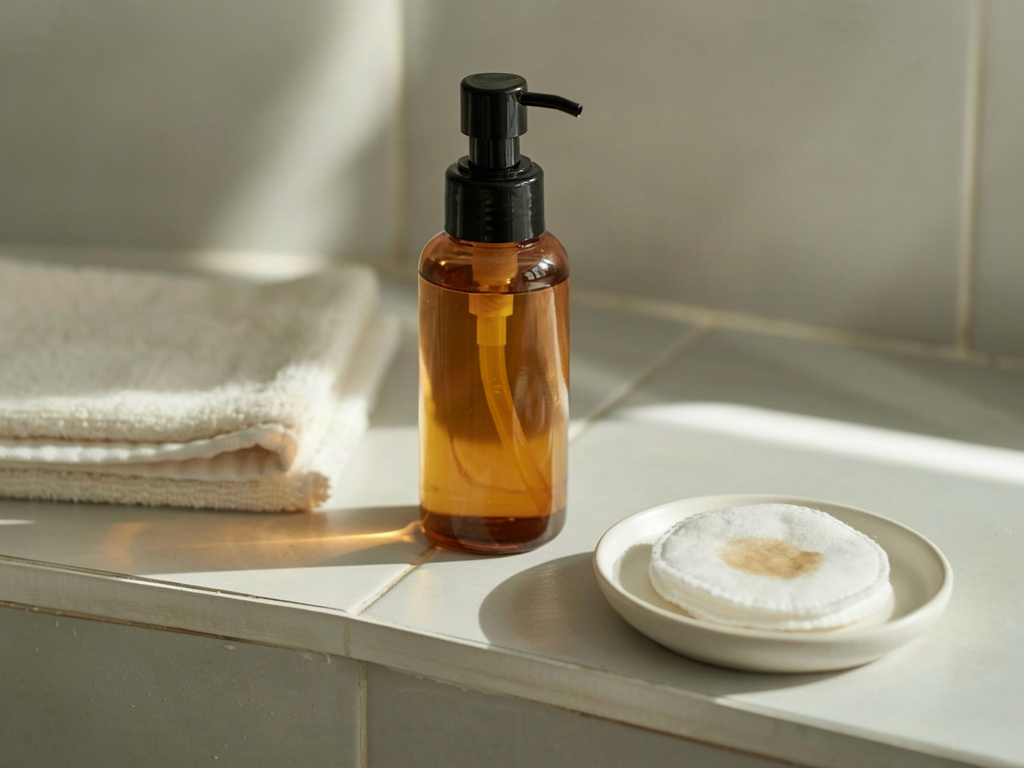
Which Remover Format Fits the Makeup You Actually Wear?
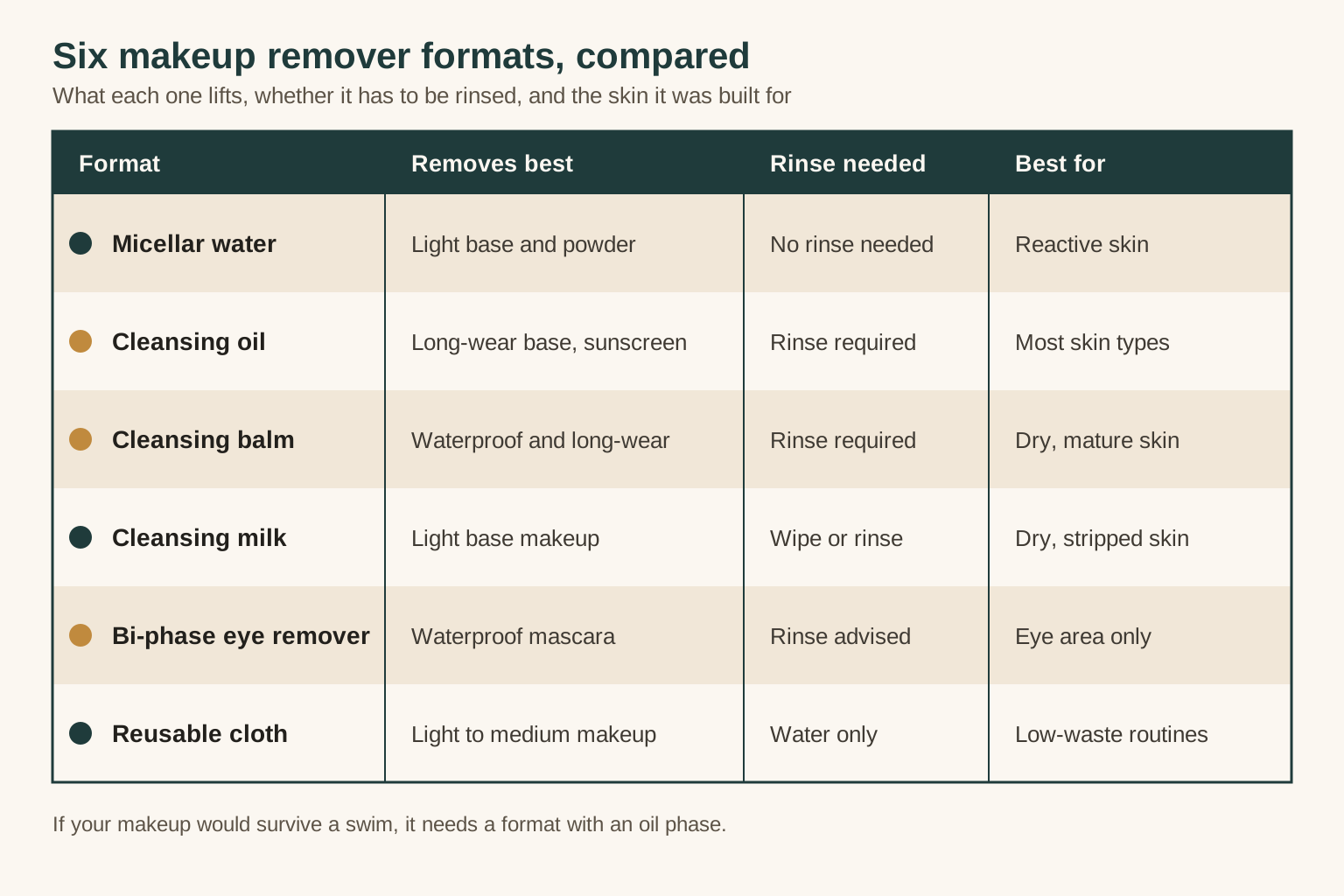
Six formats dominate the shelf - micellar water, cleansing oil, cleansing balm, cleansing milk, bi-phase eye remover and reusable cloths - and each suits a different makeup weight. The choice is not about which is best in the abstract; it is about what you put on your face this morning.
One decision rule covers most of it: if your makeup would survive a swim, it needs an oil phase to come off. Everything else is comfort, cost and how much time you are willing to spend at the sink.
Micellar water
A water-thin solution carrying 0.5 to 3 percent non-ionic surfactant, applied on a saturated pad and, in principle, left on. It is the fastest format and the kindest to reactive skin, because the surfactant load is a fraction of a foaming wash. Its limit is real: it will not break the film formers in waterproof mascara or 16-hour foundation, so a heavy makeup day still needs a second step.
Cleansing oil
A blend of light esters and emulsifiers that turns milky on contact with water and rinses clean. Massaged onto dry skin for 60 seconds, it clears long-wear foundation, sunscreen and waterproof mascara in a single pass. It costs effort: it must be emulsified and rinsed properly, and oily skin that rushes the rinse will find the residue reads as congestion within a week.
Cleansing balm
The same chemistry as an oil in a solid, waxy base that melts at skin temperature. The cushioned texture gives dry and mature skin a slip that a thin oil does not, and the jar travels without leaking. The tradeoffs are price per gram, which is the highest of any format, and jar hygiene, since fingers go in every night.
Cleansing milk
A low-surfactant emulsion that wipes off or rinses, sitting between micellar water and an oil in strength. It suits dry, easily stripped skin wearing light base makeup. Do not expect it to handle long-wear formulas; on a full face it moves pigment around rather than lifting it, and you will end up doing the job twice.
Bi-phase eye makeup remover
Two separated layers, an oil phase and a water phase, shaken to a temporary emulsion. That oil layer is what softens waterproof mascara, which is why it clears lashes that micellar water smears. It is a specialist: too oily for use across the whole face, and the residual film usually needs a rinse before serum goes on.
Reusable microfiber removal cloth
Split fibres pull pigment off with warm water alone, no product. It removes the recurring cost of cotton pads entirely and handles light to medium makeup well. The maintenance is the catch: it needs laundering at 60 degrees to stay hygienic, and it underperforms badly on waterproof formulas, where friction becomes the only tool.
If you want the underlying chemistry of the oil step in detail, read Best oil cleanser: 7 things to check before you buy.
Comparing removers against everyday washes is a different question, covered in Face wash guide to six cleanser types.
We earn a commission on some links in this guide, at no cost to you.
Four questions — shelf, skin type, concern, budget — narrow the catalog to three removers ranked by removal strength.
How Do You Pick a Cosmetic Remover for Sensitive Skin?
Sensitive skin does best with a fragrance-free, non-ionic surfactant formula near skin pH, applied on a saturated soft pad with no scrubbing. The pH target is narrow: between 4.5 and 5.5, the range in which the stratum corneum's enzymes and acid mantle function normally.
Surfactant class matters more than surfactant quantity. Non-ionic surfactants such as poloxamers and polyglyceryl esters carry no charge, so they interact far less with skin proteins than the anionic sulfates that make a wash foam. A cosmetic remover built on non-ionics can clear a face without the tight, squeaky feeling that signals lipid loss.
Fragrance is the most common trigger in this category, and the label wording is not interchangeable: fragrance-free means no fragrance was added, while unscented can mean a masking fragrance was added to hide a raw-material smell. Only the first is safe to assume.
Technique carries as much weight as formula. Saturate the pad until it is heavy, hold it still against the skin for a few seconds, then draw it across once and turn it over. Repeated passes with a dry pad are friction, and friction is what turns a tolerable formula into a reaction. The supporting evidence is unusually clear here: a 400-participant trial on micellar solution and skin comfort found itching, tingling, tightness and burning improved for about 90 percent of participants within 28 days of switching to a micellar solution, with measurable gains as early as day two.
Patch test before a full face: three consecutive nights on the jawline, same amount, same contact time. A reaction that shows on night three would have shown across the whole face on night one.
The wider rules for reactive skin are set out in How to choose a gentle cleanser for sensitive skin.
We earn a commission on some links in this guide, at no cost to you.
Not sure whether your skin is dry, reactive, or both? Six questions, two minutes, your skin type and top concern.
What Does a Make Up Remover Actually Cost per Use?
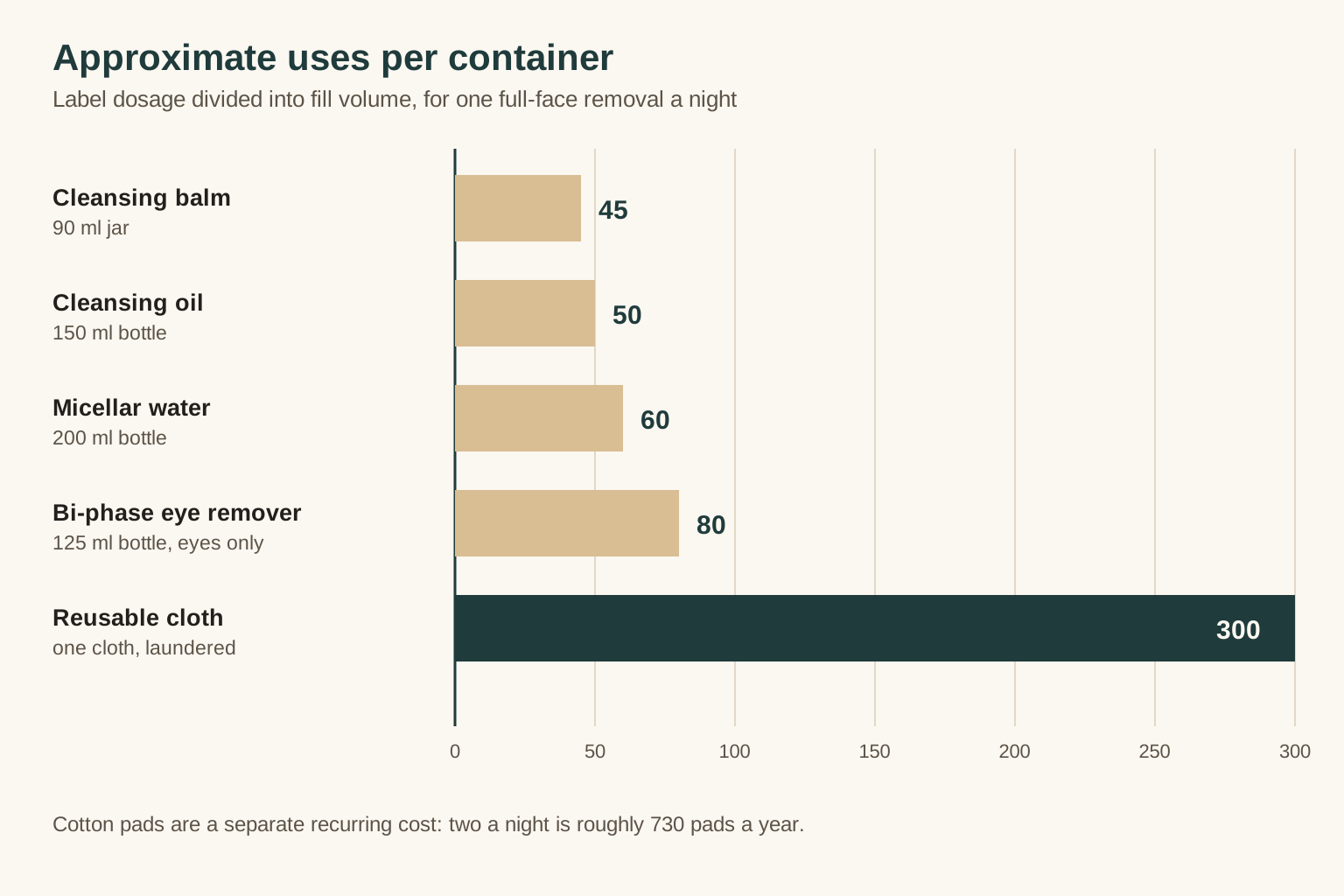
Cost per use decides value, not bottle price: a 200 ml micellar bottle runs roughly 60 removals while a 90 ml balm jar runs about 45. A make up remover is a nightly habit repeated 365 times a year, so the shelf price is the wrong number to compare.
The yields come from label dosage and fill volume. Micellar water at about 3 ml per saturated pad gives roughly 60 uses from 200 ml. A balm at 2 g per application gives about 45 from a 90 ml jar. A cleansing oil at 3 ml per pump gives about 50 from 150 ml. A bi-phase eye remover, used only on the eyes at 1.5 ml, stretches a 125 ml bottle to roughly 80 removals.
Cotton pads are the hidden line item. At two pads a night you consume about 730 a year, which adds a recurring cost that never appears in any product comparison. A reusable microfiber cloth erases that line after roughly six weeks of nightly use, and after that the only ongoing cost is laundry.
This scoring rubric puts the formats on the same three axes — removal strength, cost per use and residue — each rated from 1 to 3, where 3 is best:
| Format | Removal strength | Cost per use | Residue | Total |
|---|---|---|---|---|
| Micellar water | 1 | 3 | 2 | 6 |
| Cleansing oil | 3 | 2 | 2 | 7 |
| Cleansing balm | 3 | 1 | 2 | 6 |
| Cleansing milk | 2 | 2 | 2 | 6 |
| Bi-phase eye remover | 3 | 3 | 1 | 7 |
| Reusable cloth | 1 | 3 | 3 | 7 |
Paying more is justified in two specific cases: a fragrance-free reformulation of a product you already tolerate, and airless packaging that keeps an antioxidant-heavy oil from going rancid before you finish it. Paying more for a heavier glass bottle buys you nothing but shipping weight.
How Do You Take Off Waterproof Eye Makeup Without Damage?
Waterproof eye makeup needs an oil-based or bi-phase remover held on a closed lid for about twenty seconds so the film softens before any wiping. Waterproof mascara is a wax and film-former matrix; it yields to solvent and time, never to pressure.
Since that twenty-second hold only pays off with the right formula, compare the eye makeup remover formats by removal strength, residue and eye safety before you settle on one.
The sequence is short. Shake the bottle to emulsify, saturate a flat pad, press it onto the closed lid and lash line, and count to twenty. Then draw the pad down and outward in one stroke. Repeat once with a fresh side if anything remains. A bi-phase formula rated safe for lash extensions matters if you wear extensions, because standard oils dissolve the cyanoacrylate bond that holds them and shorten a fill by a week or more.
Rubbing is the mechanism behind two visible problems. Mechanical traction pulls lashes out at the follicle, and repeated friction on the thin periorbital skin drives post-inflammatory pigmentation that people mistake for permanent shadows. Both are caused by the motion, not by the product.
Federal safety guidance is worth following literally: never apply or remove eye cosmetics in a moving vehicle, and take care not to scratch the eyeball or surrounding tissue during removal. The full consumer advice, including how long to keep a mascara, sits in federal safety guidance for eye cosmetics .
For discoloration that persists once friction has stopped, there is more in Circle eye cream for dark circles.
If rubbing the lash line leaves your eyes gritty and stinging night after night, compare the dry eye treatment options that address the cause instead of reaching for a harsher remover.
Does Double Cleansing Remove More Than One Pass?
Double cleansing removes more because the oil step lifts wax and silicone while the water-based step clears the surfactant residue and sweat underneath. The two steps are aimed at chemically different soils, which is why doing either one twice does not substitute for doing both once.
Timing separates a real double cleanse from a fast one. Give the oil or balm about 60 seconds of massage on dry skin, add water to emulsify, then rinse. Follow with a gentle water-based wash for about 30 seconds. Under 30 seconds on the first step, the film formers have not softened and you are simply spreading them.
Not everyone should do it. On a bare-face day, or on skin that is already dry, flaking or recovering from a retinoid, the second surfactant pass removes lipids and returns nothing. One gentle wash is the better call.
The residue test settles it without guesswork: after the second cleanse, swipe a clean dry cotton pad along the jaw and hairline. If it comes away marked, the first step was too short. If it comes away clean, a third pass is wasted effort.
Where removal sits in relation to everything else you apply is mapped out in Skincare order: nine steps and what goes first.
Which Ingredients Belong on the Label, and Which Do Not?
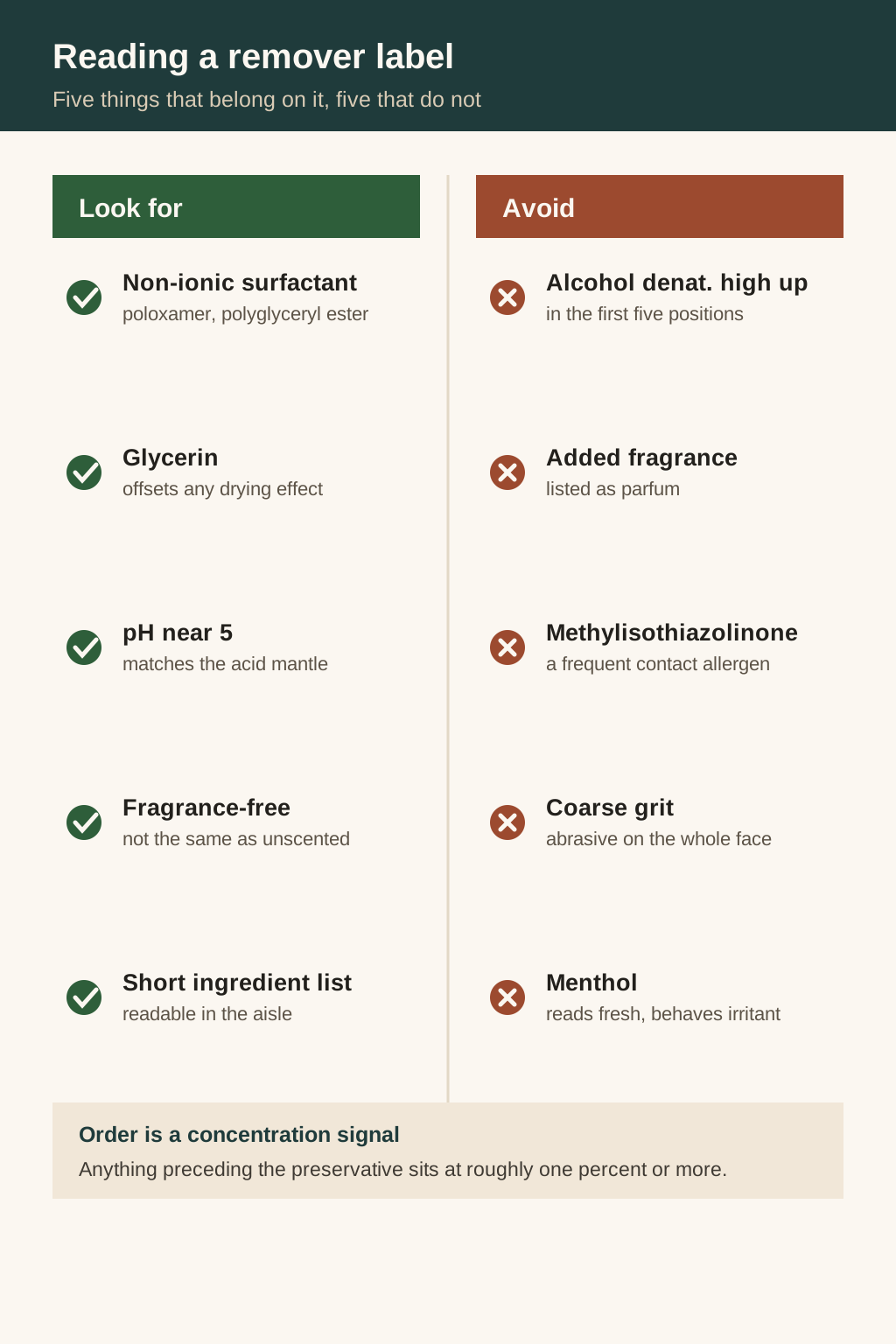
Skip denatured alcohol high in the list, added fragrance and methylisothiazolinone; look for non-ionic surfactants, glycerin and a pH near 5. Whichever spelling brought you here — makeup remover, make up remover, or the clipped make up remo people type into a search bar — the label is what separates a gentle formula from an irritating one.
Five things belong on a good label: a non-ionic surfactant such as a poloxamer or polyglyceryl ester, glycerin as a humectant to offset any drying, a stated pH near 5, explicit fragrance-free wording, and an ingredient list short enough to read in the aisle.
Five things do not: alcohol denat. in the first five positions, added fragrance or parfum, methylisothiazolinone, coarse exfoliating grit in a product meant for the whole face, and menthol, which reads as freshness and behaves as an irritant.
The mechanism behind post-cleansing tightness is documented. Surfactants extract stratum corneum components during cleansing and some remain in the tissue after rinsing, disrupting the ordered lipid structure that holds water in; research on surfactants and stratum corneum barrier damage shows that larger surfactant structures, not only single molecules, penetrate and cause it.
Position on the list is a concentration signal. Ingredients are ordered by weight down to one percent, so anything that precedes the preservative is present at roughly one percent or more. A soothing active named on the front of the bottle but trailing the preservative in the list is marketing, not formulation.
A two-page printable cheat sheet pairs each ingredient group with what it does, when it suits you and what to avoid it with — built for reading a label in the shop aisle.
What Does a Realistic Nightly Removal Routine Look Like?
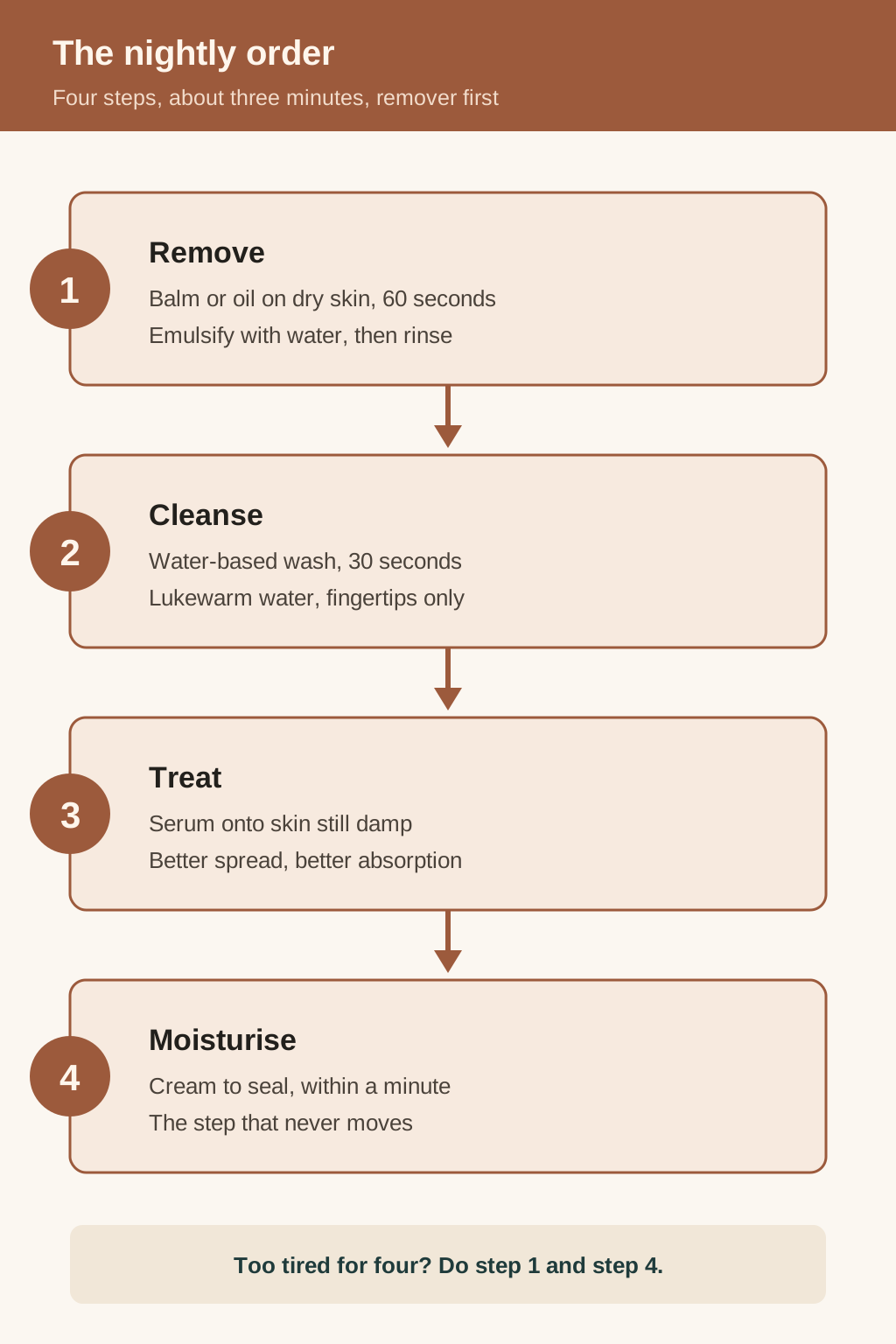
A nightly routine runs four steps in fixed order - remove, cleanse, treat, moisturise - and takes about three minutes when the remover goes first. Order is not a preference here: each step is formulated to work on what the previous one left behind.
- Remove — a hazelnut of balm or three pumps of oil on dry skin, massaged for 60 seconds, emulsified with water, rinsed.
- Cleanse — a water-based wash for about 30 seconds, lukewarm water, fingertips only.
- Treat — serum onto skin still damp from the rinse, which improves spread and absorption.
- Moisturise — a cream to seal, applied within about a minute of the serum.
On the nights you are too tired for four steps, do two: remover and moisturiser. That protects the barrier and clears the makeup, which is most of the benefit. Skipping the remover and keeping the serum is the version that does not work, because the serum cannot reach skin through a silicone film.
Heavy makeup nights add a second cleanse; bare-face days can drop the first step and start with the wash. The remover is the step that changes with what you wore, and the moisturiser is the step that never moves.
Weekly maintenance is two habits: launder reusable cloths at 60 degrees, and replace mascara every two to four months, since the tube is repeatedly exposed to the lash line.
If removal leaves your skin tight, the fix is usually the last step — start with Best moisturizer for acne prone skin.
One short email a week on removal and routine, nothing else.
One removal and routine tip a week. No product dumps.
Thanks — you're on the list.


