

The best salicylic acid cleanser for most acne-prone skin is a 2% salicylic acid gel wash built on a mild surfactant base like cocamidopropyl betaine, used once daily at night. Two percent is the FDA's maximum over-the-counter strength; sensitive skin does better at 0.5-1% in a cream base.
What does a salicylic acid cleanser actually do?
A salicylic acid cleanser uses a 0.5 to 2 percent oil-soluble beta hydroxy acid to loosen the keratin plug inside pores during a 30 to 60 second wash, then rinses away. The acid does not scrub anything off the surface. It weakens the desmosome bonds holding dead corneocytes together, so the plug of sebum and shed cells that forms a blackhead gives way instead of hardening.
Because this 30 to 60 second wash is not made for the lash line, clear mascara and liner first with one of the eye makeup remover formats that suits your eyes.
Oil solubility is the whole reason this molecule sits in acne products rather than glycolic acid. Salicylic acid is lipophilic, so it mixes with the sebum already filling a follicle and works inside the pore lining. Glycolic acid is water-soluble and stays on the surface, so a salicylic face wash reaches congestion a glycolic one never touches. Dermatology literature calls the effect desmolytic rather than keratolytic, because the acid breaks cell junctions instead of dissolving keratin.
A peer-reviewed review of salicylic acid on skin puts numbers on the scale: clinical peels run at 20 to 30 percent, roughly ten to sixty times the strength of anything sold as a wash.
Here is the honest ceiling. Cleansers with salicylic acid have 30 to 60 seconds of contact before they go down the drain, and a fraction of the dose penetrates in that window. Expect fewer blackheads and smoother texture across six to twelve weeks, not cystic acne resolved in a fortnight. Deep inflammatory lesions need a leave-on treatment, and a rinse-off wash cannot substitute for one.
What a wash does well is maintenance: it keeps pores from re-clogging between stronger treatments, and it replaces a harsh foaming cleanser with one that earns its place in the routine. If you are still deciding whether a gel, cream, oil or micellar formula suits you at all, start with cleanser types and who each suits before you narrow down to an active.
Checks 1-3: read the formula before the front label
The three checks that decide a cleanser's real strength are the labelled percentage, how long the formula stays on skin, and which surfactants carry it. Front-of-bottle claims describe none of these; the back label does, in about twenty seconds of reading.
These same three checks apply to any acne face wash, because the labelled percentage, contact time and surfactant base decide whether an active actually clears breakouts or just strips skin.
2% salicylic acid on the drug facts panel
In the United States, a salicylic acid based cleanser sold for acne is a regulated drug, so every over the counter salicylic acid cleanser carries a drug facts panel naming the active and its exact percentage. The monograph range is 0.5 to 2 percent; a 2 salicylic acid face wash is the legal ceiling, not an unusually aggressive outlier.
Two percent suits oily, resilient, congested skin. Choose 0.5 or 1 percent if your skin flushes easily or you already use a retinoid. A product listing salicylic acid only in the ingredients, with no drug facts panel, carries a fraction of a percent and will not decongest anything.
One safety note worth knowing before you buy: a government safety review of serious allergic reactions to acne products found evidence linking over-the-counter benzoyl peroxide and salicylic acid washes to rare anaphylactic reactions, with throat tightness, hives and facial swelling. Those are different from the ordinary stinging or dryness at the application site. Stop use and seek care if they appear.
Contact time and the 60-second rinse rule
An acid only works while it is on the skin, and a cleanser's contact time is measured in seconds. Massage for a full 30 to 60 seconds, then rinse; leaving a wash on for five minutes as a mask is a reliable route to a compromised barrier, not a shortcut to faster results. Formula pH matters too: salicylic acid needs a pH near 3 to 4 to stay in its active free-acid form, so a high-pH soap bar underperforms its label.
The surfactant base doing the actual cleansing
The base touches your skin longest. Look for cocamidopropyl betaine, coco-glucoside, decyl glucoside or sodium cocoyl isethionate, and avoid sodium lauryl sulfate high in the list, which strips lipids and amplifies the sting. A harsh base undoes exactly what a face wash containing salicylic acid is meant to fix: it triggers reactive oil production, and you end up shinier by mid-afternoon.
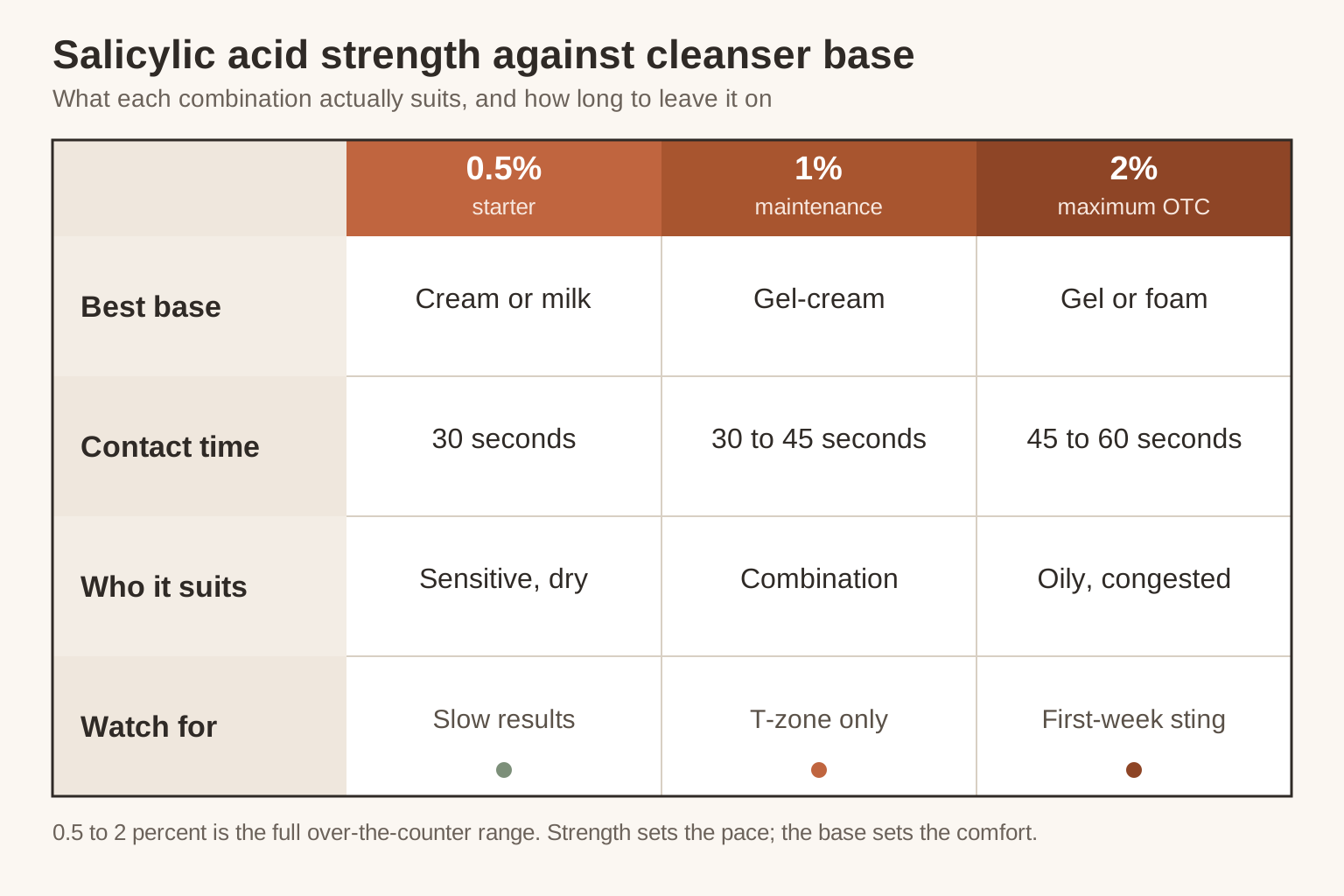
| Strength | Gel or foam base | Cream or milk base | Contact time to aim for |
|---|---|---|---|
| 0.5% | Too light to decongest; fine daily on normal skin | Starter strength for sensitive skin, every second night | 30 seconds |
| 1% | Maintenance for combination skin, T-zone only | The tolerable middle for skin already on a retinoid | 30 to 45 seconds |
| 2% | Working strength for oily, blackhead-prone skin | Slower but comfortable; good for dry acne-prone skin | 45 to 60 seconds |
Checks 4-5: match the format to oily or congested skin
Oily and congested skin does best with a low-viscosity gel or foam at 2 percent, because it rinses clean without leaving an occlusive film over already-clogged pores. Format is not a texture preference here. A rich cream wash deposits emollients and fatty alcohols that sit in the follicle opening, which is the last thing skin producing excess sebum needs.
If you are weighing the foam option specifically, it helps to know how a foaming cleanser works and which skin types its surfactant lather actually suits.
Gel and foam formats for oily, congested skin
A good salicylic acid face wash for oily skin spreads thin, foams lightly or not at all, and leaves skin feeling comfortable rather than tight within a minute of towel-drying. Clear gels tend to have the shortest ingredient lists and the fewest emollients. Foams built on glucoside surfactants give the same clean finish with less stripping than a sulfate foam.
The limitation: gels give you no cushion. If you cleanse twice a day, shave, or live somewhere with hard water, a 2 percent gel can tip into over-cleansing quickly. Washing once at night with a gel and rinsing with water in the morning solves that for most people.
The squeaky-clean test for over-stripping
Run your fingertips across your cheek thirty seconds after towel-drying. Skin should feel smooth and slightly cool. If it squeaks, grips, or feels like it needs moisturizer immediately to stop stinging, the wash is removing more lipid than the acid is worth. That squeak is barrier damage, not depth of clean.
A stronger face wash with salicylic acid buys speed, and the best salicylic acid face wash for your skin is the strongest one you can use without flinching. It costs comfort for the first two to three weeks, and on reactive skin it costs compliance. If your main complaint is shine rather than congestion, the format question matters more than the acid, and best face wash for oily skin covers the surfactant side in more detail.
Checks 6-7: supporting ingredients and label red flags
The last two checks are what supports the acid, ceramides, niacinamide, glycerin or panthenol, and what undermines it, drying alcohol, added fragrance, menthol or scrub beads. Two cleansers can both say 2 percent on the panel and behave nothing alike, and the difference is in the twenty ingredients underneath.
Those same red flags matter even more in a mild formula, so work through these gentle cleanser label checks before you pick a non-stripping everyday wash.
The same reading applies one step later in the routine, where niacinamide helps and drying alcohol does not, so run the same label checks when you choose a toner for oily skin.
Barrier support: ceramides, niacinamide, glycerin
The better face cleansers with salicylic acid put something back while they take oil away. Glycerin holds water in the stratum corneum after rinsing. Ceramides replace the lipids a surfactant removes. Niacinamide at 2 to 4 percent reduces the flushing that acids provoke and helps regulate sebum over weeks. Panthenol calms the immediate sting.
Be realistic about what survives a rinse: a cleanser deposits a modest amount of any of these. Their real job is to make the acid tolerable enough that you keep using it, which is what actually produces results. Do not pay a premium for a long actives list on a product that spends 45 seconds on your face.
One practical test of a supported formula: skin should still feel comfortable 20 minutes after washing, before you apply anything else. If it needs moisturizer within two minutes to stop feeling tight, the supporting ingredients are decorative. Cleansers that pass that test are usually the ones with glycerin in the top five and no sulfate at all.
Red flags: drying alcohol, fragrance, scrub beads
Four things on a salicylic acid facewash label predict trouble. Alcohol denat. or SD alcohol in the top five ingredients means fast evaporation and a tight finish. Added fragrance and essential oils are the most common cause of contact irritation on skin already using an acid. Menthol and camphor create a cooling sensation that reads as "working" and does nothing for pores. Physical scrub particles combined with a chemical exfoliant is one exfoliation too many in a single step.
For anything sold to treat acne, read the drug facts panel rather than the marketing copy: it states the active and the percentage, and a facial cleanser with salicylic acid that lacks the panel is not held to that standard.
Dermatology guidance on how dermatologists treat acne is a useful cross-check on where a wash sits relative to leave-on and prescription options.
Which salicylic acid cleanser suits your skin type?
Oily skin suits a 2 percent gel, combination skin a 1 to 2 percent gel-cream used only on the T-zone, and sensitive or dry skin a 0.5 to 1 percent cream or milk wash. Skin type decides the base; the percentage only decides how fast you get there.
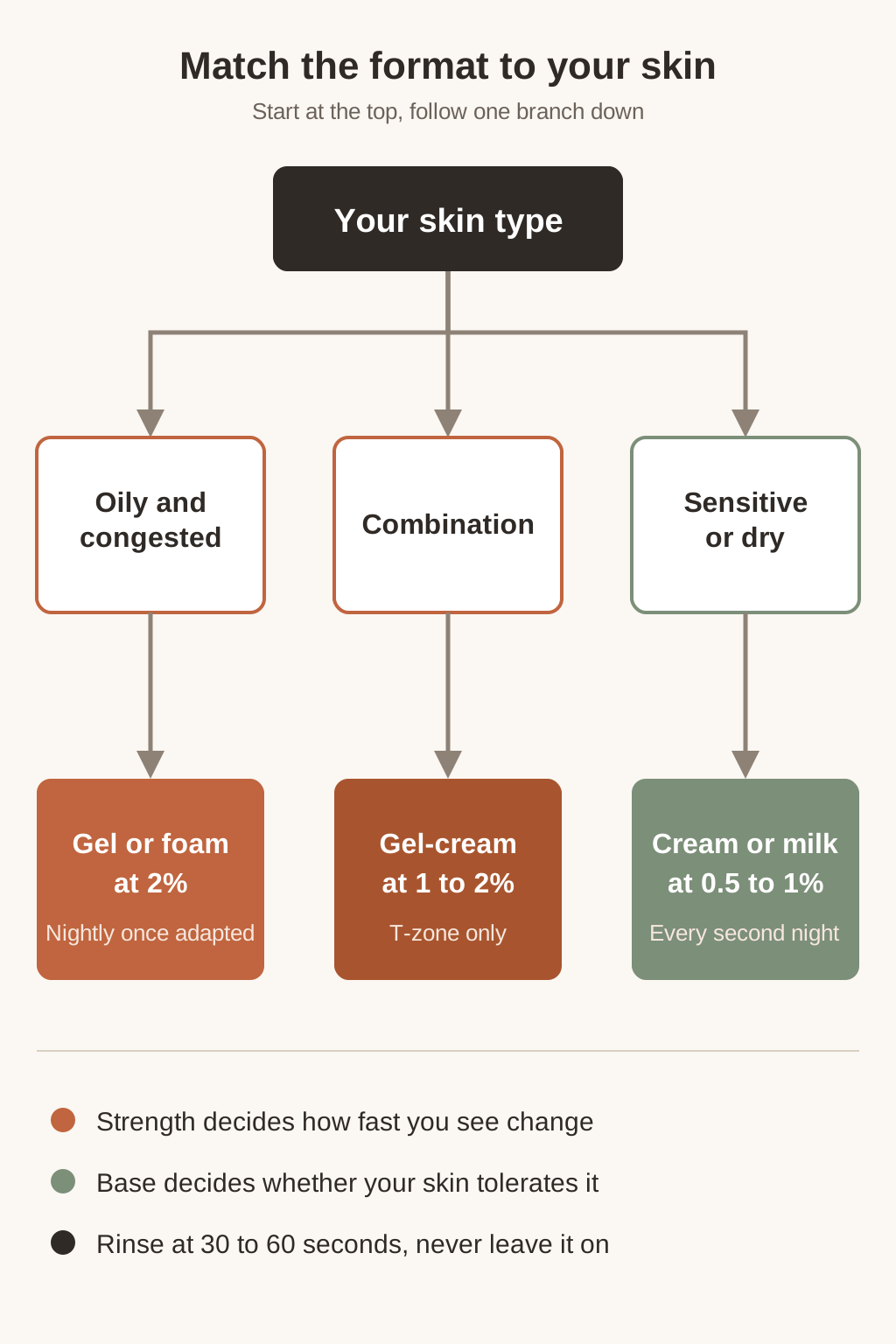
A gentle salicylic acid cleanser is gentle for structural reasons, not because the label says so. It runs at 0.5 to 1 percent, uses a cream or milk base with glucoside surfactants, carries no secondary acid such as glycolic or mandelic, and has no added fragrance. Anything stacking three acids is a treatment product wearing a cleanser's packaging.
Choosing a salicylic acid cleanser for sensitive skin means accepting a slower timeline rather than skipping the active. The compromise that works: wash with it every second or third night, rinse at 30 seconds, and use a bland non-foaming cleanser on the nights in between. You still decongest; you just do it over ten weeks instead of six. If redness rather than congestion is your main issue, gentle cleanser for sensitive skin is the better starting point.
For combination skin, the best facial cleanser with salicylic acid is usually a gel-cream applied only where the shine is. Work it through the T-zone for 45 seconds, then sweep what remains across the cheeks for the last few seconds before rinsing.
How often should you use a salicylic acid face cleanser?
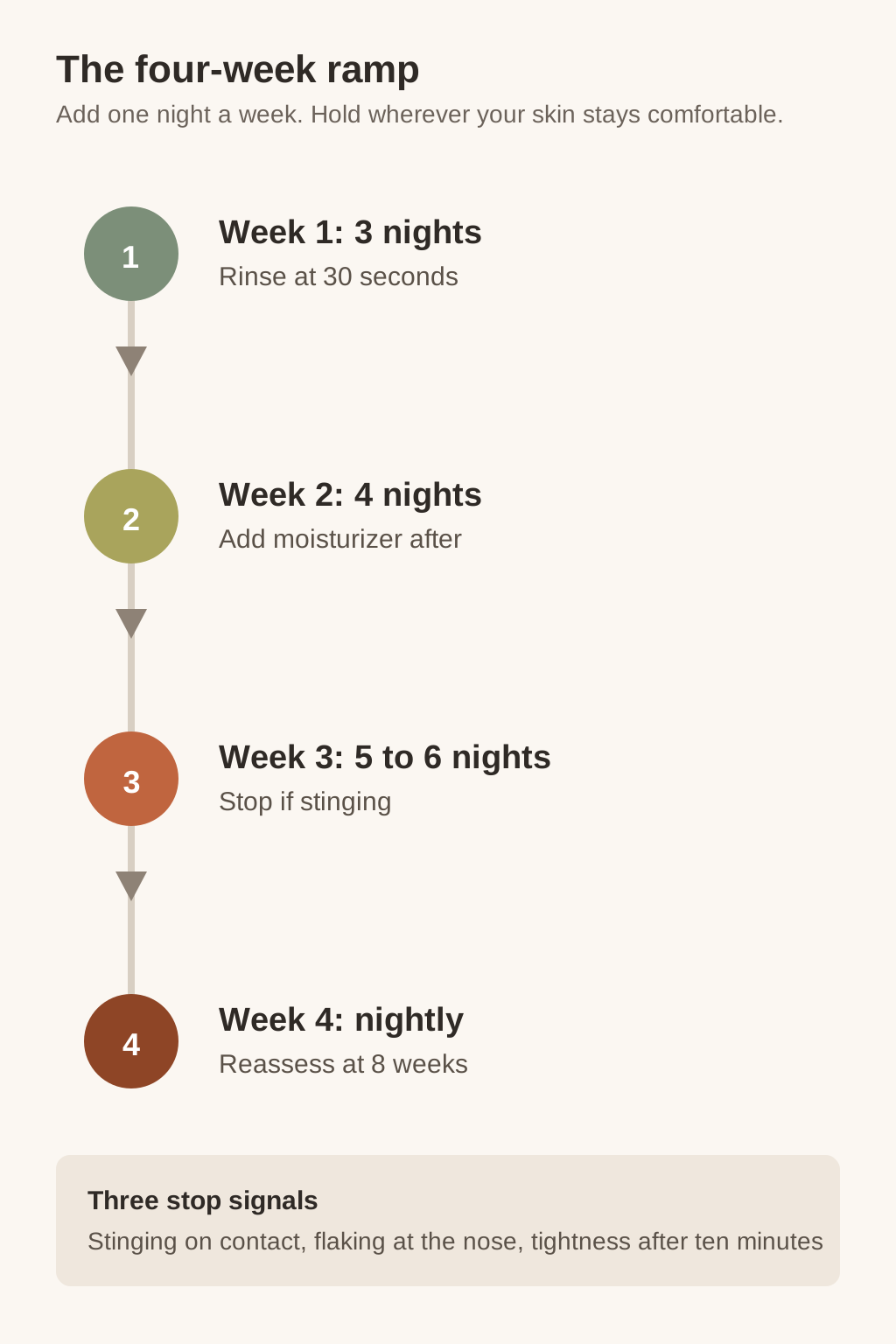
Start at three nights a week and add one night every week until you reach nightly, holding at whatever frequency leaves no stinging, flaking or lasting tightness. A salicylic acid wash acne routine that starts at twice daily fails for a predictable reason: the barrier gives out in week two, and the flaking gets mistaken for the product not working.
Evening is the better slot. Overnight is when sebum and the day's sunscreen have accumulated, and a salicylic acid face cleanser clears that before any treatment step. Mornings rarely need more than water or a non-medicated wash, because you rinsed eight hours ago. Washing with the acid twice a day only makes sense for very oily skin in hot, humid conditions, and even then only after the four-week ramp.
Order matters inside the routine: cleanse, treat, moisturize, then sunscreen in the morning. Apply moisturizer within three minutes of towel-drying, while the stratum corneum still holds water. If you use a cleanser aimed at combination skin, the same ramp applies. The full sequence is laid out in skincare order and what goes first.
Three stop signals mean you have moved too fast: stinging on application, flaking around the nostrils and chin, and tightness that has not settled ten minutes after moisturizer. Drop back one night per week, hold for two weeks, then try again. None of these are a sign the product is working.
Two habits break the ramp more often than the schedule does. The first is washing with hot water, which strips lipids before the acid has done anything. Lukewarm is enough. The second is doubling up on a night you also use a physical scrub or a clay mask, which turns a measured exfoliation into three at once. Pick one exfoliating step per evening and leave the rest of the week for repair.
What can you safely layer over a salicylic acid wash?
Niacinamide, hyaluronic acid and a ceramide moisturizer layer safely over a salicylic acid wash; retinol, benzoyl peroxide and leave-on BHA belong on alternate nights. A pimple cleanser best described as decongesting has already exfoliated for you, so the night's remaining steps should hydrate and repair rather than exfoliate again.
Vitamin C is a morning active and sits comfortably alongside an evening acid wash. Benzoyl peroxide on the same night as a 2 percent wash most often ends in raw, peeling skin around the mouth, so alternate them. A leave-on BHA exfoliant plus a salicylic wash on the same evening is one acid too many.
For the repair half of the routine, a fragrance-free moisturizer with ceramides and glycerin, applied within three minutes of washing, is what keeps the whole thing tolerable.
Two related reads: moisturizer for acne prone skin and choosing a face exfoliator.
When is a cleanser not enough for acne?
If eight weeks of consistent use has not reduced blackheads or small inflamed spots, or you have nodules, cysts or scarring, a cleanser is the wrong tool. The best salicylic acid cleanser can shift comedonal congestion, refine texture and keep pores clearer between treatments. It cannot reach the inflammation and bacterial component driving deep lesions.
Book a dermatologist when you see painful nodules or cysts, when marks are turning into pitted or raised scars, when acne spreads to the chest and back, or when breakouts follow a hormonal pattern along the jaw. Prescription topical retinoids, topical or oral antibiotics, and hormonal treatment all outperform any over-the-counter wash on those presentations.
The updated acne management guidelines set out which of those options fits which severity, and they treat topical salicylic acid as a supporting agent rather than a primary therapy.
A wash still has a role alongside prescription care: it keeps the surface clear and reduces how often stronger treatments get overwhelmed by congestion.
One practical routine tip a week, written for skin that reacts.
One skin-tested routine tip a week. No product dumps.
Thanks — you're on the list.


