

A face wash is a surfactant-based cleanser that lifts sebum, sunscreen and pollution without stripping the skin barrier. Six formats dominate: gel, cream, foaming, oil or balm, micellar and powder. Match format to skin type, keep pH near 5.5, and wash twice daily, morning, night and after sweating.
What does a face wash actually do for your skin?
A face wash uses surfactants to lift sebum, sunscreen and pollution off the skin's surface, leaving it clean enough for the next step without stripping the acid mantle. Surfactant molecules have an oil-loving tail and a water-loving head, so they wrap around sebum, sunscreen filters and airborne particulate and hold them in suspension until rinse water carries them off.
That is the whole job. A facial wash is a rinse-off step with a contact time of roughly twenty to thirty seconds, which is why it is the wrong vehicle for treatment. An acid needs minutes on skin to resurface; a humectant needs to stay put to hydrate. Thirty seconds and a rinse deletes both.
Face wash skincare goes wrong when one bottle is asked to exfoliate, hydrate, brighten and clear acne at once. Each added claim either does nothing at rinse-off speed or raises the surfactant load needed to keep the formula stable, which costs you barrier lipids.
The surface you are washing sits near pH 5.5. That acid mantle keeps enzymes working at the right rate and keeps Staphylococcus epidermidis comfortable and Cutibacterium acnes in check. An alkaline wash can push surface pH past 8 and recovery takes hours, not minutes. Wash twice and you never fully return.
Not every product with foam on the label is a face wash: Bubble skin care and Hello Bubble hair color share a name, but one is a US teen skincare line and the other a Korean foam dye.
How do you identify your skin type before buying a cleanser?
Wash with a bland cleanser, apply nothing for thirty minutes, then read the result: shine across the T-zone means oily, tightness or flaking means dry, and both means combination. Do it at the same time of day twice, a week apart, because one reading after a long flight or a hot shower tells you about the day, not the skin.
Picking a cleanser for skincare starts with that reading, not with the ingredient list on the front of the bottle. Skin type decides how much surfactant you can afford to lose lipids to; the ingredient list only tells you how that surfactant load was assembled.
Sensitivity is a flag layered on top of dry, oily, combination or normal, never a fifth type. Oily skin that stings at fragrance is oily and sensitive, and it still needs a low-residue format, just without the perfume. Treating sensitivity as a type is how people with oily, reactive skin end up on rich cream cleansers that leave them congested.
Searches for the best face face wash return contradictory answers for exactly this reason: the same formula is a five-star product for one skin type and a four-week breakout for another. A skin care facial cleanser that suits you in January, when indoor heating drops humidity to 25 percent, can be too rich by July, when sebum output climbs with ambient temperature. Plan on two formats a year, not one holy grail.
Which rinse-off face wash formats suit which skin types?
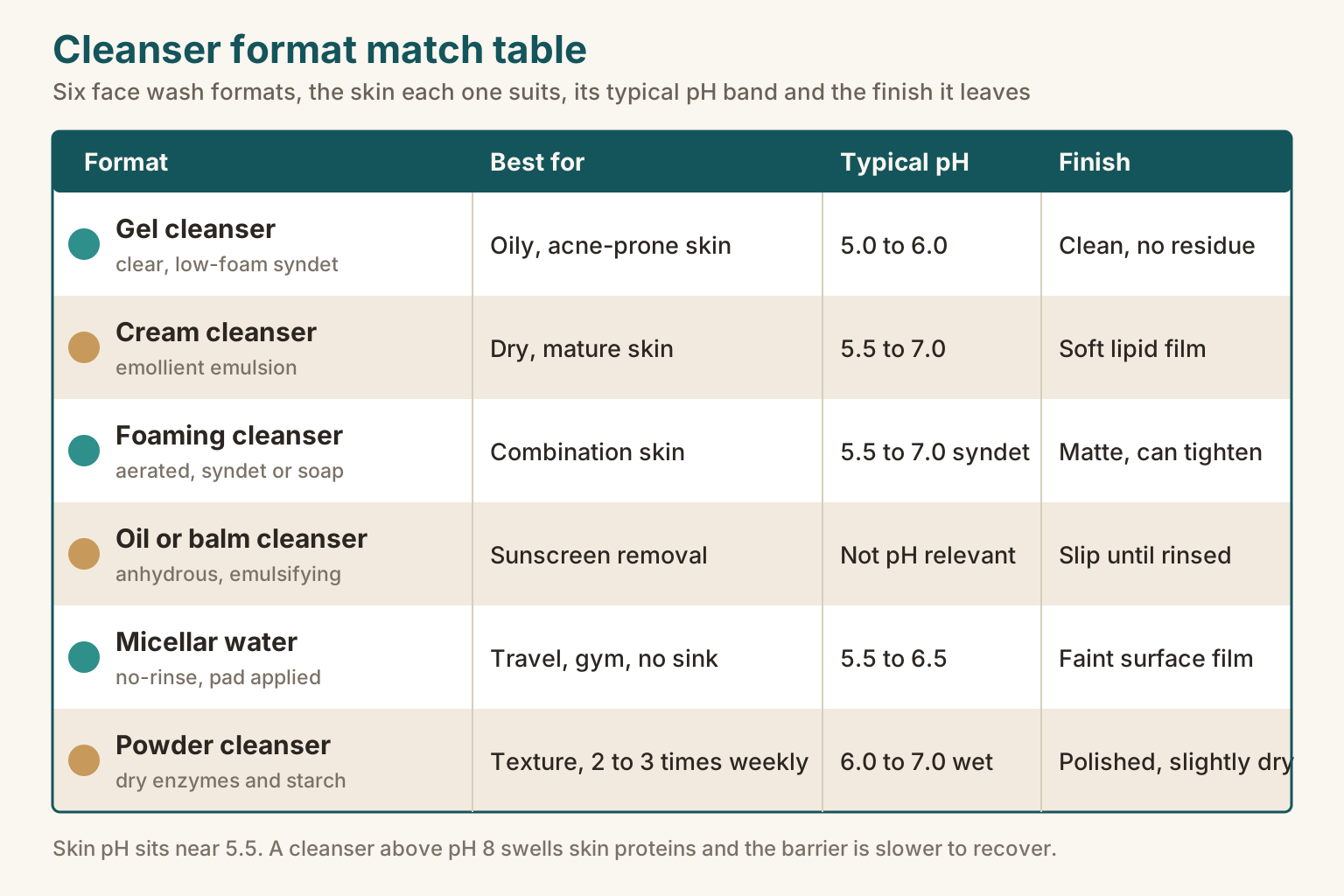
Gel suits oily and acne-prone skin, cream suits dry and mature skin, and foaming suits combination skin as long as its surfactant system is a syndet rather than true soap. The three differ in surfactant load and in what they leave behind, not only in how they feel in the hand.
Foam sits in the middle of that range, and a closer look at how a foaming cleanser works explains why the surfactant blend matters far more than the lather itself.
| Format | Best for | Typical pH | Finish |
|---|---|---|---|
| Gel cleanser | Oily, acne-prone | 5.0 to 6.0 | Clean, no residue |
| Cream cleanser | Dry, mature | 5.5 to 7.0 | Soft lipid film |
| Foaming cleanser | Combination | 5.5 to 7.0 syndet | Matte, can tighten |
| Oil or balm cleanser | Sunscreen removal | Not pH relevant | Slip until emulsified |
| Micellar water | No-rinse situations | 5.5 to 6.5 | Faint surfactant film |
| Powder cleanser | Texture, 2 to 3 times weekly | 6.0 to 7.0 once wet | Polished, slightly dry |
Gel cleanser
A clear or translucent gel built on low-foam syndet surfactants, usually cocamidopropyl betaine with sodium methyl cocoyl taurate or a glucoside. It clears sebum and sunscreen without leaving an occlusive film, which is why oily and acne-prone skin tolerates it twice daily. Use a pea-sized amount; a gel that needs three pumps is underpowered and you will over-scrub to compensate. Not for you if your skin flakes by midday, because a gel returns nothing to the lipid layer.
For a deeper comparison of acid levels and sulfate-free bases in this format, read our guide to the best face wash for oily skin.
Stronger is not better here: dermatologist advice on controlling oily skin warns that a cleanser which is too harsh irritates skin and can push oil production up rather than down.
Affiliate disclosure: we earn a commission if you buy through the links in these cards, at no extra cost to you.
Cream cleanser
An opaque, low-lather emulsion that carries emollients such as glycerin, squalane or a fatty alcohol alongside a small surfactant fraction. It leaves a thin lipid film after rinsing, which dry and mature skin needs because its own barrier replaces lipids slowly. Massage for twenty seconds and rinse with lukewarm water; the film is the point, so do not buff it off with a cloth. Not for you if you wear long-wear makeup daily, as a cream rarely shifts it in one pass.
Foaming cleanser
A pump or pressurised formula that aerates on dispensing. Foam is the fastest format to over-strip when the surfactant system is soap-based, because whipping air in usually means a higher surfactant concentration and an alkaline pH. Read the label: if you see sodium palmate, sodium tallowate or potassium cocoate near the top, it is soap. If the first surfactant is a glucoside or a taurate and glycerin appears in the first five ingredients, it is a syndet worth using on combination skin. Fragrance in the top half of the list is a bet you do not need to make with a daily face wash.
When is an oil, micellar or powder cleanser the better choice?
Choose an oil or balm when sunscreen and long-wear makeup need dissolving, micellar water when rinsing is impossible, and a powder when you want gentle enzymatic polish two or three times weekly. These three solve problems that water-based surfactants handle badly, and each carries a specific cost.
If long-wear makeup rather than sunscreen is the real problem, see how to choose a makeup remover, which compares six formats by removal strength, cost per use and skin type.
Cleansing oil or balm
An anhydrous blend of plant oils or esters plus an emulsifier, usually polysorbate 20 or a polyglyceryl ester. Oil dissolves oil, so it lifts silicone-heavy sunscreen, water-resistant filters and long-wear pigment that a gel merely smears. Work it into dry skin for thirty seconds, add water until it turns milky, then rinse. The emulsification test tells you whether a balm will leave a film: if it never goes milky, it has no emulsifier and it will sit on your skin until a second wash removes it.
Our guide to the best oil cleanser covers emulsifier types and which oils suit acne-prone skin.
Affiliate disclosure: we earn a commission if you buy through this link, at no extra cost to you.
Micellar water
Micelles are surfactant spheres suspended in water; a soaked pad pulls oil into them on contact. It is the right tool for a hotel room with hard water, a gym bag, or a night when standing at a sink is not happening. Treat it as a no-rinse option rather than a nightly replacement, because the surfactant you do not rinse stays on skin and a faint film can build over a week and read as congestion. Dragging a dry pad is the other cost: use a saturated one and press, do not scrub.
Powder cleanser
A dry blend of rice starch, clays and enzymes such as papain or bromelain, activated in your palm with water. Keeping enzymes dry keeps them stable without a preservative system, which is why the format suits people who react to preservatives. Two or three uses a week is the ceiling for most skin, because enzymatic polish plus a daily gel quickly adds up to over-exfoliation. Not for you if you want the same ritual every night, as the mixing step is genuinely fiddly over a basin.
Comparing formats in a cleansing shop listing comes down to three checks: whether an emulsifier is named, whether fragrance appears at all, and whether the product expects a second wash after it. A balm that needs a follow-up gel is two products and four minutes, not one.
Which ingredients make a mild face wash genuinely mild?
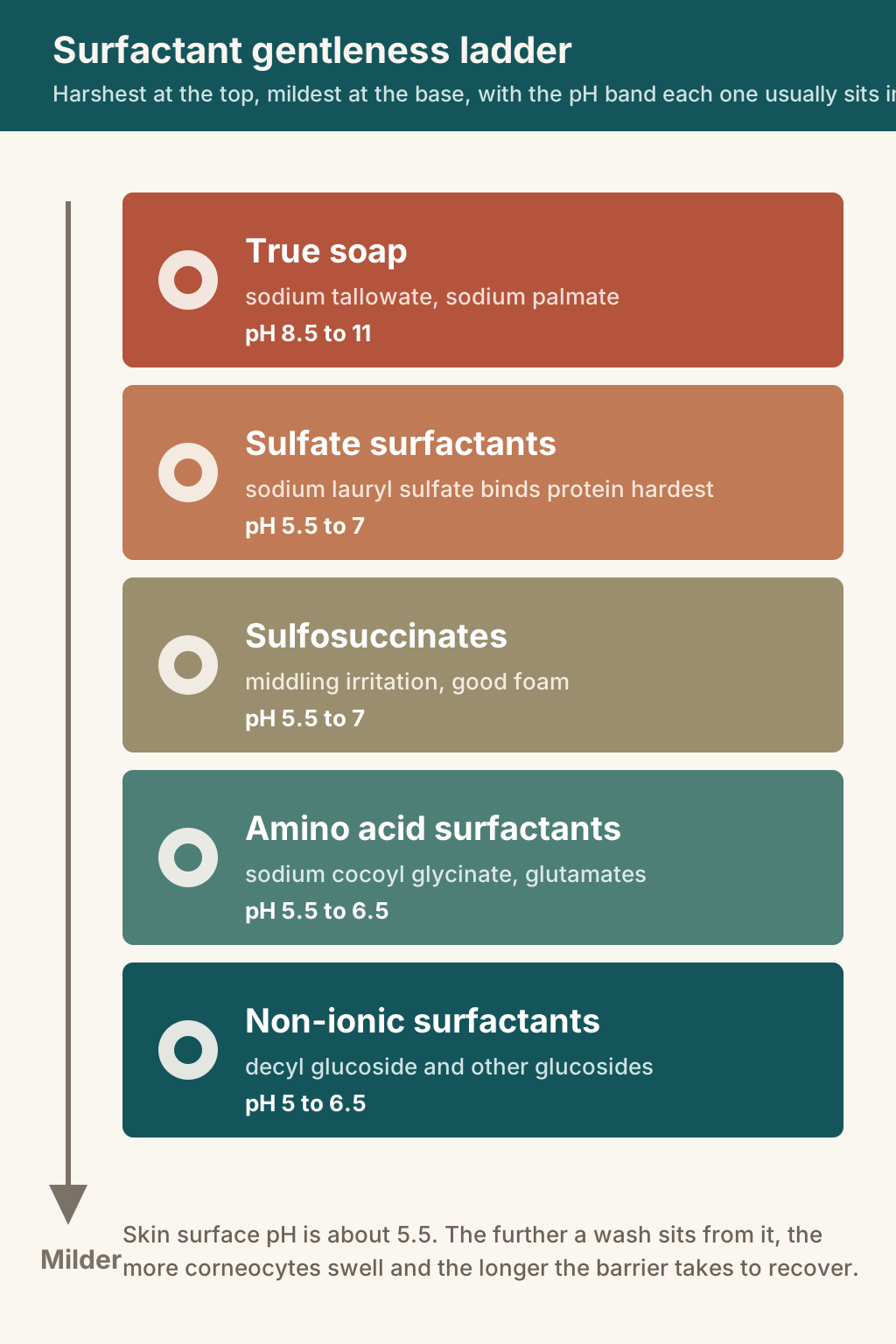
Mildness comes from the surfactant class and the pH: non-ionic and amino acid surfactants at pH 5.5 to 7 disturb skin proteins far less than true soap at pH 8.5 or higher. The word gentle on the front of a bottle is unregulated; the surfactant order on the back is not.
True soap, made by saponifying fats, runs pH 8.5 to 11. A syndet bar or liquid lands between 5.5 and 7, close to the skin's own surface. That gap matters because skin proteins swell markedly once cleanser pH passes 8, and swollen corneocytes let surfactant reach deeper into the stratum corneum.
Rank the classes: non-ionic surfactants such as the glucosides irritate least, amino acid surfactants such as sodium cocoyl glycinate sit just behind them, sulfosuccinates are middling, and sodium lauryl sulfate binds skin protein hardest. Sodium laureth sulfate is milder than sodium lauryl sulfate despite the near-identical name, which is the single most useful label distinction to learn.
The chemistry is well documented: peer-reviewed research on soaps versus syndet cleansers sets out why mild syndets disturb the barrier less across every skin type.
Glycerin, panthenol and ceramides in a wash limit the barrier cost rather than adding hydration; at thirty seconds of contact they mostly deposit a little and blunt surfactant binding. Judge them as damage control, not as moisturizing.
Acids belong in a leave-on step. Glycolic or lactic acid needs minutes at a controlled pH to work, so a rinse-off wash gives it a fraction of what it needs. If texture is your concern, put the work in a leave-on exfoliant and let the wash stay boring.
Two further routes to a lower-irritation wash: our guide to a gentle cleanser for sensitive skin covers fragrance-free formulations, and choosing a face exfoliator explains how to keep polish and cleansing in separate steps.
How should you wash your face, step by step?
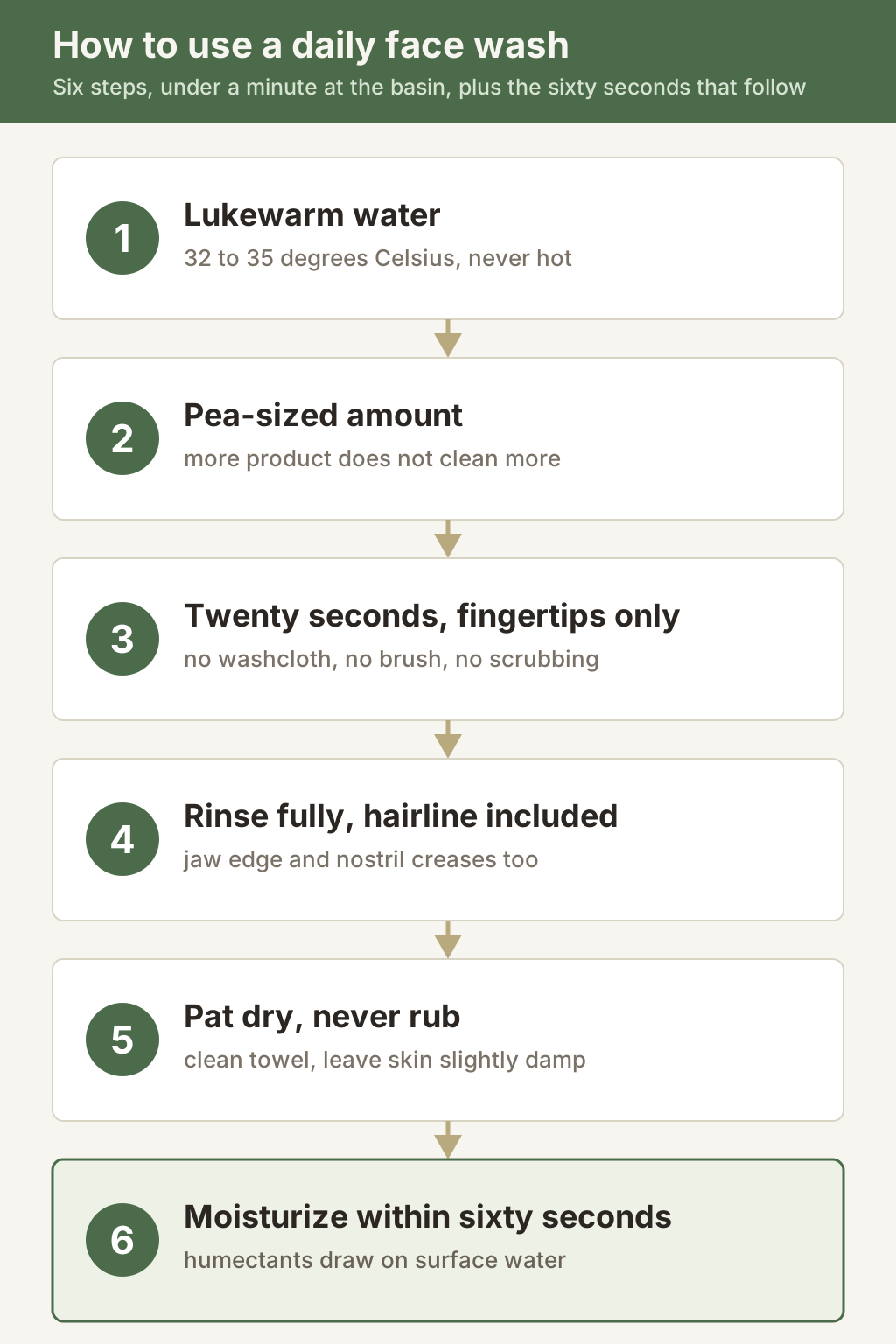
Wet with lukewarm water, work a pea-sized amount over the face with fingertips for about twenty seconds, rinse the hairline and jaw fully, pat dry, then moisturize within sixty seconds. Water temperature is the variable people get wrong most often.
Lukewarm, around 32 to 35 degrees Celsius, is the target. Hot water raises transepidermal water loss and strips lipids faster than the surfactant does; cold water leaves film-forming sunscreen sitting on the skin because the filters never soften.
Fingertips only. No washcloth, no silicone brush, no konjac sponge. Mechanical friction on wet, surfactant-softened skin is how a well-chosen formula still ends in red cheeks. A pea-sized amount is enough for a face; doubling the dose does not clean more, it just needs more rinsing.
A daily face wash runs twice a day plus after sweating. That is a ceiling, not a target: dry and sensitive skin often does better with water alone in the morning. Rinse the hairline, the jaw edge and the creases beside the nostrils, where residue collects and drives the small bumps people blame on their moisturizer.
Pat dry with a clean towel, never rub, then apply your moisturizer within sixty seconds while the stratum corneum is still damp, so humectants pull from that surface water rather than from deeper tissue.
This matches the dermatology academy's face washing guidance, which specifies a non-abrasive alcohol-free cleanser, lukewarm water, fingertips, and no scrubbing.
Where the wash sits in the order matters too: how to build a skin care routine sets the sequence, and face moisturizer for every skin type covers what goes on in that sixty-second window.
Do you need to double cleanse every night?
Double cleanse only on nights you wore waterproof sunscreen or long-wear makeup; bare skin washed twice most evenings dries out faster than it gets cleaner. The method is an oil-based pass first to dissolve film formers, then a water-based pass to remove the oil and what it captured, in that order.
On those nights, waterproof mascara and long-wear liner need their own step, so compare eye makeup remover formats before you reach for your usual face wash around the eyes.
The case for it is specific. Water-resistant mineral sunscreen, transfer-proof foundation and long-wear lip colour are built to survive water and surfactant, and a single gel pass leaves a measurable amount behind. Bare skin plus a chemical sunscreen usually rinses clean in one thorough twenty-second pass.
The cost is real: two surfactant exposures a night means more lipid loss, more dryness and a barrier that recovers slower, and dermatologists generally rate antioxidants and sunscreen as better uses of the same effort. Skip the second pass on bare-skin days and you lose nothing.
For the clinical position, see clinical view on whether double cleansing is necessary, which concludes that one thorough wash with a gentle cleanser is adequate for most people.
Which face wash mistakes damage the skin barrier?
The common failures are chasing a squeaky-clean finish, layering scrubs and acid washes in the same week, and swapping products before any of them has had four weeks to work. Each one has a mechanism behind it.
- Chasing squeaky-clean. That tight, sanded feeling is surfactant binding to keratin and lipid loss, not cleanliness. Skin should feel comfortable and slightly soft after rinsing.
- Stacking abrasives. A scrub, an acid wash and a cleansing brush in one week is three forms of exfoliation on the same seven days of barrier repair. Pick one and keep it to twice weekly.
- Fortnightly switching. Changing face wash skincare products every two weeks means nothing gets a fair trial; cell turnover alone takes about four weeks, so give a formula that long before judging it.
- Hot water and a rough towel. These undo a well-chosen cleanser in ten seconds. Lukewarm water and patting dry cost nothing.
Distinguishing a barrier problem from a purge saves weeks of guessing. A damaged barrier stings on application, looks pink and feels rough across broad areas, and improves within days once you simplify. A purge appears as small clustered breakouts where you normally congest, starts two to three weeks into a new active, and settles by week six.
One cleansing fix a week, written for a specific skin type rather than a product launch.
One cleansing fix a week. No product dumps.
Thanks — you're on the list.


